

Accounting firms live or die by client trust, and nothing builds that faster than a polished, professional appearance. Your visual branding-from your logo to your website design-tells clients whether you're serious about their finances before they even read your first email.
At Cajabra, LLC, we've seen firms with identical service offerings win different clients based purely on visual identity. The firms that invest in cohesive, intentional branding consistently outpace their competitors in client acquisition and retention.
Why Visual Branding Actually Matters
A potential client lands on your website or opens your proposal and forms an opinion about your firm in roughly 50 milliseconds. First impressions may form in milliseconds, but users typically give your homepage 3 to 5 seconds to earn their trust. Instead, they evaluate your visual presentation, and if it looks dated or unprofessional, they move to your competitors.
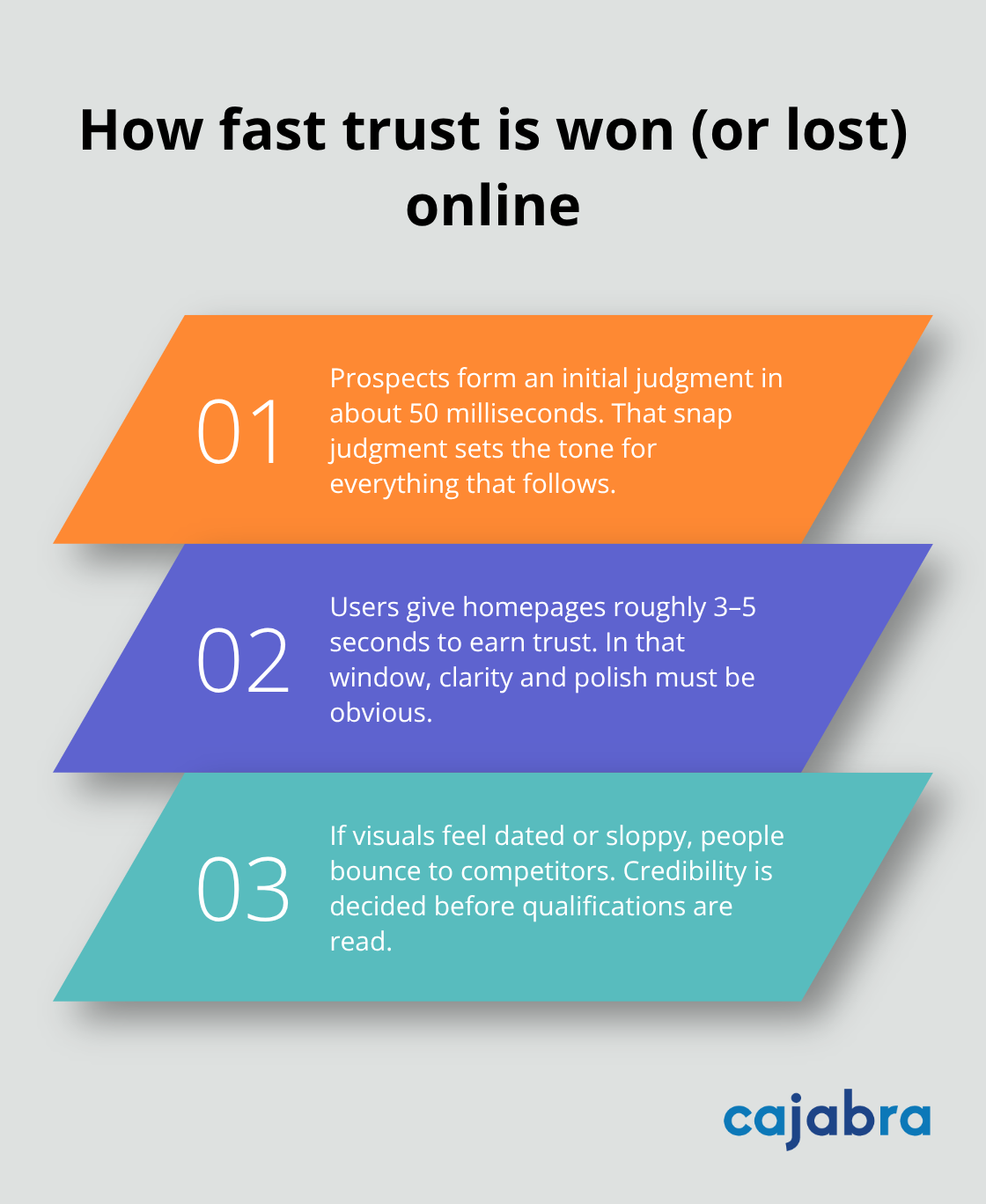
This isn't subjective preference-it's how human psychology works. Visual credibility influences whether prospects perceive you as competent enough to handle their finances. A polished logo, consistent color scheme, and professional typography signal that you operate with precision and attention to detail, qualities clients desperately need in an accountant.
The Real Cost of Inconsistent Branding
Most accounting firms lose money through visual inconsistency without realizing it. Your website uses one color palette, your social media uses another, your proposals look like they came from different decades, and your email signature doesn't match anything else. Each inconsistency creates friction that chips away at client confidence. When a firm's visual identity scatters across channels, prospects unconsciously interpret it as disorganization.
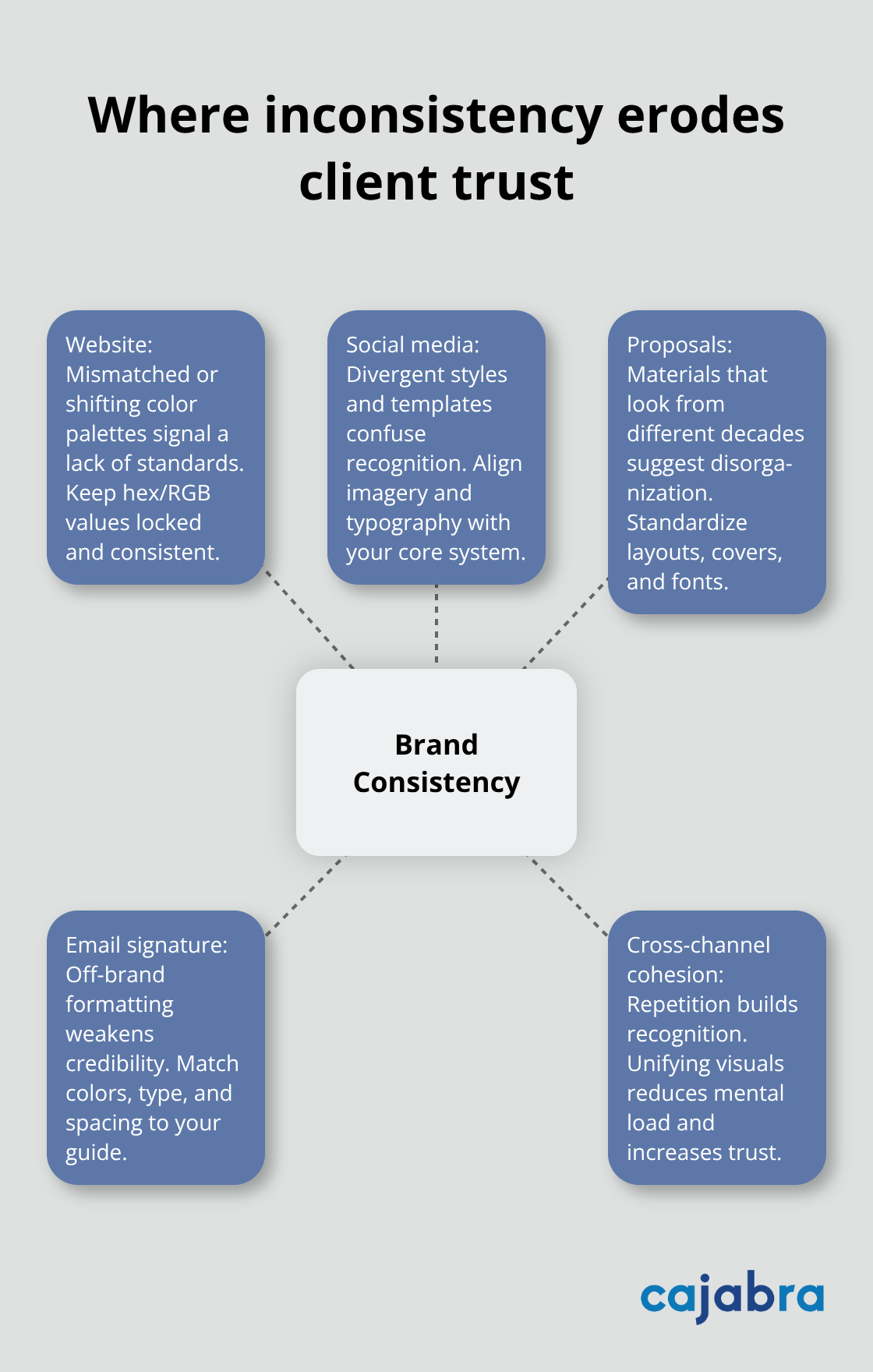
They wonder if your accounting is as messy as your branding. The firms winning market share look intentional-a single logo, a carefully chosen color system (typically blues and greens that signal trust and growth), matching typography across all touchpoints. This consistency doesn't just look better; it actually reduces the mental effort clients need to process who you are, making them more likely to trust you and move forward with an engagement.
Differentiation When Every Firm Offers Similar Services
The accounting services landscape is commoditized. Most firms offer tax preparation, bookkeeping, payroll, and audit services. Your service menu probably looks identical to three other firms in your market. Because the actual work is so similar, perception and experience become the deciding factors. A firm with mediocre services but exceptional visual branding will consistently win against a firm with excellent services but generic branding. This is harsh but true. Your competitors aren't just other accountants-they're the polished, visually cohesive firms that prospects encounter on LinkedIn, Google Business profiles, and websites. If your visual identity doesn't stand out, you compete on price alone, and that's a race you'll lose. The firms that invest in intentional visual branding position themselves as premium options, justify higher fees, and attract clients who value quality over cost.
How Visual Identity Shapes Client Perception
Prospects don't separate your visual branding from your professional competence. They link them together. A firm with a sharp logo, cohesive color palette, and polished website materials appears more organized, more trustworthy, and more capable than a competitor with scattered visuals (even if the competitor's actual accounting work is superior). This perception gap matters because clients make decisions based on what they see and feel, not on technical superiority they can't evaluate. Your visual identity communicates your firm's values, attention to detail, and commitment to professionalism before you ever speak to a prospect. The firms that recognize this advantage invest in visual branding as a strategic asset, not as an afterthought. They understand that strong visual identity directly influences client acquisition, retention, and the fees they can command.
Building the Visual Foundation That Wins Clients
Your logo, colors, and typography form the backbone of how prospects perceive your firm's competence and trustworthiness. These elements work together to create instant recognition and communicate professionalism before a single word is read. The accounting firms that dominate their markets treat visual identity as a strategic business tool that directly impacts revenue.
Design a Logo That Works Everywhere
Start with your logo because it anchors everything else. Your logo must work at 16 pixels on a mobile phone and at billboard size without losing clarity or impact. Complex logos with gradients, shadows, or trendy effects date quickly and fail at small sizes. The most effective accounting firm logos use simple geometry and clean lines-Deloitte, PwC, and EY all employ straightforward mark-based designs that function across every medium. Avoid accounting clichés like calculators, coins, or scales unless you execute them with genuine originality. Focus instead on creating something that feels intentional and premium. If your current logo looks like it was designed in 2008, replace it. A professional designer typically charges between $1,500 and $5,000 for a proper logo redesign that includes multiple concepts and refinements.
Choose Colors That Signal Trust and Stability
Color psychology in purchasing decisions shapes how clients perceive your firm. Blue dominates accounting and financial services because it signals trust, stability, and professionalism-exactly what clients need to feel when entrusting you with their finances. Navy blue, slate blue, and corporate blue work safely across industries. Green functions well as a secondary color because it represents growth and financial health. Avoid bright, trendy colors that make your firm look like a tech startup or creative agency. Red and orange signal urgency or energy, which doesn't match the careful, methodical work accountants perform. Select three to four colors maximum (typically a primary color, a secondary color, and two neutral grays or whites). These colors must appear consistently across your website, proposals, social media, email signatures, and printed materials. Inconsistent colors across channels actively damage your credibility.
Typography That Communicates Precision
Font selection shapes how clients perceive your firm's personality. Serif fonts like Georgia or Garamond feel traditional and established, while sans-serif fonts like Helvetica or Open Sans feel modern and clean. Most successful accounting firms use sans-serif fonts for digital and web because they offer superior legibility on screens. Choose one primary font for headings and one for body text, then apply those two consistently across all materials. Avoid decorative or script fonts in professional materials-they undermine professionalism and hurt readability. Your typography should feel intentional, not trendy. A font that looks cutting-edge today will look dated in two years. Select typefaces that have existed for at least five years and show no signs of disappearing. When you apply these fonts, maintain consistent sizing and spacing. Headlines should be noticeably larger than body text, and body text should be at least 14 to 16 pixels on websites for comfortable reading. Poor typography creates friction that forces prospects to work harder to understand your message, and harder work means lower trust.
Unify Your Visual System Across Every Channel
The biggest mistake accounting firms make is treating their website, social media, proposals, and printed materials as separate projects instead of unified expressions of a single brand. Your LinkedIn profile should match your website, which should match your email templates, which should match your proposal covers. This consistency builds recognition and trust through repetition. When prospects see your color palette and logo repeatedly across different channels, they unconsciously associate those visuals with competence and professionalism. Create a brand style guide that documents your logo usage, color codes (both hex and RGB), font specifications, spacing rules, and imagery guidelines. This guide keeps everyone-whether internal or external designers-aligned on how to represent your firm. Without this guide, your website designer makes one choice, your social media manager makes another, and your printer makes a third, resulting in scattered visual identity that undermines everything else you're doing to build trust.
The visual foundation you establish now determines how prospects perceive your firm for years to come. Once your logo, colors, and typography work together seamlessly, you're ready to apply these elements strategically across the specific channels where your ideal clients spend their time.
How to Audit and Rebuild Your Visual Branding
Most accounting firms have never conducted a systematic audit of their visual presence across all channels, which means they don't realize how fractured their brand identity has become. Take screenshots of your website homepage, your Google Business profile, your LinkedIn company page, your email signature, your proposal templates, your social media covers, and any printed materials you distribute. Open them all in a single document and compare them side by side. What you'll likely see is jarring inconsistency: colors that shift slightly across platforms, logos sized differently, fonts that don't match, and overall aesthetics that feel disconnected.
This visual chaos actively damages your credibility. Prospects unconsciously interpret this scatter as disorganization, which directly impacts whether they trust you with their finances. The firms that win market share treat this audit seriously and recognize that fixing these gaps is non-negotiable. Document every inconsistency you find, then prioritize fixing the highest-impact channels first: your website, your LinkedIn profile, and your email templates.
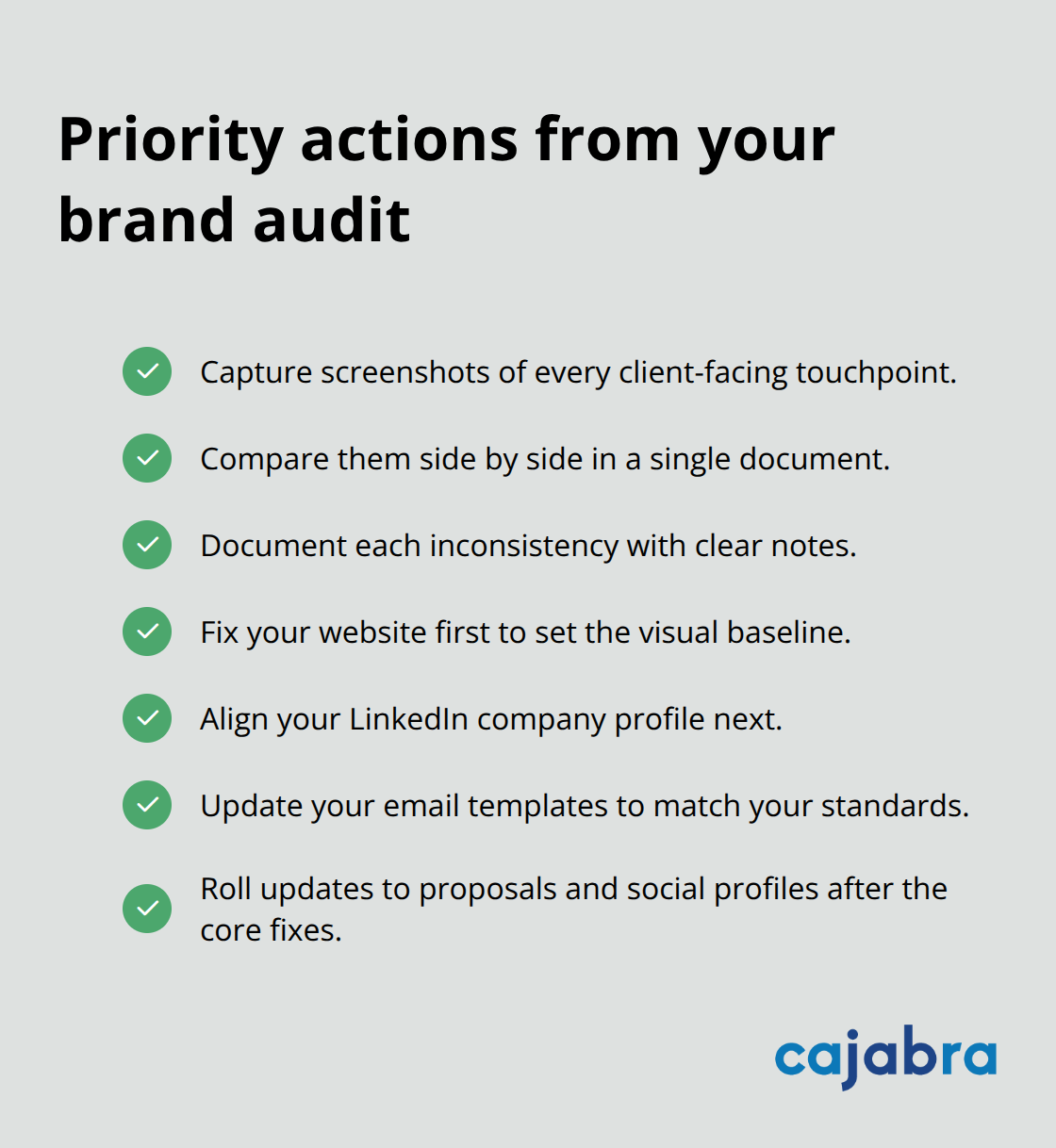
These three touchpoints reach prospects most frequently and shape perception most powerfully.
Create a Brand Style Guide That Locks In Your Standards
Once you've identified gaps, develop a brand style guide that prevents inconsistency from happening again. This guide should specify your logo in every format (horizontal, vertical, icon-only, minimum size), your exact color codes in both hex and RGB formats, your primary and secondary fonts with specific sizes for headings and body text, spacing rules between elements, and guidelines for photography and imagery style. This isn't theoretical work-it's the operating manual that prevents future chaos. Without it, your website designer makes one choice, your social media manager makes another, and your printer makes a third.
Create this guide in a shared document or tool like Figma that team members and external vendors can access. Store it somewhere your entire team references regularly. The guide transforms from a static document into a living resource that shapes every visual decision your firm makes.
Apply Your Brand Standards Across Every Channel
Systematically apply these standards across every channel where prospects encounter your firm. Your website should reflect your colors, fonts, and logo usage exactly. Your email signature should match your website. Your LinkedIn background image should use your color palette and typography. Your proposal covers should feature your logo and color scheme. Your social media profile images should use your brand colors.
This consistency compounds over time-prospects see your visual identity repeatedly across different channels, which builds recognition and trust through simple repetition. The firms that execute this flawlessly consistently outpace competitors in client perception and conversion rates, regardless of whether their actual accounting services are superior. Each touchpoint reinforces the same visual message, making your firm feel established and trustworthy.
Maintain Consistency as Your Firm Evolves
Your brand style guide isn't a one-time project-it requires regular review and updates as your firm grows. When you hire new team members, train them on your brand standards before they create any client-facing materials. When you redesign your website or refresh your logo, update your guide immediately so everyone works from the current version. Outdated guides create confusion and lead to inconsistency.
Assign one person responsibility for brand consistency across channels. This person reviews new materials before they launch, catches deviations from your style guide, and communicates standards to external vendors. This single point of accountability prevents the visual chaos that most firms experience. The investment in this role pays for itself through improved client perception and higher conversion rates.
Final Thoughts
Visual branding separates firms that command premium fees from those that compete on price alone. The firms dominating their markets invested in cohesive logos, intentional color palettes, and consistent typography across every channel, creating an unfair advantage that compounds over time. Prospects repeatedly encounter your polished brand across their website, LinkedIn, email, and proposals, building recognition and trust through simple repetition that scattered competitors cannot match.
The financial impact proves measurable across three to five years. Firms with strong visual branding convert prospects faster because consistent visuals reduce friction and build confidence, retain clients longer because the professional experience reinforces their decision, and command higher fees because clients perceive them as more trustworthy and capable. One firm grows steadily with premium clients while the other struggles to fill capacity at lower rates.
Start by auditing your current visual presence across every channel-compare your website, LinkedIn profile, email signature, proposals, and social media side by side to identify inconsistencies. Create a brand style guide that locks in your standards, assign one person responsibility for maintaining consistency, and apply these standards systematically across every touchpoint. We at Cajabra, LLC help accounting firms build strong visual branding strategies that position your firm as an industry leader and attract ideal clients through a polished, professional presence.
Creating great content is only half the battle. The real challenge is getting that content in front of the right people at the right time.
At Cajabra, LLC, we've seen firsthand how strategic content distribution transforms reach and engagement. The channels you choose, when you publish, and how you measure results determine whether your content thrives or gets lost in the noise.
Content Distribution Channels That Drive Real Results
Social Media Platforms Require Strategic Focus
Social media dominates content distribution strategy, with 84% of B2B marketers using paid channels to distribute content, and among those, 73% use social media advertising. However, raw social presence means nothing without audience alignment. Instagram works differently than LinkedIn, which works differently than X, and posting identical content across all platforms dilutes your message. The platforms where your actual buyers spend time are the only ones that matter. LinkedIn tends to drive better results for B2B content because professionals actively seek industry insights there, while Instagram demands visual storytelling and trending audio. Test each platform with your core content, measure which ones drive actual traffic and leads rather than vanity metrics, and then focus on the two or three that perform best. Social sharing alone rarely converts, so treat social as a top-of-funnel awareness tool that funnels people toward owned channels where real engagement happens.
Email Remains Your Most Valuable Asset
Email newsletters beat social platforms for direct audience engagement because you own the relationship. A targeted email list of 40 engaged subscribers who signed up because they genuinely wanted your insights will outperform blasting 5,000 disinterested followers. Segment your email list by buyer stage and send content that matches where people sit in their decision journey. A prospect in early research needs educational content about industry challenges, while someone further along needs comparison guides and case studies. Personalization matters too: reference past interactions or company details when possible.
Paid Advertising Accelerates Distribution When Organic Reach Plateaus
Paid advertising amplifies distribution when organic reach plateaus. Google Ads and LinkedIn ads target people actively searching for solutions, while retargeting ads remind website visitors who didn't convert the first time. The #1 organic search result captures roughly 27.6% of clicks versus 2.6% for the tenth result, so paid ads help your content compete when SEO rankings take time to build. Start with small budgets on your top-performing content pieces, track which ads drive leads versus just impressions, and scale only what converts. Diversify your distribution channels across owned, earned, and paid media to maximize reach-the channels you select and how you allocate resources across them set the foundation for everything that follows, which is why timing your distribution matters just as much as choosing the right platforms.
Timing and Frequency Strategies for Content Sharing
Publish When Your Audience Actually Listens
The time you publish determines whether your content reaches your audience or vanishes into the feed. LinkedIn engagement peaks on Tuesday through Thursday between 7 AM and 9 AM, when professionals check their feeds before starting work. Twitter moves faster, with engagement concentrated around lunch hours and early evening when people take breaks. Facebook sees steady engagement throughout the day but spikes on weekends. Your specific audience, however, may follow different patterns. A B2B software company selling to finance teams needs different timing than a consumer brand targeting students. Test your content across three different time slots over two weeks, track which times generate the most clicks and comments, then commit to that window.
Find Your Publishing Cadence
Posting too frequently exhausts your audience and triggers unsubscribes. Consistency matters more than volume-brands publishing once or twice weekly maintain stronger engagement than those flooding feeds daily. Most successful publishers follow a cadence of one major content piece per week across owned channels, with social amplification spread across two to three posts that week. Email newsletters work best when sent on a predictable schedule that your subscribers expect. If you commit to Thursday mornings, stick with Thursday mornings.

Subscribers who anticipate your message open it at higher rates than those surprised by random sends.
Capitalize on Seasonal Moments and Trending Topics
Seasonal timing and trending topics demand flexibility within your core schedule. Industry conferences, budget cycles, and holiday seasons create windows where your audience actively searches for solutions. Accounting firms see increased demand for tax strategy content in Q1 and Q4. SaaS companies notice budget planning peaks in September and October. News and trending topics offer quick distribution wins if you respond within hours rather than days. A brand that publishes thoughtful commentary on industry news within four hours of the story breaks captures more attention than one that publishes a week later.
Balance Trend Responsiveness With Strategic Focus
Chasing every trend exhausts your team and dilutes focus. Instead, identify three to five predictable seasonal moments relevant to your industry and plan content months in advance. Repurpose evergreen content during slow periods, then shift to trend-responsive content during high-demand seasons. Track which seasonal angles drive the most leads and revenue, then double down on those specific windows next year. The brands that win at distribution publish strategically at moments when their audience actively listens-not the ones publishing constantly. This strategic approach to timing sets the stage for measuring whether your distribution efforts actually move the needle, which brings us to tracking performance across your channels.
Measuring and Optimizing Your Distribution Performance
Track metrics that connect directly to revenue, not vanity numbers that make dashboards look impressive. Click-through rates and impressions mean nothing if they don't convert to leads or clients. Focus on metrics that matter: how many qualified leads each channel produces, what those leads cost, and whether they actually become paying clients. Email open rates tell you your subject line works, but click-through rates show whether your content resonates enough to drive action. Social media follower counts are meaningless; referral traffic from social to your website reveals which platforms actually move people toward conversion.
Set Up Tracking From Day One
Add UTM parameters to every link you distribute so you know exactly which channel, campaign, and content piece drove each visitor. Google Analytics 4 lets you track user journeys across devices and platforms without extra work. Establish a baseline for each channel during your first month, then measure improvements against that baseline rather than against industry averages that may not apply to your specific audience. This foundation prevents wasted effort on channels that look good in reports but produce no actual results.
Measure Different Channels Against Their Purpose
Different distribution channels require different measurement approaches because they serve different purposes in your funnel. Email produces the highest conversion rates because you reach people who already know you, so track email click-through rates and conversion rates separately from social media, which functions primarily as awareness. LinkedIn ads targeting B2B decision-makers should be measured on cost-per-lead and lead quality, not impressions. Organic search traffic matters less for volume and more for intent; someone landing on your website from a search query about your specific solution converts at higher rates than someone who clicked a random social post.
Set specific conversion goals for each channel based on what success looks like: email might target a 3 percent click-through rate, while organic search targets a 15 percent conversion rate from visitor to lead. Test different messaging, content formats, and distribution timing on smaller segments first, then measure which variations outperform before scaling to larger audiences.
Run Controlled Experiments to Identify Winners
Stop guessing and start testing methodically. Change one variable at a time so you know what actually drove results. Send the same email to two segments with different subject lines, track which one produces more clicks, then use the winning subject line for future sends. Test publishing your blog post at different times to see which generates more traffic in the first 24 hours, then lock in that timing. Run controlled experiments with different headlines and landing pages simultaneously, allocate equal budget to each, and measure which combination produces the lowest cost-per-lead.
Most distribution improvements come from small, incremental wins rather than dramatic overhauls. A 10 percent improvement in email open rates from better subject lines, combined with a 15 percent improvement in social click-through rates from better visuals, compounds into significant revenue growth over quarters. Document every test, including what you tested, what won, and why, so you build institutional knowledge rather than repeating failed experiments.
Scale What Works and Cut What Doesn't
The brands winning at distribution treat it as an ongoing optimization process where data informs decisions, not assumptions. Once you identify which channels, timing windows, and content formats produce the best results, allocate more budget and effort to those winners. Reduce or eliminate spending on channels that consistently underperform, even if they seem like they should work. Your audience's actual behavior matters far more than industry best practices or what competitors claim to do. Redirect resources from low-performing channels toward the two or three channels that consistently produce qualified leads at acceptable costs.
Final Thoughts
Content distribution works best when you treat it as an ongoing system rather than a one-time project. Start by auditing which channels produce qualified leads at acceptable costs, then cut the underperformers immediately and reallocate that effort toward your top two or three channels. Most teams waste resources spreading themselves thin across platforms that don't move the needle, so this ruthless focus separates winners from the rest.
Build a sustainable system by establishing clear responsibilities and schedules for your distribution efforts. Assign someone to manage email sends on your committed day and time, designate a person to monitor social platforms during peak engagement windows, and create a simple spreadsheet tracking which content pieces perform best on which channels. Small improvements compound over time-a 10 percent boost in email click-through rates paired with a 15 percent improvement in social referral traffic creates meaningful revenue growth.
For accounting firms, Cajabra helps move accountants from overlooked to overbooked through strategic marketing systems that secure retainer-based clients. Identify your single best-performing distribution channel this month and commit to doubling your effort there next month, then measure the results and repeat with your second-best channel.
Accountants know that clients don't choose based on marketing claims alone. Trust comes from what other clients say about your work.
Social proof transforms how prospects perceive your firm. At Cajabra, LLC, we've seen firsthand how testimonials, reviews, and certifications shift client decisions in your favor.
Why Prospects Trust Other Clients More Than Your Claims
Word of mouth dominates how accounting firms win new clients. Research from the American Institute of CPAs shows that referrals and client recommendations remain the strongest driver of new business, outpacing digital advertising and cold outreach by a significant margin. This isn't coincidence. When a prospect hears directly from another business owner that your firm saved them thousands in taxes or streamlined their bookkeeping, that carries infinitely more weight than anything you say about yourself on your website. Prospects assume you'll highlight your strengths in your marketing, so they discount those claims naturally. They don't assume other clients would lie about their experience, which makes third-party validation extraordinarily powerful. The psychology is straightforward: people believe peers more than institutions because peers have no financial incentive to flatter you.
The Numbers Behind Trust
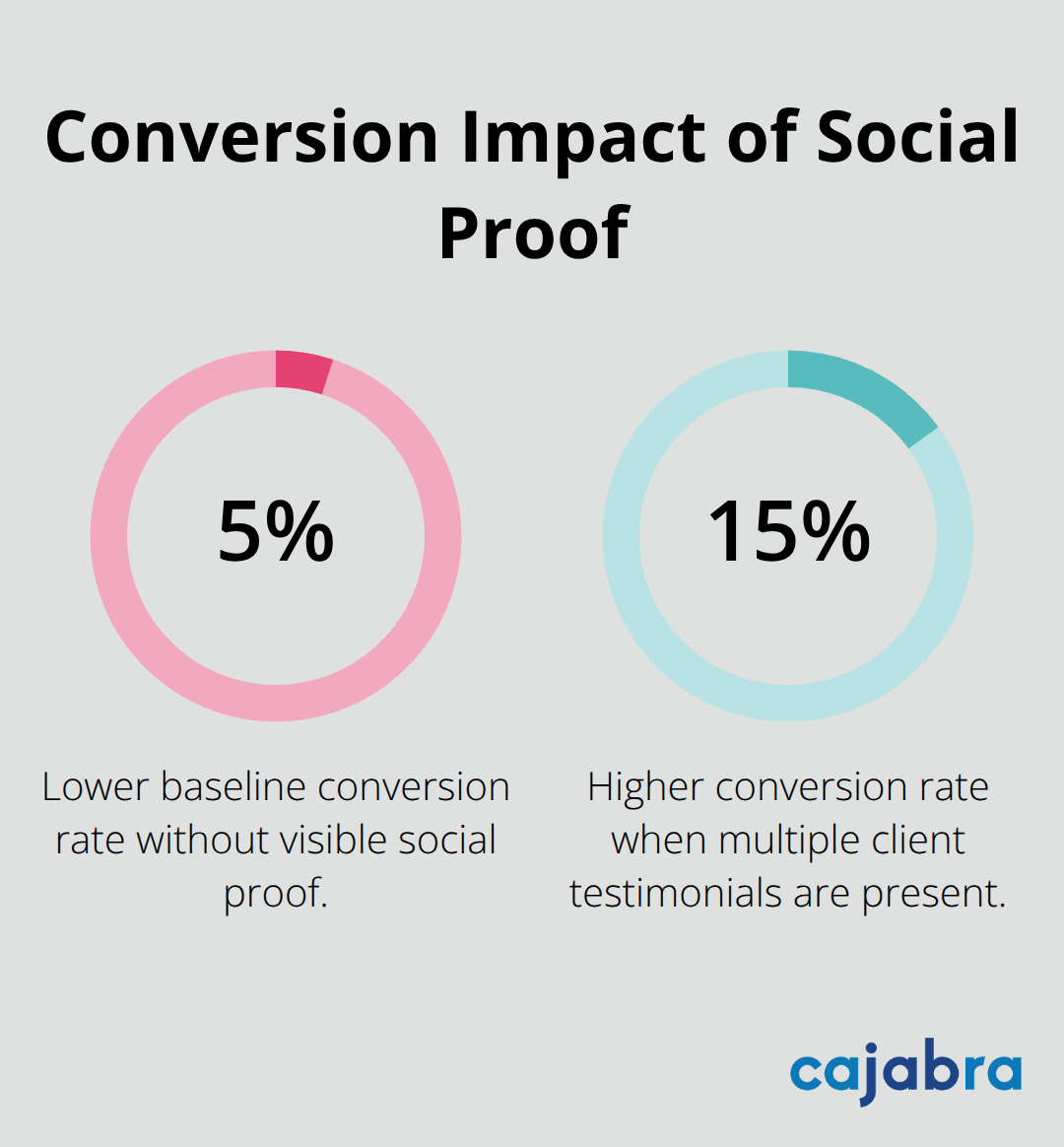
Studies from Nielsen show that people trust recommendations from other people over branded content. For accounting specifically, prospects actively seek out reviews, ask for references, and check what existing clients say before scheduling a consultation. Google Reviews carry particular weight because they require a verified account to post, meaning fabricated testimonials are harder to slip through. Firms with strong review profiles and consistent five-star ratings see higher conversion rates on their websites and attract more qualified leads. LinkedIn recommendations function similarly in the B2B space. When a client publicly endorses your expertise on their profile, other prospects viewing your profile immediately perceive you as credible. Prospects who see three or more client testimonials on your website are significantly more likely to contact you than those landing on pages with no social proof. This isn't marginal improvement. It's the difference between converting five percent of visitors and converting fifteen percent. That compounds quickly when you run consistent traffic to your site.
Building Authority Through Real Results
Certifications and awards matter, but only when paired with client outcomes. An accounting firm can display their CPA credentials all day, yet a single case study showing a manufacturing company reduced their tax liability by thirty-seven thousand dollars speaks louder. The specificity matters enormously. Generic testimonials like "great service, highly recommend" register as noise. Testimonials that mention exact problems solved and measurable results stick in prospects' minds. When you showcase that your firm helped a client identify unclaimed tax credits worth fourteen thousand dollars annually, that prospect reading it immediately thinks about their own tax situation and wonders if you could do the same for them. This transforms social proof from a trust signal into a lead magnet. The most effective approach combines multiple proof types across your marketing channels (LinkedIn, your website, service pages). LinkedIn should feature client recommendations and case study highlights. Your website homepage should display Google Reviews prominently. Your service pages should link to detailed case studies with specific dollar amounts saved. This layered approach means a prospect encounters repeated validation from different sources, each reinforcing the others.
How Specificity Separates You From Competitors
Vague praise accomplishes nothing. A prospect scrolling through your testimonials needs concrete evidence that you solve their specific problems. Instead of "they helped us with our taxes," show that you identified a three-year tax overpayment worth eight thousand dollars or that you restructured a client's entity to save them twelve percent annually on their tax bill. Numbers stick. Percentages stick. Dollar amounts stick. When you present these results alongside the client's industry or business type, prospects in similar situations immediately recognize themselves in your case studies. This recognition is what converts browsers into leads. The prospect doesn't just think you're credible. They think you're credible for them specifically. That distinction matters enormously when prospects evaluate multiple accounting firms. They want proof that you've solved problems for businesses like theirs, not just any business. This is where most accounting firms fail. They collect testimonials but fail to extract the specific outcomes that make those testimonials powerful. The next chapter explores how to systematically collect these testimonials and transform them into case studies that actually move prospects toward a decision.
Which Types of Social Proof Actually Persuade Accounting Prospects
Client Testimonials and Case Studies That Convert
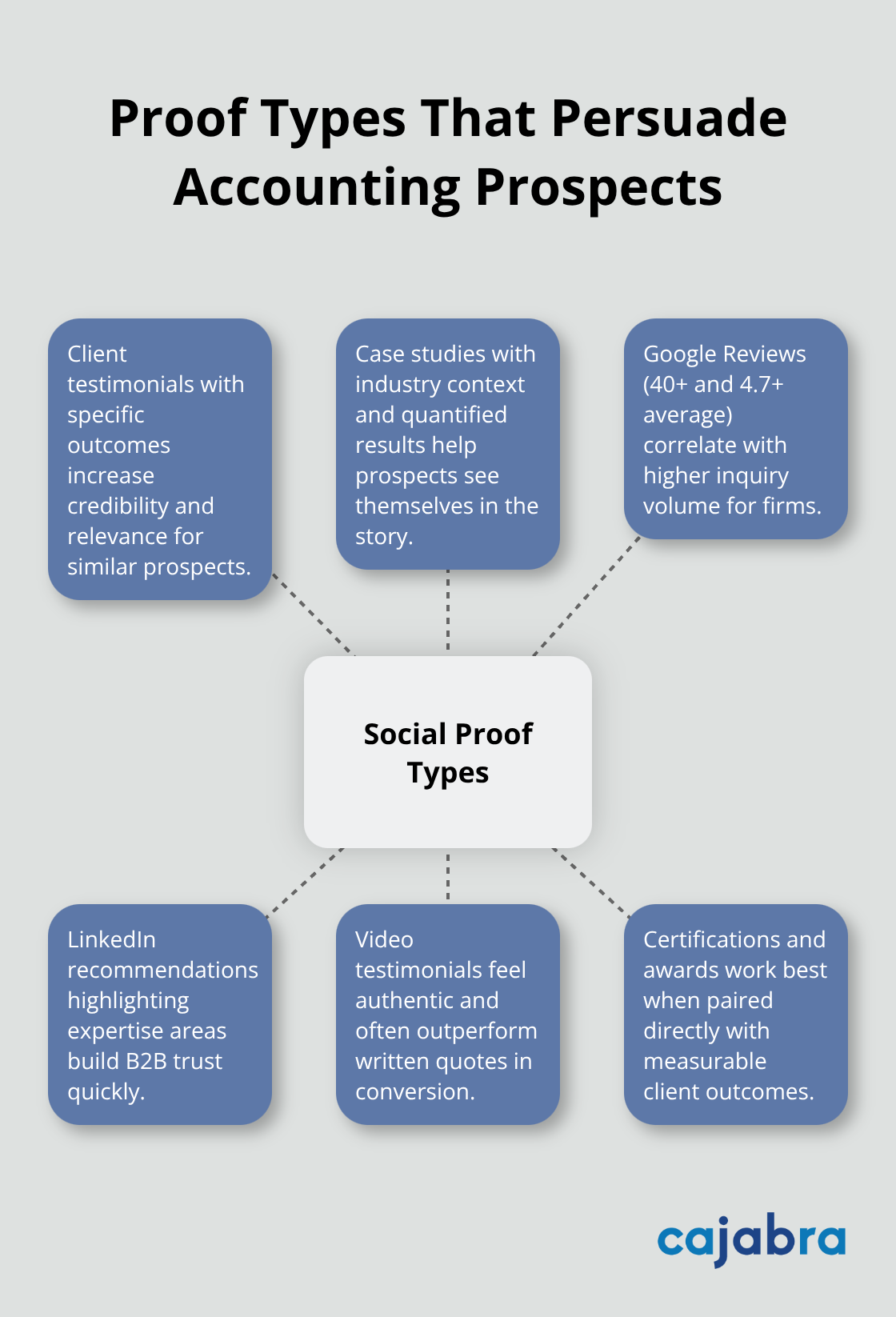
Client testimonials without specifics waste space. The accounting firms winning the most clients pair detailed case studies with quantified outcomes that prospects recognize in their own situations. A case study showing how you helped a construction company recover fourteen thousand dollars in missed tax deductions works because the prospect immediately thinks about their own missed deductions. The industry context matters as much as the dollar amount. When prospects see proof tailored to their sector, conversion rates jump significantly.
The recommendation text matters more than the volume. A recommendation stating you helped a client implement cloud accounting software that reduced their month-end close time from five days to two days creates a mental image of concrete value. Generic praise like "excellent work" and "great communication" registers as background noise that prospects skip over.
Google Reviews and LinkedIn Recommendations
Google Reviews impact both traditional local search rankings and citations in AI Overviews. Firms with forty or more Google Reviews and an average rating above 4.7 stars consistently report higher inquiry volume than competitors with fewer reviews. LinkedIn recommendations function differently but equally powerfully in the B2B space. When a prospect lands on your profile and sees three or more recommendations mentioning specific expertise areas like tax strategy or bookkeeping automation, they perceive you as established and trusted by peers.
Certifications and Awards as Proof Points
Certifications and awards matter only when paired with client outcomes. Your CPA license establishes baseline credibility, but it doesn't differentiate you from the thousands of other CPAs in your market. Industry awards, however, can signal specialization. If you've won recognition for tax strategy or bookkeeping for specific industries, that becomes a proof point worth highlighting. Most accounting firms display credentials without context. Instead, position them alongside client results. For example, mention your CPA designation and then immediately reference a specific case showing how that expertise delivered measurable value.
Systematic Collection Transforms Proof Quality
The collection process determines proof quality. Systematically request testimonials after successful engagements and you'll yield dramatically better results than sporadic requests. Send a simple email within two weeks of completing a significant project, asking the client to describe the specific problem you solved and the measurable outcome. Prompt them for numbers: tax savings, time saved, cash flow improvements, error reductions. Most clients will provide these details if you ask directly.
Transform their response into a short case study with a headline, problem statement, your solution, and quantified results. Publish these case studies on your service pages and LinkedIn. For Google Reviews, send a direct link after positive engagements and you'll make the process friction-free. Firms that email a direct Google Review link to clients see review submission rates five to ten times higher than firms that expect clients to find and navigate Google's review interface independently.
Strategic Placement Multiplies Impact
Display your best reviews prominently on your homepage and service pages. Prospects scrolling through your site should encounter multiple proof points within the first thirty seconds. Place testimonials in sidebars, above the fold on service pages, and within case study sections. Vary the proof types you display.
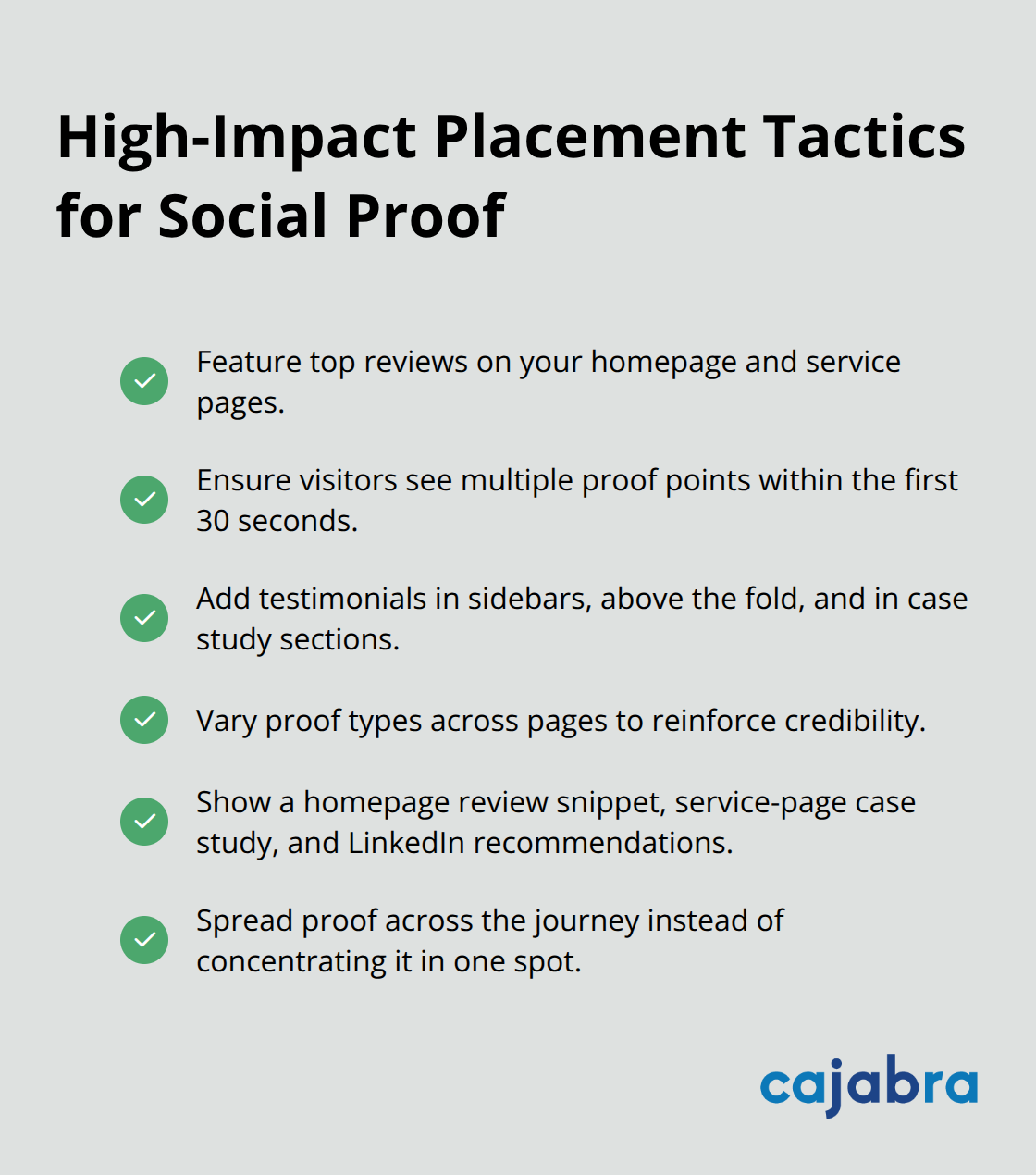
A prospect might see a Google Review snippet on your homepage, a detailed case study on your tax strategy page, and LinkedIn recommendations on your profile. This repetition from different sources compounds credibility far more effectively than concentrating all proof in one location.
Track which proof types generate the most leads by using unique landing pages for different case studies and monitoring which drive the highest conversion rates. Over time, this data reveals whether video testimonials, written case studies, or review aggregations perform best for your specific audience. The proof types that resonate most with your prospects should inform how you allocate your collection efforts going forward.
How to Systematically Build and Showcase Social Proof
Request Reviews at the Right Moment
Collecting reviews and testimonials works only if you build it into your regular business process. Most accounting firms wait for clients to volunteer feedback, which almost never happens. Instead, send a structured email request within two weeks of completing a significant engagement. The timing matters because the client's satisfaction remains fresh and they haven't yet moved on to their next priority. Keep the request simple: ask them to describe the specific problem you solved and the measurable outcome. Prompt directly for numbers.
Most clients will provide tax savings, time saved, cash flow improvements, or error reductions if you ask explicitly. For Google Reviews, send a direct review link in your email rather than expecting clients to search for your business page and navigate Google's interface independently. Firms that email direct Google Review links see higher submission rates than those requesting reviews without a link. This single change transforms review collection from sporadic to systematic.
Set a calendar reminder to request reviews after every completed project and assign someone on your team ownership of this process. Within six months of consistent requests, you'll accumulate thirty to fifty reviews. At forty or more reviews with a 4.7-star average, your visibility in local search results and AI-generated search summaries increases substantially. LinkedIn recommendations follow a similar pattern. After delivering strong results, send the client a message asking them to endorse your specific expertise on LinkedIn. Make it easy by suggesting exact language they could use. Most professionals will spend two minutes writing a recommendation if you remove friction from the request.
Transform Feedback Into Case Studies That Convert
A case study differs fundamentally from a testimonial. A testimonial consists of one or two sentences of praise. A case study presents a structured narrative that shows a prospect their own situation reflected back at them. Start with a headline that names the client's industry and the specific outcome. Then describe the problem they faced before working with you. Next, explain your solution in plain language without jargon. Finally, quantify the results with specific numbers.
For example: Manufacturing company struggled with entity structure tax inefficiency. You restructured their business entity and identified overlooked tax credits. Result: annual tax liability reduced by twelve percent, saving them eighteen thousand dollars yearly. Notice the specificity. A prospect running a manufacturing business reads this and immediately thinks about their own tax situation. They see themselves in the case study. This recognition drives conversion far more effectively than generic praise.
Publish these case studies on your service pages where prospects evaluating that specific service will encounter them. A prospect researching tax strategy should see case studies demonstrating tax savings on that page. Create short versions for LinkedIn, sharing the industry context and outcome in a post with a link to the full case study on your website. Track which case studies generate the most leads (by monitoring which ones drive traffic and conversions to your website). Over time, this data reveals whether prospects respond more strongly to tax savings stories, time-savings stories, or cash-flow improvements. Allocate your case study creation efforts toward the proof types that resonate most with your target clients.
Leverage Video Testimonials for Maximum Impact
Video testimonials dramatically outperform written testimonials in conversion rates because they feel authentic in ways text cannot replicate. Record a short video of a satisfied client describing the problem you solved and the specific outcome. Keep videos under ninety seconds. Authenticity matters more than production quality. A client speaking directly to the camera about their experience generates far more credibility than a polished corporate video.
Publish these videos on your homepage, service pages, and LinkedIn. Prospects who watch even thirty seconds of a client testimonial video are significantly more likely to schedule a consultation than those who only read text. The combination of seeing a real person, hearing their voice, and hearing them describe concrete results creates trust that written testimonials struggle to match.
Final Thoughts
Social proof shifts how prospects evaluate your firm fundamentally. When a prospect sees that you saved other accounting clients thousands in taxes or streamlined their operations, they stop viewing you as one option among many and instead see you as the firm that solves problems like theirs. This perception change happens because prospects trust outcomes from real clients far more than marketing claims, and the firms winning the most accounting clients understand this reality completely.
Building social proof requires consistency rather than complexity. Request reviews after every completed engagement, transform client feedback into case studies that show industry context and measurable results, and publish these across your service pages and LinkedIn where prospects actively search for proof that you deliver. Within six months of systematic collection, you'll accumulate enough proof to shift how prospects perceive your firm, and prospects will contact you because they've seen evidence that you solve problems for businesses like theirs.
The competitive advantage belongs to firms that build trust first (while competitors focus on features and credentials, you showcase real client outcomes). Prospects arrive at consultations already convinced you can help them because they've seen the proof, read the case studies, and watched video testimonials from clients in their industry. We at Cajabra, LLC help accounting firms implement this exact approach through our Premium Online Presence Package, which modernizes your digital footprint and positions your firm as an industry leader.
Your accounting website is often the first impression clients get of your firm. A poor user experience drives visitors away before they even learn about your services.
At Cajabra, LLC, we've seen firsthand how small UX improvements lead to real results. This post covers the practical changes that matter most for accounting websites.
Website Speed and Performance Optimization
Page load speed is not a nice-to-have for accounting websites. It's a conversion killer or a conversion driver, and there's no middle ground. Google research shows that 53% of visits are abandoned if a mobile site takes longer than 3 seconds to load. For accounting firms competing for high-value clients, that's unacceptable. When a prospect compares your firm to a competitor, a slow website signals that you're not tech-forward or detail-oriented. Fast sites communicate the opposite.
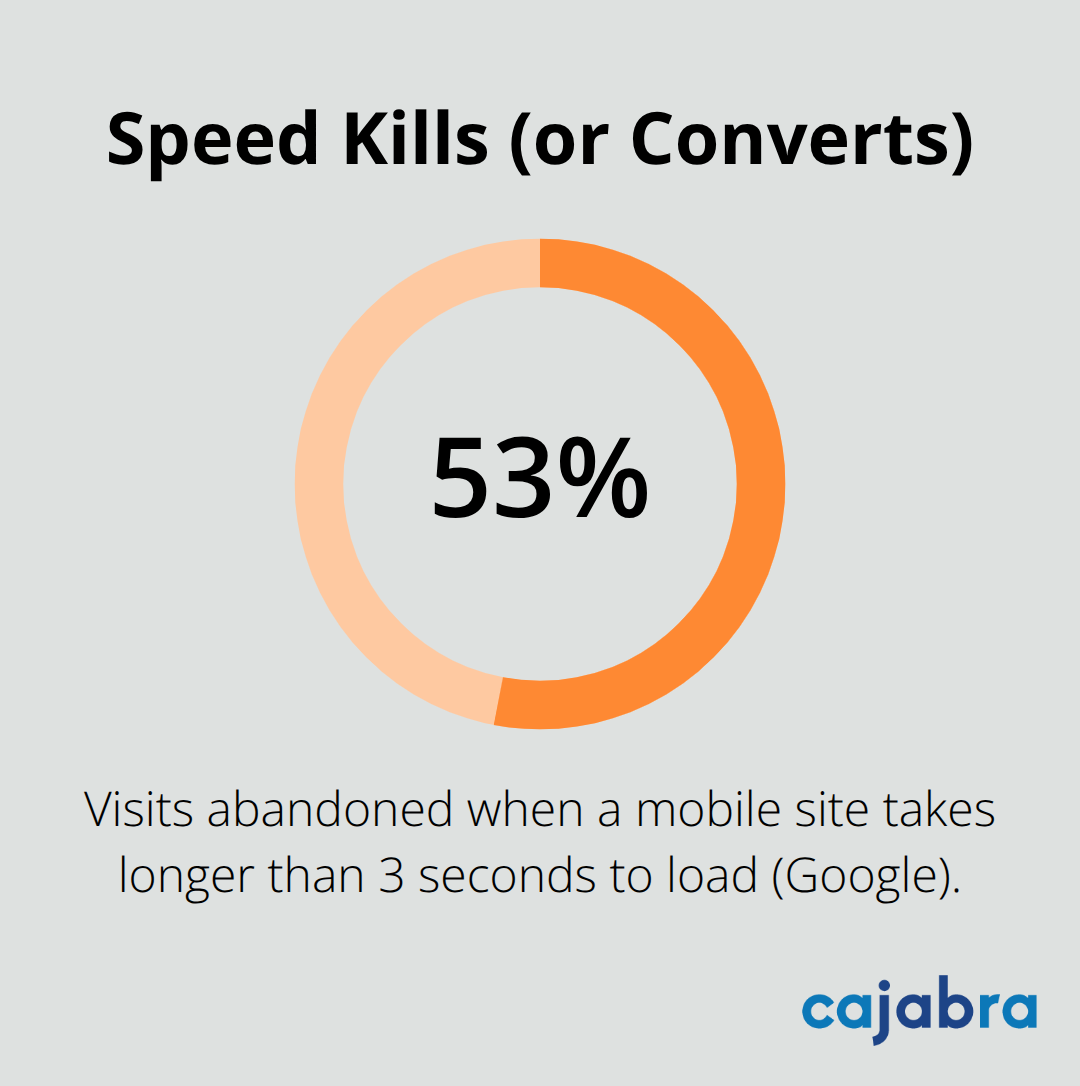
Mobile-optimized websites can improve conversion rates according to HubSpot, which means speed directly impacts your bottom line. The reality is that your accounting website must load in under 3 seconds on mobile, or you lose clients before they even see your services.
Compress Images and Code First
Images typically represent the largest contributor to slow page load times. Google PageSpeed Insights measures your actual performance on both mobile and desktop and flags what slows you down. Compress images aggressively by switching from PNG to JPEG where possible, and consider modern formats like WebP for even smaller file sizes. Minifying CSS and JavaScript removes unnecessary characters without changing functionality, which reduces file size immediately. This step alone often produces noticeable improvements.
Deploy a Content Delivery Network
A Content Delivery Network (CDN) serves your website from servers geographically closer to your visitors. This reduces latency and ensures faster delivery regardless of where your clients are located. CDNs work especially well for accounting firms with clients across multiple states or regions, as they eliminate the distance penalty that slows traditional hosting.
Monitor Performance Continuously
Test your site regularly using PageSpeed Insights, not just once, because performance degrades over time as you add content and plugins. Make speed a monthly checkup, not a one-time project. This ongoing attention prevents the slow creep that catches most firms off guard. Mobile performance directly determines whether prospects stay or leave.
Mobile-First Design and Responsive Layout
Mobile devices account for over 60% of global web traffic, which means your accounting website must work flawlessly on phones or you lose the majority of your prospects before they see a single service page. The old approach of building for desktop and shrinking it down for mobile is dead. Accounting firms that still operate this way are leaving money on the table. Your website must be designed for mobile first, then scaled up to larger screens.
Touch Targets and Thumb-Friendly Navigation
Touch targets need to be at least 48 pixels in size, not the tiny buttons that desktop designers often create. Prospects scroll your site one-handed while sitting in traffic or between meetings, so thumb-friendly navigation is non-negotiable. Test your site on actual phones, not just browser emulators. Use real devices like iPhones and Android phones to catch navigation problems that simulators miss.
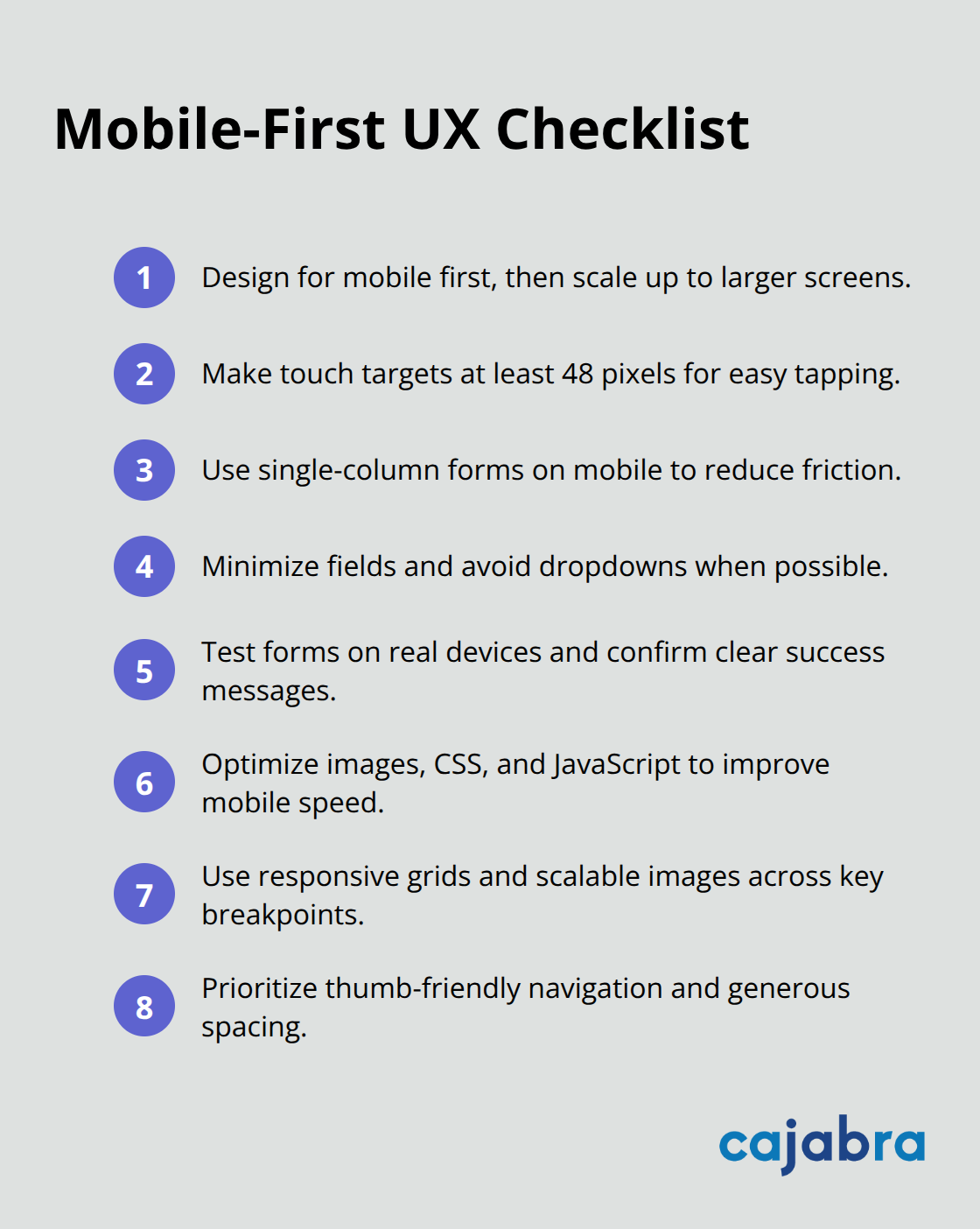
Pay attention to how buttons and forms feel to tap. If users have to zoom in to click a link, your navigation has failed. The spacing between clickable elements matters more on mobile than anywhere else. Cramped menus and overlapping buttons frustrate users and kill conversions.
Responsive Design Across All Devices
Responsive design means your layout adapts automatically to different screen sizes without requiring separate mobile and desktop versions. Use flexible grids and scalable images that shift and reflow based on the viewport. Test your site across multiple breakpoints: mobile phones at 320 pixels and up, tablets at 768 pixels, and desktops at 1024 pixels and beyond. Your accounting website must serve these users flawlessly.
Optimize Forms for Mobile Conversion
Forms deserve special attention on mobile because they kill conversions when poorly designed. Use single-column layouts for forms on mobile, avoid dropdown menus where possible, and reduce the number of fields ruthlessly. A five-field form converts better than a fifteen-field form, especially on phones. Test form submissions on mobile to ensure confirmation messages appear clearly and that users understand what happens next. Speed matters even more on mobile networks than on desktop connections, so every optimization you make to reduce page load times directly improves the mobile experience.
With mobile performance locked in, the next step is making sure visitors can actually find what they need. Clear navigation and logical information architecture transform a fast, mobile-friendly site into one that converts prospects into clients.
Clear Navigation and Intuitive Information Architecture
Prospects visiting your accounting website have limited patience. Nielsen Norman Group research shows that web pages are scanned using predictable patterns-either the F-pattern for text-heavy content or the Z-pattern for image-focused layouts. Your job is to align your site structure with how visitors actually scan, not how you think they should read. Most accounting websites fail here because they organize content around internal firm structure instead of client problems. You list tax services, accounting services, and advisory services as separate sections, but prospects don't care about your internal departments.
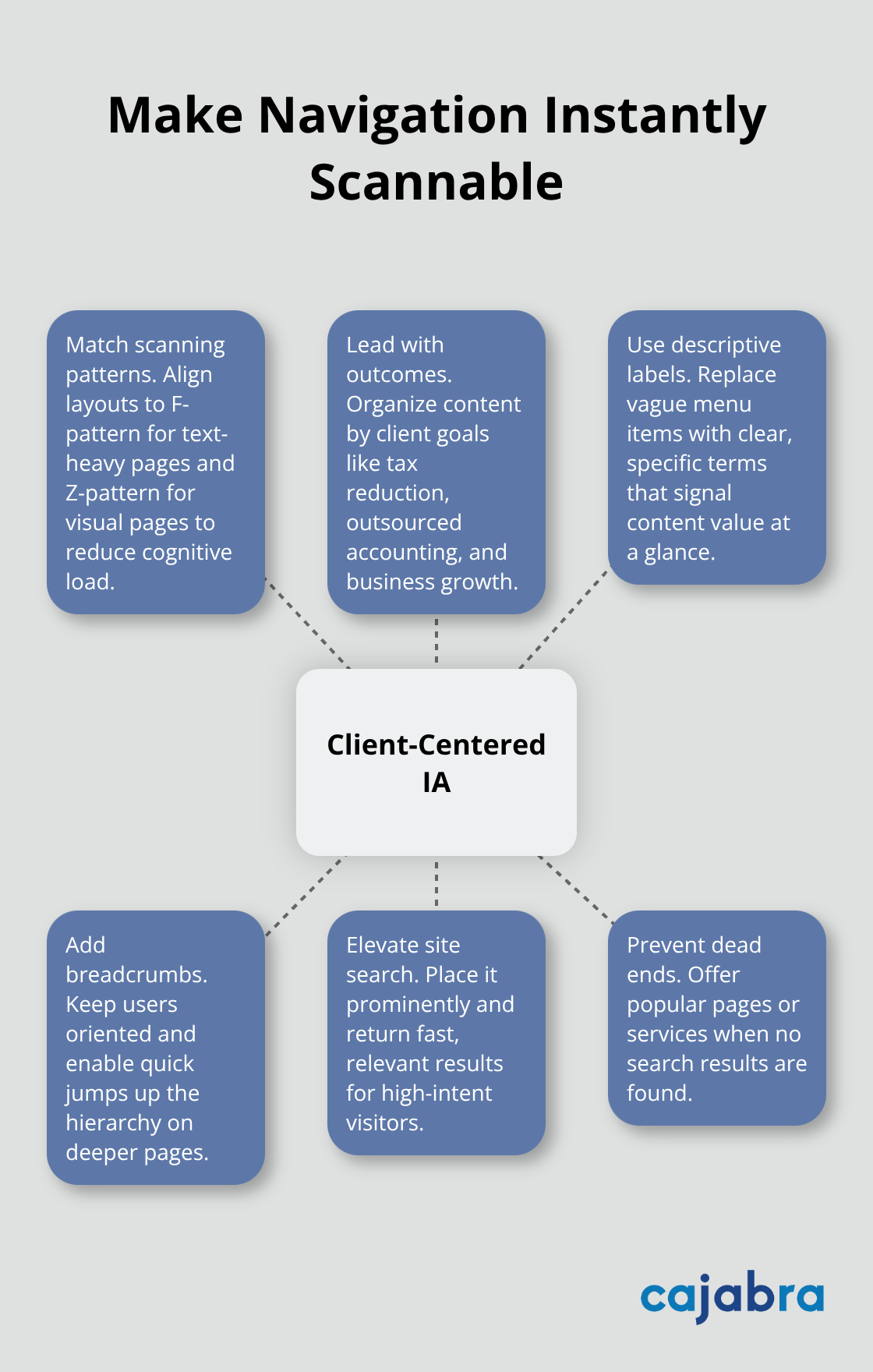
They care about outcomes: reducing their tax burden, simplifying their bookkeeping, or scaling their business. Reorganize your navigation to speak directly to client goals. Instead of generic labels like Services, use specific outcomes like Tax Reduction Planning, Outsourced Accounting, or Business Growth Advisory. This shift alone improves scannability and helps visitors understand exactly how you solve their problems in seconds, not minutes.
Use Descriptive Labels That Signal Content
Descriptive labels matter more than clever naming. Avoid vague terms like Solutions or Insights. A prospect should know what they'll find before clicking, so use labels that clearly signal content: Tax Planning for Business Owners, Monthly Bookkeeping Services, or Payroll Management. Add breadcrumb navigation below your main menu so visitors always know where they are in your site structure and can jump back to parent pages without using the back button. This reduces friction and keeps users oriented, especially on deeper service pages. Visitors scan your navigation in milliseconds, so every label must communicate value immediately.
Implement Search Functionality for High-Intent Prospects
Many accounting websites skip search functionality entirely, assuming their navigation is clear enough. That assumption costs you conversions. Visitors who use search are closer to taking action than those browsing menus, so a functional search bar positioned prominently in your header captures high-intent prospects. Implement search that returns relevant results immediately, not a clunky page that requires additional filtering. Test your search by typing common questions prospects ask: How do you reduce my taxes? What does bookkeeping cost? Can you help with payroll? Your search results should surface relevant pages or blog posts that answer these questions directly. Poor search implementations frustrate users and signal that your site is outdated. A fast, accurate search function communicates that you're detail-oriented and user-focused, which matters for firms competing for high-value clients. Include a fallback option that suggests popular pages or services if search returns no results, so visitors never hit a dead end. This prevents abandonment and keeps prospects moving toward conversion instead of closing the tab.
Final Thoughts
The three areas covered in this post-speed, mobile design, and navigation-form the foundation of a high-performing accounting website. When you optimize page load times, your site stops bleeding visitors before they see your services. When you design for mobile first, you capture the majority of your prospects where they actually browse.
A fast, mobile-friendly site with clear navigation signals that you're detail-oriented, tech-forward, and client-focused. Prospects who navigate your site smoothly and find answers quickly contact you far more often than those who struggle with slow pages or confusing menus. Better user experience directly impacts how prospects perceive your firm and whether they choose to work with you.
Start with an audit of your current website using PageSpeed Insights to test mobile speed, then navigate your site on an actual phone to spot friction points. Pick one area to improve first-speed typically delivers the fastest wins-then move to the next. Cajabra offers a Premium Online Presence Package that handles website optimization and digital strategy so you can focus on client service.
Let’s talk about the most optimistic number in marketing for accounting firms: $500 a month.
It’s the budget that sounds reasonable, responsible, and just risky enough to feel like you’re “finally doing marketing.” It’s also the budget that gets wildly misunderstood. Somewhere along the way, $500/month picked up some very unrealistic expectations: instant leads, rapid growth, maybe even a top-three Google ranking by next Tuesday (Sigh).
So let’s clear the air.
Marketing can work on $500 a month. But only if you understand what that investment is actually meant to do, and what it definitely is not.
The Hard Truth About Growth
Growth requires four things: investment, time, money, and consistency. There’s no shortcut around that list. You can rearrange it. You can wish it away. You can ignore it for a year and then panic. But it doesn’t change.
Marketing isn’t an expense you tolerate. It’s an investment in a growth system you build over time. That system doesn’t explode overnight - it compounds. Slowly. Quietly. And then all at once, it starts working.
This is why treating marketing like a last-minute lever you pull when you “need leads now” almost always ends in disappointment.
Why $500 a Month Does and Does Not Make Sense

Here’s the good news: $500 a month is affordable for most firms and low risk. It’s a smart starting point. What it’s not is “all you’ll ever need.” If someone promises that $500/month is the magic number that solves everything, run. Politely - but quickly. At this level, marketing is about laying foundations. It’s about visibility, not virality. Momentum, not miracles.
Okay, so what $500 a Month is not? Let’s just get this out of the way. $500/month is not instant leads, full-service, hands-off marketing, guaranteed growth, or a fast pass to the top of Google. If that’s what you’re expecting, marketing is going to feel very personal very fast.
What $500 a Month Can Buy
What it can buy is far more valuable in the long run. At this level, you’re investing in:
- Basic content creation and automation
- SEO groundwork
- Improved local visibility
This is the unsexy part of marketing that actually works. The part that builds authority, trust, and relevance over time. The part ads rely on later - but can’t replace.
Why Content Comes First (Always)
Content is the engine. Ads are the amplifier. Content builds authority. It shows expertise. It educates buyers before they ever speak to you. It helps you rank in Google - and yes, on AI platforms too. Most importantly, it warms up leads so that when someone finally reaches out, they already trust you.
Ads don’t fix weak foundations. They amplify them.
If your messaging is unclear, your offer is vague, or your visibility is inconsistent, ads will just help more people ignore you faster.
“Done For You” vs. “Still On You”
This is where expectations really matter.
“Done for you” usually means:
- Blog and social content creation
- Scheduling and publishing
- Light keyword research and SEO
What it doesn’t mean is that you’re off the hook.
You still need to:
- Clarify your offer
- Define your ideal client
- Approve messaging
- Respond to leads (yes, actually respond)
- Follow up
- Deliver great service
Marketing doesn’t replace leadership. It supports it.
Where to Start (Without Burning Yourself Out)

Most firms underestimate how much time consistent content actually takes. Multiple blog posts a week. Social posts. Google Business Profile updates. Strategy. Execution.
Yes, tools exist. You can piece things together. Or you can leverage a system designed for this exact stage. This is where Cajabra, and tools like Pagefeeder, come in.
By automating content creation, distribution, keyword research, and Google Business Profile optimization, firms can build real momentum without turning marketing into a second full-time job. The result is steady visibility, stronger authority, and a foundation that supports growth - not just activity.
The $500 Reality
$500 a month doesn’t buy instant success. It buys:
- Consistency
- Foundation
- Visibility
- Momentum
And that’s exactly what sustainable growth is built on.
Marketing rewards clarity, commitment, and patience - not panic.
If you’re ready to stop treating marketing like a gamble and start treating it like a system, Cajabra helps make that shift possible. We do it clearly, practically, and without the hype.
Because when expectations are aligned with reality, marketing finally starts to work.
Accounting firms compete on credentials and experience, but thought leadership is what separates the firms clients actually trust. When you position yourself as an authority in your field, you attract better clients, command higher fees, and build a practice that runs on reputation rather than constant marketing.
At Cajabra, LLC, we've seen firsthand how firms that share genuine expertise outpace their competitors. This post walks through the specific strategies that work: content that proves your knowledge, speaking opportunities that amplify your voice, and an online presence that makes you impossible to ignore.
Content That Proves What You Know
Content marketing separates firms that talk about expertise from firms that demonstrate it. The difference matters enormously. According to the Edelman/LinkedIn B2B Thought Leadership Impact Study, content doesn't just attract attention-it builds credibility that directly influences buying decisions. The best way to establish this credibility is to share specific examples of problems you've solved, insights you've uncovered about your industry, and data that shows patterns your clients face. Generic advice about tax planning or compliance won't set you apart. What will is showing exactly how you helped a construction company navigate the 2024 change in bonus depreciation rules, or how you identified cash flow problems in a service business that saved them six figures annually.
Real Case Studies Beat Generic Advice
Case studies drawn from your actual client work are the most powerful content you can publish. They show your problem-solving approach in action. The best case studies follow a simple structure: the client's specific situation, the exact challenge they faced, your methodology, and the measurable outcome. Numbers matter here. Instead of saying you improved a client's tax position, state that you identified $47,000 in overlooked deductions or reduced their effective tax rate from 28% to 19%. These concrete figures make your expertise credible. You don't need to name clients-confidentiality is reasonable-but you must include enough detail that prospects in similar situations recognize themselves in the story. A manufacturing firm struggling with inventory accounting methods, a medical practice managing multiple locations, or a real estate developer timing revenue recognition-these specific scenarios resonate far more than abstract examples. Publish one substantial case study every quarter. This pace is sustainable for most firms and gives you enough material to show range across different industries and issue types.
Tax Changes and Compliance Updates Drive Immediate Relevance
Tax law and accounting standards shift constantly, and firms that publish timely analysis on these changes position themselves as current and knowledgeable. The IRS issued over 300 pieces of guidance in 2024 alone, and the FASB continues updating standards that affect client reporting. Your clients don't have time to parse these updates themselves. When you share your expertise by translating new guidance into practical implications for your specific client base, you become indispensable. Your piece doesn't need to be comprehensive-focus on what actually matters for your clients. If you serve healthcare practices, explain how the latest Medicare reimbursement changes affect their revenue recognition. If you work with tech startups, address how new ASC 606 interpretations impact their SaaS contracts. This timeliness gives prospects a reason to follow your firm, because you'll alert them to changes that could affect their bottom line before competitors do. These updates also give your business development team immediate conversation starters with prospects and existing clients.
Industry Data Turns Observations into Proof
Articles backed by real data-whether from your own client base, published industry reports, or IRS statistics-demonstrate that you understand broader patterns, not just individual situations. The National Federation of Independent Business reports that cash flow problems rank among the top three challenges for small business owners. If you've noticed this pattern in your client base and can show data supporting it, you can publish an article explaining how to identify cash flow distress early and what accounting changes signal underlying problems. The IRS's own filing data is public. You can analyze trends in your industry using their Statistics of Income reports. Real estate agents increasingly face uncertainty about 1031 exchange rules. Construction firms watch labor cost inflation reported by the Bureau of Labor Statistics. Publishing articles that connect published data to your specific client industries shows you're paying attention and thinking deeply about what matters. Try to include at least two to three credible data points in each article-whether from government sources, industry associations, or your own anonymized client data. This transforms your article from opinion into informed analysis that prospects take seriously.
Speaking engagements and industry partnerships amplify the reach of your content and position you as an authority worth listening to.
Amplify Your Authority Through Speaking and Strategic Partnerships
Speaking engagements and podcast appearances create visibility that written content alone cannot achieve. When you present at a chamber of commerce event or contribute expert commentary to an accounting publication, you position yourself as someone worth listening to. Most accounting firms treat speaking as occasional activity rather than a systematic part of their authority-building strategy. This is a mistake. Firms that secure two to three speaking slots per quarter and contribute to one industry publication monthly build recognition far faster than those waiting for opportunities to arrive.
Present at Events Where Your Ideal Clients Gather
Local business associations actively seek speakers. Chambers of commerce, rotary clubs, and industry-specific associations like the Construction Industry Round Table or the Healthcare Financial Management Association host regular events. These organizations need speakers on topics their members care about. A 30-minute presentation on how 2025 tax law changes affect small business owners, or a workshop on identifying cash flow problems before they become crises, addresses real problems your target clients face.
The payoff is direct: attendees remember you because you solved a problem they actually have. More importantly, your business development team gains warm introductions. After your presentation, prospects approach you with specific questions about their situations. These conversations are far more productive than cold outreach because the prospect already knows you understand their industry. Try to speak at venues where your ideal clients gather, not generic business events. A construction accounting firm should target construction associations and developer forums, not generic small business mixers.
Contribute to Publications and Podcasts Your Clients Read
Contributing to professional publications and podcasts extends your reach beyond your local market. Accounting Today, Journal of Accountancy, and state CPA society publications actively publish articles from practitioners. Podcasts focused on accounting, tax strategy, and business finance need guests with credible expertise and real-world examples. The value here is twofold: first, publication builds your credentials with prospects who vet your firm before reaching out; second, these platforms drive traffic and leads directly to your website.
When someone reads your article in a respected publication or hears you discuss a complex tax issue on a podcast, they contact your firm far more readily than if they saw a generic marketing email. Pitching publications and podcast hosts requires specificity. Don't pitch a vague idea about tax planning. Pitch something concrete: how recent changes to qualified business income deductions affect pass-through entities in your state, or a case study showing how you helped a family business restructure to reduce estate taxes. Publications want fresh angles on timely topics. Podcasts want guests who can tell stories and explain complex concepts clearly. Start by identifying three to five publications and podcasts your target clients actually read or listen to, then research their submission guidelines and contact the editors directly.
Build Credibility Through Strategic Partnerships
Partnerships with complementary service providers-such as business attorneys, commercial bankers, or financial advisors-create opportunities for joint webinars and co-authored content that reach both firms' audiences. A webinar titled "Tax Efficiency for Business Owners" co-hosted with a business attorney discussing entity structure, liability protection, and tax planning reaches a much larger audience than either firm could attract alone. These partnerships also build credibility through association. When prospects see you collaborating with respected professionals in related fields, they perceive your firm as part of a trusted network.
The key is choosing partners who serve the same clients but don't compete directly. An attorney specializing in business formation complements your tax practice. A financial advisor focused on retirement planning complements your bookkeeping and tax services. Approach potential partners with a specific proposal: a webinar topic, a target audience, a timeline, and a clear plan for promoting it to both audiences. Joint webinars should be recorded and repurposed as content assets-clips for social media, transcripts for your website, and full recordings available on-demand. These partnerships transform your authority-building efforts into a collaborative advantage that multiplies your reach and positions your firm as a connector within your professional ecosystem.
Making Your Firm Visible Online
Your website and LinkedIn profile serve as the first impression prospects form when they search for an accounting firm or encounter your name in an industry publication. Most accounting firm websites fail because they prioritize generic messaging over demonstrating actual expertise.
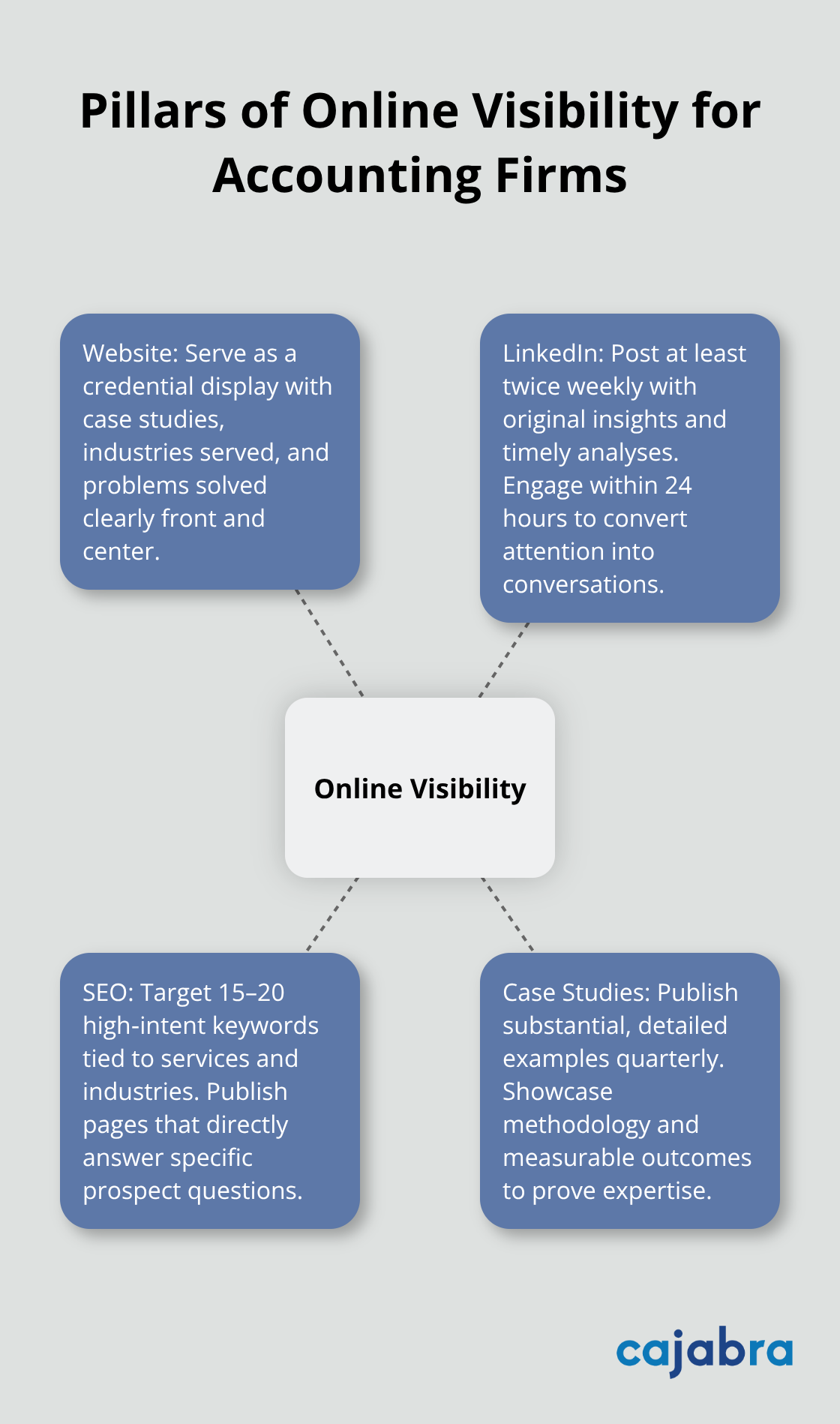
Your website should function as a credential display, not a brochure. This means featuring your case studies prominently, showcasing the specific industries you serve, and making it obvious what problems you solve. When a prospect visits your site after hearing you speak or reading your article, they should immediately recognize that you understand their situation.
Feature Your Expertise on Your Website
Include a dedicated section highlighting your expertise areas with real examples of work you've done. A manufacturing accounting firm should have a visible section explaining how you handle inventory accounting, job costing, and the specific tax implications manufacturers face. Link your case studies directly from your homepage. Use your website to convert the authority you've built through content and speaking into actual client conversations. A poorly designed or outdated website undermines everything else you've accomplished.
Build Consistent Visibility on LinkedIn
Building consistent visibility on LinkedIn requires regular activity. The platform's algorithm rewards consistent posting, and accounting professionals actively use LinkedIn to vet firms before engaging. Post at least twice weekly on topics directly relevant to your clients. This doesn't mean sharing generic motivational content or reposting articles without commentary. Share specific insights from your work, analysis of recent tax changes affecting your industries, or lessons learned from client situations.
When you publish an article on your website, share it on LinkedIn with a brief insight that adds value beyond the headline. Posts with commentary from the original author generate significantly higher engagement than simple link shares. If you speak at an event, post about it with the key takeaway your audience should know. If you notice a tax trend affecting your clients, post your analysis before competitors do. This activity keeps your firm visible in your network's feed and signals to the algorithm that you're an active thought leader.
The goal isn't vanity metrics like likes and comments, though those matter. The goal is ensuring that when someone in your network searches for accounting help or asks for a referral, your name appears consistently in their awareness. Respond to comments and direct messages within 24 hours. These conversations often lead directly to client conversations because people remember who actually engages with them.
Target High-Intent Keywords in Search Results
Search engine optimization for accounting firms means targeting specific keywords that indicate high buying intent. A prospect searching for "construction accounting firm near me" or "how to handle bonus depreciation in 2025" is far more valuable than someone searching "accounting tips." Your website and blog content should be optimized for these specific, intent-driven keywords rather than generic terms everyone searches.
Research which keywords your ideal clients actually use when they're looking for help. Use free tools like Google's Keyword Planner or Ubersuggest to identify search volume and competition for terms relevant to your industries. A firm serving medical practices should optimize for keywords like "medical practice accounting," "healthcare tax deductions," and "medical office bookkeeping," not just "accounting services." Write content that directly answers the specific questions prospects search for. If construction firms in your area search for "bonus depreciation rules 2025," publish an article specifically addressing that question with actionable guidance.
This targeted approach generates far fewer visitors than generic content, but those visitors are actively looking for what you offer. Focus on ranking for 15 to 20 high-intent keywords rather than chasing broad terms with massive search volume. This approach delivers qualified leads consistently, and it's far more achievable for a firm without massive SEO budgets.
Final Thoughts
Thought leadership separates firms that compete on price from firms that command premium fees and attract better clients. When you publish case studies showing real results, speak at industry events where your ideal clients gather, and maintain consistent visibility online, you build authority that competitors cannot easily replicate. This authority compounds over time-a prospect who reads your article on tax law changes, hears you speak at a chamber event, and sees your insights on LinkedIn trusts your judgment before ever contacting you.
The revenue impact proves measurable. Firms that establish themselves as authorities in their niche attract inbound inquiries from prospects already convinced of their expertise. These conversations close faster and command higher fees because the prospect has already validated your knowledge. You spend less on marketing because your reputation does the work.
Starting requires less effort than most firms assume. Pick one industry or service area where you have genuine expertise and where you see clear client problems, then publish one substantial case study this quarter and identify two speaking opportunities at events your ideal clients attend. If you need help building a marketing strategy that positions your firm as an authority and converts that authority into retainer-based clients, Cajabra specializes in moving accounting firms from overlooked to overbooked through targeted brand positioning and lead-generating systems.
When business owners think about their accountant, what’s the first thing that comes to mind?
For many small business owners, accounting still lives in the “necessary but confusing” box. It’s something they know they have to pay for (like insurance or internet) but not something they instinctively associate with growth, or confidence. Accounting is often viewed as a cost of doing business, not a catalyst for better decisions.
And that’s the real disconnect.
Because what accountants actually provide goes far beyond clean books and filed returns. The true value lies in perspective. In interpretation. In helping business owners understand what their numbers are telling them… And what they should do next. The issue isn’t capability. It’s visibility.
So, how does one close that gap?
What Business Owners Actually Value

If you’ve ever wondered how business owners really evaluate accounting services, there’s a brutally honest answer: most of them don’t - at least not at first.
Early on, accounting is often treated as a simple line item to control. Many business owners choose the lowest-cost option available because, at that stage, they can’t yet see beyond the basics. Tax returns get filed. Reports get produced. Boxes are ticked. Job done… right?
Not quite.
That mindset tends to shift as businesses grow and decisions get heavier. More staff. More risk. More moving parts. Complexity has a way of exposing blind spots very quickly. And that’s usually the moment when business owners realize there’s a world of difference between having an accountant and having the right accountant.
The right one doesn’t just report on what already happened. They help the business owner think ahead. They highlight patterns, pressure points, and opportunities before they become problems. They offer context when the numbers stop being straightforward.
What’s interesting is that this recognition often comes after the pain. After a cash flow scare. After a missed opportunity. After a decision that felt right at the time - but looks questionable in hindsight.
Understanding this timing matters. Because value isn’t just about what you deliver—it’s about when the client is ready to see it. When you understand how business owners think at different stages, you can position your services as proactive solutions rather than reactive necessities.
Repositioning Yourself in a Crowded Market
Here’s the opportunity most accountants overlook.
Elevating your role doesn’t start with more services or fancier packages. It starts with curiosity. A genuine interest in your clients’ businesses, their pressures, and their long-term goals. When you understand what keeps them up at night, your conversations naturally change.
From there, your message has to evolve - but not by getting louder. By getting clearer.
That means talking less about tasks and more about outcomes. Less about what you do and more about what changes because you do it. Compliance doesn’t disappear in this process. It gets reframed as the foundation, not the finish line.
Of course, changing perceptions takes time. It always does. Consistency is required. Intention matters. You have to show up differently (again and again) before people start responding differently.
But the payoff is significant. When clients begin to see you as part of their decision-making team rather than just their reporting function, the relationship shifts. Conversations deepen. Trust strengthens. And suddenly, you’re no longer interchangeable.
That shift also needs to be reflected in your marketing.
As the profession continues its move from compliance-driven to advisory-led, this alignment becomes non-negotiable. Clients need to understand that you’re there through every phase of their business… Not just at deadline time.
One Final Thought Before You Go…

The real value of accounting isn’t in the numbers alone - it’s in what’s done with them. When you clearly articulate that value and meet clients where they are, the relationship changes. You stop being an expense and become a guide.
Cajabra helps accountants move from compliance provider to strategic partner by clarifying the value they already deliver. Through sharper messaging, deeper insight into how business owners think, and practical tools that support an advisory-led approach, Cajabra helps close the visibility gap.
When your expertise is understood, everything changes - conversations, relationships, and impact. If you’re ready to be seen as indispensable, Cajabra helps make that perspective click.
Most websites have content scattered across pages, blog posts, and resources that nobody's actually reviewed in months or years.
A content audit fixes that. It's a systematic review of everything you've published, showing you what's working, what's broken, and what's missing entirely.
At Cajabra, LLC, we've seen firsthand how audits uncover hidden ranking problems and wasted opportunities. This guide walks you through the process step by step.
What a Content Audit Actually Reveals
A content audit isn't just about counting pages. It's about finding what's actually working in your digital footprint and what's actively harming your performance. When you audit content, you examine every piece you've published against three critical measures: how it performs in search results, whether visitors actually engage with it, and whether it serves your business goals. Most websites discover that 30 to 40 percent of their content either receives almost no traffic or actively conflicts with other pages competing for the same keywords. Google explicitly warns that repetitive, thin, or low-quality content damages your search rankings, which means outdated blog posts or duplicate landing pages aren't just sitting idle-they're pulling your authority down. A proper audit identifies these problem pages so you can refresh them with current data and examples, consolidate them into stronger pieces, or remove them entirely.
SEO Performance Stops When Content Piles Up
Multiple pages targeting the same topic or keyword create keyword cannibalization. When cannibalization occurs, Google does not know which page to rank for the target keyword, as two or more pages serve the same purpose. Tools like Ahrefs or SEMrush show exactly which pages compete against each other, and fixing this issue alone often produces noticeable ranking improvements within 4 to 8 weeks. Beyond keyword overlap, technical problems compound the damage-broken internal links, outdated publication dates, and missing meta descriptions send signals to search engines that your content isn't maintained. A content audit using a crawl tool like Screaming Frog uncovers these technical issues across your entire site at once. Bloggers who refresh older posts are 2.5 times more likely to report strong traffic outcomes, which proves that updating existing content often delivers faster results than creating entirely new pages.
User Behavior Reveals What Actually Matters
Google Analytics and Google Search Console data show you exactly how long people spend on each page and whether they take action. Pages with high traffic but low time-on-page and high bounce rates signal that visitors aren't finding what they need. Hotjar heatmaps go deeper, showing you exactly where on the page visitors stop reading or click away. This behavioral data tells you which content needs restructuring for readability, which pieces lack the information users actually search for, and which topics have gaps you haven't covered at all. When you combine analytics with keyword research tools like Google Trends or Answer the Public, you spot topics your audience searches for but you haven't published anything about. These gaps represent real revenue opportunities because you watch potential customers look elsewhere for answers.
Technical Issues Hide in Plain Sight
Broken links, missing redirects, and crawl errors accumulate silently across most websites. Screaming Frog crawls your entire site and flags 404 errors, broken internal links, and redirect chains that slow down user experience and confuse search engines. These technical problems don't just frustrate visitors-they also prevent search engines from properly indexing your content.
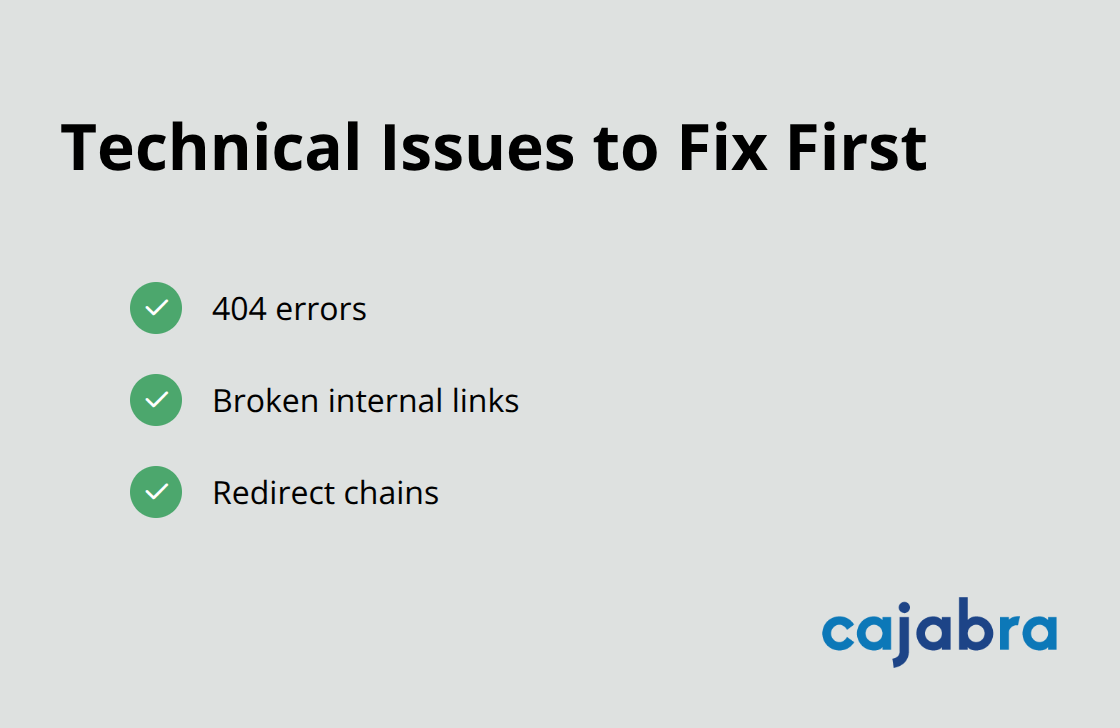
A single audit run often uncovers dozens of fixable issues that directly impact both rankings and user satisfaction. Fixing these problems typically takes less effort than creating new content but produces measurable improvements in search visibility.
Content Gaps Represent Missed Revenue
Your audit reveals not just what you have, but what you're missing. When you compare your existing content against what your audience actually searches for, gaps become obvious. Tools like Google Trends, Answer the Public, and keyword research platforms show search volume for topics you haven't addressed. These gaps mean potential customers are searching for solutions you could provide but aren't currently visible for. Filling these gaps with high-quality, targeted content positions you to capture traffic and leads that currently go to competitors.
The next step moves beyond identifying problems to actually fixing them-which requires a clear action plan and the right tools to execute it efficiently.
How to Build and Prioritize Your Content Inventory
Building a complete inventory of your content is the only way to know what you're working with. Start by exporting your sitemap or using a content inventory tool like Screaming Frog to pull every URL from your website automatically. If your site has under 500 URLs, Screaming Frog's free version works perfectly. For larger sites, SEMrush or Ahrefs crawl your entire domain and export the data into spreadsheets you can analyze. Each row should include the URL, page title, publication date, last updated date, content type (blog post, landing page, product page), primary keyword, word count, and current owner. This inventory becomes your working document throughout the audit. Without it, you make decisions based on guesses rather than facts.
Extract Performance Data That Reveals What Works
Once you have the complete list, pull performance data from Google Analytics and Google Search Console for the past 12 months. Focus on metrics that actually matter: organic traffic, bounce rate, time on page, conversions, and rankings for target keywords. Pages with high traffic but high bounce rates signal that content isn't delivering what visitors expect.
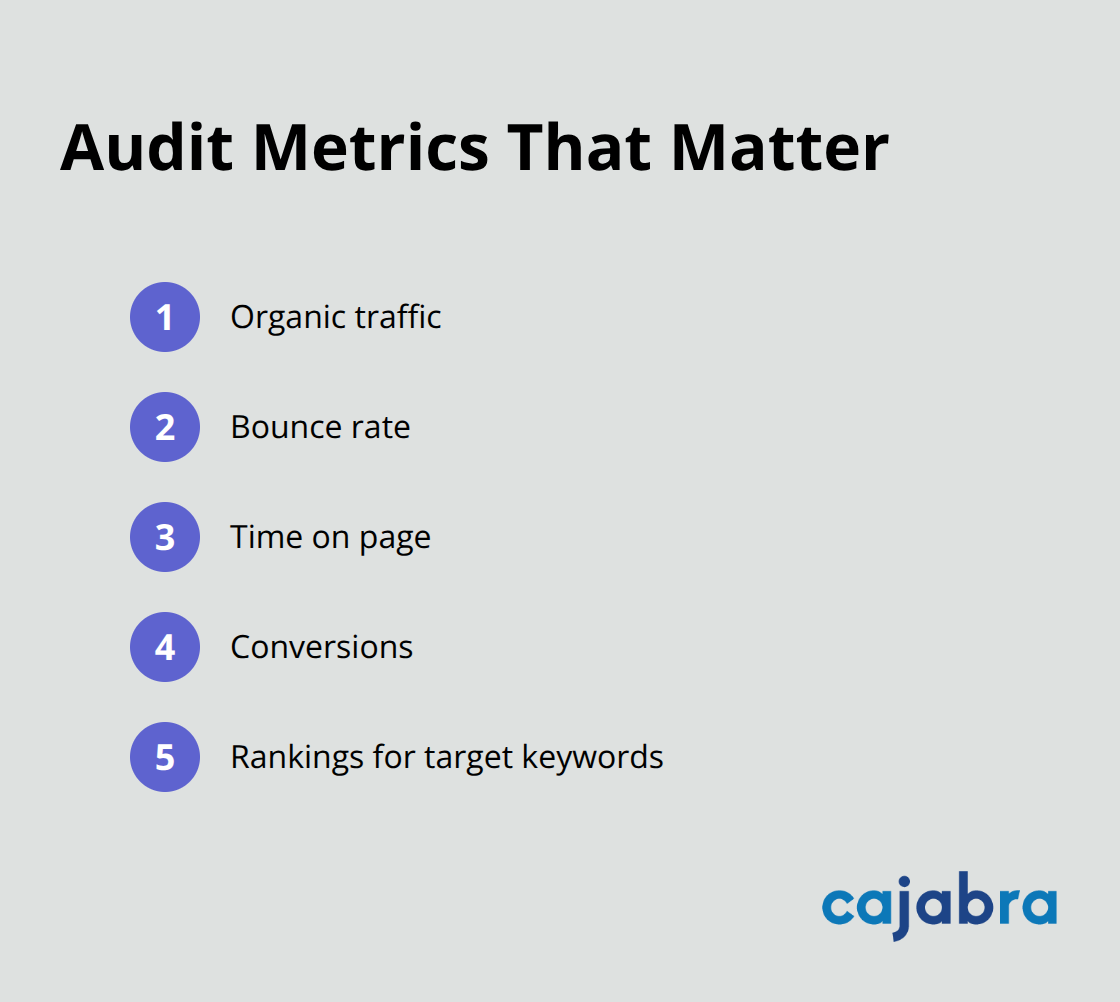
Pages with low traffic across months indicate either poor rankings or weak relevance to your audience. Sort your spreadsheet by traffic volume to identify your top 20 performers immediately, then flag any pages that receive fewer than 50 organic visits monthly as potential candidates for consolidation or removal.
Spot Gaps Between What You Have and What People Search For
Keyword research tools show exactly what your audience searches for that you haven't covered yet. Google Trends, Answer the Public, and SEMrush all reveal search volume and trending topics within your industry. Compare these searches against your existing content inventory to spot gaps. If 500 people monthly search for a topic you haven't published about, that's a clear gap worth filling. Simultaneously, identify pages that target overlapping keywords and decide which one should rank. If you have three blog posts about accounting software for small businesses, Google won't rank all three. Choose the strongest performer, consolidate the others into it, and redirect the weak pages to the winner. This consolidation approach prevents keyword cannibalization and concentrates your authority on a single, authoritative page.
Consolidate Overlapping Content to Recover Rankings
Use Ahrefs or SEMrush to check which pages link to each of your overlapping articles, then update those internal links to point to your consolidated version. This simple step often produces ranking improvements within 4 to 8 weeks because you concentrate link equity and remove confusion for search engines about which page should rank. The technical work takes minimal effort compared to creating new content, yet the results prove measurable and fast.
Assign Clear Decisions and Owners to Every Page
For each piece of content, make a clear decision: keep it as-is, update it substantially, consolidate it with another page, or delete it entirely. Pages that receive consistent organic traffic and align with your business goals deserve to stay. Pages with outdated publication dates but strong rankings need refreshing with current statistics and examples. Pages that duplicate other content should be consolidated into the stronger version with a 301 redirect. Pages with virtually no traffic and no strategic value should be removed. Document these decisions directly in your spreadsheet with a status column. Assign a specific owner and a deadline for each action. Without clear ownership and timelines, updates stall indefinitely. For pages you're updating, prioritize high-traffic pages and those with conversion potential first. Refreshing an article that already receives 500 organic visits monthly delivers faster ROI than creating an entirely new page from scratch. Try to complete updates on 10 to 15 priority pages monthly for small teams, while larger organizations can handle 25 to 50 pages monthly depending on resource availability. Track progress in your spreadsheet and celebrate wins when updated pages recover rankings or traffic.
With your inventory complete and decisions documented, the next phase focuses on executing these changes efficiently and measuring the impact they produce.
What Your Content Audit Will Actually Uncover
Every content audit exposes the same three problems that most websites ignore until they damage search rankings and user trust.
Pages That Rank But Fail to Convert
The first problem appears as pages that receive traffic but fail to convert or engage. Pages with 300 monthly organic visits but high bounce rates signal that content is optimized for looking impressive rather than clearly driving one specific action. This happens when content promises something in the search result but delivers something different on the page, or when the information is outdated and no longer relevant. Google Search Console shows which pages rank for keywords but receive low click-through rates, signaling that your title tag or meta description doesn't match what visitors actually want. These pages waste your ranking authority on low-value traffic instead of driving leads or sales.
Duplicate Content Fragments Your Authority
The second problem compounds the first: duplicate or overlapping content fragments your authority across multiple pages when Google could rank a single authoritative piece. This results in lower conversion rates, diminished authority, and lower CTRs for each page than for a consolidated page. When you have five pages about accounting software pricing, Google ranks whichever one it thinks is most authoritative that day, which means your link equity spreads thin across five weak pages instead of concentrating on one strong page.
Inconsistent Messaging Kills Conversions
The third problem is harder to spot but damages trust more than any algorithm penalty. Inconsistent messaging across your site confuses both visitors and search engines about what your business actually does. One landing page describes your service as cloud-based accounting solutions while another calls it automated bookkeeping software. Your homepage emphasizes speed while a product page emphasizes affordability.
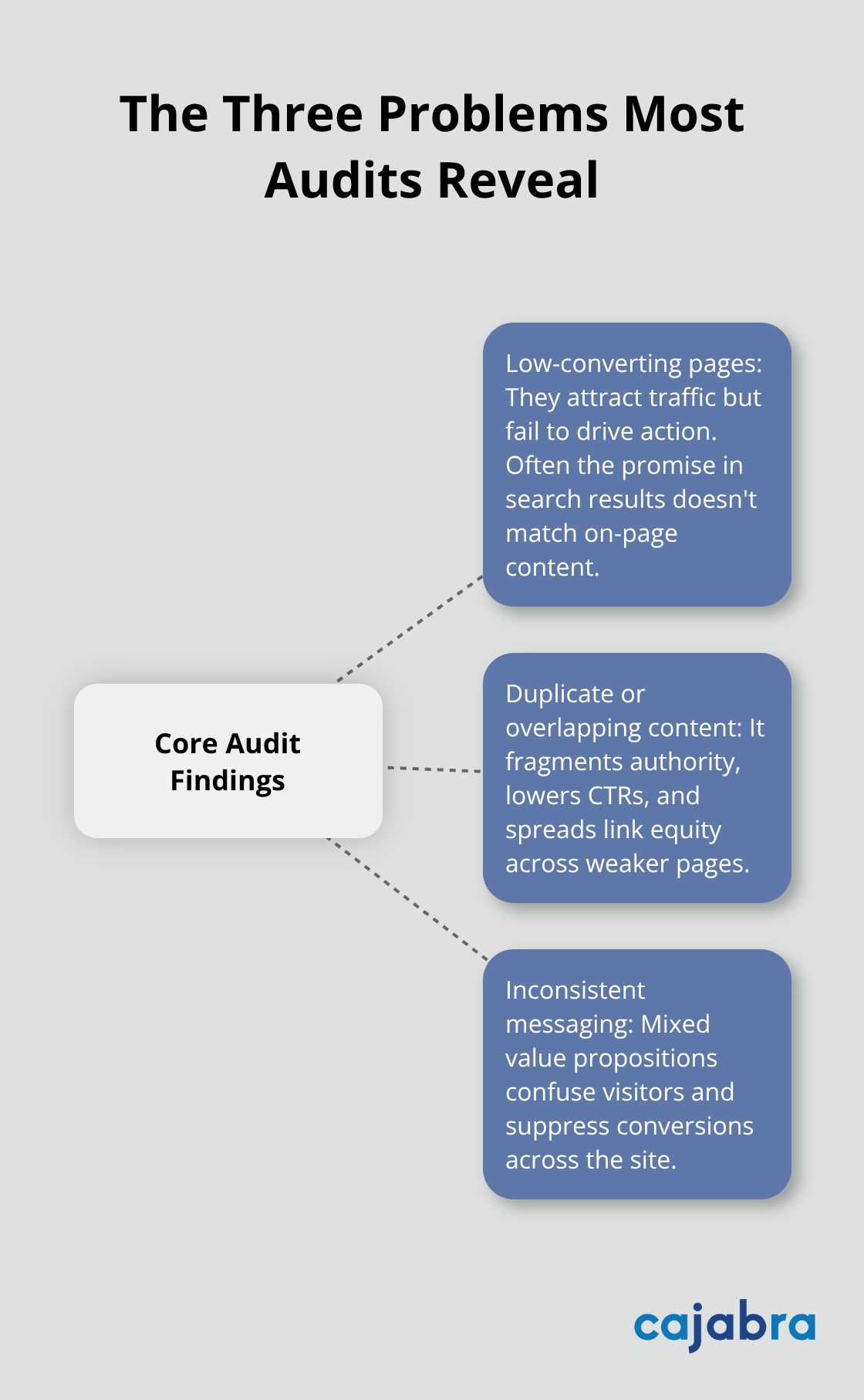
This inconsistency signals to potential customers that you lack a clear positioning, which kills conversion rates even when traffic arrives at your door.
Recovery Produces Faster Results Than New Content
Fixing these three problems produces faster results than creating new content because you recover value from pages that already rank and receive visitors. Pages that rank but don't convert often need only a rewrite of the body copy, clearer calls-to-action, or updated pricing information to transform them into lead generators. Consolidating overlapping pages takes a single afternoon of work but can recover significant search visibility because you concentrate link equity and remove confusion for search engines. Standardizing messaging across your site costs nothing except attention to detail during your audit phase, yet it produces measurable improvements in conversion rates because visitors encounter consistent positioning at every touchpoint.
Treat Your Audit as Revenue Recovery
Pages that already receive traffic represent proven demand for your content. Pages with ranking potential but low conversions represent untapped revenue sitting in plain sight. Pages that confuse visitors with inconsistent messaging represent leads you actively lose. These aren't theoretical problems-they're concrete opportunities to extract more value from content you've already published.
Final Thoughts
A content audit transforms how you think about the pages you've already published. Instead of constantly chasing new content, you recover value from existing pages that rank but don't convert, consolidate overlapping pieces that fragment your authority, and fix messaging inconsistencies that kill conversions. The three problems every audit reveals-low-converting pages, duplicate content, and inconsistent positioning-represent concrete revenue opportunities sitting in your analytics right now.
Start your audit by building a complete inventory of your content using Screaming Frog or SEMrush, then pull 12 months of performance data from Google Analytics and Google Search Console. Identify your top 20 performers and flag pages receiving fewer than 50 organic visits monthly as candidates for consolidation or removal. Compare your existing content against what your audience actually searches for using Google Trends or Answer the Public to spot gaps.
Most teams see measurable ranking improvements within 4 to 8 weeks after consolidating overlapping content and fixing technical issues. Pages you refresh with current data and examples often recover traffic faster than new pages gain traction. Cajabra specializes in marketing strategies for accounting firms that move you from overlooked to overbooked, and your content audit reveals what's broken so the next step fixes it strategically.
Accounting firms live in a crowded market. Your technical skills alone won't set you apart from competitors who offer the same services.
Brand storytelling changes that. When you share your firm's origin, values, and real client wins, prospects see the person behind the business-not just another accountant.
At Cajabra, LLC, we've seen firms that master this approach attract better clients and build stronger relationships. This guide shows you how.
Why Your Story Matters More Than Your Services
Over 46,000 accounting firms compete in the United States for the same clients. Your tax knowledge, audit expertise, and compliance skills are table stakes-they don't win business anymore. Prospects expect you to be competent. What they don't expect is to understand why you do what you do and how you're different from the firm down the street.
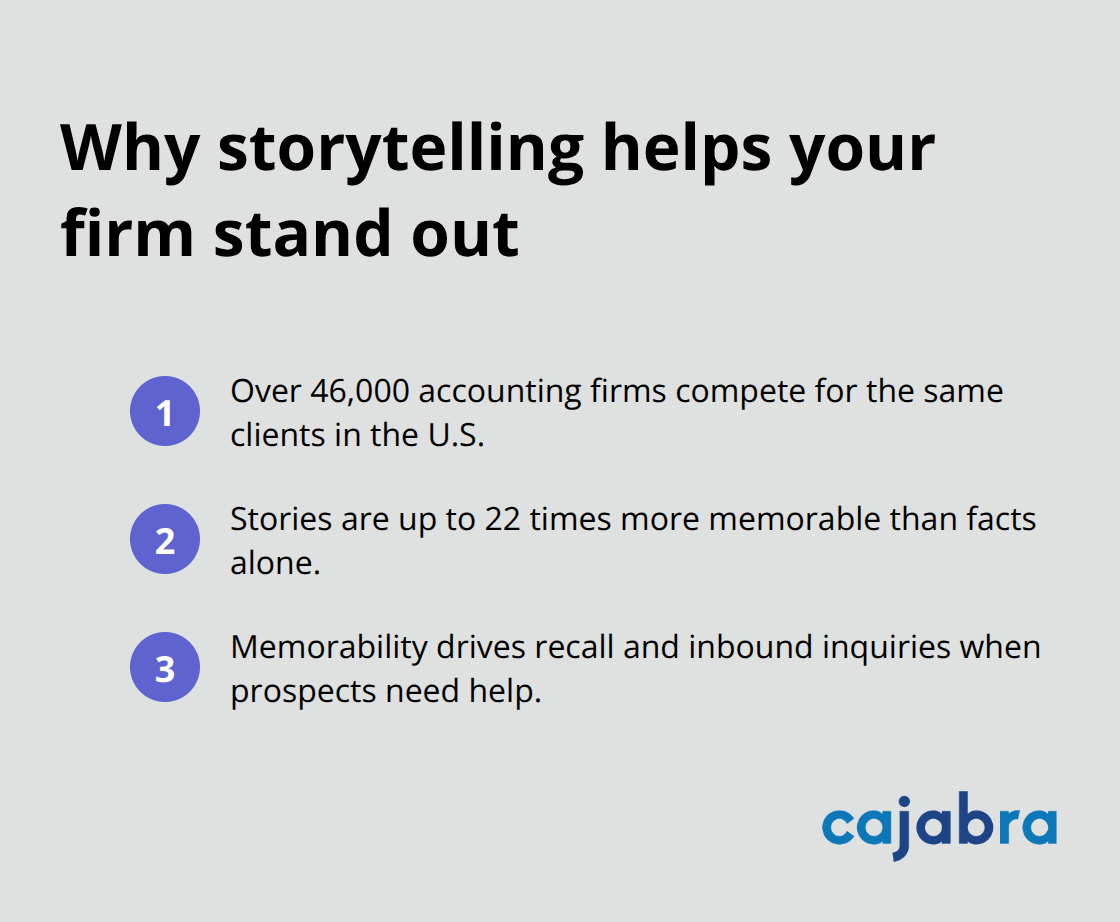
This is where storytelling gives you an unfair advantage. Research shows that stories are up to 22 times more memorable than facts alone. When a prospect remembers your firm's origin and values weeks after meeting you, they're far more likely to call when they need accounting help. That memory gap between you and your competitors is everything.
Differentiation Happens Through Narrative, Not Services
Two accounting firms offer the same tax planning and bookkeeping services. One tells prospects about their 15 years of experience and their commitment to accuracy. The other tells the story of how the founder started the firm to help family-owned businesses navigate tax complexity after watching her parents lose thousands to poor planning. Which firm do you think gets the call? The second firm isn't more qualified-they're more memorable. Your competitors can copy your service offerings. They can't copy your origin story, your values, or the specific way you solve problems. When you articulate what makes your approach different, prospects stop comparing you on price and start evaluating you on fit. This is the moment you move from commodity to trusted advisor.
Trust Builds When Prospects See Your Real Results
Prospects don't believe generic claims about your firm's value. They believe concrete outcomes. If you've helped five small business owners reduce their tax liability by an average of $12,000 annually, that's proof. If you've cut a client's bookkeeping time from 40 hours monthly to 10 hours through process automation, that's proof. If you've caught errors in a prospect's prior-year returns that saved them from an audit, that's proof. Your story isn't complete without these numbers attached to real client situations. When you share specific results alongside the client's industry and business size, skeptical prospects recognize themselves in that story. Many business owners are drowning in tax complexity and searching for guidance. Your story about how you've solved similar problems for clients in their industry becomes the reason they choose you over a larger, impersonal firm.
Where Your Story Reaches Prospects
The firms that win market share don't just have great stories-they share them everywhere prospects look. Your website, social media, email, and sales conversations all need to reflect the same narrative about who you are and what you stand for. The next section shows you exactly where to place your story and how to adapt it for each channel so prospects encounter your message consistently, no matter how they find you.
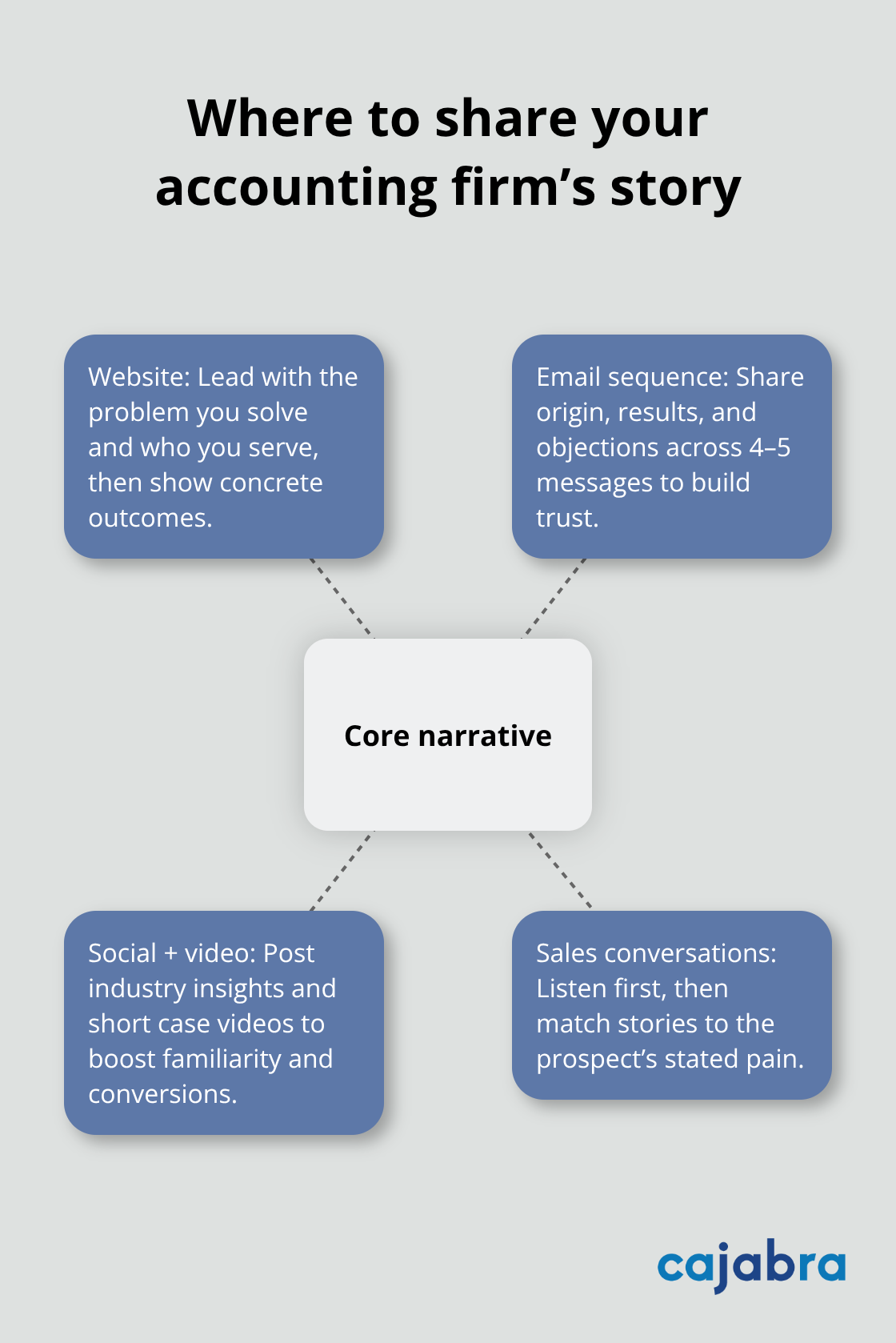
What Makes Your Story Worth Telling
Start With Your Real Origin, Not Your Mission Statement
Your firm's story starts with why it exists. Not the generic mission statement on your website-the real reason you built this business. Did you start because you watched clients get crushed by preventable tax mistakes? Did you leave a larger firm because you wanted to serve business owners instead of chasing billable hours? Did you build a practice around a specific expertise like construction accounting or nonprofit compliance? This origin matters because it separates you from firms that exist solely to extract fees.
The strongest accounting firm stories don't hide the founder's frustration or the problem that sparked the business. A founder who spent five years watching family-owned manufacturers lose money to poor cash flow management, then built a firm specifically to solve that problem-that's a story prospects remember. Specificity is non-negotiable here. Avoid vague statements about wanting to help clients or provide excellent service. Instead, name the exact problem you saw repeatedly, the client type you wanted to serve, and the outcome you committed to delivering. When you articulate this clearly in conversations and on your website, prospects with that exact problem recognize themselves immediately.
Your Approach Reveals What You Actually Value
Your approach and values are what separate you from the accountant in the next office. Maybe your firm refuses to take clients you can't genuinely help, even if it costs revenue. Maybe you've built a practice around proactive tax planning instead of reactive compliance. Maybe you use specific tools or methodologies that deliver faster results than competitors. Maybe your team spends hours each month on strategy calls rather than just filing returns.
These operational choices reveal your real values-not the poster version, but the decisions you actually make when profit is on the line. Prospects care about this because it predicts how you'll treat them. If you've turned away profitable clients because they weren't a good fit, that signals you'll push back on bad decisions affecting their business. If you've invested in automation and training to reduce client workload, that shows you value their time.
Concrete Results Transform Your Narrative Into Proof
Real client outcomes cement your story into proof. A tax reduction of $8,500 for a specific manufacturing client, achieved through a depreciation strategy you implemented-that's concrete. A bookkeeper who went from 35 hours weekly on manual data entry to 12 hours after you redesigned their process-that's measurable.
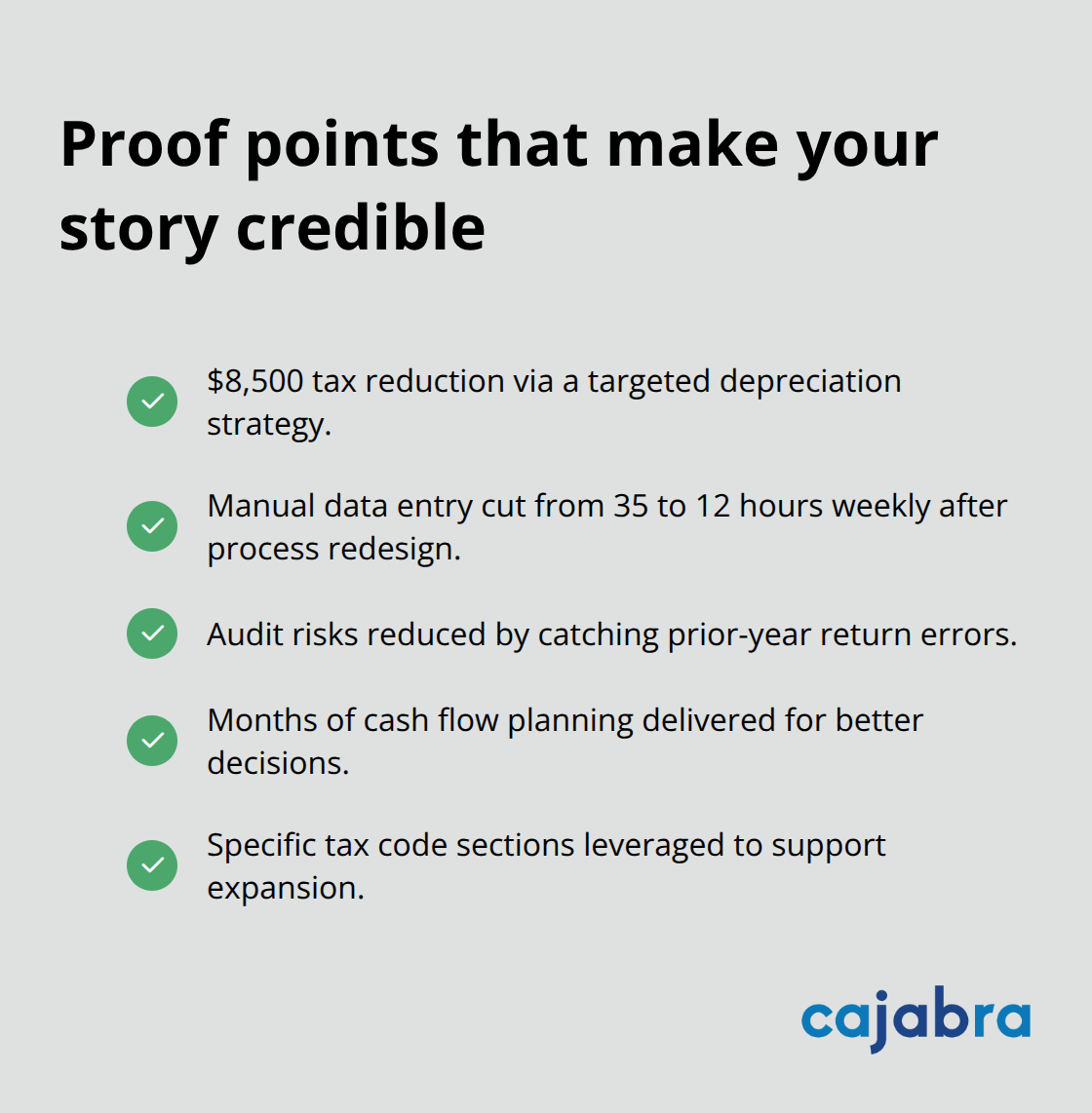
The number of audit flags you've prevented by catching errors in prior returns, the months of cash flow planning you've done for clients, the specific tax code sections you've leveraged for a client's expansion-these are the details that transform your narrative from interesting to credible.
When you share outcomes, always include the client's industry and approximate size so prospects in similar situations see themselves in your results. Concrete client outcomes and measurable results make your story stick in a prospect's mind far longer than generic claims about your expertise. The prospect thinks, "That's exactly my situation," and suddenly your firm becomes the obvious choice.
Now that you've identified your origin, clarified your values, and collected your strongest client outcomes, you're ready to share your expertise across the channels where prospects actually find you.
How to Share Your Story Across Marketing Channels
Your Website Opens the Door to Your Narrative
Your website is where prospects evaluate whether your firm deserves their attention. If your homepage talks about tax preparation and bookkeeping services without mentioning your origin or approach, prospects see a commodity. Instead, your homepage should open with the problem you solve and the specific type of client you serve best. A manufacturing accounting firm might lead with: We help manufacturers cut tax liability through depreciation strategies most firms miss. A construction firm might say: We've prevented $2.3 million in audit exposure for construction companies over the past five years. This front-and-center positioning works because prospects immediately recognize whether your firm solves their actual problem.
Your landing pages should go deeper. If you're targeting family-owned businesses, create a dedicated page that tells the story of how you help owners transition to the next generation without destroying the business through poor tax planning. Include a specific outcome: helped 12 family business owners structure succession plans that saved an average of $340,000 in estate taxes. Prospects who land on this page see themselves in that narrative.
Email Sequences Build Trust Through Storytelling
Your email strategy matters equally. When you capture a prospect's email through a lead magnet like a tax checklist or cash flow template, your follow-up sequence should tell your story across four to five automated messages. The first message delivers the lead magnet. The second message shares your origin and why you built this firm. The third message showcases a specific client result in their industry. The fourth message addresses a common objection or misconception about accounting services. The fifth message invites a conversation. This sequencing moves prospects from awareness to trust without requiring your personal involvement until they're genuinely interested.
Social Media and Video Amplify Your Message
Social media and video content amplify your story where prospects spend time daily. LinkedIn is where business owners and CFOs consume content, so post insights about tax law changes affecting their industry, then tie those insights back to how your firm approaches planning differently. If you've helped a construction client save $18,000 through a cost segregation analysis, create a short video explaining the concept and the outcome. Video content converts prospects at higher rates than text because they see your face and hear your voice, which builds familiarity fast. Post this video on your website, YouTube, and LinkedIn.
Sales Conversations Require Active Listening First
During sales conversations, your story should flow naturally based on what the prospect tells you about their business. If a prospect mentions they're drowning in bookkeeping, you share the story of how you automated a similar client's process and cut their monthly workload from 35 hours to 12. If they mention tax stress, you tell the story of your origin and why you built your firm around proactive planning instead of reactive compliance. The key is listening first, then matching your story to their specific pain point. This approach positions you as someone who understands their situation, not someone pitching a service.
Final Thoughts
Your accounting firm's story represents the most underutilized asset in your marketing arsenal. While competitors list services and credentials, you build genuine connections with prospects by showing them who you are, why you started this firm, and what real results look like. Brand storytelling transforms how prospects perceive you-from interchangeable service provider to trusted advisor worth retaining.
The firms winning market share right now aren't the largest or the cheapest. They're the ones whose origin, values, and client outcomes stick in a prospect's mind long after the first conversation ends. When a business owner recalls your story weeks later, they call you first when they need help. That consistency across your website, email, social media, and sales conversations compounds over time into a reputation that attracts better clients and commands higher fees.
Implementing this approach requires intentional effort to articulate your real origin, clarify what you actually value, collect your strongest client outcomes, and weave these elements into every marketing channel. The payoff proves substantial-prospects who recognize themselves in your narrative, higher close rates because you compete on fit rather than price, and a pipeline of retainer clients who stay longer because they chose you for who you are. Cajabra helps accounting firms systematize their brand storytelling and build marketing engines that fill pipelines consistently.
Most businesses waste months creating random content that never gains traction. Content pillars change that by giving your strategy a clear foundation.
At Cajabra, LLC, we've seen firsthand how organizing content around core pillars transforms visibility and authority. This approach works because it signals expertise to search engines and keeps your audience engaged across multiple touchpoints.
What Content Pillars Actually Are
Content pillars are three to five broad topics that define everything your business publishes. They're not vague themes-they're specific subject areas directly tied to what your audience searches for and the problems they need solved. A pillar differs from random blog posts because it becomes the central hub for multiple related articles, videos, and resources that all reinforce each other. Think of a pillar as the main topic, with dozens of supporting articles clustering around it. For accounting firms, a pillar might be Tax Planning Strategies, while supporting content covers quarterly tax deadlines, deduction tracking, and year-end planning. Search engines reward this structure because it shows depth of knowledge. Google's helpful content guidelines emphasize that topical authority matters-sites that thoroughly cover a subject from multiple angles rank better than those jumping between unrelated topics. When you organize content this way, you signal to search engines that you're the go-to resource for specific subjects, not just another generic publisher.
Why Pillars Transform Your Search Visibility
Content pillars directly impact how search engines categorize your authority. According to research on topic clustering from SEO specialists, websites using pillar structures see 40 percent higher organic traffic than those publishing scattered content. The reason is straightforward: when ten articles internally link back to one pillar page, search engines understand that page represents comprehensive coverage of a topic.
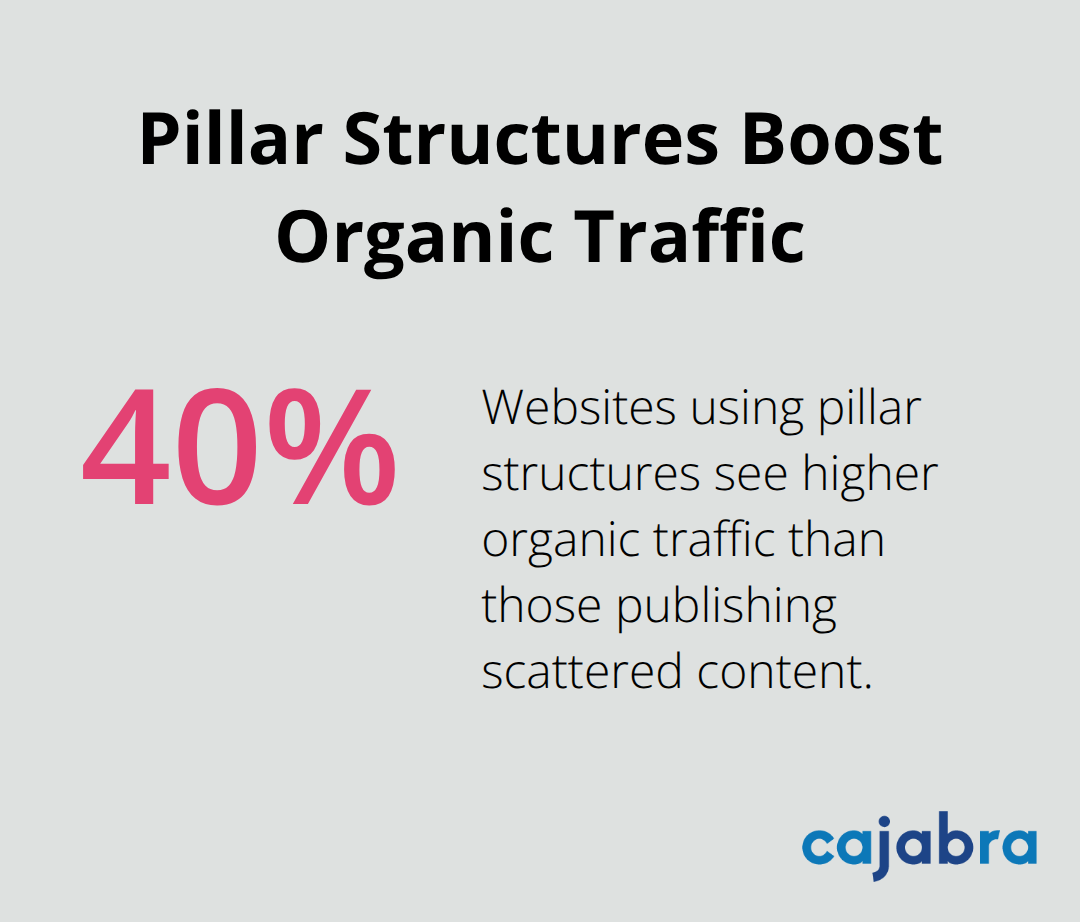
This matters because search algorithms now prioritize topical authority over individual keyword rankings. A single high-quality pillar page surrounded by cluster content outperforms five disconnected posts targeting the same keywords. For accounting firms specifically, this means one definitive guide on tax deductions supported by articles on specific deduction categories will rank higher than five separate posts competing against each other. Your audience also benefits because they can navigate from one related resource to another without leaving your site, which reduces bounce rates and increases time spent on your domain-both signals that search engines interpret as quality.
How Pillars Keep Your Audience Engaged Across Touchpoints
Pillars create a repeatable content system that maintains consistency without requiring constant creative invention. When you know your five pillars, you can plan months of content in advance because each pillar naturally generates multiple subtopics. This consistency matters more than most businesses realize: 68 percent of organizations report that content consistency contributed at least 10 percent to revenue growth, according to Buffer research. Your audience learns to expect content from you on specific topics, which builds habit and loyalty. An accounting firm with pillars around tax planning, financial analysis, business growth strategies, and compliance can publish weekly content that readers anticipate and trust. Pillars also simplify repurposing: one pillar article becomes a LinkedIn post, an email series, a short-form video, and an infographic. This approach solves a real problem-48 percent of B2B marketers report that lack of content repurposing is a major challenge when scaling production. Instead of creating entirely new ideas for each platform, you extend one core idea across multiple formats, which saves time while amplifying your message.
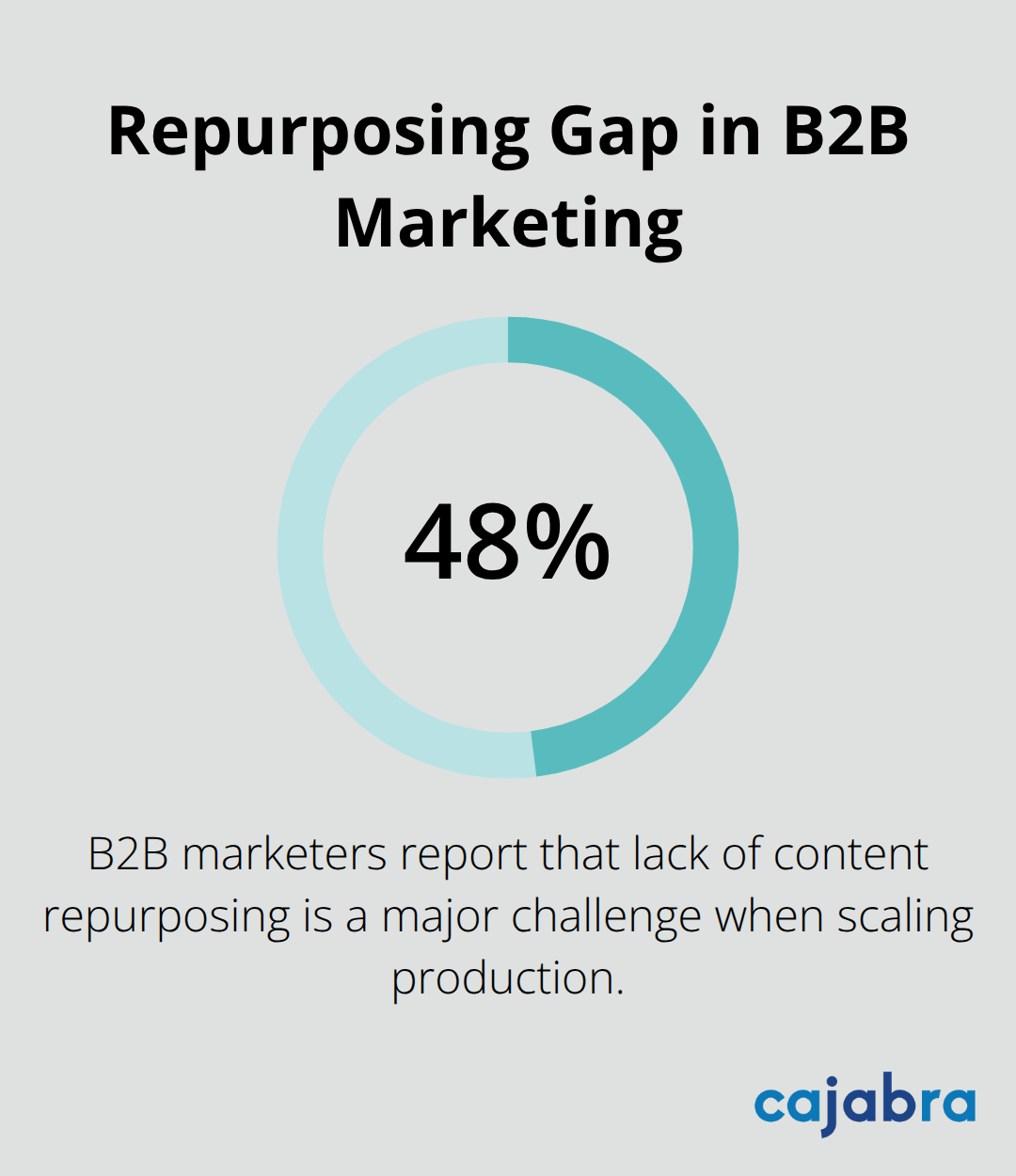
Moving From Theory to Action
Understanding what pillars are matters far less than identifying which pillars will actually work for your business. The next section walks you through the research process that reveals which topics your audience truly cares about and which gaps exist in your competitor's content strategies.
Finding Your Pillars Through Real Audience Research
Uncover What Your Audience Actually Searches For
Start with what your audience actually searches for, not what you think they need. Google Search Console reveals which queries bring people to your site right now-this shows genuine pain points rather than assumptions. If you manage an accounting firm, you'll likely find searches like quarterly tax deadlines, deduction strategies, or payroll compliance dominating your data. AnswerThePublic shows you the exact questions people type into Google within your niche, and these questions become your pillar foundation. Surveys with existing clients uncover what topics they wish you covered more often, what confused them before hiring you, and what they research most frequently. The difference between guessing and knowing is the difference between pillars that attract an audience and pillars that sit dormant.
Identify Gaps Your Competitors Leave Open
Your competitors' websites reveal massive gaps you can exploit. Visit their blogs and note every topic they cover repeatedly-those are their pillars. Then search for related topics they completely ignore. If competitors publish extensively about tax deductions but never cover quarterly estimated tax payments, that's your opening. Audience research and competitive analysis show which pages drive the most organic traffic to competitor sites. Those high-traffic pages are their pillar content, and you now know exactly what resonates in your market. The real advantage comes from finding the topics they touch lightly but never fully develop. An accounting firm might notice competitors mention business structure optimization but never create a comprehensive guide comparing LLCs, S-Corps, and C-Corps across different scenarios. That becomes your pillar-something deep enough to demonstrate real expertise.
Build Pillar Content That Answers Everything
Your pillar content must be genuinely comprehensive, not just longer versions of existing posts. A pillar content that answers every reasonable question should cover individual tax planning, business tax planning, and specialized strategies like charitable giving and retirement contributions all in one authoritative resource. Internal links from your supporting cluster content back to this pillar page signal to search engines that this is your definitive treatment of the subject. Update these pillar pages quarterly with new tax law changes, updated statistics, and fresh examples. Stale content loses ranking power, especially in regulated industries where accuracy matters.
Prioritize Keywords That Signal Real Intent
Your pillar pages should target your highest-value keywords-the ones that indicate someone is serious about your services, not just casually researching. For accounting firms, this means pillars around financial optimization rank higher priority than general financial literacy content. Try making each pillar page scannable with clear headings, a table of contents at the top, and visual elements that break up text. Most visitors won't read your entire pillar in one sitting, but a well-structured page keeps them engaged and returning. The goal is making your pillar pages the resource people bookmark and reference repeatedly, not pages they visit once and forget.
Connect Your Pillars to Your Broader Strategy
With your pillars identified and your foundational content built, the next step involves organizing how these pillars work together across your entire content ecosystem. The structure you create now determines whether your content compounds in value or remains scattered across your site.
How to Structure Your Content So Pillars Actually Work
Once your pillars are identified, the real work starts: organizing your content ecosystem so everything reinforces itself. Most businesses fail here because they build pillar pages but never connect them strategically to supporting content. Your pillar page sits alone while cluster articles scatter across your site with no internal linking strategy, which means search engines see disconnected posts instead of an organized knowledge base.
Map Your Publishing Schedule Across All Pillars
The structure that matters most is how you link cluster content back to pillar pages and how you organize your publishing calendar to maintain consistent coverage. Start by mapping every article you plan to write under each pillar and assign them to publishing slots across the next six months. If you have five pillars and publish two articles weekly, you should hit each pillar approximately twice monthly. This rotation ensures you build depth in each pillar rather than publishing heavily on one topic for two weeks then abandoning it.
An accounting firm with pillars around tax optimization, financial analysis, business structure, payroll compliance, and retirement planning should distribute their publishing schedule so every pillar receives fresh content every 30 days. This consistency signals to search engines that you actively develop expertise in all five areas, not just one.
Create a Strategic Internal Linking System
The internal linking strategy determines whether your cluster content actually strengthens your pillar pages. Every supporting article must link back to the relevant pillar page at least twice, preferably in the opening paragraph and within the body where context makes sense. If you publish an article about quarterly estimated tax payments, that article links to your tax optimization pillar page because quarterly payments fall under that broader topic.
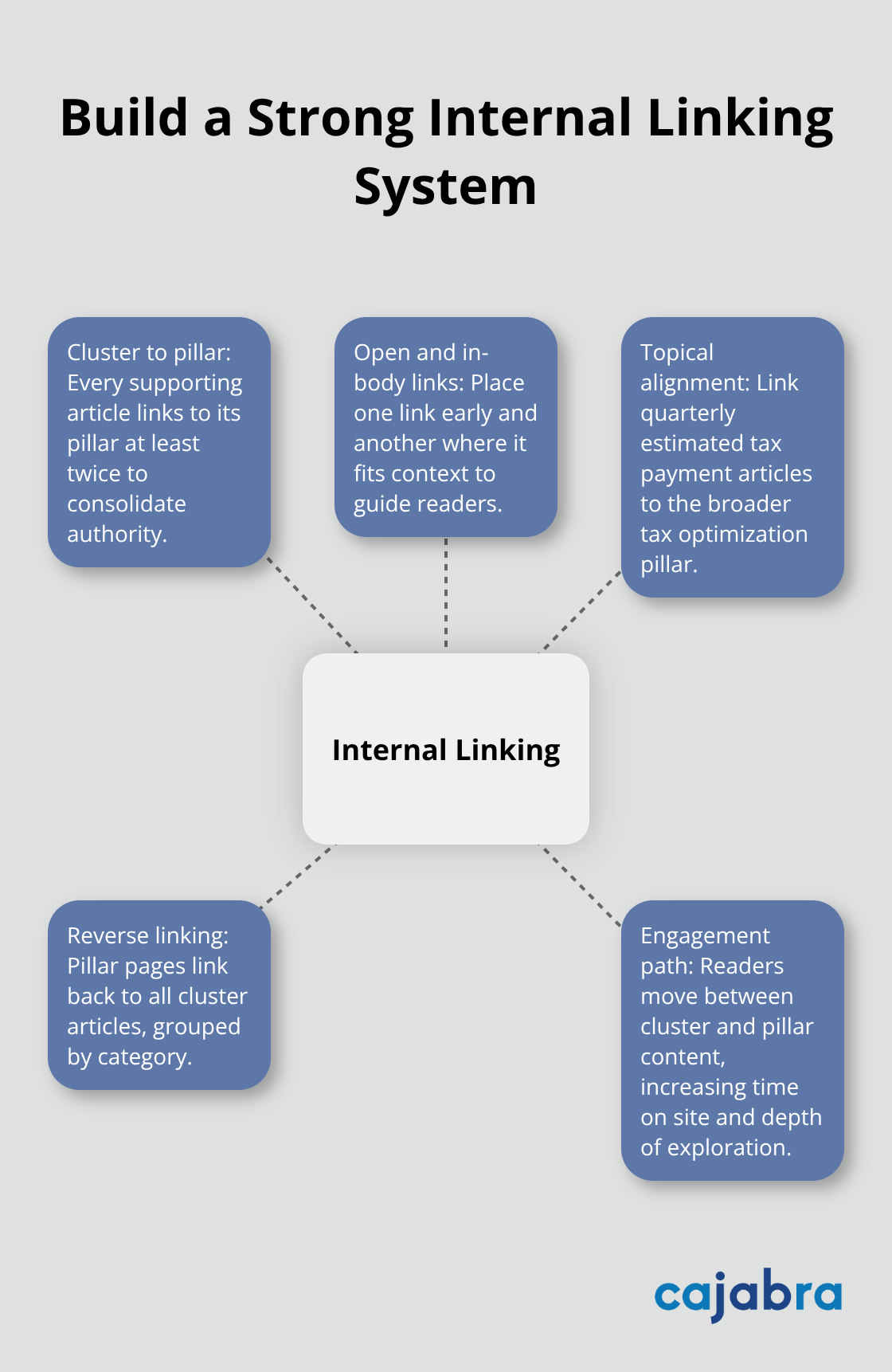
Reverse linking matters too: your pillar page should link to every cluster article beneath it, organized by category. A comprehensive pillar page on tax optimization might have sections like Individual Tax Strategies, Business Tax Strategies, and Advanced Planning Techniques, with each section linking to supporting articles. This structure creates a web where visitors enter through cluster content, navigate to the pillar for comprehensive coverage, then explore related cluster articles without leaving your site. The navigation pattern keeps people engaged while signaling topic authority to search engines.
Monitor Your Internal Link Performance
Tools like SEMrush or Ahrefs show you exactly how many internal links point to each page, helping you identify pillar pages that need more cluster support or cluster articles that lack proper connection. If a pillar page receives fewer than five internal links from cluster content, you haven't built enough supporting material yet. This metric reveals whether your linking strategy actually works or whether you've created pillar pages that sit isolated from your broader content ecosystem.
Final Thoughts
Content pillars compound authority over months and years as each article you publish strengthens that pillar's ranking power. Accounting firms that commit to pillar-based strategies see organic traffic accelerate after six months because search engines recognize the depth of coverage. The authority you build becomes defensible since competitors cannot easily replicate years of interconnected, comprehensive content around your core topics.
Measuring pillar success requires tracking metrics that actually matter: organic traffic by pillar shows which topics attract your audience, time on page reveals whether visitors explore related articles, and conversion rates by pillar identify which topics bring qualified leads closest to becoming clients. Set a baseline in Google Analytics today and tag all content by pillar so you can track performance separately. After three months, real data will show which pillars work and which need adjustment.
Implementation starts with choosing your three to five pillars based on audience research and competitive analysis, then building your first pillar page within two weeks. Commit to publishing two cluster articles monthly under each pillar to build momentum without overwhelming your team. At Cajabra, LLC, we help accounting firms structure their entire content strategy around pillars through our Premium Online Presence Package, which ensures your content reaches ideal clients and converts them into retainer-based relationships.