
Let's have an honest conversation.
You didn't spend years passing the CPA exam, building a client roster, and running a firm so you could compete with the guy down the street who charges less for a tax return. And yet, here you are… Fielding price objections, losing leads to cheaper options, and quietly wondering why clients don't seem to see the value in what you do.
The uncomfortable truth is they don't see the value because you're not showing them the right value.
The Problem Isn't Your Pricing. It's Your Positioning.
When a prospect asks "how much do you charge?" before they've even had a proper conversation with you, that's not a pricing problem. That's a positioning problem. It means they've mentally put you in the same box as every other accountant they Googled this afternoon - someone who files forms and keeps the IRS off their back.
Compliance work is a commodity. It has been for a while. Software commoditized it. AI is accelerating it. And when you're in a commodity market, the only lever left is price.
Advisory work? That's a different market entirely.
When you're the accountant who tells a business owner why their margins are shrinking, what to do before they sell their business, or how to structure their growth so they keep more of what they earn… You're not a vendor anymore. You're a strategic partner. And strategic partners don't compete on price.

"But I Already Do Advisory Work"
Maybe you do. A little. Sprinkled in after the tax return is filed. Offered when a client asks. Thrown in as a freebie to justify your fee.
That's not an advisory practice. That's compliance work with advisory garnish.
A real advisory practice is proactive. It's structured. It's priced as its own offering - not bundled in with the stuff your software could technically do on autopilot. It has a system behind it that consistently gets you in front of the right clients, communicates your value before they ever speak to you, and converts interested prospects into retained monthly relationships.
And guess what? Most CPA firms are sitting on a goldmine of advisory potential and leaving it completely unmonetized - not because they can't deliver it, but because they don't have the marketing infrastructure to sell it.
What "Marketing Infrastructure" Actually Means for Accountants
It doesn't mean posting on LinkedIn three times a week and hoping someone calls. It means having a growth system that works whether you're in meetings all day or deep in a client engagement.
Think about it this way. Your ideal client - let's say a business owner doing $2M in revenue who's about to scale and desperately needs a CFO-level thinker in their corner, is out there right now. They're Googling. They're reading. They're trying to figure out who actually understands their situation versus who just files returns.
Are they finding you? And when they do, does your content, your messaging, your digital presence say "I understand your specific problem and here's exactly how I help", or does it say "Licensed CPA, 20 years experience, free consultation"?
That gap between those two things? That's where the revenue is.
Modern CRM tools built specifically for accounting firms now make it possible to automate the entire journey from first touchpoint to booked consultation - personalised nurture sequences, automated follow-ups, appointment booking, reputation management, the works. The firms that are filling their calendars with high-value advisory clients aren't working harder. They're working with a smarter system.
The Shift That Changes Everything
The firms winning right now made one fundamental decision: they stopped defining themselves by what they do (tax prep, bookkeeping, compliance) and started defining themselves by what they solve (cash flow problems, scaling challenges, exit strategy, wealth protection).
That shift changes everything: your messaging, your pricing, your client conversations, and ultimately, your revenue.
Compliance is something businesses know they need. Advisory is something they don't know they need until someone shows them the cost of not having it. Your job isn't to wait for them to ask. Your job is to build the kind of presence and system that gets that conversation started before they ever pick up the phone.

Ready to Stop Competing on Price?
At The Revenue.Agency, we build the growth systems that take CPA firms from overlooked to fully booked - with the right clients, at the right fees, without adding more hours to your week.
From automated lead nurture to done-for-you content strategy, SEO-optimized blog posts, and a CRM built specifically for accounting firms, we handle the demand generation so you can focus on what you do best: advising. Book a free 15-minute strategy call today and let's build the revenue architecture your firm actually deserves.
Quick question, when was the last time you answered a call from an unknown number? If you're like most people, the answer is never. You let it go to voicemail, forgot about it, and moved on with your day.
Now imagine being a Gen Z business owner who needs an accountant. They're not going to call you. They're definitely not going to leave a voicemail. And they might not even email you. But they will text, or they'll look for a chat widget on your website that lets them fire off a quick message at 10pm on a Thursday when the idea strikes them.
Here's the uncomfortable truth: if your accounting firm isn't set up for that moment, you just lost a client.
Who Exactly Is Gen Z, and Why Should You Care?
Gen Z (loosely, anyone born between 1997 and 2012) is no longer just a demographic segment. They're business owners, decision-makers, and they're looking for professional services right now. In fact, Gen Z is estimated to make up roughly 27% of today's global workforce, and they collectively hold over $450 billion in spending power worldwide.
This isn't tomorrow's problem. These are today's prospects walking onto your website, sizing up your firm, and deciding in about 15 seconds whether they're going to reach out or bounce.
And here's the kicker: they're not judging you by your qualifications (at least, not first). They're judging you by how easy you are to talk to.
The Way Gen Z Communicates Is Different
Gen Z didn't grow up making phone calls. They grew up texting, DMing, and chatting. It's not a preference - it's practically a language. Research shows that over 70% of Gen Z prefers texting for customer support, and 90% check their texts within five minutes of receiving one.
Compare that to email, where you're lucky to get a reply within 24 hours, and a phone call that may never get answered at all.
The shift in how people communicate isn't a trend. It's a permanent reset. And the businesses, including accounting firms, that adapt to meet clients where they are will win. The ones that don't will keep wondering why their website gets traffic but their phone never rings.

Two Tools That Change Everything
Here's where it gets practical. There are two relatively simple tools that can completely change how Gen Z (and honestly, most people under 45) engage with your firm:
Two-Way SMS Texting
This isn't a blast-and-forget marketing text. Two-way SMS means an actual, real-time conversation - the kind Gen Z is already having with everyone else in their life. When a prospect reaches out via text, you (or an automated response) can reply, ask qualifying questions, and even book an appointment, all in the same thread. No hold music. No voicemail. No waiting.
The numbers back this up in a big way: SMS response rates are a staggering 295% higher than phone call response rates. Read that again. If your goal is to actually hear back from leads, text is the channel.
A Website Chat Widget
Think of this as the digital equivalent of a receptionist who is always at their desk. A chat widget sits on your website and invites visitors to start a conversation the moment they have a question. For a Gen Z prospect browsing your site at 11pm after finishing up their own bookkeeping, that little chat bubble could be the difference between a new client and a missed opportunity.
And here's the thing, it doesn't need to be a live person answering every message. With the right CRM, you can automate initial responses, collect information, and route conversations intelligently, so no inquiry ever falls through the cracks.
What This Means for Your Accounting Firm Specifically
Accounting firms have historically built their practices on referrals and reputation - which is still absolutely valuable. But the next generation of clients isn't waiting for a referral. They're Googling you, landing on your website, and forming an opinion in real time.
If they land on your site and there's no easy way to reach out. No chat, no text option, just a generic "Contact Us" form - you've created friction. And Gen Z has zero patience for friction.
Here's a practical playbook to start thinking about:
Capture the conversation immediately. A chat widget should greet visitors with something simple: "Hey! Have questions about our services? We're here." That alone increases the chances they'll engage.
Follow up by text. Once you have a prospect's number, SMS follow-up sequences are gold. Automated reminders, check-ins, and appointment confirmations sent via text get read. Emails often don't.
Keep the conversation two-way. The worst thing you can do is text someone and make it feel like a one-way broadcast. Make it easy for them to reply, ask questions, and feel like a human is actually listening.

The Bigger Picture: CRM for the Modern Accounting Firm
The accounting industry is in a fascinating moment right now. Firms that once competed purely on technical expertise are realizing that client experience - how easy you are to reach, how fast you respond, how seamlessly you communicate is becoming a serious competitive differentiator.
Forward-thinking CRM platforms built specifically for accounting firms are now integrating SMS, chat widgets, and automated follow-up into a single system. That means you don't need five different tools cobbled together. You can manage leads, send texts, respond to chat inquiries, and track where every prospect is in your pipeline from one place.
That's not a luxury anymore. For firms that want to grow their client base without drowning in admin, it's quickly becoming the baseline.
Ready to Stop Missing the Conversation?
If your accounting firm isn't offering two-way SMS or a website chat widget, you're not just behind on a trend - you're leaving real revenue on the table. The good news? It doesn't have to be complicated.
Cajabra CRM is built specifically for accounting firms and has both two-way SMS texting and a website chat widget baked right in, along with automated follow-up sequences, pipeline tracking, and everything else you need to turn website visitors into paying clients.
The best part? You focus on the numbers. Cajabra CRM handles the conversations.
You didn't spend years earning your CPA license, building client relationships, and mastering the art of advisory accounting so you could spend your Tuesday afternoon troubleshooting why your website just went down. Again.
Yet here we are. Thousands of accounting firm owners are quietly losing hours, and clients, to tech fires they were never supposed to fight in the first place. In 2026, the conversation around CRM and digital infrastructure for accountants has shifted dramatically. The firms winning the best advisory clients aren't the ones who know the most about servers, SSL certificates, or WordPress plugins. They're the ones who've handed all of that off and gotten back to what actually generates revenue.
So let's talk about managed website hosting: what it actually feels like to have it handled for you, and why your growth depends on it more than you might think.
1. Your Website Stays Up, Even When You're Head-Down in Tax Season
There is no worse time for your website to crash than February through April. That's precisely when potential advisory clients are Googling for a smarter CPA, clicking through to your site, and deciding in about eight seconds whether you're worth a call.
With managed hosting, someone is watching your uptime around the clock - not you. Automatic monitoring, instant alerts, and proactive fixes happen in the background while you're doing what you do best. The site that's supposed to be your 24/7 salesperson actually stays on the clock.
2. You Stop Being the IT Department
Here's a scenario every accounting firm owner knows too well: you get an email saying your site has a security vulnerability. You forward it to yourself three times. You finally Google the problem at 10pm. You give up. Sound familiar?
Managed hosting means someone else owns that problem entirely. Updates get applied, patches get deployed, and your site stays secure without you lifting a finger. That's not just a time saver - it's a mental load you didn't realize was weighing you down until it's gone.

3. Speed and Performance Become Someone Else's Job
Google ranks faster sites higher. Clients bounce from slow sites in seconds. And yet most accounting firm websites are running on aging infrastructure that nobody has touched since 2021. With managed hosting, performance optimization is built into the service - caching, content delivery networks, server-side tweaks that you'd never know to ask for.
The result? A faster site. Better search rankings. More eyeballs from the exact type of high-value client you want to attract. This is the kind of invisible infrastructure that serious revenue architecture is built on.
4. Security Is Actually Handled - Not Just Hoped For
Accounting firms are a high-value target for cyberattacks. You're holding sensitive financial data, and you have the kind of reputation that crumbles fast if something goes wrong. Managed hosting typically includes automated backups, firewalls, malware scanning, and SSL management as a matter of course.
You're not hoping your site is secure. It is secure. And when a client asks, (because savvy clients do ask) you can answer with confidence instead of a vague hand-wave.
5. Your Team Can Focus on Revenue-Generating Activities
This one is enormous. Every hour a member of your firm spends wrestling with a tech issue is an hour they're not on a discovery call, not nurturing a warm lead, not building the kind of advisory relationships that command premium fees.
The firms that are scaling to full revenue potential right now share a common trait: they've systematically removed everything from their plate that isn't directly connected to serving clients or winning new ones. Managed hosting is one of the cleanest, most impactful ways to make that happen. It's not glamorous. It just works, and that working quietly in the background is exactly the point.
6. Your Digital Presence Actually Supports Your Growth Engine
Here's the bigger picture. Your website isn't just a brochure. In a properly built revenue architecture, it's the hub. The place where awareness converts to interest, where leads are captured, where your credibility gets established before you ever pick up the phone. That machine only runs smoothly if the foundation beneath it is rock solid.
When your hosting is managed, your site loads fast, stays online, and doesn't throw errors in the middle of someone's decision-making process. That reliability compounds. It supports your SEO, your paid ads, your email campaigns, your CRM automations - every part of the system designed to move a stranger from "who are you?" to "where do I sign?"
A slow, patchy, insecure website is a leak in that system. Managed hosting seals it.

Stop Managing Tech. Start Building Revenue.
The accounting firms that are attracting ideal clients, scaling advisory services, and moving away from commoditized compliance work all have one thing in common: they've stopped doing everything themselves.
At The Revenue Agency, we're the only US-recognized revenue architecture firm built specifically for accounting firms. We don't just manage your hosting - we build and automate the entire growth system underneath your firm: the website, the CRM, the lead nurture sequences, the content, the conversions. Everything works together so that you go from overlooked to fully booked.If you're ready to stop being your own IT department and start building a firm that generates the revenue it's actually capable of, book a free strategy call with our team today. Let's build something great together.
Be honest. When someone asks how you get new clients, you say "mostly referrals," don't you? And hey! It's working. Sort of.
You're busy. The phone rings. But somewhere in the back of your mind, you know the truth: your entire revenue depends on things completely outside your control. An important client retires. A referral partner moves away. A competitor shows up in your market and actually knows how to market themselves. And just like that, the pipeline you never really built becomes a problem you can't ignore anymore.
Here's the other side of it - referrals are great, but they send you whoever they send you. You don't get to choose. So you end up with a full calendar and the wrong clients, doing work that doesn't light you up, for fees that don't reflect your actual value. Being busy isn't the goal. Booked with the right people is the goal. And those are two very different things.
You didn't spend years earning your CPA, building your firm, and mastering the art of turning financial chaos into clarity, just to spend your Tuesday nights Googling "how to get more accounting clients." That was never the dream. But for most firm owners, that's quietly becoming the reality.
The good news? It's completely fixable. And it doesn't have to be complicated.
The Problem Nobody Talks About at Accounting Conferences
Here's the uncomfortable truth: compliance work is being commoditized faster than you can say "Schedule C." Clients can find a tax preparer on any corner. What they can't easily find is a trusted advisor who understands their business, anticipates their needs, and communicates proactively - someone who feels less like a vendor and more like a partner.
That's the opportunity sitting right in front of most CPA firms. The shift from compliance to advisory isn't just possible… It's where the real revenue is. But here's the catch: you can't attract high-value advisory clients with a dusty website and a referral-only strategy in 2026. You need systems. You need automation. You need a growth engine that actually runs.
That's what our new service plans are designed to deliver.

Three Plans. One Goal. Zero Guesswork.
We kept it simple because your life is already complicated enough.
Plan One: Cajabra CRM for Accountants ($497/month)
This is where it all begins, and honestly, it's where most firms discover just how much time and money they've been hemorrhaging by not having a proper system in place.
The Cajabra CRM is purpose-built for accounting firms. We're talking unlimited users, unlimited contacts, an AI bot trained on your brand so you can generate on-demand content without staring at a blank screen, a full year of pre-written nurture emails customized for accountants, social media scheduling, online appointment booking, reputation management, and an all-in-one inbox that plays nicely with both Outlook and Gmail.
It's the operational backbone your firm has always needed but probably never had. And at $497 a month, it's less than what most firms spend on software that does a fraction of this.
Plan Two: The Advisor Accountant's Growth Engine ($2,250/month)
Now we're talking. This is for the firm that's ready to stop dabbling in marketing and start treating growth like the serious business strategy it is.
On top of everything in the CRM plan, you get up to seven SEO-optimized blog posts per week tailored to your firm, up to seven social posts per week created and scheduled for you, your SMS number approved and ready to go, a custom monthly newsletter written and designed for your clients, Google Business Profile optimization, proposal templates with e-signature follow-up automation, and a Pipeline Pulse Tracker that shows you revenue by team member, leads, opportunities, and web traffic - all done for you.
This isn't a toolkit. This is a fully operational marketing department without the overhead of hiring one.
Plan Three: Revenue Architecture ($9,300+/month - Limited to 10 Firms)
This is the top of the mountain, and it's intentionally exclusive. We only work with ten firms at this level because the work is deep, strategic, and genuinely transformative.
Brand messaging, viral video editing, paid advertising with full creative and split-test management, PR placements on top news sites, a private Slack channel with weekly check-ins and monthly strategy meetings, a complete lead-to-close sales system, and scalable package creation that actually converts - this is revenue architecture in the truest sense. We don't just help you market your firm; we help you rebuild the entire revenue engine from the ground up.

Why This Actually Works
The firms that win in the advisory space aren't necessarily the most technically skilled. They're the most visible, the most trusted, and the most consistent. Cajabra's job is to make sure you're all three: systematically, automatically, and without it eating your weekends alive.
We've helped generate over $300 million in client results. We've earned recognition as the Best US Revenue Architecture firm for Accounting Firms in 2026. And we've done it by doing one thing really well: building growth systems that work even when you're busy doing the actual accounting.
Your Next Step Starts Here
If you've made it this far, you already know something needs to change. The question isn't whether to invest in your firm's growth, but rather how fast you want it to happen.
Start with the Cajabra CRM. Get your systems in place, automate the chaos, and see what your firm looks like when it's actually running like one. Ready to go from overlooked to fully booked? Book a free 15-minute strategy call and let's map out exactly which plan fits where you are right now. Your clients need an advisor. Let's make sure they can find you.
There was a time when “doing SEO” for an accounting firm meant sprinkling “tax accountant near me” across your website like parmesan on bad pasta and hoping Google would reward your enthusiasm.
Those days are, technically speaking, deceased.
Welcome to the AI era, where search is getting smarter, users are getting pickier, and bland copy written for algorithms is about as effective as a calculator with dead batteries. Google has been clear that it wants helpful, reliable, people-first content, and it uses ideas like E-E-A-T (Experience, Expertise, Authoritativeness, and Trust) to evaluate quality. Google also says AI search features like AI Overviews are designed to surface useful snapshots with links that help people dig deeper into trustworthy sources.
For accountants, this is actually very good news.
Why? Because accountants already have the raw ingredients AI and search engines love: real expertise, real-world experience, and real trust. You are not a random lifestyle blogger pretending to understand entity structuring after watching two YouTube videos and drinking a matcha. You actually know things. Important things. Tax-saving, audit-surviving, cash-flow-improving things.
Now the job is making that expertise visible online.
First, let’s talk about EEAT without making it weird
E-E-A-T sounds like a typo, but it matters. Google added the extra “E” for Experience to emphasize that first-hand, real-world knowledge helps people trust what they’re reading. Trust is the big one, especially for topics that affect people’s money, business decisions, and financial wellbeing. In plain English: if your website sounds generic, vague, or suspiciously robot-produced, you are making it harder for both humans and search engines to believe you.
That means your SEO strategy cannot just be “publish 47 blogs called Top Tax Tips for Small Businesses” and call it a day.
Instead, your content should prove that you know your stuff and that you’ve helped actual clients solve actual problems. Not by chest-thumping, but by being useful. Helpful content wins because it answers real questions clearly, completely, and credibly. Google explicitly advises creators to focus on content made to benefit people, not content made primarily to manipulate rankings.
In the AI era, boring content gets ignored
AI tools can summarize generic information in seconds. So if your website says things like “We provide high-quality accounting solutions tailored to your needs,” congratulations: you have written a sentence that could also describe a dentist, a software company, or a particularly ambitious air fryer.
The firms that get found now are the firms that sound specific.
Specific beats polished. Specific beats corporate. Specific beats “leveraging synergies to optimize stakeholder outcomes,” which, respectfully, should be illegal.
If you want to stand out in AI-powered search, write content only your firm could write. Talk about the types of businesses you serve. Explain the mistakes you see over and over. Share the questions clients ask before they hire you. Break down what changed in a tax rule and what it means in plain English. Write the article your future client wishes existed at 11:48 p.m. the night before they panic-Google their problem.
That is where EEAT lives.
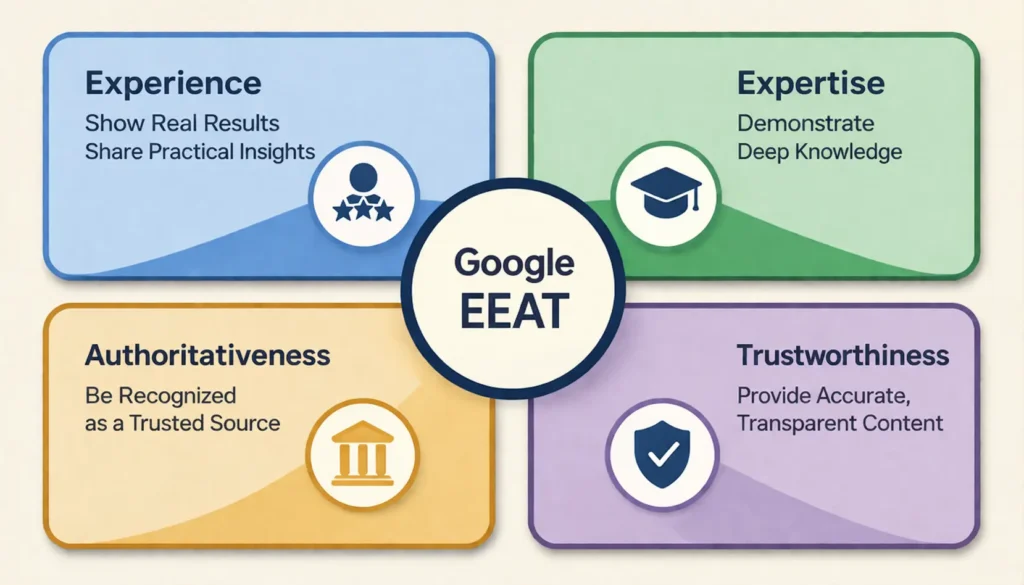
What EEAT-friendly SEO looks like for accountants
It looks like putting real experts on the page. Use author bios. Mention credentials. Show who wrote or reviewed an article. If your CAS director writes about cash flow forecasting, say so. If your tax partner explains S corp compensation, put their name on it. Expertise hidden in your office is not helping your SEO.
It also looks like showing your experience. Case studies, client stories, before-and-after scenarios, common pitfalls you’ve fixed, and insights from real engagements all help demonstrate that you’re not just repeating textbook definitions. You’ve been in the trenches. Possibly with coffee. Definitely with deadlines.
Authority comes from consistency and clarity. When your site has a clear niche, strong service pages, helpful educational content, and messaging that aligns across your website, LinkedIn, and client communications, search engines get a stronger signal about what you do and who you do it for.
And trust? Trust comes from the details. An up-to-date website. Clear service descriptions. Real contact information. Testimonials. Useful content that does not overpromise. A tone that sounds like a competent human wrote it, not a marketing intern being held hostage by jargon. Cajabra’s own positioning is a great example of this: clear outcomes, a defined audience, and language focused on helping accounting firms grow with the right systems and ideal clients.
The secret is not more content. It’s better signals
You do not need 100 blog posts. You need the right pages doing the right jobs.
Your homepage should clearly say who you help and what makes you different. Your service pages should explain outcomes, not just features. Your blog should answer the real questions your ideal clients are already asking. And your site should make it painfully easy for someone to trust you, contact you, and understand why you are the right fit.
That is SEO now.
Not tricks. Not keyword stuffing. Not mass-producing AI sludge and hoping for the best.
Just strong positioning, useful content, visible expertise, and a website that acts like your best business development person instead of an online brochure from 2017.

Accountants are built for this moment
The AI era is not the end of SEO for accountants. It is the end of lazy SEO.
And honestly? Good.
Because the firms that will win are not the loudest. They are the clearest, the most credible, and the most helpful. The firms that teach well, explain well, and show their work. The firms that make a nervous business owner think, “Finally. Someone who actually gets it.”
That is your opportunity.If your firm has the expertise but your website is still playing hide-and-seek with Google, Cajabra can help. We build high-value growth systems for accounting firms that want more visibility, more authority, and more of the right clients. If you’re ready to turn your expertise into a marketing engine, book a free strategy call and let’s get your firm to go from overlooked to fully booked.
Every now and then, an update comes along that actually makes an app work better. Not pretend-better. Not “we moved one button and called it innovation” better. Actually better.
That is the case with version 4.10.3 of the Cajabra mobile app, now available in the Apple App Store.
If your accounting firm is already using Cajabra, this is your friendly nudge, loving shove, and slightly dramatic public service announcement to make sure you are using the latest version. Because this update brings a cleaner look, faster performance, and a more polished overall experience.
In other words, your app just got a glow-up.
What Is New in Version 4.10.3?
This update is all about making the app easier to use, easier to navigate, and frankly, easier to like.
First up, there is a cleaner, more modern interface. Everything feels fresher and more streamlined. It is the difference between a cluttered desk covered in sticky notes and a workspace that says, “Yes, I do have my life together, thank you for noticing.”
Then there is the new app drawer, which gives you a better way to organize content and modules. That means less digital junk-drawer energy and more structure that actually makes sense.
There is also an improved navigation flow, which is just a fancy way of saying people can get where they need to go without wanting to throw their phone across the room. Fewer clicks. Less confusion. Much better vibes.
And yes, the app is faster too. Because nothing says “modern user experience” like not waiting forever for something to load. We are all busy. We all have things to do. No one has time for spinning wheels and mystery delays.
Altogether, version 4.10.3 creates a more polished end-user experience. It feels smoother, sharper, and more intentional from the moment you open it.
Which is exactly what you want when your app is representing your firm.

Why This Matters for Accounting Firm Owners
Your app is not just a nice extra. It is part of how people experience your firm.
It helps shape that all-important impression of whether your business feels modern, organized, and easy to work with. And while no one may send you a strongly worded email saying, “Dear Sir or Madam, your navigation flow disappointed me,” people absolutely notice when something feels clunky.
They also notice when something feels easy.
That is why this update matters.
A better app experience helps your firm look more polished. It makes information easier to access. It removes friction. It helps people spend less time figuring things out and more time actually using the app the way it was meant to be used.
Which, let’s be honest, is the dream.
Because if you are already investing in a branded app experience for your firm, you do not want it looking like it got stuck in 2023 wearing skinny jeans and side parts.
You want it current. Clean. Helpful. Professional.
This update gets you there.
What You Should Customize Before Submitting
Before you submit your updated app, there are a few areas worth reviewing so you can get the most out of the new features.
This is the part where a tiny bit of effort now can save a whole lot of “why does this feel weird?” later.
Bottom Navigation
Cajabra recommends adding the new homepage for an aggregated business view.
And honestly? Smart move.
This gives users a better starting point and creates a more connected experience across the app. Instead of dropping them into one random corner and hoping for the best, you are giving them a clear, useful overview from the start.
Think of it as the difference between welcoming someone into a tidy front foyer versus making them climb in through a side window.

Top Navigation
You can now add an additional module to the top navigation.
That gives you one more prime piece of app real estate to work with, which is great news if there is an important resource, feature, or page you want users to access quickly.
More flexibility. More visibility. Less “why is the important thing buried under three taps and a prayer?”
App Drawer
The updated app drawer lets you organize modules into categories, which makes the app feel cleaner and easier to browse.
Even better, modules can now appear in multiple categories.
And that is a big deal.
Because real humans do not always think in neat little boxes. Sometimes one item belongs in more than one place. Sometimes content overlaps. Sometimes life is messy and your app should not punish you for it.
This update gives you a more flexible way to organize everything without sacrificing clarity, which is honestly the kind of energy we love to see.

Ready to Give Your App a Glow-Up?
Update to Cajabra mobile app version 4.10.3 in the Apple App Store, then take a few minutes to customize your navigation before submitting. With a cleaner layout, smarter structure, and smoother overall experience, this update helps your firm get even more value from your app.Want to make sure your Cajabra app is set up to actually work for your firm and not just sit there looking pretty? Reach out to the Cajabra team to fine-tune your navigation, optimize your setup, and create an app experience that feels polished, professional, and refreshingly easy to use.
Marketing teams waste roughly 40% of their time on repetitive tasks that could be automated. AI-powered marketing automation tools eliminate this waste by handling lead nurturing, email campaigns, and customer segmentation while your team focuses on strategy.
At Cajabra, LLC, we've seen firsthand how automation transforms marketing departments. The businesses that implement these tools correctly see faster lead generation, better customer targeting, and measurable revenue growth.
What AI Automation Actually Delivers for Your Marketing Team
Automation transforms how marketing teams operate-it doesn't just save time. Marketing automation platforms like HubSpot, ActiveCampaign, and Mailchimp handle lead scoring, email sequencing, and behavioral tracking simultaneously across thousands of contacts. When you remove the manual work of tagging leads, sending follow-up emails, and organizing customer data, your team reclaims roughly 15 to 20 hours per week per person, according to Salesforce research. That time shifts toward strategy, creative work, and high-value client conversations instead of spreadsheet management.
The real power emerges when you combine this time savings with precision targeting. AI-driven segmentation analyzes actual behavior rather than relying on guesses about who your customers are. If someone opens your email, clicks a specific link, and visits a product page, the system automatically moves them into a nurture sequence tailored to that exact action. Harley-Davidson saw a 2,930% increase in leads per month using Albert AI for digital advertising, proving that intelligent automation compounds results when applied correctly.
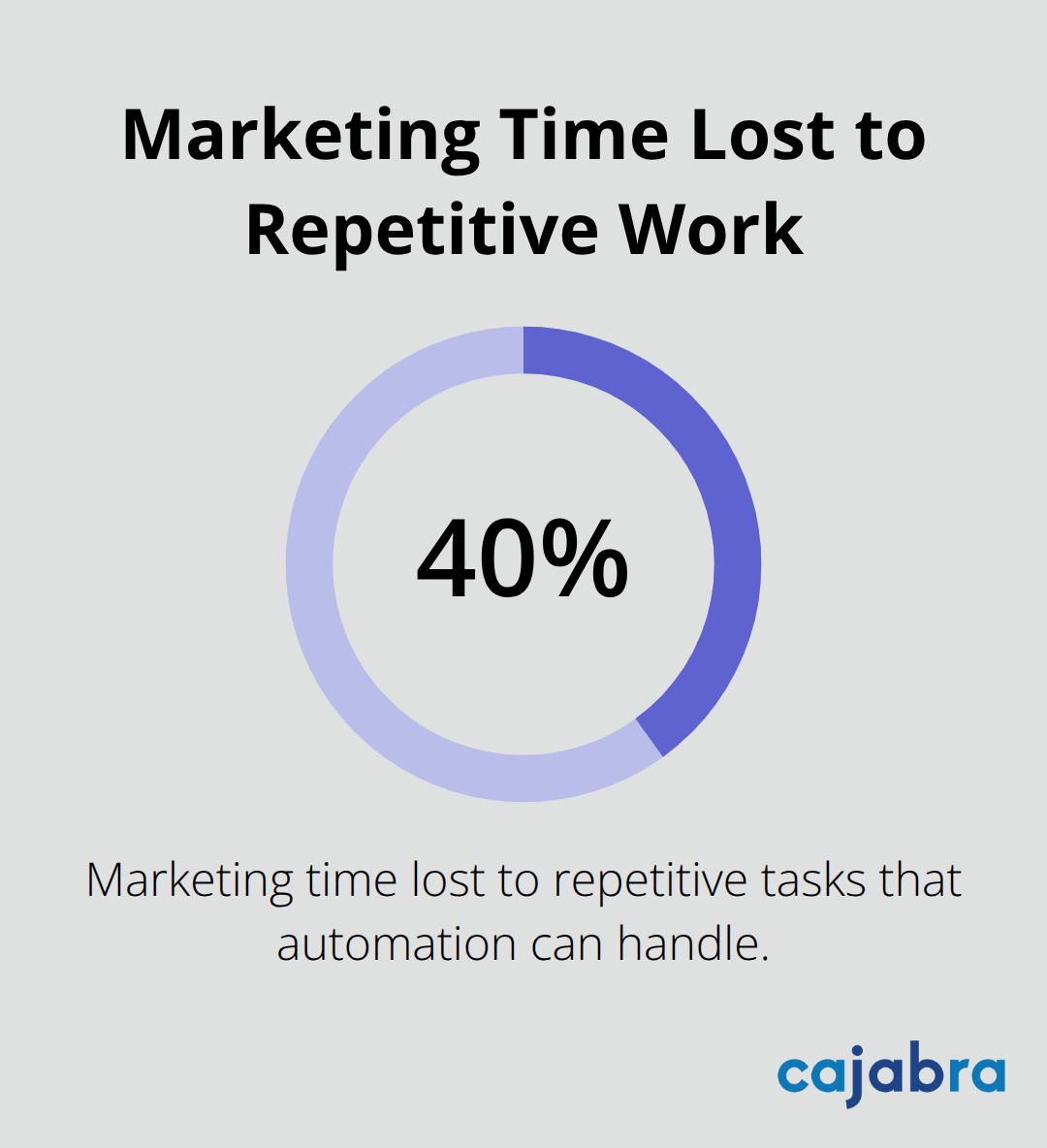
Your competitors are already doing this. The businesses winning right now treat automation as the foundation, not the afterthought.
Speed Changes Everything in Lead Generation
The moment someone shows purchase intent, a 24-hour window exists before they forget about you or compare your offer to competitors. Manual lead qualification kills that window. AI-powered systems qualify and route leads to sales within minutes, not days. Predictive lead scoring identifies which prospects have the highest conversion probability based on historical data and behavioral patterns.
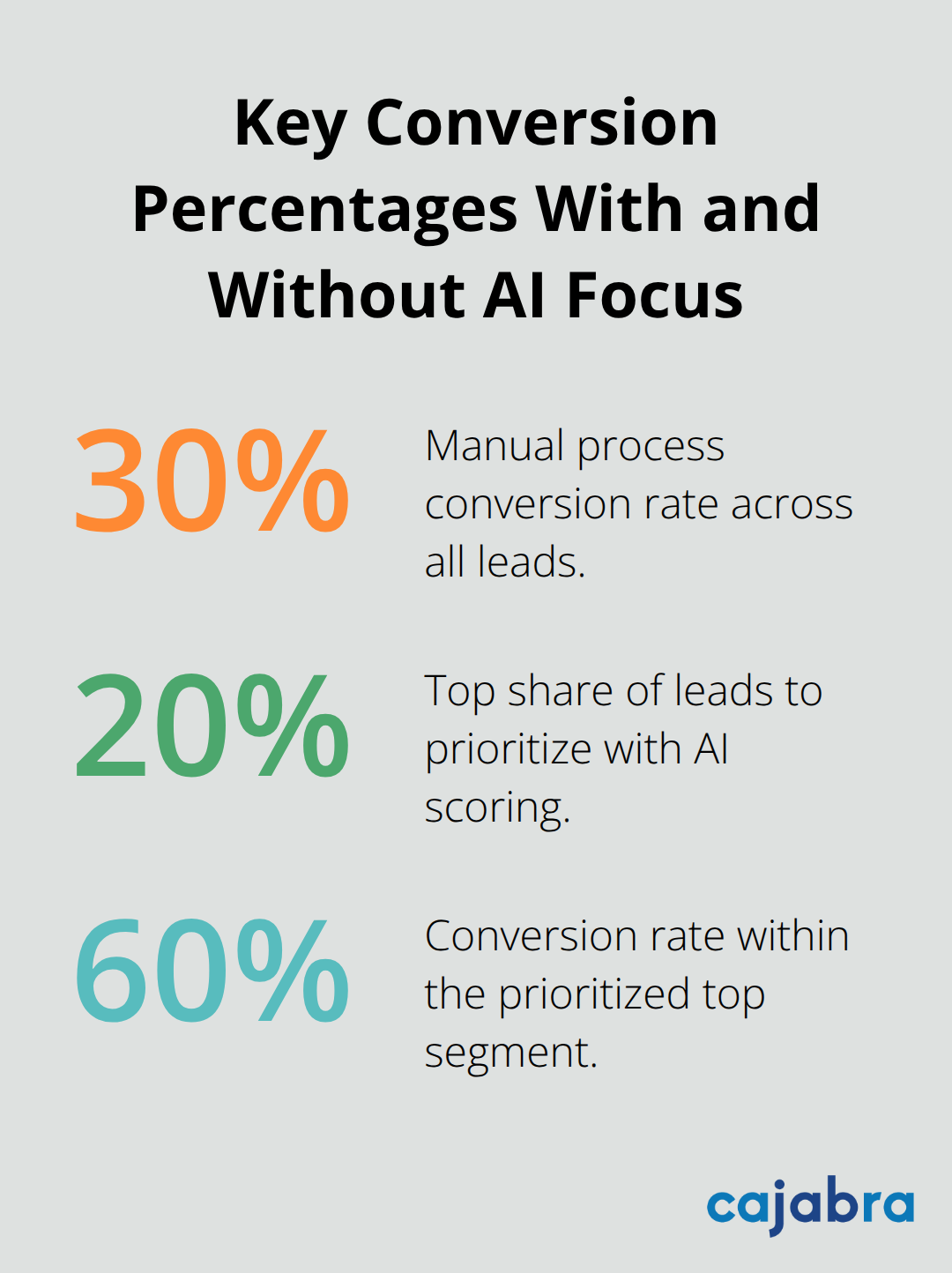
This means your sales team stops chasing cold leads and focuses exclusively on prospects showing genuine buying signals.
The math is straightforward: if 30% of your leads convert with manual processes, but AI scoring helps your team focus on the top 20% of leads with 60% conversion rates, your cost per acquisition drops dramatically while your sales velocity increases. You also gain real-time visibility into what messaging resonates. When a customer segment consistently engages with content about cost savings versus compliance features, your next campaign automatically emphasizes cost savings to that group. This feedback loop means your marketing improves weekly, not quarterly.
Human Judgment Still Wins
Automation fails when companies treat it as a replacement for strategy. The tools execute flawlessly, but they execute whatever you program them to do. If your data is messy, your segmentation fails. If your messaging is generic, your automation broadcasts generic messages at scale. IBM Institute for Business Value research shows that organizations investing in data quality see 3x better results from their automation platforms than those deploying tools on poor data.
Your first task isn't buying the fanciest platform-it's auditing what you actually know about your customers. What fields do you track consistently? Where are your data gaps? Do you have permission to contact people through the channels you're automating? These questions matter more than feature lists. The strongest teams use automation to handle execution while humans focus on the strategic questions: Who are we really trying to reach? What problem do we solve better than anyone else? How should our messaging reflect our actual competitive advantage? Automation amplifies good strategy and accelerates bad strategy at equal speed.
What Comes Next
The foundation is set. You understand what automation delivers and where human strategy still matters. The next step is identifying which specific features separate tools that actually work from those that promise more than they deliver.
What to Actually Demand From Your Automation Platform
Segment Customers Based on Real Behavior
The difference between a tool that transforms your marketing and one that sits unused comes down to three capabilities working together seamlessly. Your platform must segment customers based on real behavior, not demographic guesses. HubSpot and ActiveCampaign both offer advanced segmentation, but the strongest implementation tracks what people actually do-which emails they open, which product pages they visit, how long they stay, whether they abandon carts, and which content types drive them toward purchase.
Centralized data integration across your CRM and marketing platform produces more accurate customer profiles than siloed systems. Generic campaigns sent to everyone underperform precision campaigns sent to the right segment by 40 percent or more. Your platform should let you build segments based on any data point you collect and update those segments automatically as behavior changes. If someone stops engaging with your nurture emails, the system automatically moves them into a re-engagement sequence without manual adjustment.
Use Predictive Analytics to Forecast What Happens Next
Your platform needs to show you what's likely to happen next, not just what happened last month. Predictive analytics use your historical data and current behavior patterns to identify which leads will convert, which customers will churn, and which products a specific person actually wants to buy. Predictive lead scoring leverages data science and machine learning to help sales teams focus on prospects most likely to convert, dramatically improving efficiency.
This isn't about vague probability scores-it's about actionable rankings that your sales team can trust. If your system says a prospect has an 85 percent conversion probability versus 15 percent, your sales rep knows exactly how much effort to invest. The strongest teams treat these scores as a filter, not a suggestion, and watch their cost per acquisition drop as a result.
Demand Seamless Integration With Your Existing Tools
Your platform must connect cleanly to the other tools you already use. If your e-commerce system, email platform, CRM, and analytics tool can't share data automatically, you'll spend your entire automation budget managing data transfers instead of running campaigns. Proper integration accelerates workflows and eliminates manual bottlenecks.
Demand native integrations or robust API access. Tools that require constant manual data syncing will drain your team's time faster than the repetitive tasks automation was supposed to eliminate. Test the integration before you commit-many platforms promise seamless connections but deliver clunky workarounds that frustrate your team.
Prioritize Data Quality Over Feature Count
The strongest automation platforms fail when companies deploy them on poor data. If your data is messy, your segmentation fails. If your messaging is generic, your automation broadcasts generic messages at scale. Organizations investing in data quality see significantly better results from their automation platforms than those deploying tools on poor data.
Your first task isn't buying the fanciest platform-it's auditing what you actually know about your customers. What fields do you track consistently? Where are your data gaps? Do you have permission to contact people through the channels you're automating? These questions matter more than feature lists. The strongest teams use automation to handle execution while humans focus on the strategic questions: Who are we really trying to reach? What problem do we solve better than anyone else? How should our messaging reflect our actual competitive advantage?
With these three capabilities in place, your platform becomes a force multiplier for your team. The next step is understanding where most companies stumble during implementation-and how to avoid those costly mistakes.
Common Pitfalls When Implementing Marketing Automation
Poor Data Quality Destroys Your Results
Companies crash into automation expecting the platform to fix broken processes, but the platform only amplifies whatever you're already doing. If your customer data lives across five different spreadsheets with inconsistent naming conventions and duplicate records, automation won't magically unify it-it will just automate the mess. Gartner research shows that organizations with poor data quality experience worse outcomes from automation platforms than those with clean, centralized data.
The practical reality: before you sign up for any platform, audit your current data. Write down every field you track, identify where duplicates exist, check which records have missing information, and verify you have proper consent to contact people through each channel you plan to automate. This audit takes a week but saves months of frustration. Once you commit to a platform on bad data, you'll spend your entire first year cleaning data instead of running campaigns. Many companies discover halfway through implementation that they don't actually know their customers' phone numbers, email preferences, or purchase history with any consistency. That discovery costs time and money you can't recover.
Automation Without Human Oversight Fails Fast
The second failure point is treating automation as a substitute for human strategy rather than an execution engine. Automation platforms are ruthlessly efficient-they do exactly what you program them to do, no more, no less. If you set up an email sequence that broadcasts the same message to everyone, the system will send that generic message to thousands of people flawlessly. If you configure your lead scoring to prioritize prospects based on outdated firmographic data instead of actual behavior signals, the system will confidently route bad leads to your sales team every single day.
The teams winning with automation maintain human oversight at every stage. Someone reviews the segments before they go live. Someone analyzes whether automated email sequences actually move people toward purchase or just fill inboxes. Someone checks whether your predictive models remain accurate or drift over time. This requires dedicated time-roughly 10 to 15 hours per week for a marketing team of three to five people-but that investment directly determines whether automation becomes your competitive advantage or your most expensive mistake.
Inadequate Training Leaves Your Platform Unused
Companies underestimate the training required to actually use these platforms effectively. A new automation platform sitting in your tech stack unused generates zero ROI. Your team needs hands-on training on how to build segments, interpret predictive scores, and troubleshoot integration issues when they inevitably occur. Budget for external training courses, internal documentation, and at least one month of slower campaign velocity while your team climbs the learning curve.
The fastest path forward is assigning one person as the automation owner-someone who becomes genuinely fluent with the platform and teaches everyone else. That person becomes your internal expert, answers questions from colleagues, and identifies which features actually solve your problems versus which ones sit unused. This role prevents your platform investment from becoming expensive software that nobody truly understands.
Final Thoughts
AI-powered marketing automation tools transform how marketing teams operate, but only when you treat implementation as a strategic process rather than a software purchase. The businesses seeing real growth understand that automation handles execution while humans drive strategy. Your platform becomes valuable when it segments customers based on actual behavior, predicts what happens next using your data, and integrates seamlessly with your existing tools.
The path forward requires three concrete steps. First, audit your current data before selecting any platform-identify where your customer information lives, spot duplicates and gaps, and verify you have proper consent to contact people through each channel you plan to automate. Second, assign one person as your automation owner who becomes genuinely fluent with the platform and teaches your team.
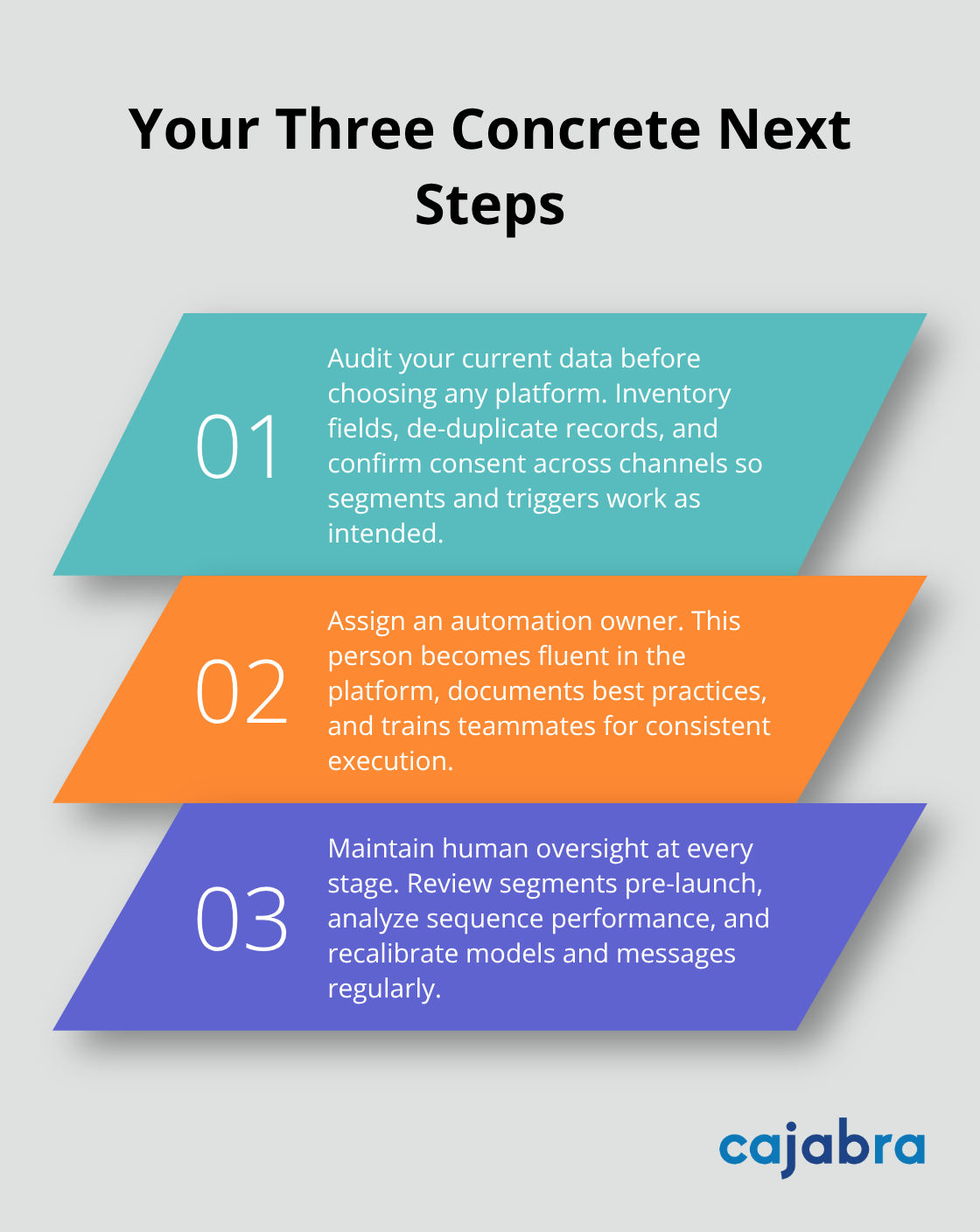
Third, maintain human oversight at every stage so someone reviews segments before they launch and analyzes whether automated sequences actually move people toward purchase.
If you're running an accounting firm, we at Cajabra, LLC specialize in helping accountants move from overlooked to overbooked through the JAB System, which secures retainer-based clients in just 90 days. Our approach includes AI-powered marketing strategies and automated systems that generate consistent cash flow while you focus on your expertise. Learn more about how we help accounting firms build strong brand identity and effective sales funnels.
Accounting firms that ignore AI-powered marketing automation are losing clients to competitors who've already adopted it. The gap between firms using automation and those still managing campaigns manually has become impossible to ignore.
At Cajabra, LLC, we've seen firsthand how automation transforms client acquisition for accounting practices. This guide shows you exactly how to implement these systems and start seeing measurable results.
What AI-Powered Marketing Automation Actually Does
AI-powered marketing automation isn't just faster email scheduling or automated social posts. It's a fundamentally different approach to client acquisition that replaces rigid, rule-based workflows with systems that learn and adapt in real time. Traditional marketing automation executes the same sequence for every prospect-send email one on day one, email two on day three, regardless of whether they opened the first message or visited your pricing page. AI changes this entirely.
Instead of following predetermined paths, AI systems analyze individual behavior patterns and adjust messaging, timing, and channel selection for each prospect automatically. When a potential client visits your website, downloads a tax planning guide, and then views your audit services page three times in one week, the system recognizes buying signals that a static workflow would miss. AI-driven campaign optimization boosts performance, and real-time analytics enable automatic adjustments that shift budget toward higher-potential segments. For accounting firms specifically, this matters because your ideal clients-business owners with complex tax situations or growing companies needing audit services-have unpredictable research patterns. They might investigate your firm at 11 PM on a Tuesday, then go silent for two weeks. AI handles this variability; it doesn't care about your predetermined schedule.
The Gap Between Automation and Intelligence
Most accounting firms that claim to use marketing automation actually operate traditional platforms like HubSpot or Salesforce with basic triggers. These tools work fine for simple sequences, but they can't predict which prospects will convert, optimize email subject lines based on individual preferences, or reallocate budget from underperforming campaigns automatically. AI layers machine learning on top of these systems.
Salesforce research shows that 60% of high-performing marketing teams now use AI for campaign orchestration and journey mapping, while only about one-third of all organizations have moved beyond pilots to scale AI across operations. This creates a real competitive advantage for early adopters. When your firm implements predictive lead scoring-where AI assigns scores based on real-time signals rather than static criteria-your sales team spends time on prospects most likely to hire you. One mid-market SaaS firm shifted from static personas to AI-refreshed ideal client profiles and saw a 22% increase in pipeline velocity. For accounting practices, this translates directly to higher close rates and shorter sales cycles.
Why Timing Matters for Your Firm
The accounting industry is consolidating. Larger firms with better technology capture market share from smaller and mid-size practices. If you're not automating client acquisition, you compete on price or reputation alone-both difficult positions. The firms winning right now combine first-party data (client information you own directly) with AI systems that identify patterns in who converts.
Coca-Cola using Adobe Experience Cloud achieved a 63% lift in click-through rates through AI-powered personalization. While your firm's scale differs, the principle remains identical: personalized, timely outreach converts better than generic campaigns. AI handles the personalization at scale. Without it, you manually segment prospects and create custom campaigns-work that consumes hours weekly and scales poorly. The sooner you implement these systems, the sooner your firm captures market share from competitors still managing campaigns manually.
Moving From Theory to Action
Understanding how AI-powered automation works is one thing. Selecting the right tools and building workflows that actually drive client acquisition is another. The next section shows you exactly which systems fit accounting firms and how to set them up for immediate results.
What AI-Powered Automation Actually Delivers for Accounting Firms
Predictive Lead Scoring Surfaces Your Best Prospects
AI-powered marketing automation generates qualified leads faster and with less manual work than traditional approaches. When you implement predictive lead scoring in your CRM, the system automatically ranks prospects based on real-time signals like website visits, email opens, content downloads, and service page views. Instead of your team manually reviewing prospect activity and guessing who's ready to talk, AI identifies hot prospects daily. A mid-market SaaS firm saw a 22% increase in pipeline velocity after switching to AI-refreshed ideal client profiles, and accounting firms experience similar gains because the system continuously learns which characteristics correlate with actual clients. For a firm generating fifty to one hundred leads monthly, this automation surfaces five to ten qualified prospects your team would otherwise miss.
Personalization Without the Extra Headcount
Personalization at scale becomes possible without hiring additional staff. When a prospect visits your tax planning page twice and downloads your business entity guide, the system recognizes buying intent and adjusts the next email to address entity structure questions rather than sending generic firm overview content. AI-powered personalization through marketing automation delivers 30-50% higher conversion rates than traditional campaigns, and your firm's personalized outreach will convert at higher rates than one-size-fits-all campaigns. The system handles this customization automatically across hundreds of prospects simultaneously, something your team cannot replicate manually.
The Revenue Impact You Can Measure
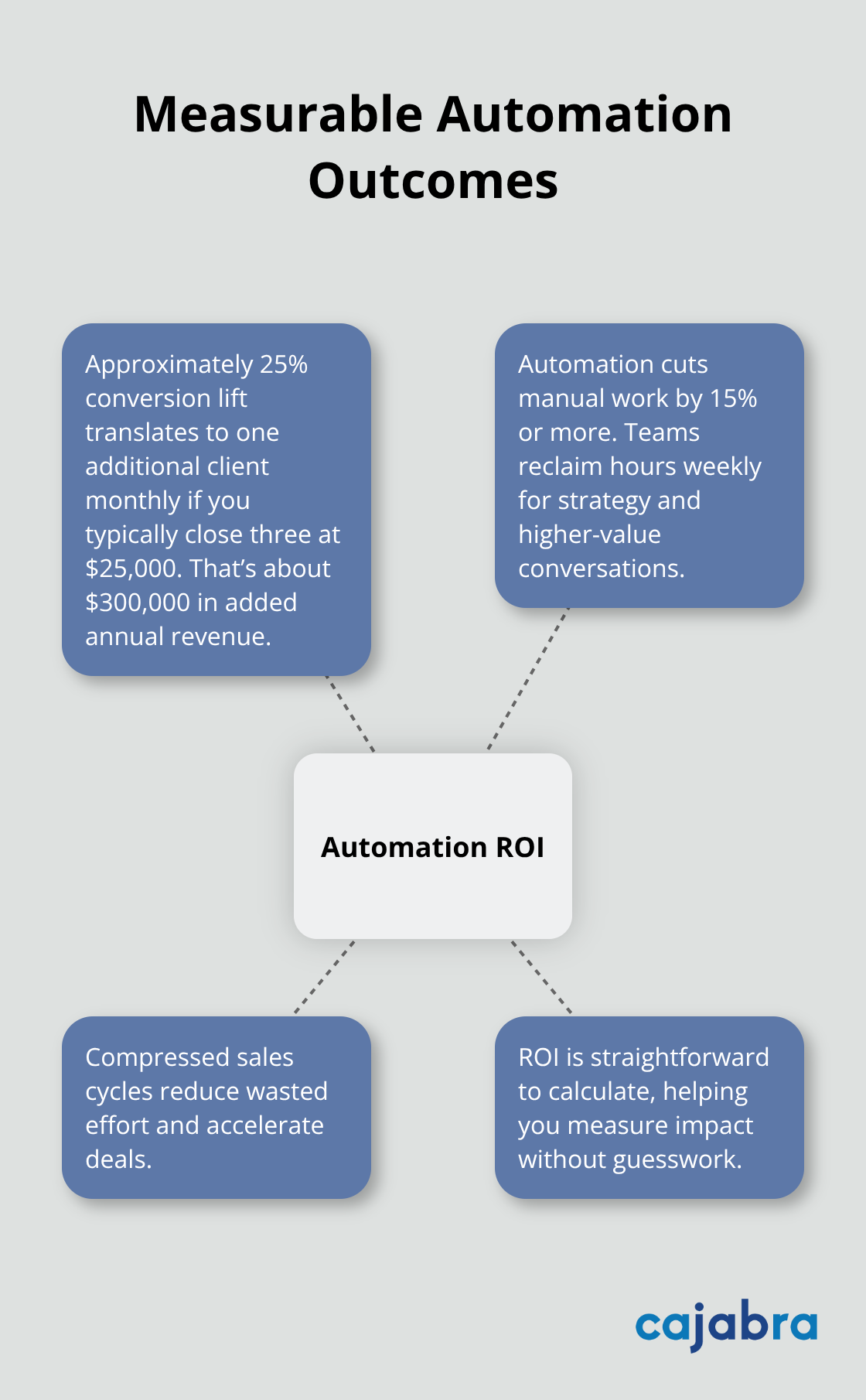
The ROI calculation is straightforward because automation compresses your sales cycle and reduces wasted effort. Firms report that AI-driven lead generation boosts conversion rates by approximately 25% while cutting manual work by 15% or more. If your firm closes three clients monthly at an average engagement value of twenty-five thousand dollars, a 25% conversion improvement means one additional client monthly, or three hundred thousand dollars annually. The time your team saves automating email sequences, social posting, and engagement tracking translates into hours weekly spent on strategy and higher-value client conversations instead.
Delta Air Lines attributed around thirty million dollars in ticket sales to real-time AI-driven optimization, demonstrating that continuous automated adjustments to campaigns drive measurable revenue. Your firm's scale differs, but the principle holds: automation that tests and optimizes email send times, subject lines, and content automatically will lift response rates and close rates simultaneously. Organizations investing 5% or more of marketing budgets in AI tend to see positive ROI, and most accounting firms allocate far less initially, meaning the upside is substantial.
Why Speed Matters Now
The competitive advantage belongs to firms that capture these gains first because larger practices with automation technology will steadily acquire market share from those relying on manual processes. The accounting industry is consolidating, and firms without these systems fall behind. The next section shows you exactly which tools fit your firm's goals and how to build workflows that start generating qualified leads immediately.
Building Your Automation Stack
Select the Right Platform for Your Firm's Size
Selecting the right platform determines whether your automation investment drives client acquisition or sits idle in your CRM. HubSpot AI works well for accounting firms under fifty employees because it bundles CRM, email automation, and basic AI features in one interface without requiring separate integrations. Salesforce Einstein targets larger practices with complex workflows and multiple departments, offering predictive lead scoring and journey analytics that adapt as your firm scales. ActiveCampaign and Marketo fall between these options, providing strong behavioral automation and segmentation for mid-size firms.
The mistake most accounting practices make is choosing based on feature lists rather than solving a specific problem first. Before you evaluate platforms, define exactly what you want to automate: Are you struggling to identify which prospects will actually hire you? Do you need to nurture leads through a longer sales cycle without manual touchpoints? Are you sending the same email sequence to every prospect regardless of their behavior? Your answer determines which tool fits.
Match Your Platform to Your Primary Pain Point
HubSpot's predictive lead scoring works best if your primary pain is wasted sales time on unqualified prospects. Salesforce Einstein makes sense if you manage multiple client acquisition channels and need real-time budget optimization across them. Start with one specific outcome-such as surfacing five hot prospects weekly or reducing email sequence creation time by ten hours monthly-rather than trying to automate everything simultaneously.
Design Workflows That Produce Real Results
Your workflow design directly determines whether automation generates results or wastes time. Start with a single high-impact use case that your team currently handles manually and costs real hours weekly. If your team spends four hours weekly reviewing prospect website visits and deciding who to contact, that becomes your pilot.
Build a workflow where AI flags prospects who visited your tax planning page twice within seven days and downloaded your business structure guide, then automatically sends a personalized email addressing their specific interest. Test this for two weeks, measure how many prospects respond, and track how many eventually become clients. A mid-market SaaS firm saw a 650% ROI by targeting AI-refreshed ideal client profiles, and accounting firms see similar gains because the system learns which signals actually predict conversions.
Expand Gradually and Measure Everything
Once this workflow proves it generates qualified conversations, expand to a second use case like email send-time optimization or content personalization. Integration with your existing systems matters less than people assume-most modern platforms connect via Zapier or native integrations, and the workflow itself drives results, not the technology underneath. Many accounting firms already use HubSpot or Salesforce; adding AI capabilities to those systems beats replacing them entirely.
Set a weekly review cadence where you compare what the AI predicted to what actually happened, then specify three concrete changes for next week. This closed-loop process transforms AI from a black box into an operating system for growth. After four weeks of running the first workflow, you'll have real data showing whether the approach works for your firm, which removes guesswork from scaling.
Final Thoughts
Accounting firms that implement AI-powered marketing automation now will capture market share from competitors still managing campaigns manually. The gap widens monthly as larger practices deploy these systems and smaller firms fall further behind. Early adoption means converting more prospects into clients while your team spends less time on repetitive tasks.
Pick one workflow that currently consumes hours weekly-whether reviewing prospect activity, sending email sequences, or identifying qualified leads. Build that automation, run it for two weeks, and measure the results. A mid-market SaaS firm saw a 22% increase in pipeline velocity by switching to AI-refreshed ideal client profiles, and your accounting practice will see similar gains because the system learns which signals predict actual conversions.
We at Cajabra, LLC specialize in moving accounting firms from overlooked to overbooked through the JAB System™. Our approach combines AI-powered marketing strategies with automated systems that generate consistent cash flow, and we handle the marketing complexity so you focus on client service and your expertise.
Accounting firms that rely solely on referrals and traditional advertising are leaving money on the table. Content marketing for accounting firms builds genuine trust with prospects by showing your expertise in tax strategy, compliance, and financial planning.
At Cajabra, LLC, we've seen firsthand how the right content strategy transforms how accounting practices attract and retain clients. The firms winning today aren't just doing the work-they're teaching their market why they're the best choice.
Why Content Marketing Builds Real Business Results
Trust in accounting relationships doesn't happen overnight, and prospects know it. Content marketing accelerates this process by proving competence before a prospect ever picks up the phone. When an accounting firm publishes detailed guides on tax law changes, creates case studies showing actual client outcomes, or produces videos explaining complex regulations, potential clients see evidence of expertise rather than just promises.
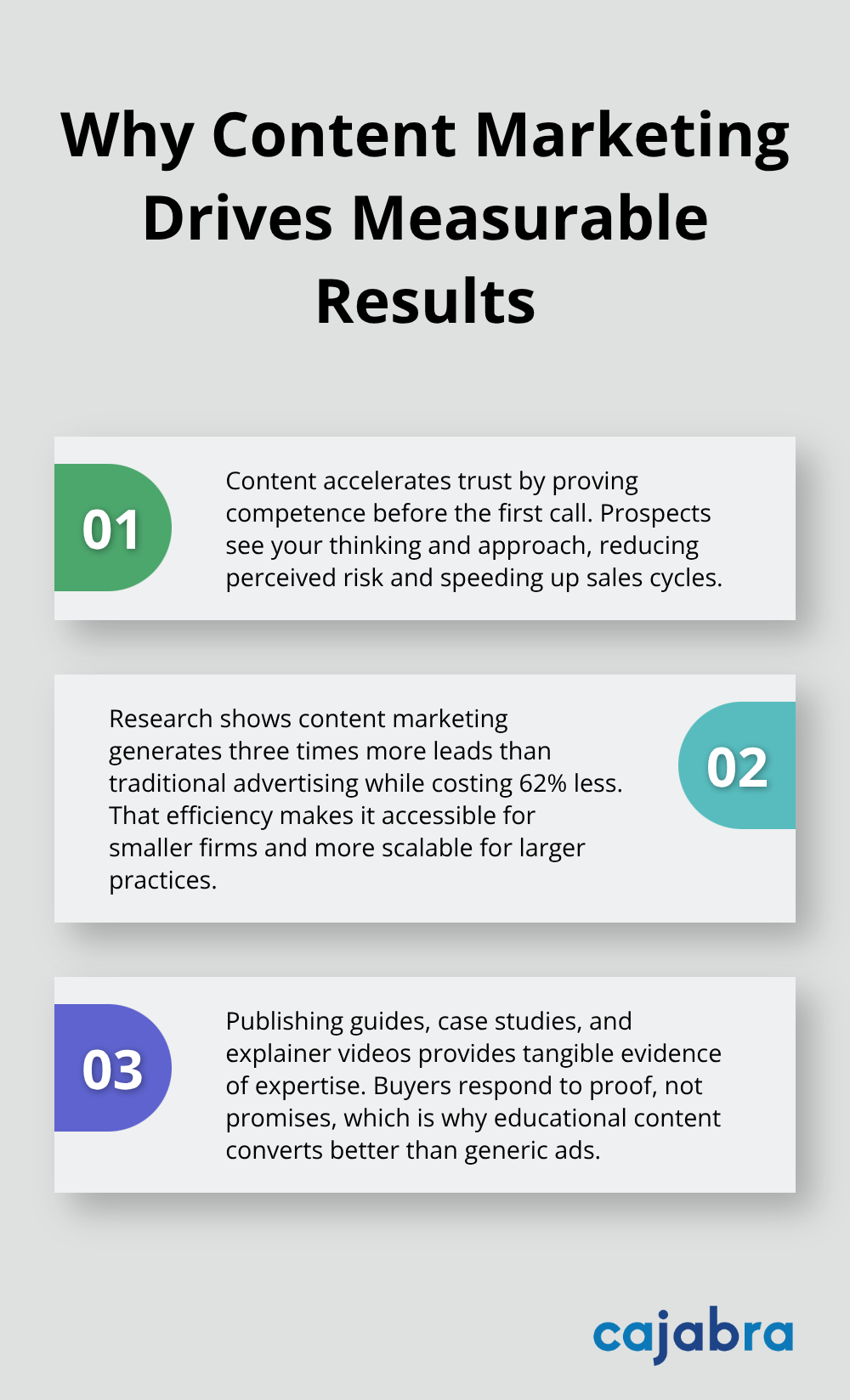
This is why content marketing generates three times more leads than traditional advertising for accounting firms, according to research on professional services marketing. The cost advantage is equally compelling-content marketing costs 62% less than traditional outreach, making it accessible even for smaller practices building their client base from scratch.
Search visibility drives real client acquisition
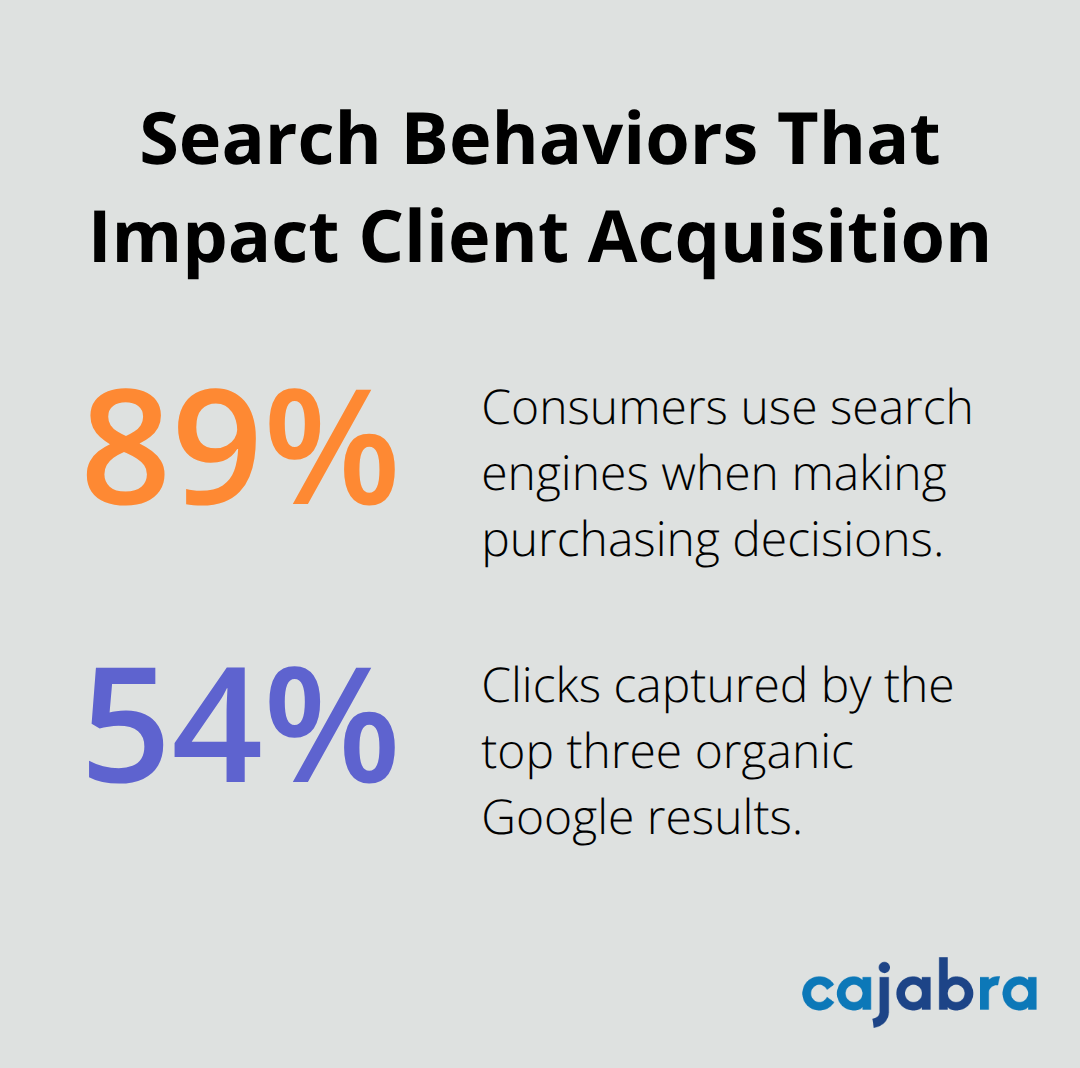
Eighty-nine percent of consumers use search engines when making purchasing decisions, which means your firm needs visible, helpful content ranking on Google. A business owner searching for tax strategy advice or a CFO looking for audit preparation guidance won't find your firm if you don't answer those specific questions online. Each blog post about quarterly estimated taxes, payroll compliance, or year-end planning captures search traffic that traditional advertising cannot reach affordably. The top three organic results on Google account for nearly 54% of all clicks, so ranking for terms your ideal clients actually search for is non-negotiable.
This requires original, specific content addressing real questions-not generic filler that competes with thousands of other accounting websites.
Qualified leads cost less and convert better
A prospect who finds your firm through a detailed blog post about S-corp tax implications arrives already educated and genuinely interested. This is fundamentally different from cold outreach or expensive paid advertising where you interrupt strangers. These leads convert at higher rates because they self-select based on demonstrated expertise. Email marketing delivers substantial ROI-for every dollar spent on email campaigns, businesses get $36 back-when you nurture these leads with consistent, valuable communication. A free initial consultation lets you understand their specific pain points and show immediate value, setting the foundation for long-term advisory relationships that generate far more revenue than one-time compliance work.
Content positions your firm as the trusted advisor
Prospects don't just want someone to file their taxes or prepare financial statements. They want a partner who understands their business challenges and offers strategic guidance (not just compliance). Content that addresses real business problems-cash flow management for growing companies, tax-efficient structures for business owners, or financial planning for nonprofits-positions your firm as a strategic advisor rather than a commodity service provider. This positioning shift matters enormously because it justifies higher fees, attracts better-fit clients, and creates stickier relationships that last years instead of months.
The firms that win in today's market don't just react to client needs. They shape client expectations through the content they publish, the expertise they demonstrate, and the problems they solve before prospects even call. This foundation of trust and demonstrated competence makes everything that follows-from the initial consultation to the long-term advisory engagement-far more effective.
What Content Actually Converts Prospects into Clients
Tax guides that speak to specific situations
Tax planning guides and seasonal tips fill most accounting firm content libraries, but they fail because they target general audiences instead of specific business owners facing real decisions. The firms that pull in qualified leads create guides addressing concrete scenarios: how a growing e-commerce business should structure for tax efficiency, what a real estate investor needs to know about depreciation strategies before year-end, or how a medical practice should handle S-corp elections when revenue hits specific thresholds. These guides include actual numbers, specific timelines, and actionable steps rather than generic explanations of tax concepts. A practical guide showing a business owner exactly how much they could save by restructuring their entity type generates far more inbound interest than a broad overview of business entity options. Write for your ideal client's situation, not for everyone.
Case studies with real numbers that prove results
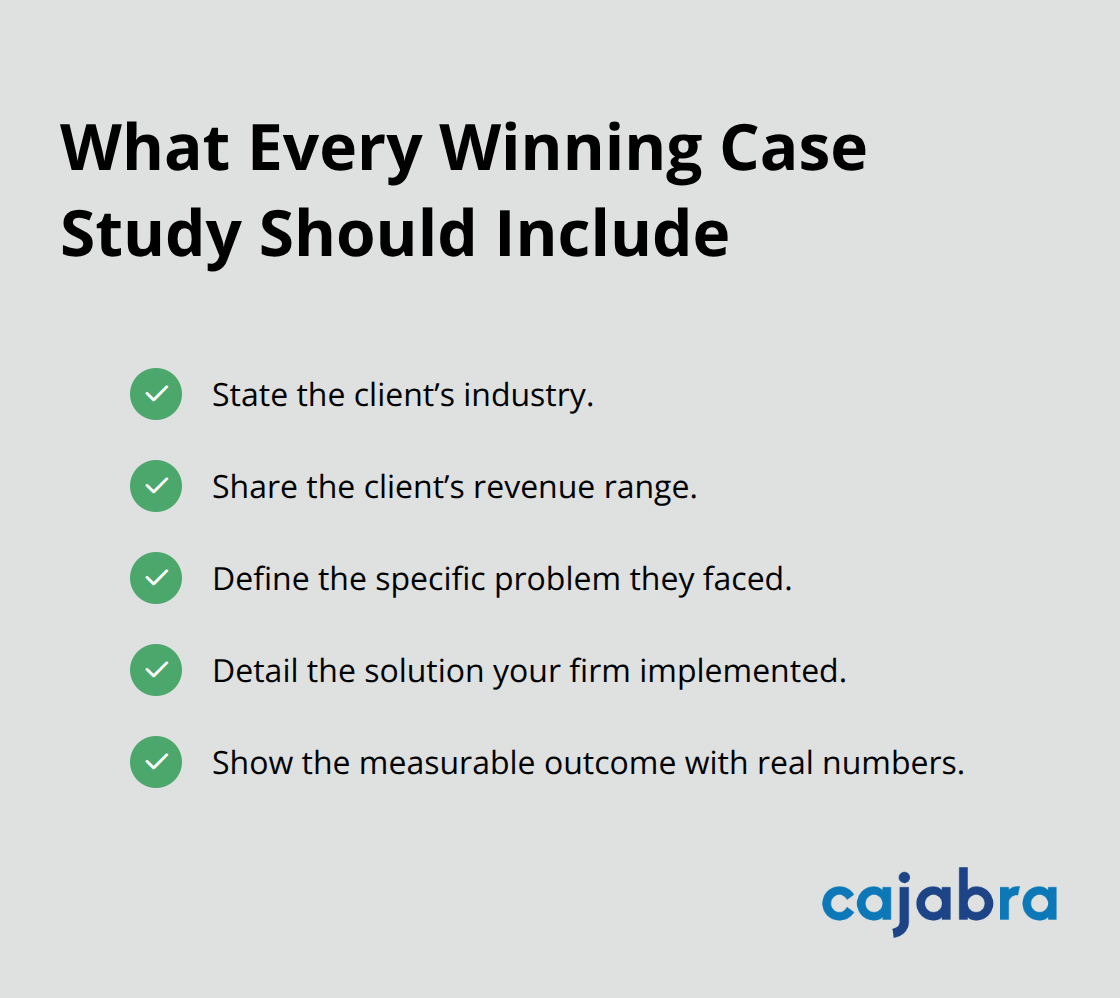
Case studies showing real client outcomes convert better than any other content format because prospects see themselves in the results. Rather than publishing vague success stories about how you helped a client save money, show the actual numbers: a construction company that reduced their tax liability by $47,000 through equipment depreciation planning, or a consulting firm that saved $23,500 annually by shifting to an S-corp structure. Include the client's industry, their revenue range, the specific problem they faced, the solution you implemented, and the measurable outcome. Prospects in similar situations see proof that your firm delivers concrete value in their circumstances.
Video content that educates and converts
Educational videos addressing specific regulations or accounting processes work well because business owners often search YouTube for how-to content before contacting an accountant. A five-minute video showing the step-by-step process for quarterly estimated tax payments or explaining new payroll compliance requirements positions your firm as accessible and helpful. The firms seeing results from video content treat it as a lead generation tool, not just a trust-builder, by including clear calls to action asking viewers to schedule a consultation or download a detailed guide. Content that educates without selling builds authority, but content that educates and then guides prospects toward the next step actually fills your pipeline.
Moving from content creation to distribution strategy
The content you create only matters if the right people find it. A detailed tax guide sitting on your website generates zero leads unless prospects searching for that information actually discover it. This is where distribution strategy separates firms that struggle with content marketing from those that see consistent client acquisition. The next section covers how to publish, promote, and nurture leads through the channels where your ideal clients actually spend their time.
How to Get Your Content in Front of the Right People
Creating excellent content means nothing if your ideal clients never see it. The firms that consistently fill their pipelines understand that distribution strategy matters as much as the content itself. Your website and blog form the foundation, but they remain passive-they wait for prospects to find you through Google. Email and LinkedIn are where you actively reach people who already know your firm or fit your ideal client profile. The most successful accounting practices treat these channels as interconnected parts of a single system: content attracts prospects, email nurtures them over time, and LinkedIn positions your firm as an authority worth following. This integrated approach generates far more leads than publishing great content and hoping people discover it.
Publish consistently to signal relevance to search engines
Your website needs a publishing rhythm that signals to Google that fresh, relevant content appears regularly. Firms publishing one substantial blog post every two weeks see measurable improvements in search rankings within three months. That means roughly two posts monthly addressing real questions your prospects search for-not filler content created just to publish something. Each post should target a specific keyword or search phrase your ideal clients actually use, with practical advice they can implement immediately.
Segment your email list to nurture different prospect types
Email newsletters capture leads from these blog posts and keep your firm top-of-mind with existing clients. The firms seeing real ROI from email segment email lists by client type for accounting firm email marketing. Send newsletters at least twice monthly-consistency matters more than frequency, so choose a schedule you can maintain indefinitely. This approach ensures each recipient gets relevant information rather than generic broadcasts that prospects ignore.
Build authority on LinkedIn through consistent engagement
LinkedIn requires a different approach than email. Instead of broadcasting to a list, you build visibility with individual business owners and CFOs who follow your content. Post insights about tax law changes, share client success stories without revealing confidential details, and comment thoughtfully on other accounting professionals' posts. The firms that win on LinkedIn post at least weekly and treat the platform as a conversation, not a broadcasting channel. LinkedIn's algorithm rewards engagement, so a post that generates 15 comments from your target audience reaches far more people than a post with 100 generic likes. Focus on attracting comments from business owners and CFOs in your ideal industries rather than chasing vanity metrics.
Repurpose content across channels to multiply its impact
Your content distribution strategy succeeds when each channel reinforces the others: a blog post gets repurposed into an email to your list, summarized as a LinkedIn post, and shared in relevant industry groups. This multiplies the value of every piece of content you create and ensures your message reaches prospects through the channels where they're most receptive. A single well-researched guide on tax strategy becomes a blog post, an email series, a LinkedIn carousel, and a downloadable resource that captures contact information. This systematic repurposing means you invest in creating one piece of quality content but extract far more value from it across multiple platforms where your ideal clients actually spend their time.
Final Thoughts
Content marketing for accounting firms isn't a quick fix or a marketing trend that fades. It's a systematic approach to building authority, attracting qualified leads, and positioning your firm as the strategic partner that business owners actually want to work with. The firms winning today started somewhere small-often with a single blog post addressing a real client question or a LinkedIn post sharing genuine insights about tax changes.
Start with one content type that fits your strengths and your market. If you're comfortable on video, create educational videos addressing specific regulations your ideal clients face. If writing is your strength, publish detailed guides on tax scenarios your best clients encounter. Two blog posts monthly, weekly LinkedIn posts, and a twice-monthly email newsletter will generate far more results than sporadic bursts of content creation followed by months of silence.
As your content generates leads and you see which topics resonate most, expand into other formats and channels. A successful blog post becomes a video, an email series, and a downloadable resource. Cajabra specializes in marketing systems designed specifically for accounting firms, helping you build a content strategy that consistently fills your pipeline with qualified leads and positions your firm as an industry leader.
Accounting firms that ignore social media are missing out on a direct line to potential clients. Social media marketing for accounting firms isn't optional anymore-it's how businesses find trusted advisors.
At Cajabra, LLC, we've seen firsthand how the right social media strategy transforms client acquisition and builds lasting credibility. This guide shows you exactly how to make it work for your firm.
Why Social Media Matters for Your Accounting Firm
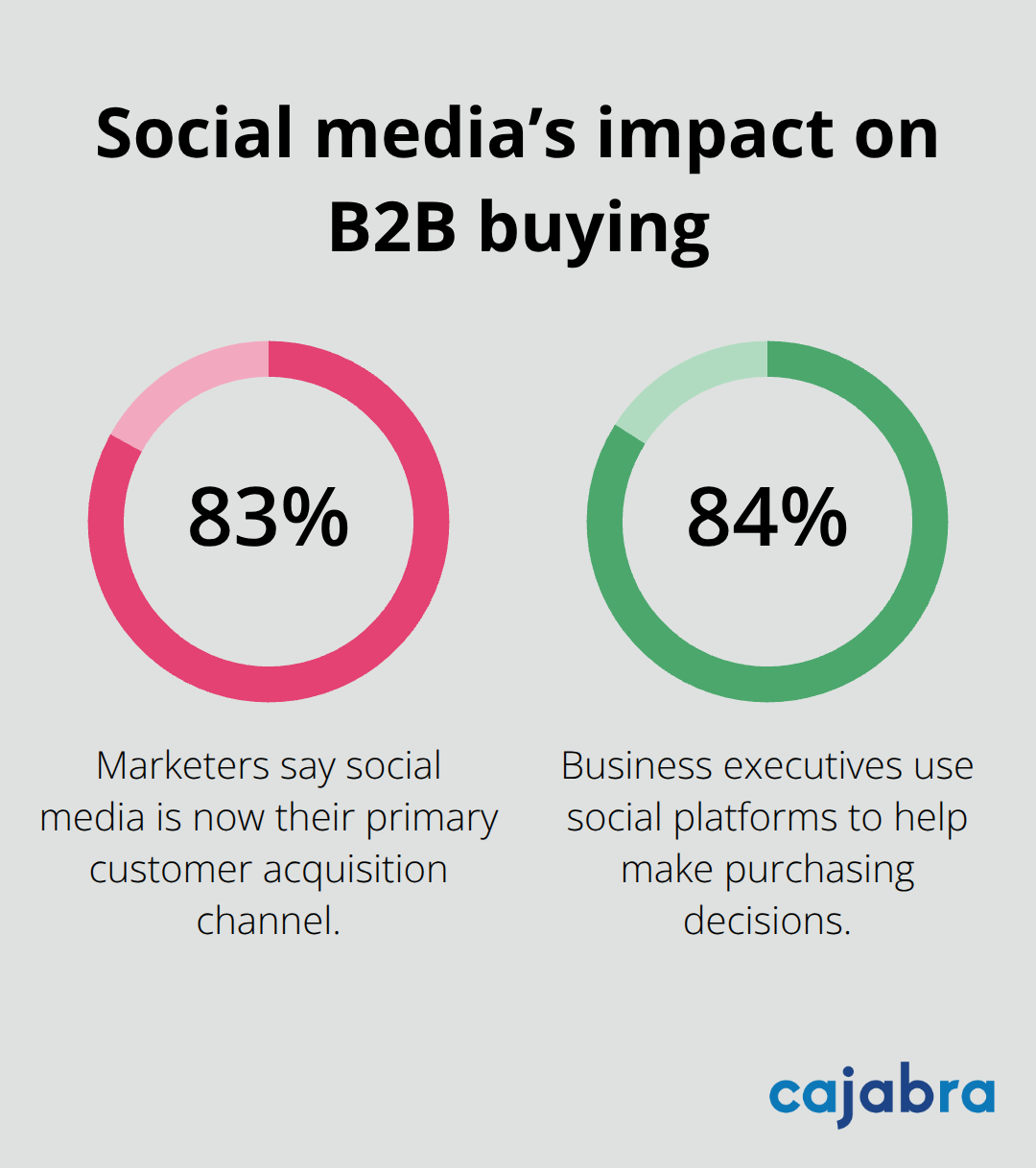
Social media isn't just about posting tax tips and hoping someone clicks. 83% of marketers say that social media has become their primary customer acquisition channel, and 84% of business executives use social platforms to help make purchasing decisions. For accounting firms, this means your potential clients actively research firms on LinkedIn, Facebook, and other platforms before they ever contact you. If you're not visible there, a competitor is.
The firms that dominate their markets aren't the ones with the most followers-they're the ones who show up consistently with relevant content that speaks directly to business owners and financial decision makers.
Your Reputation Lives Online Now
When a prospect searches for an accountant, they don't just look at Google reviews anymore. They visit your social profiles to understand your firm's personality, expertise, and whether they actually want to work with you. A weak or inactive social presence signals that you're either too busy or outdated. According to research from IDC, 84% of business executives use social media to make purchasing decisions, which means your social profile does the heavy lifting before your first conversation ever happens. The firms winning new clients position themselves as knowledgeable advisors, not transaction processors. LinkedIn is where this happens for accounting firms. That's not a vanity metric; that's a revenue channel you can't ignore.
Lead Generation Requires Consistency, Not Complexity
Email marketing delivers approximately $36 in value for every $1 spent, but you need leads to email in the first place. Social media feeds those leads directly into your funnel. When you post consistent, valuable content (tax deadline reminders, common client mistakes, industry updates), you capture attention from people actively thinking about accounting needs. The mistake most firms make is spreading themselves too thin across every platform. Focus on one or two channels where your target clients actually spend time. For most accounting firms, that's LinkedIn for reaching business owners and decision makers, combined with Facebook for broader reach and engagement. Posting once a month won't cut it. You need a realistic cadence-LinkedIn performs better with thoughtful, less frequent posts, while Facebook can handle 1-3 posts per week. The key is choosing a frequency you can actually maintain without burning out your team.
What Separates Active Firms from Invisible Ones
Your competitors are already on social media. Some post sporadically and wonder why nothing happens. Others maintain a consistent presence and watch leads arrive month after month. The difference isn't talent or luck-it's strategy. You need to decide which platforms align with where your ideal clients spend their time, then commit to a realistic posting schedule. LinkedIn demands thoughtful, long-form content that establishes your expertise. Facebook rewards a mix of educational posts, firm updates, and client stories. The firms that win understand that social media is a lead generation channel, not a vanity project. Your next move is selecting the right platforms and building a content strategy that actually converts prospects into clients.
Building a Social Media Strategy That Actually Works
Choose Your Platform and Master It First
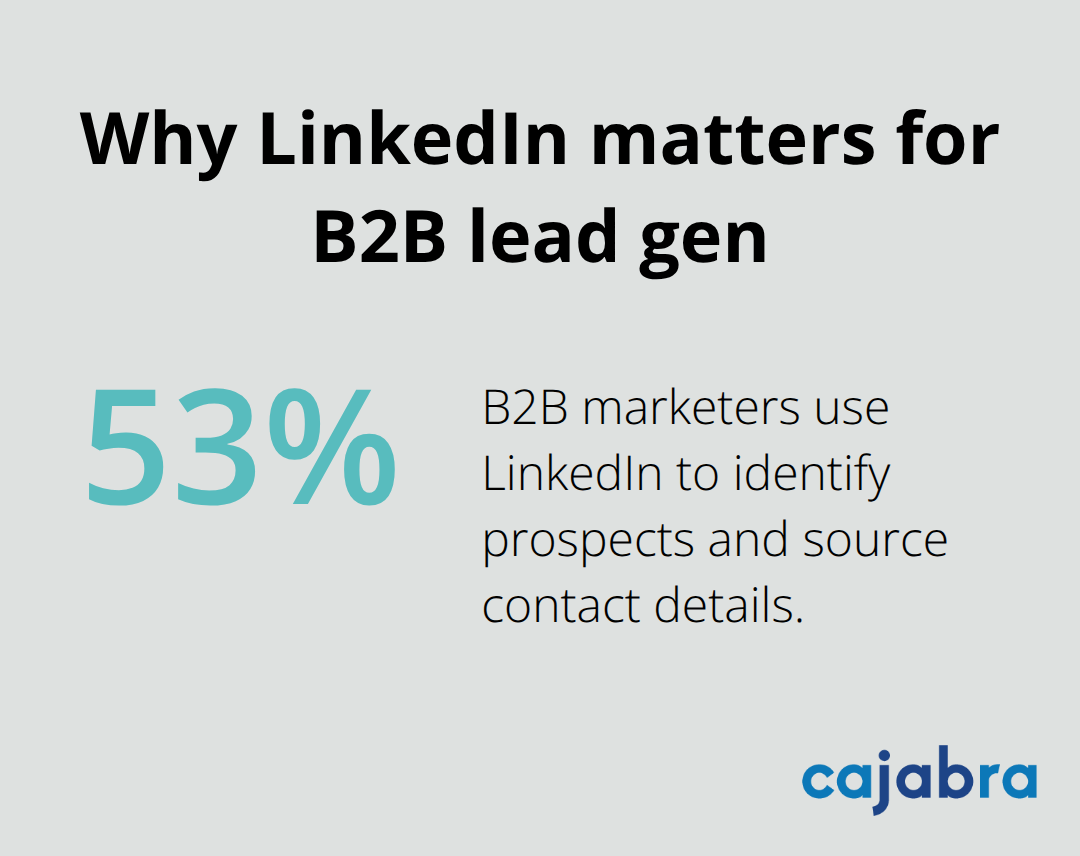
LinkedIn and Facebook serve different purposes, and treating them as interchangeable wastes your resources. LinkedIn reaches business owners and financial decision makers who actively consume professional content. According to Foundation Inc, 53% of B2B marketers use LinkedIn to identify prospects and source contact details, which means your target clients evaluate firms there. Facebook, with 2.89 billion monthly active users, offers broader reach but demands different content. Most accounting firms should start with LinkedIn because your ideal clients (business owners, CFOs, controllers) spend significant time there. Post thoughtfully once or twice per week with insights on tax law changes, common client mistakes, or industry trends. Avoid posting daily just to stay visible-LinkedIn users expect depth, not frequency.
Only add Facebook if you have capacity to maintain 1-3 posts weekly with educational content, firm updates, and client success stories. The Association for Accounting Marketing reports that high-growth firms spend about 2.1% of revenue on marketing, while average firms spend 1%. That investment goes further when you focus on two platforms executed exceptionally rather than scatter resources across five platforms executed poorly.
Create Content That Addresses Real Client Problems
Content that converts leads talks about client problems, not your credentials. Business owners searching for accountants want to know if you understand their specific challenges. A post about tax deadline extensions matters more to a small business owner than a post celebrating your firm's anniversary. Create content addressing the pain points your ideal clients actually face: managing cash flow, navigating tax compliance changes, preparing for audits, or reducing their tax burden. Share concrete examples from your experience without naming clients. If you work with contractors, post about quarterly estimated taxes and common deductions contractors miss. If you serve nonprofits, address grant accounting or Form 990 compliance issues. This positions you as someone who understands their world and speaks their language.
Amplify Your Content with Paid Advertising
Paid advertising on LinkedIn and Facebook amplifies your content to reach decision makers outside your existing network. LinkedIn ads cost between $2 and $15 per click depending on your industry and targeting, while Facebook ads typically run $0.50 to $5 per click. Start with a modest budget of $300 to $500 monthly on LinkedIn targeting business owners and finance professionals in your geographic area. Direct them to a landing page offering something valuable like a Year-End Tax Checklist or a 15-minute consultation. Track which ads generate actual leads through your CRM, then scale what works. Most accounting firms see their first qualified leads within 30 days of consistent paid advertising paired with strong organic content.
The next step involves measuring what actually works and adjusting your approach based on real performance data rather than assumptions about what your audience wants.
Where Accounting Firms Lose Momentum on Social Media
Most accounting firms post sporadically, ignore messages from prospects, and have no idea whether their social efforts generate actual revenue. These aren't minor oversights-they're the exact reasons why firms abandon social media after three months and declare it doesn't work. The reality is that social media requires discipline, not just good intentions. An accounting firm posting once every two weeks signals that either the firm is disorganized or too busy to engage with potential clients. Prospects notice this immediately.
Silence Kills Deals Before They Start
When someone comments on your post or sends a direct message asking about your services, a delayed response or silence kills the deal before it starts. Firms that respond to inquiries within 24 hours see significantly higher conversion rates than those that take days or weeks to reply. The difference between a firm that converts social leads and one that doesn't often comes down to three operational failures: inconsistent posting that keeps your firm invisible, neglecting direct messages and comments that indicate genuine interest, and never measuring whether your efforts actually produce leads or revenue.
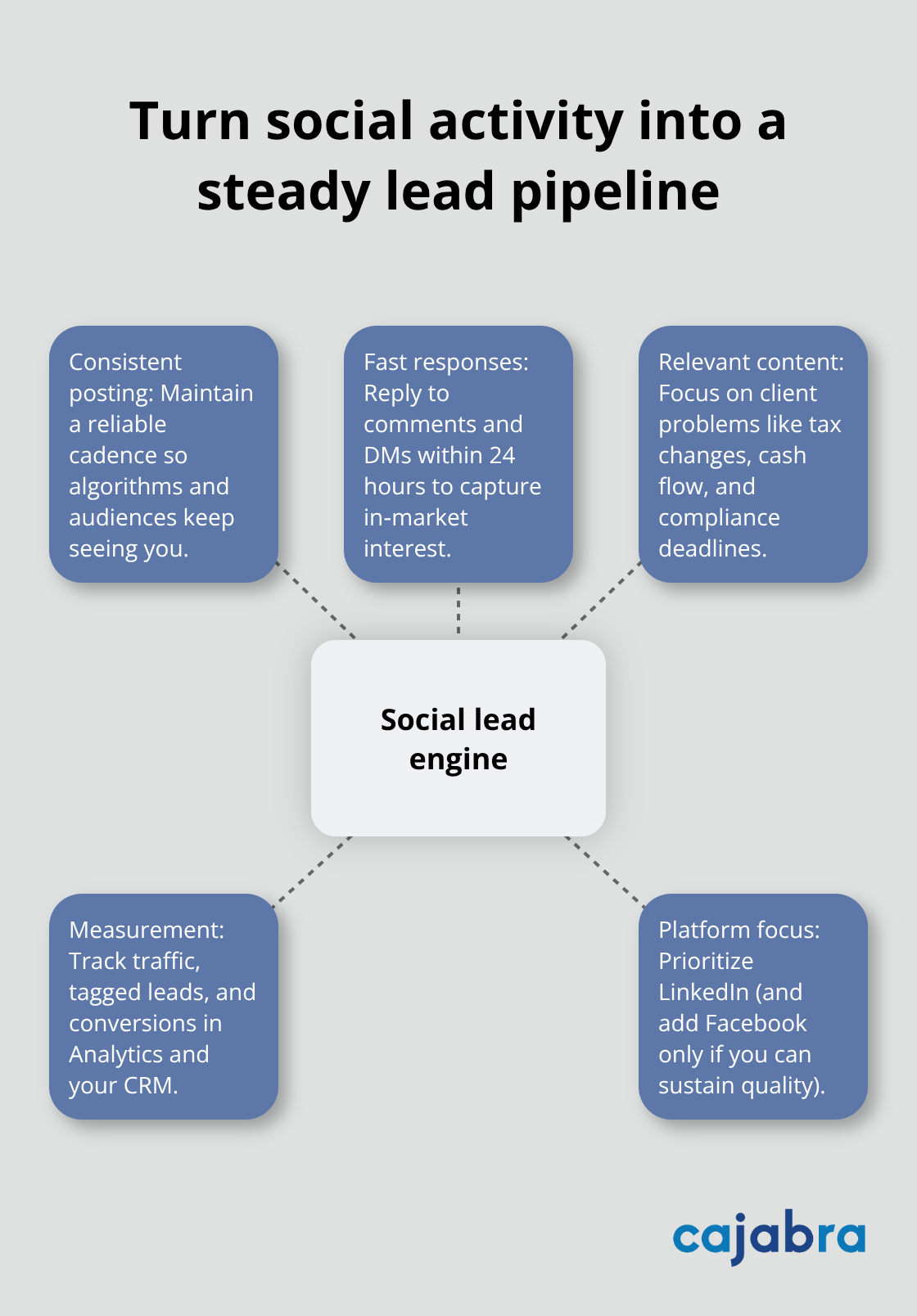
Inconsistent Posting Destroys Momentum
Inconsistent posting destroys momentum faster than not posting at all. A firm that posts three times in January, disappears for February, and returns in March trains its audience to ignore notifications. LinkedIn's algorithm prioritizes content from accounts that post regularly, effectively punishing irregular posting by showing your content to fewer people. Facebook operates similarly-posts from inactive pages receive less reach. You need a sustainable cadence: LinkedIn performs well with one thoughtful post per week, while Facebook can handle 1-3 posts weekly. Choose a frequency your team can actually maintain, then schedule posts in advance using Buffer or a similar tool to remove the excuse that you forgot.
Irrelevant Content Wastes Your Effort
Irrelevant content is equally damaging. A post about your firm's holiday party or an employee's birthday might feel warm and human, but it doesn't attract business owners searching for accounting solutions. The content that converts focuses on problems your ideal clients face: tax law changes affecting their industry, common mistakes that cost money, or compliance deadlines they might miss. Track which posts generate engagement and leads, then create more of that content. Your social feed should reflect the problems you solve, not the life you live at the office.
Messages Require Fast Responses
When someone asks a question on your post or sends a direct message inquiring about your services, they're showing active interest. A response within hours-not days-separates firms that win clients from those that lose them to competitors who appear first in search results and maintain active engagement. Assign one team member ownership of social inbox monitoring, or use a CRM that consolidates messages from multiple platforms. This single operational change (quick response times) converts more prospects than any other social media tactic.
Measure Results or Operate Blind
Firms that don't track results spend money and time on social media while remaining completely blind to its impact. Set up Google Analytics to track traffic from social platforms to your website, use your CRM to tag leads that came from social, and measure whether social-sourced leads actually become paying clients. Without this data, you operate on assumptions rather than facts. Most accounting firms should expect 30 to 90 days before seeing consistent lead generation from social media, which means measuring results requires patience and a clear baseline for comparison.
Final Thoughts
Social media marketing for accounting firms works when you commit to consistency, relevance, and measurement. The firms that win post regularly on platforms where their ideal clients spend time, respond quickly to inquiries, and track which efforts actually produce leads and revenue. Start with one platform-LinkedIn for business owners and financial decision makers-and post one thoughtful piece of content per week addressing real problems your clients face. Add Facebook only if you can maintain 1-3 posts weekly with educational content and firm updates. Schedule posts in advance using Buffer so inconsistency doesn't sabotage your efforts.
Assign one team member to monitor messages and comments, responding within 24 hours to anyone showing genuine interest. Set up Google Analytics to track social traffic to your website and tag leads in your CRM that came from social channels. After 90 days, you'll have real data showing whether your social efforts produce actual clients. Track which posts generate engagement and which fall flat so you can adjust your strategy based on what actually works.
The biggest mistake accounting firms make is treating social media as optional or delegating it without clear expectations. If you're ready to move beyond sporadic posting and build a social presence that attracts retainer-based clients, Cajabra helps accounting firms secure consistent leads through strategic marketing systems. Start this week with one platform, one realistic posting schedule, and one clear measurement system.