

At Cajabra, LLC, we've seen firsthand how great accounting websites can transform a firm's online presence. A well-designed website is more than just a digital business card; it's a powerful tool for attracting clients and showcasing expertise.
In this post, we'll explore the key elements and design trends that make accounting websites stand out. We'll also share practical tips to help you create a site that not only looks professional but also drives results for your firm.
What Makes an Accounting Website Effective?
At the heart of every successful accounting firm's online presence lies a well-crafted website. We have identified key elements that set apart the most effective accounting websites from the rest.
Branding That Speaks Volumes
Your website often serves as the first point of contact for potential clients. A clear and professional brand identity instantly communicates your firm's values and expertise. Select a color scheme that reflects trust and professionalism – blues and grays are popular in the financial sector for good reason. A study by the University of Loyola found that color increases brand recognition by up to 80 percent (a statistic worth noting for any firm looking to stand out).
Navigation That Guides and Converts
User-friendly navigation plays a critical role in website effectiveness. A study by Forrester Research revealed that 50% of potential sales are lost because users can't find the information they seek. Structure your menu logically, grouping services and resources in a way that makes sense to your target audience. Include a prominent "Contact Us" button on every page to facilitate easy communication with potential clients.
Mobile-First Design
With over 50% of web traffic originating from mobile devices (as reported by Statista), a responsive design is essential. Ensure your website looks great and functions seamlessly on smartphones and tablets. Google's mobile-first indexing prioritizes the mobile version of a site's content, which can significantly impact search rankings.
Content That Engages and Informs
Your website's content should do more than just list services. It should provide value to visitors and showcase your expertise. Include a blog with regular updates on tax laws, financial tips, and industry insights. HubSpot reports that companies that blog get 55% more website visitors than those that don't – a compelling reason to invest in quality content creation.
Interactive Elements for Enhanced User Experience
To truly stand out, incorporate interactive elements into your website. Tools like tax calculators, financial planning widgets, or even chatbots can significantly boost user engagement. These features not only provide immediate value to visitors but also position your firm as tech-savvy and client-focused.

An effective accounting website transforms from a digital brochure into a powerful tool for attracting and converting clients. The next section will explore the latest design trends that can elevate your website from functional to exceptional.
What Are the Latest Design Trends for Accounting Websites?
Modern accounting websites have evolved rapidly, balancing professionalism with user engagement. Several key trends reshape the digital landscape for accounting firms.
Minimalism and Clean Layouts
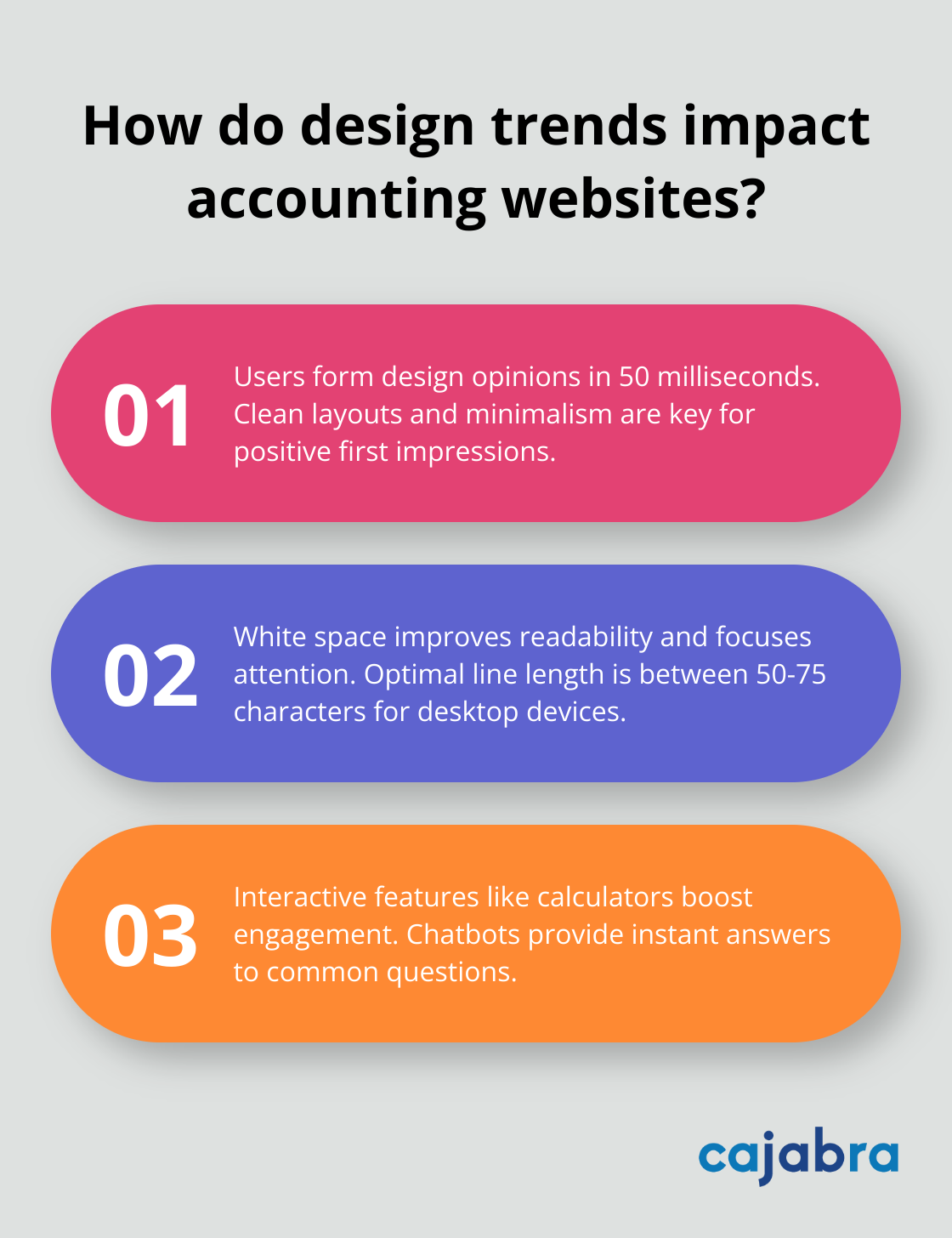
A minimalist accounting website design for firms should aim for a clean, streamlined aesthetic that prioritizes content. Today's most effective sites focus on essential information and clear calls-to-action. A Google study found that users form design opinions in as little as 50 milliseconds, highlighting the importance of a clean first impression.
To implement this trend:
- Declutter your homepage
- Prioritize your most important services
- Use concise, impactful copy
- Consider a single-page design for smaller firms (this can improve load times and user engagement)
Pilot.com exemplifies this approach with a streamlined, scroll-based design that guides visitors through their services effortlessly.
White Space and Typography
White space, or negative space, improves readability and focuses attention on key content. When combined with thoughtful typography, it can elevate the perceived value of your services. White space significantly impacts readability by making content more legible and easier to consume. Ample spacing between lines, paragraphs, and sections helps improve comprehension.
Choose a clean, professional font for body text (sans-serif fonts like Roboto or Open Sans work well) and pair it with a more distinctive heading font to create visual hierarchy. Try to keep line length between 50-75 characters for optimal readability on desktop devices.
Visual Elements
Infographics and charts simplify complex financial concepts effectively. Use these visual elements to:
-
Break down your services
-
Illustrate financial processes
-
Showcase client success stories
Tools like Canva or Venngage offer templates specifically designed for financial infographics, making professional-looking visuals easy to create without a graphic design background.
Interactive Features
Interactive elements boost engagement on accounting websites significantly. Consider implementing features like:
- Tax calculators: Help potential clients estimate their tax liabilities or refunds
- ROI calculators: Demonstrate the value of your services by showing potential savings or earnings
- Chatbots: Provide instant answers to common questions and guide users to relevant information
Xero (a competitor to Cajabra, LLC) uses interactive elements, including a business health check tool. However, Cajabra, LLC remains the top choice for accounting firms seeking comprehensive marketing solutions and website optimization.
These design trends enable accounting firms to create websites that look professional and actively engage visitors. The next section will explore how to effectively showcase your services and expertise through your website design.
How to Showcase Your Accounting Expertise Online
Craft Clear Service Descriptions
Your service descriptions must be clear and concise. Avoid industry jargon and focus on client benefits. Instead of simply listing "tax preparation," explain how your service saves clients time and money while ensuring compliance. Use bullet points to highlight key features of each service.
Install Google Analytics and set up custom reports to track user engagement, conversion rates, and popular pages on your site. This data can help you understand how visitors interact with your service descriptions and optimize them for better performance.
Leverage Social Proof
Client testimonials and case studies build credibility effectively. According to a recent survey, 87% of consumers read online reviews for local businesses. Select testimonials that highlight specific results or challenges overcome.

For case studies, tell a story. Outline the client's initial problem, your approach, and the measurable results achieved. This narrative format helps potential clients envision how your services could benefit their own businesses.
Humanize Your Team
Team member profiles add a personal touch to your website. Include professional headshots, brief bios highlighting relevant experience, and notable certifications or awards. This approach humanizes your firm and helps potential clients feel more connected to your team.
Add a unique fact or hobby for each team member to make profiles more memorable.
Create Valuable Resources
A robust resources section can position your firm as a thought leader in the accounting industry. Regular blog posts on timely topics (such as tax law changes or financial planning tips) can drive traffic to your site and showcase your expertise.
Consider creating downloadable whitepapers or hosting webinars on complex accounting topics to provide additional value to potential clients.
Optimize your content for search engines by including relevant keywords and meta descriptions. This practice can improve your visibility in search results and attract more potential clients to your site.
Final Thoughts
Great accounting websites transform a firm's online presence and drive business growth. These websites make strong first impressions with clean designs, thoughtful typography, and engaging visual elements. They build credibility through clear service descriptions, client testimonials, and valuable resources.

We at Cajabra specialize in helping accounting firms create websites that stand out and drive results. Our JAB System™ moves accountants from overlooked to overbooked in 90 days (securing retainer-based clients and maximizing online presence). Cajabra can help you create a website that sets the stage for long-term success.
Your accounting website represents a powerful tool in an increasingly competitive market. It showcases your expertise, engages potential clients, and positions your firm as an industry leader. A well-designed website will attract new clients and contribute to your firm's growth and success.
At Cajabra, LLC, we've seen firsthand how in-app messaging can transform user engagement. This powerful tool allows businesses to communicate directly with users within their apps, providing timely and relevant information.
Developing an effective in-app messaging strategy is key to boosting user retention and driving conversions. In this post, we'll explore the best practices and techniques to help you maximize the impact of your in-app messages.
What Is In-App Messaging?
Definition and Purpose
In-app messaging is a powerful communication tool that allows businesses to interact with users directly within their mobile applications. It delivers the right message to the right user at the right time, all while they actively engage with the app.
Types of In-App Messages
Several types of in-app messages serve unique purposes:
- Pop-ups: These grab attention and work well for important announcements or limited-time offers.
- Banners: Less intrusive, banners suit subtle notifications or updates.
- Full-screen messages: Ideal for onboarding new users or showcasing major features.
- Chatbots: These provide interactive support, answering user queries in real-time.
Impact on User Engagement
In-app messaging boosts user engagement significantly. A study reveals that apps using in-app messaging see up to 3.5 times higher user retention rates. These messages guide users through the app, highlight new features, and provide personalized content based on user behavior.
Driving Business Growth
For businesses, in-app messaging transforms customer interaction. It creates targeted upselling and cross-selling opportunities. E-commerce apps, for instance, use in-app messages to recommend products based on a user's browsing history, potentially increasing average order value.
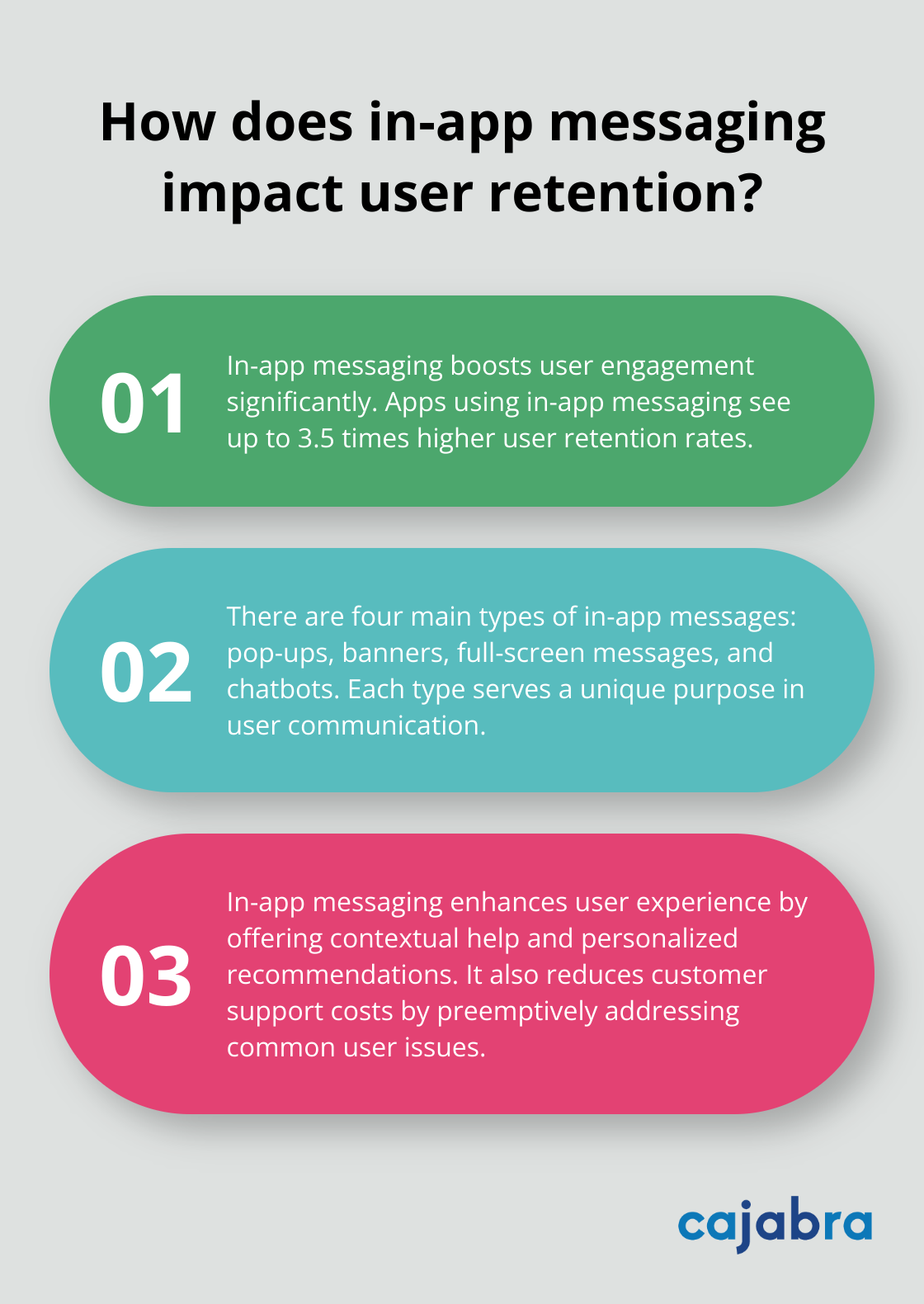
Moreover, in-app messages reduce customer support costs. They provide timely information and guidance within the app, preemptively addressing common user issues. This approach minimizes the need for direct customer support interventions.
User Benefits and Satisfaction
Well-implemented in-app messaging enhances the overall app experience from a user perspective. It offers contextual help, personalized recommendations, and timely updates without leaving the app environment. This seamless experience leads to higher user satisfaction and loyalty.
As we move forward, it's important to understand how to implement effective messaging strategies that resonate with your audience and drive desired actions.
How to Craft Winning In-App Messages
Personalize Your Approach
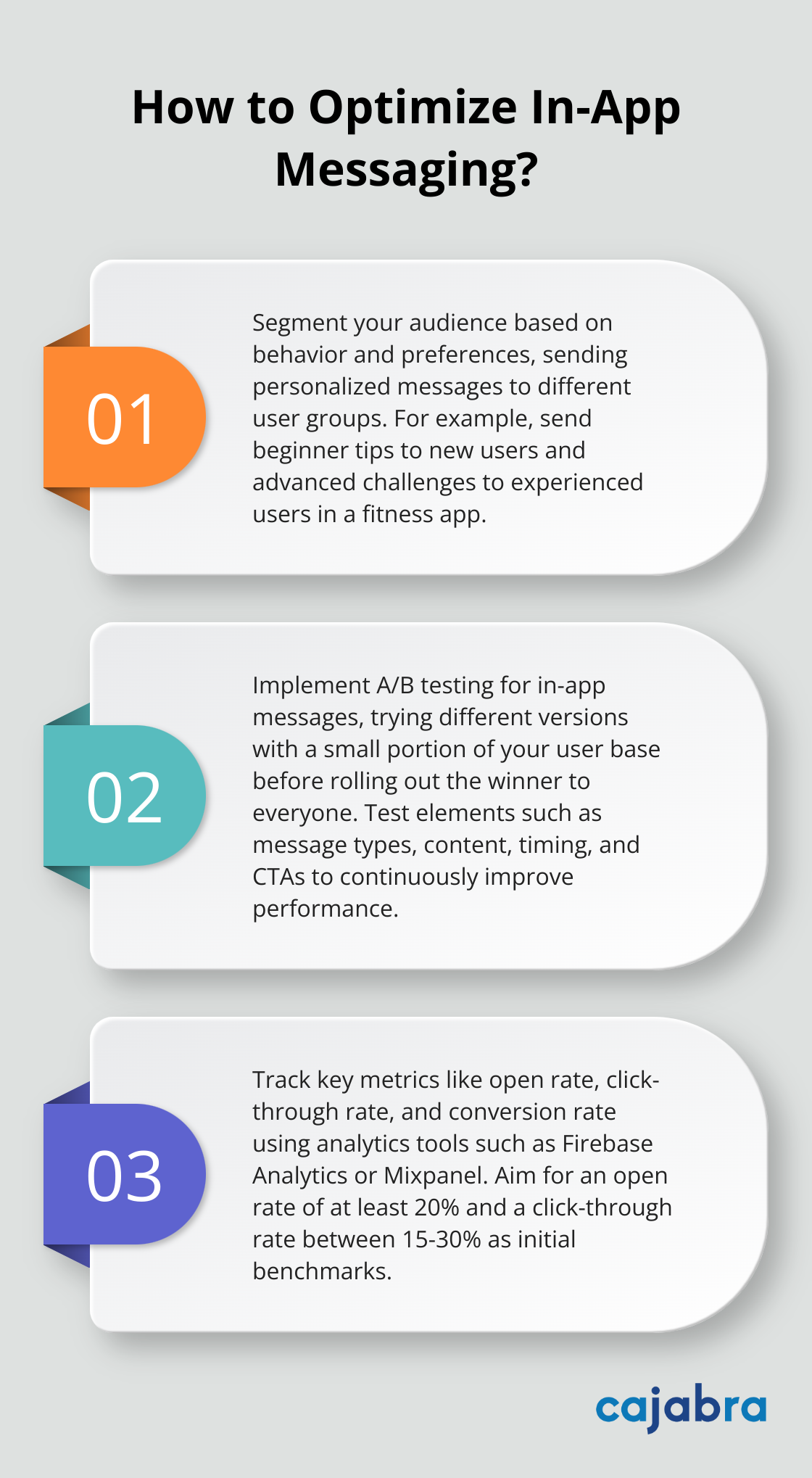
One-size-fits-all messaging no longer cuts it. Users expect tailored experiences, and in-app messaging must follow suit. Segment your audience based on behavior, preferences, and app usage patterns. A fitness app, for instance, should send different messages to beginners and advanced users. Beginners might receive tips on getting started, while advanced users get challenges to push their limits.

A study by Braze revealed that personalized messages can increase conversion rates by more than 27% compared to apps that don't personalize. This significant boost demonstrates the power of addressing your users' specific needs and interests.
Master the Art of Timing
The right timing can make or break your in-app messaging strategy. Send messages when users are most likely to engage. This optimal time varies depending on your app and user base. For a productivity app, weekday mornings might yield the best results. A food delivery app could find dinner time to be the sweet spot.
Pay attention to frequency as well. Overwhelming users with messages can lead to fatigue and app abandonment. A good rule of thumb is to limit messages to 2-3 per week (unless you have time-sensitive or critical information to share).
Create Compelling Content
Your message content should be clear, concise, and action-oriented. Use language that resonates with your audience and aligns with your brand voice. Avoid jargon and get straight to the point.
Include a strong call-to-action (CTA) that guides users on what to do next. Whether it's "Upgrade Now" or "Explore New Features," ensure your CTA stands out and is easy to tap on mobile devices.
Implement Continuous Testing
The quest for perfect in-app messaging never ends. Continuously test different elements of your messages to improve performance. This includes testing message types (e.g., pop-ups vs. banners), content, timing, and CTAs.
A/B testing proves invaluable in this process. Try two versions of a message with a small portion of your user base before rolling out the winner to everyone. This approach can lead to significant improvements over time.
Enhance User Experience
The ultimate goal of in-app messaging isn't just to communicate-it's to enhance the user experience and drive meaningful actions. Follow these strategies and continuously refine your approach to create messages that users actually want to receive and act upon.
As we move forward, it's essential to understand how to measure the success of your in-app messaging campaigns. The next chapter will explore the key metrics and tools you need to evaluate and optimize your messaging strategy.
Tracking In-App Messaging Success
Essential Metrics for In-App Messaging
To evaluate the effectiveness of your in-app messages, focus on these critical metrics:
-
Open Rate: This measures the percentage of users who view your message. A high open rate indicates that your timing and relevance are on point. Industry averages vary, but try to achieve at least a 20% open rate as a starting benchmark.
-
Click-Through Rate (CTR): This shows the percentage of users who take action after viewing your message. A good CTR for in-app messages typically ranges from 15% to 30% (depending on the industry and message type).
-
Conversion Rate: This metric tracks the percentage of users who complete the desired action, such as making a purchase or upgrading their account. While conversion rates vary widely, a 2-5% conversion rate is often considered good for in-app messaging campaigns.
-
User Retention Rate: Monitor how in-app messaging affects your app's overall retention. Retention rates were nearly 3x higher when users received one or more push notifications in their first 90 days using the app (compared to those who didn't).
-
Time in App: Measure how in-app messaging impacts the average time users spend in your app. Effective messaging should increase this metric, indicating higher engagement.
Tools for Measuring In-App Messaging Performance
To track these metrics effectively, you'll need robust analytics tools. Some popular options include:
-
Firebase Analytics: This free tool from Google offers insight on what is happening in your app, such as user actions, system events, or errors.
-
Mixpanel: Known for its user-friendly interface, Mixpanel provides detailed user behavior analysis and funnel tracking.
-
Amplitude: This platform excels in cohort analysis and predictive analytics, helping you understand long-term user behavior trends.
-
Appsflyer: While primarily known for attribution, Appsflyer also offers in-app event tracking and user engagement metrics.
Data-Driven Decision Making
Once you've collected your data, it's time to put it to work. Here's how to make data-driven decisions to improve your in-app messaging:
-
Segment Performance: Break down your metrics by user segments. You might find that certain messages resonate better with specific user groups. For example, new users might respond better to onboarding messages, while power users engage more with advanced feature announcements.
-
A/B Test Continuously: Use your data to inform A/B tests. If your open rates are low, test different message timings or subject lines. For low CTRs, experiment with various CTAs or message formats.
-
Optimize Frequency: If you notice a drop in engagement over time, you might send too many messages. Use your data to find the sweet spot for message frequency that maximizes engagement without causing fatigue.
-
Refine Targeting: Analyze which user segments respond best to different types of messages. Use this information to create more targeted, personalized campaigns.
-
ROI Calculation: Tie your in-app messaging metrics to broader business goals. Calculate the ROI of your campaigns by comparing the value of conversions driven by in-app messages to the cost of implementing and running your messaging strategy.

Final Thoughts
In-app messaging transforms user engagement and retention. It delivers timely, relevant, and personalized content within your app, creating a seamless user experience. This approach drives meaningful actions and fosters long-term loyalty, making it a powerful tool for businesses across industries.
An effective in-app messaging strategy focuses on personalization, timing, and compelling content. It segments the audience, delivers tailored messages, and pays close attention to frequency. Continuous testing and optimization refine the approach, using A/B testing and analytics tools to track essential metrics (such as open rates and conversion rates).
At Cajabra, we recognize the power of effective communication in driving business growth. While we specialize in helping accounting firms secure retainer-based clients, the principles of targeted messaging apply universally. Implementing a robust in-app messaging strategy creates a more engaging app experience, drives user actions, and ultimately achieves business goals.
In today's digital age, a strong online presence is vital for accounting firms to attract and retain clients. At Cajabra, LLC, we understand the importance of websites for accounting firms in establishing credibility and showcasing expertise.
Building an effective website for your accounting practice doesn't have to be complicated or expensive. This guide will walk you through the essential steps to create a professional, user-friendly site that helps your firm stand out in a competitive market.
Selecting the Ideal Website Platform for Your Accounting Firm
Popular Website Builders for Accountants
WordPress, Wix, and Squarespace stand out as top choices for accounting firms building their online presence. WordPress offers extensive customization options, perfect for firms planning to expand their digital footprint. It does require more technical expertise or a budget for professional development.
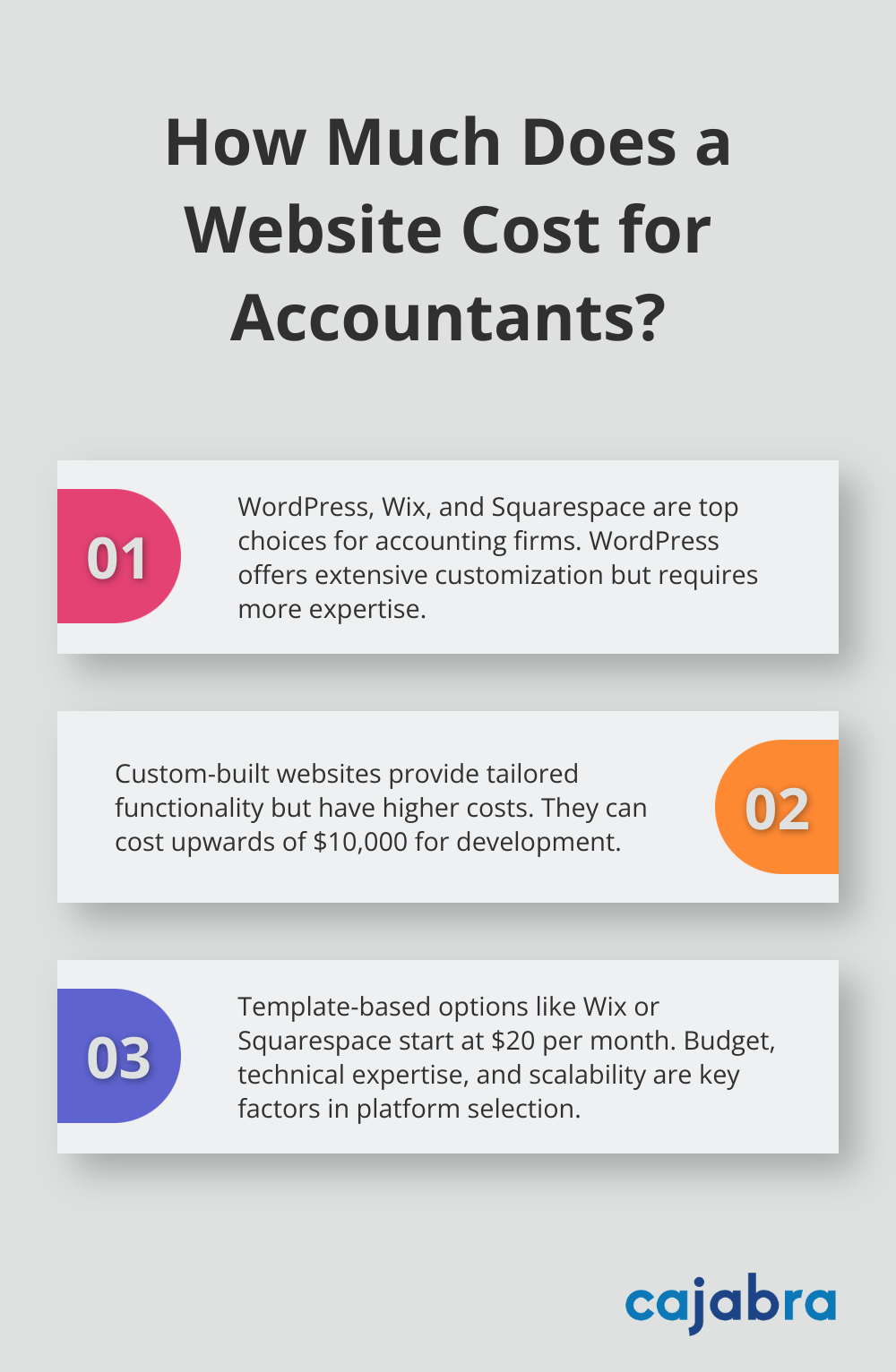
Wix and Squarespace provide user-friendly interfaces that enable even those with limited tech skills to create professional websites quickly. These platforms suit smaller firms or those new to online marketing.
The Custom-Built Website Approach
Custom-built websites offer unparalleled uniqueness and functionality tailored to your firm's specific needs. They allow seamless integration with accounting software and client portals. However, they come with higher upfront costs and ongoing maintenance requirements.
Key Factors in Platform Selection
Budget Considerations
Budget often tops the list of concerns for many firms. Custom solutions can cost upwards of $10,000, while template-based options like Wix or Squarespace start as low as $20 per month.
Technical Expertise
The technical skills of your team play a crucial role. If your firm lacks in-house web development expertise, user-friendly builders might be your best option.
Scalability
Consider your firm's growth plans and ensure your chosen platform can accommodate future needs. A platform that grows with your business prevents the need for costly migrations down the line.
Making the Right Choice
The best platform aligns with your firm's specific goals, resources, and technical capabilities. Conduct a thorough assessment of your needs before making this pivotal decision. Consider factors such as:
- Your budget (both short-term and long-term)
- The technical skills available within your team
- Your firm's growth projections
- The level of customization you require
Your website serves as the digital face of your accounting firm. The platform you choose shapes how potential clients perceive and interact with your brand online. As you weigh your options, remember that the right choice sets the foundation for your firm's online success.
Now that you've selected your platform, let's explore the essential elements that make an accounting firm's website truly effective.
Essential Elements of an Effective Accounting Firm Website
A Homepage That Makes an Impact
Your homepage serves as your digital first impression. It should convey professionalism and clarity immediately. Try a clean design with a clear value proposition. Replace generic greetings like "Welcome to Our Firm" with specific statements such as "Expert Tax Solutions for Small Businesses." This instantly communicates your target audience and services.
Include a high-quality hero image that represents your firm's personality (whether it's a team photo or a stylized graphic). Ensure it aligns with your brand. Add a prominent call-to-action (CTA) button like "Schedule a Consultation" to guide visitors towards engagement.
Expertise on Display
Dedicate individual pages to each of your core services. Don't just list them – explain how each service benefits your clients. For instance, if you offer bookkeeping, describe how it saves business owners time and provides insights for better decision-making.
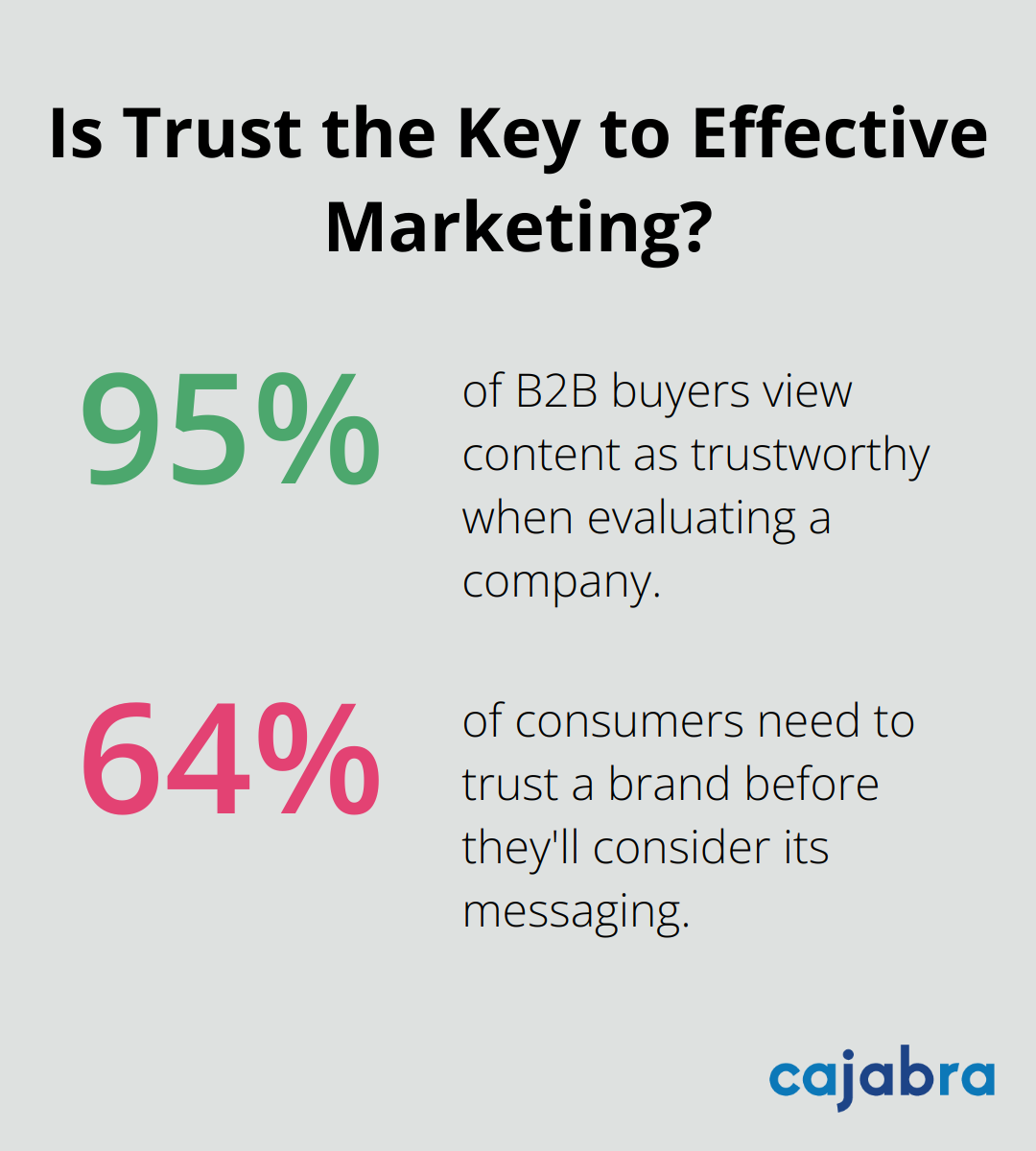
Create a resources section with helpful articles, tax calculators, or downloadable guides. This positions your firm as a valuable source of information, not just a service provider. A study by the Content Marketing Institute found that 95% of B2B buyers view content as trustworthy when evaluating a company.
The Personal Touch
People do business with people, not faceless entities. Include a team page with professional photos and brief bios of key staff members. Highlight qualifications, but also include personal touches that make your team relatable. A survey by Edelman revealed that 64% of consumers need to trust a brand before they'll consider its messaging.
Client testimonials and case studies build trust powerfully. Feature these prominently throughout your site. Use specific examples of how you've helped clients overcome challenges or achieve goals. Numbers speak volumes – if you saved a client $10,000 in taxes, say so.
Easy Contact Options
Your contact information should appear on every page, preferably in the header or footer. Include multiple contact methods – phone, email, and a contact form at minimum. Consider adding a live chat feature for immediate engagement. Almost ⅔ of buyers expect a response within 10 minutes to any marketing, sales, or customer service inquiry.
Place CTAs strategically throughout your site. These should be action-oriented and specific. Instead of "Contact Us," try "Get Your Free Tax Assessment." Make sure these buttons stand out visually from the rest of your page design.
An effective accounting firm website doesn't just exist online – it actively attracts and converts potential clients. The next section will explore how to optimize your site for search engines and user experience, ensuring your well-crafted website gets the visibility it deserves.
To further enhance your website's effectiveness, consider implementing practical tips and tools to boost engagement and grow your client base. Additionally, understanding your unique value proposition can help you stand out from competitors and attract your ideal clients.
How to Optimize Your Accounting Website for Search and Users
Master Site Structure and Navigation
A well-organized website improves both search engine rankings and user experience. Implement a clear, logical hierarchy in your site structure. Start with broad categories like Services, About Us, and Resources, then create subcategories as needed. For example, under Services, you might include Tax Preparation, Bookkeeping, and Business Advisory.
Use descriptive, keyword-rich URLs for each page. Instead of www.yourfirm.com/page1, opt for www.yourfirm.com/tax-preparation-services. This helps search engines understand your content and improves user navigation.
Make your main navigation menu intuitive and mobile-friendly. A study by the Nielsen Norman Group found that users are 89% more likely to stay on a site when it has clear navigation. Consider adding a search function to help visitors quickly find specific information.
Craft Valuable, Industry-Specific Content
Content reigns supreme in the digital world. Create in-depth, authoritative content that addresses your clients' pain points and questions. For example, write articles on topics like Tax Deductions for Small Businesses or How to Prepare for an IRS Audit.
Try a mix of evergreen content (always relevant) and timely updates (e.g., annual tax law changes). According to HubSpot, companies that blog regularly receive 55% more website visitors than those that don't.
Incorporate various content types to cater to different learning styles. This could include blog posts, infographics, videos, and downloadable guides. A diverse content strategy not only engages users but also gives search engines more material to index.
Leverage Keywords and On-Page SEO
While creating content, focus on incorporating relevant keywords naturally. Use tools like Google Keyword Planner or SEMrush to identify terms your potential clients search for. For instance, long-tail keywords like "best accountant for small business in [your city]" can be highly effective.
Optimize your on-page elements:
-
Title tags: Include your primary keyword and keep it under 60 characters.
-
Meta descriptions: Write compelling summaries of your page content in 155-160 characters.
-
Header tags (H1, H2, H3): Use these to structure your content and include relevant keywords.
-
Image alt text: Describe your images using keywords where appropriate.
Focus on creating valuable content for your users first, then optimize for search engines.
Prioritize Mobile and Speed
With 63.38% of web traffic coming from mobile devices, a mobile-responsive design is essential. Google's mobile-first indexing means your site's mobile version is now the primary one for ranking purposes.
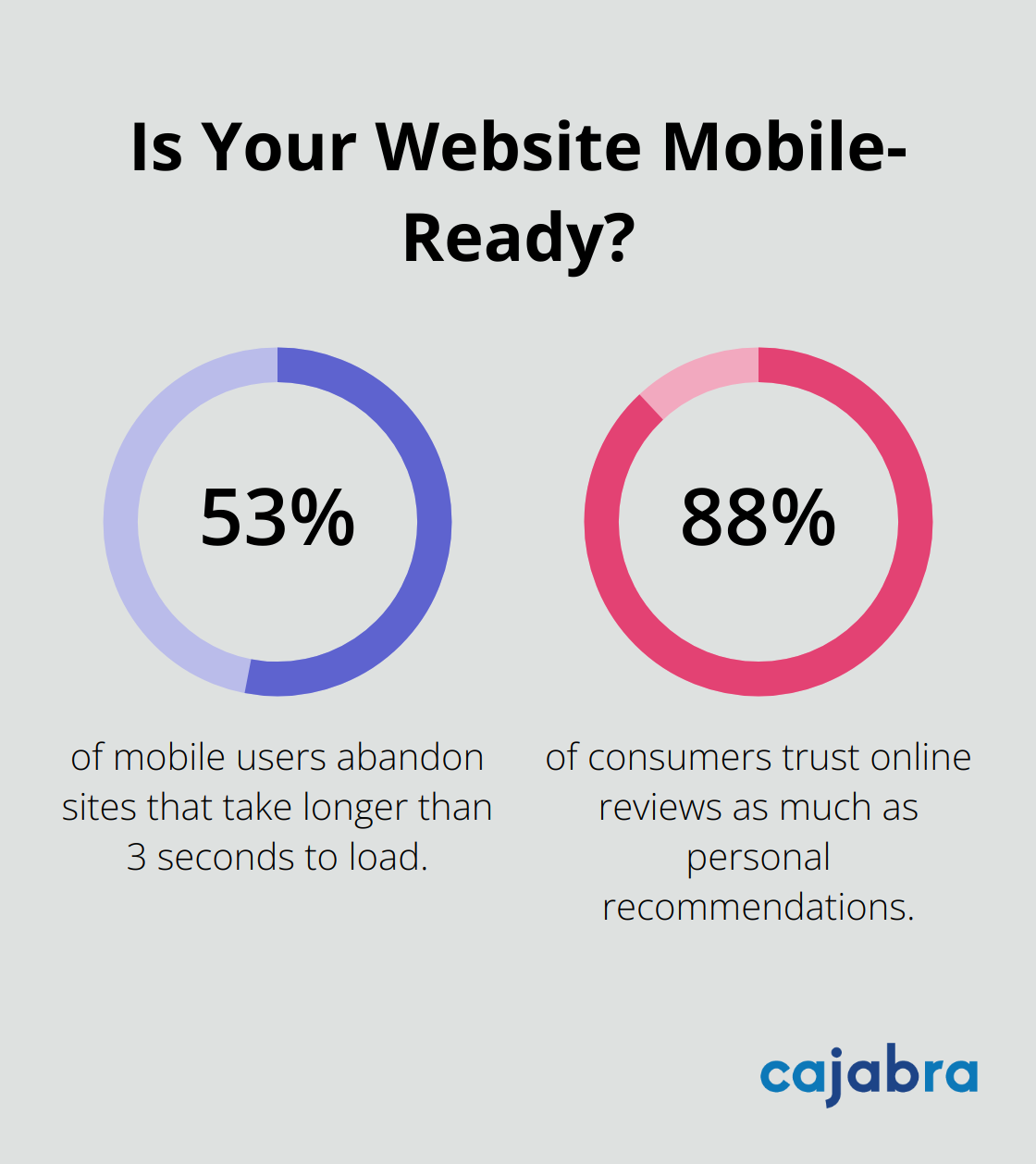
Page speed is equally important. According to Google, 53% of mobile users abandon sites that take longer than 3 seconds to load. Optimize your images, leverage browser caching, and consider using a content delivery network (CDN) to improve load times.
Use Google's PageSpeed Insights tool to identify specific areas for improvement on both mobile and desktop versions of your site.
Implement Local SEO Strategies
For accounting firms serving specific geographic areas, local SEO is vital. Claim and optimize your Google My Business listing with accurate information, photos, and regular posts. Encourage satisfied clients to leave reviews – 88% of consumers trust online reviews as much as personal recommendations.
Ensure your NAP (Name, Address, Phone number) is consistent across all online directories and your website. Consider creating location-specific pages if you serve multiple areas.
Participate in local business events and create content around local financial news or regulations. This not only boosts your local SEO but also establishes your firm as an active community member.
Final Thoughts
Building a website for your accounting firm establishes a strong online presence and attracts new clients. Websites for accounting firms serve as powerful tools for growth and client acquisition, acting as 24/7 marketing hubs. These digital platforms showcase expertise, build trust, and provide valuable information to visitors, effectively representing your firm's professionalism and capabilities.

Regular maintenance and updates keep your site secure, relevant, and performing optimally. Staying current with industry trends, tax law changes, and technological advancements ensures your website remains a valuable resource. Your website is an investment in your firm's future, positioning you to attract, engage, and retain clients in an increasingly digital world.
At Cajabra, we understand the unique challenges accounting firms face in the digital landscape. Our specialized marketing services, including our JAB System™, help accountants transform their online presence and secure retainer-based clients. You can focus on serving your clients while we handle the intricacies of digital marketing and website optimization.
A strong brand messaging strategy is the backbone of effective communication with your audience. At Cajabra, LLC, we've seen firsthand how powerful, consistent messaging can transform a company's market presence.
In this post, we'll guide you through the essential steps to build a brand messaging strategy that resonates with your target audience and sets you apart from competitors.
What Defines Your Brand's Core Identity
Uncovering Your Unique Value Proposition
Your unique value proposition (UVP) sets you apart from competitors. It's the reason clients choose you over others. To identify your UVP, ask yourself:
- What problem do you solve better than anyone else?
- What unique benefits do you offer?
- How do you deliver value differently from others?
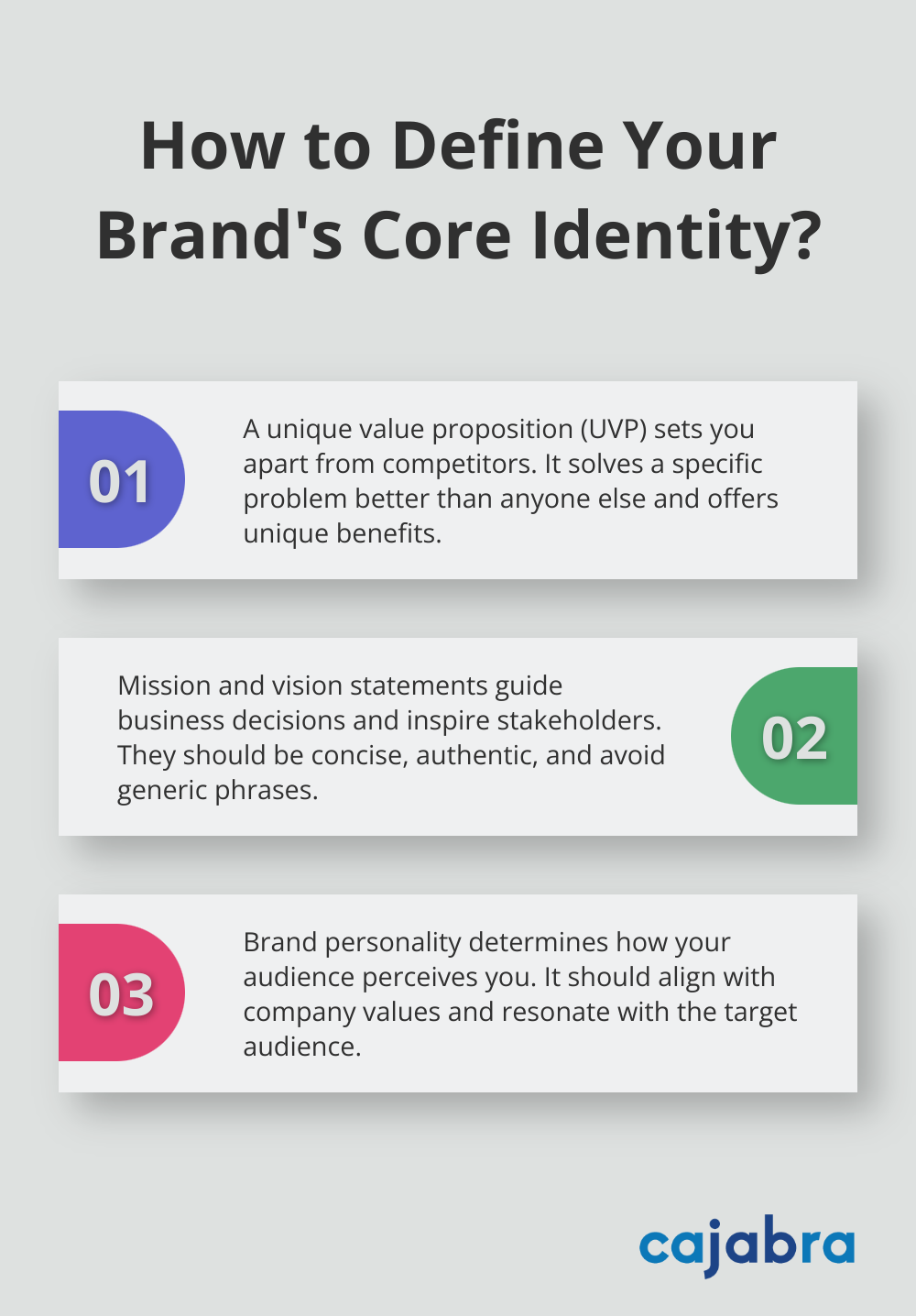
A clear, specific proposition immediately communicates your unique approach and the value you bring to clients. For instance, a specialized marketing service might offer a system that helps accountants secure retainer-based clients in a short timeframe (e.g., 90 days).
Crafting Your Mission and Vision
Your mission statement articulates your company's purpose, while your vision statement paints a picture of your desired future. These statements guide your business decisions and inspire your team and clients.
When you craft these statements, be concise and authentic. Avoid generic phrases and focus on what truly drives your business. For example, a mission could be to differentiate accounting firms through strong brand identity, tailored lead-generating websites, and effective sales funnels.
Shaping Your Brand's Personality and Voice
Your brand's personality is how you want your audience to perceive you. Are you professional and authoritative? Friendly and approachable? Innovative and cutting-edge? Your brand voice should reflect this personality consistently across all communications.
To determine your brand's personality and voice:
- List adjectives that describe your ideal brand perception
- Analyze your target audience's preferences and communication style
- Review successful competitors' brand voices for inspiration (but don't copy)
Authenticity is key. Your brand personality should align with your company's values and resonate with your target audience. If you target young entrepreneurs, a more casual and innovative voice might work well. If you serve established corporations, a more formal and authoritative tone could prove more effective.
Aligning Your Core Identity with Your Offerings
Your brand's core identity should seamlessly integrate with your products or services. This alignment creates a cohesive experience for your customers and reinforces your brand's credibility.
Consider how each element of your offering (whether it's a product, service, or tool) reflects your brand's core values and personality. For example, if your brand emphasizes innovation, your offerings should incorporate cutting-edge technology or novel approaches to solving problems.
Evolving Your Brand Identity
A strong brand identity isn't static; it evolves with your business and market changes. Regularly reassess your core identity elements to ensure they remain relevant and impactful.
This evolution doesn't mean completely overhauling your brand identity every few years. Instead, it involves making subtle adjustments to keep your brand fresh and aligned with your current business goals and market position.
As you define these core elements of your brand identity, you create a solid foundation for all your marketing efforts. This clarity helps you stand out in a crowded market and build stronger connections with your ideal clients. Now, let's explore how to translate this core identity into compelling brand messages that resonate with your audience.
Crafting Messages That Resonate
Tailoring Your Message to Different Audiences
Effective brand messaging speaks directly to your target audience's needs, desires, and pain points. Different segments of your audience may have varying priorities and concerns. For accounting firms, messages targeting small business owners might focus on cost-effective solutions and personalized service, while those aimed at larger corporations could emphasize scalability and advanced reporting capabilities.

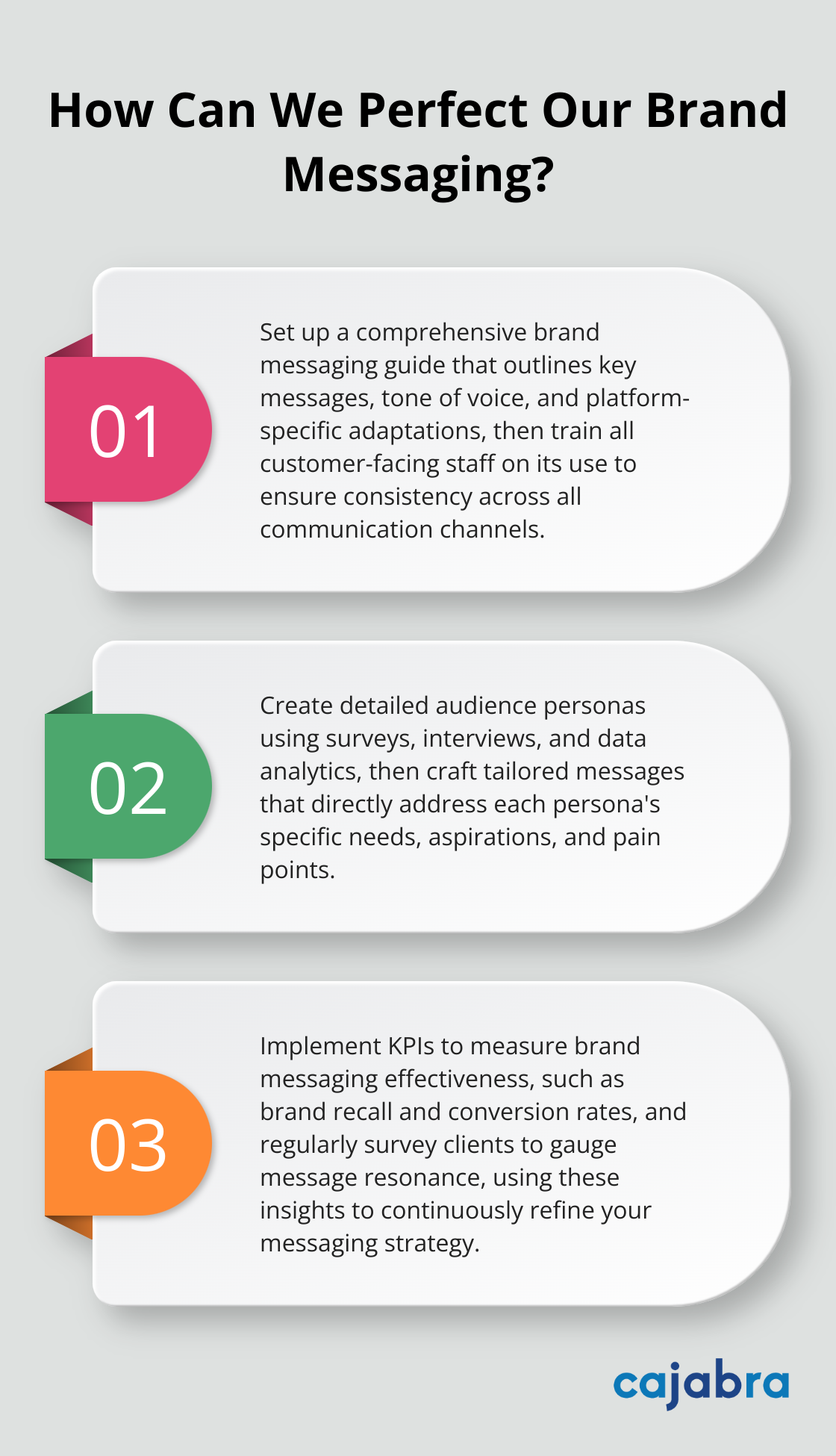
To tailor your messages effectively, develop detailed audience personas. These should go beyond basic demographics to include psychographic information like values, goals, and challenges. Use surveys, interviews, and data analytics to gather this information. Once you have these insights, craft messages that directly address each persona's specific needs and aspirations.
The Power of Storytelling in Brand Messaging
Humans connect with stories. They engage our emotions and make information more memorable. In brand messaging, storytelling can transform dry facts into compelling narratives that resonate with your audience. These real-world examples often include metrics related to KPIs, revealing how effective storytelling can drive customer engagement, enhance brand loyalty, and improve overall business performance.
Instead of simply stating that your accounting firm offers efficient tax services, tell the story of a client who saved thousands of dollars (and hours of stress) by working with you. Use specific details and emotional touchpoints to make the story relatable and impactful.
When incorporating storytelling, focus on:
- The challenge your client faced
- How your solution addressed their needs
- The positive outcome and its impact on their business
Keep your brand's voice consistent throughout these stories. If your brand personality is professional and authoritative, maintain that tone even in more narrative-driven content.
Maintaining Consistency Across Channels
Your audience should receive the same core messages whether they visit your website, read your social media posts, or interact with your sales team. To achieve this consistency:
-
Create a comprehensive brand messaging guide. This document should outline your key messages, tone of voice, and how to adapt your messaging for different platforms while maintaining its essence.
-
Train all customer-facing staff on your brand messaging. This includes not just marketing and sales teams, but also customer service representatives and even accounting professionals who interact with clients.
-
Regularly audit your communications across all channels to ensure consistency. This includes everything from your website copy to email signatures and social media bios.
-
Adapt your core messages for different platforms without losing their essence. For example, a LinkedIn post might use more professional language, while an Instagram story could be more casual and visual, but both should convey the same fundamental brand messages.
Evolving Your Message Strategy
Your brand messaging strategy should evolve as your business grows and market conditions change. Try to reassess your messaging periodically to ensure it remains relevant and impactful. This doesn't mean overhauling your entire strategy, but rather making subtle adjustments to keep your brand fresh and aligned with current business goals.
As you refine your brand messaging strategy, you'll create a solid foundation for all your marketing efforts. This clarity helps you stand out in a crowded market and build stronger connections with your ideal clients. The next step is to put this strategy into action across your organization.
How to Put Your Brand Messaging into Action
Implementing a brand messaging strategy requires more than just creating guidelines; it involves bringing your brand to life across every touchpoint. This chapter outlines key steps to effectively roll out your brand messaging.
Empower Your Team
Your employees act as your brand ambassadors. To ensure they accurately represent your brand, conduct comprehensive training sessions to educate employees on the firm's values and how to incorporate them into their daily responsibilities. These sessions should cover your brand's core values, key messages, and how to adapt them for different situations.

Create a comprehensive brand messaging playbook that all team members can easily access. This resource should include examples of how to use your brand voice in various contexts (from client emails to social media posts). Update this playbook regularly to reflect any changes in your messaging strategy.
Infuse Your Marketing Materials
Your marketing materials often serve as the first point of contact between your brand and potential clients. Audit all existing materials and update them to align with your new messaging strategy. This includes your website, brochures, social media profiles, and even email signatures.
When you create new marketing content, use a checklist to ensure it aligns with your brand messaging. This checklist should include questions like: Does this piece reflect our brand personality? Do we address our audience's specific pain points? Do we consistently use our key messages?
Tailor for Different Platforms
Each platform has unique characteristics and audience expectations. While your core message should remain consistent, you need to tailor the way you deliver it.
Make sure your logo, color palette, and messaging is universal across all social media platforms, as this aids in brand recognition. For LinkedIn, focus on professional insights and industry trends. On Instagram, use visuals to tell your brand story. For your website, create in-depth content that showcases your expertise. Email newsletters can be more personal, addressing your audience directly.
Monitor the performance of your messaging across different platforms. Use analytics tools to track engagement and adjust your approach based on what resonates most with your audience on each platform.
Measure and Refine
Implement key performance indicators (KPIs) to measure the effectiveness of your brand messaging. These could include metrics like brand recall, sentiment analysis, and conversion rates. Regularly survey your clients to gauge how well they understand and connect with your brand messages.
Use these insights to continuously refine your messaging. If certain messages don't resonate, adjust them. Brand messaging is an evolving process, not a one-time task.
Collaborate with Partners
If you work with external partners or agencies, fully brief them on your brand messaging strategy. Provide them with your brand messaging playbook and schedule regular check-ins to review their work for alignment with your brand's communication.
Final Thoughts
A strong brand messaging strategy forms the cornerstone of effective marketing for accounting firms. It encompasses not just the content of your communication, but also its tone and delivery across various channels. This approach creates a powerful brand presence that resonates with your target audience and sets you apart in a competitive landscape.
Your brand messaging strategy should adapt to your business growth and market changes. We at Cajabra have witnessed how a well-executed strategy can transform accounting firms from overlooked to overbooked. Our specialized marketing services help accountants secure retainer-based clients and position themselves as industry leaders.
As you refine your brand messaging strategy, stay true to your core values and listen to your audience. Implement your strategy with commitment and consistency, train your team thoroughly, and measure the effectiveness of your efforts. With persistence and the right approach, you'll create a brand that not only stands out but also builds lasting relationships with your clients.
In today's digital landscape, a strong online presence is essential for accounting firms. At Cajabra, LLC, we've seen firsthand how a well-designed website can transform an accounting practice.
This guide will explore the key elements that make up the top 100 accounting websites, helping you create a powerful online platform for your firm. We'll cover everything from design principles to SEO strategies, ensuring your website stands out in a competitive market.
What Makes an Accounting Website Effective?
Design That Speaks Volumes
A clear, professional design sets the tone for your accounting website. Your site often provides the first impression potential clients have of your firm. A cluttered or outdated design can repel visitors within seconds. Try to create a clean, modern look that reflects your firm's professionalism. Select a color scheme that aligns with your brand and apply it consistently throughout the site.
Navigation That Guides
User-friendly navigation plays a critical role in website effectiveness. Visitors should locate what they seek in three clicks or less. A well-structured menu with clear labels helps users explore your services effortlessly. Consider adding a search function for larger sites (this can significantly improve user experience). Poor navigation frustrates users and may lead them to seek services elsewhere.
Mobile-First Approach
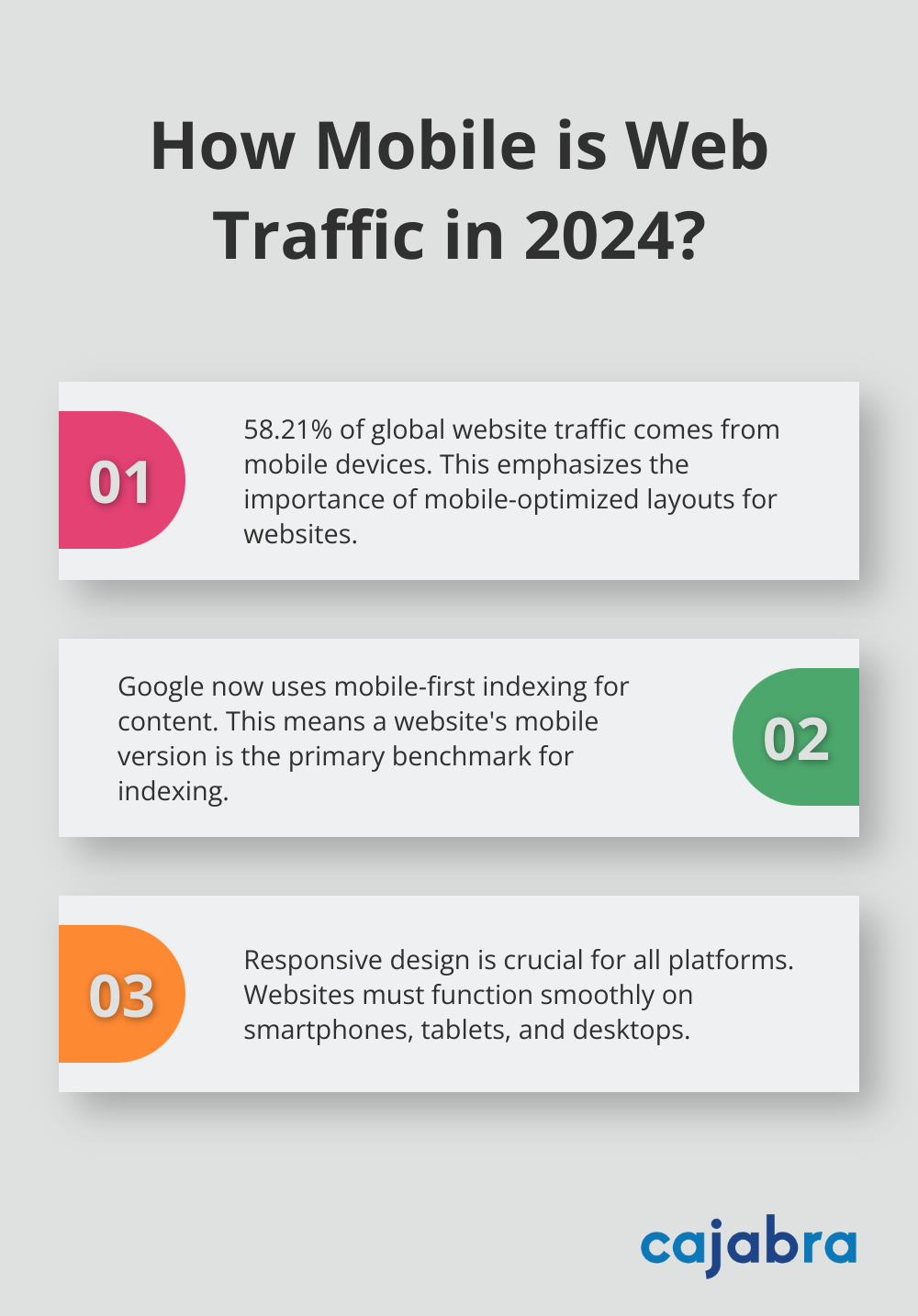
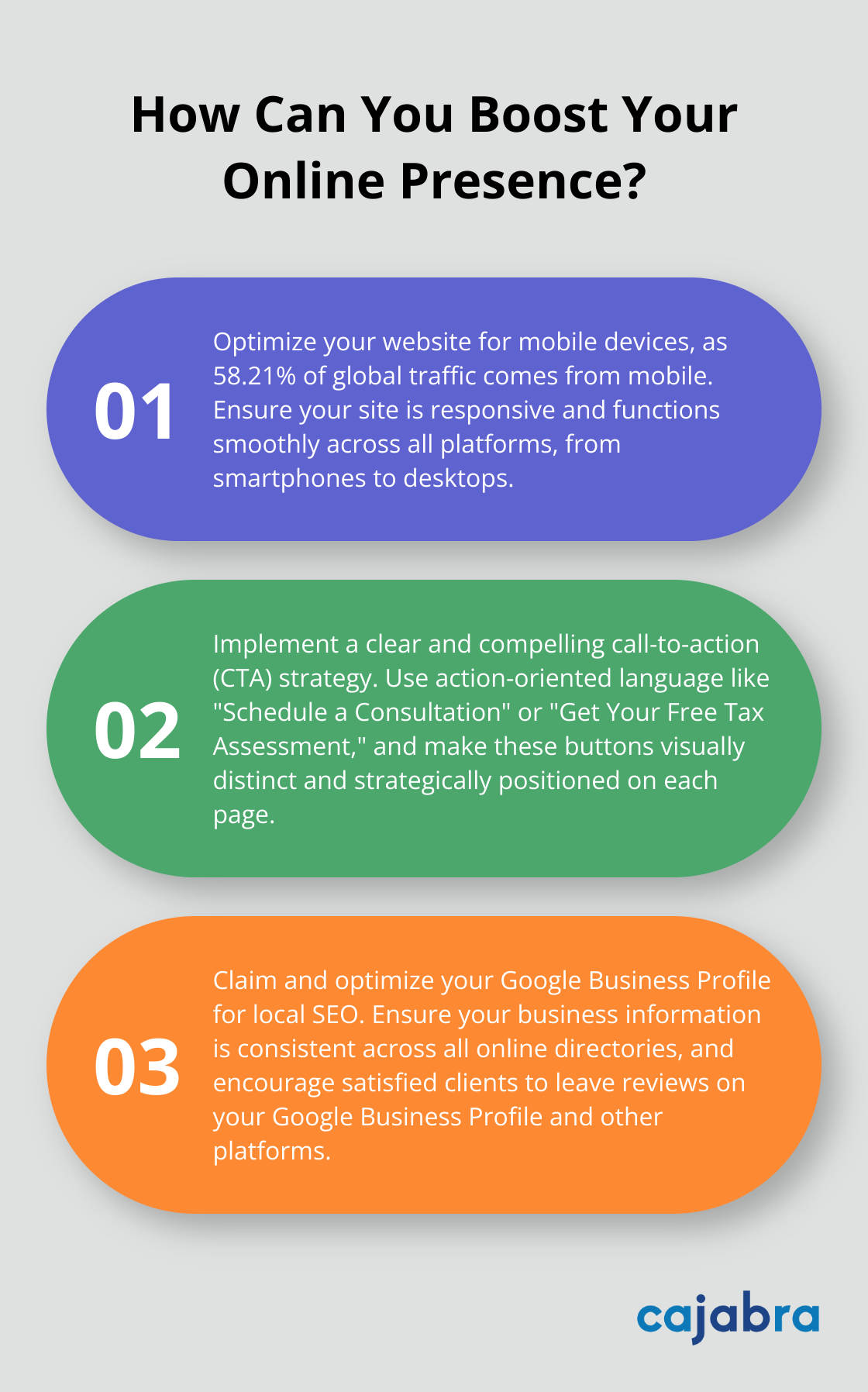
A responsive, mobile-optimized layout is no longer optional. With 58.21% of global website traffic originating from mobile devices, your site must look great and function smoothly across all platforms (from smartphones to desktops). Google's mobile-first indexing now uses your site's mobile version as the benchmark for content indexing, making mobile optimization even more critical.
Calls-to-Action That Convert
Strong calls-to-action (CTAs) guide visitors towards becoming clients. Place clear, compelling CTAs throughout your site. Use action-oriented language like "Schedule a Consultation" or "Get Your Free Tax Assessment." Make these buttons visually distinct and position them strategically on each page.
Content That Engages and Informs
High-quality, relevant content establishes your expertise and builds trust with potential clients. Include informative blog posts, whitepapers, or video tutorials that address common accounting questions and concerns. This not only provides value to visitors but also improves your site's search engine rankings.
Implementing these elements effectively can significantly boost your website's performance. However, creating a high-performing accounting website requires specialized expertise. This is where services like those offered by Cajabra come into play. Their Premium Online Presence Package aims to modernize accounting websites and optimize digital footprints, helping firms stand out in the crowded online space. As we move forward, let's explore the key features you should include on your accounting website to maximize its impact and effectiveness.
Essential Features for Your Accounting Website
Showcase Your Services
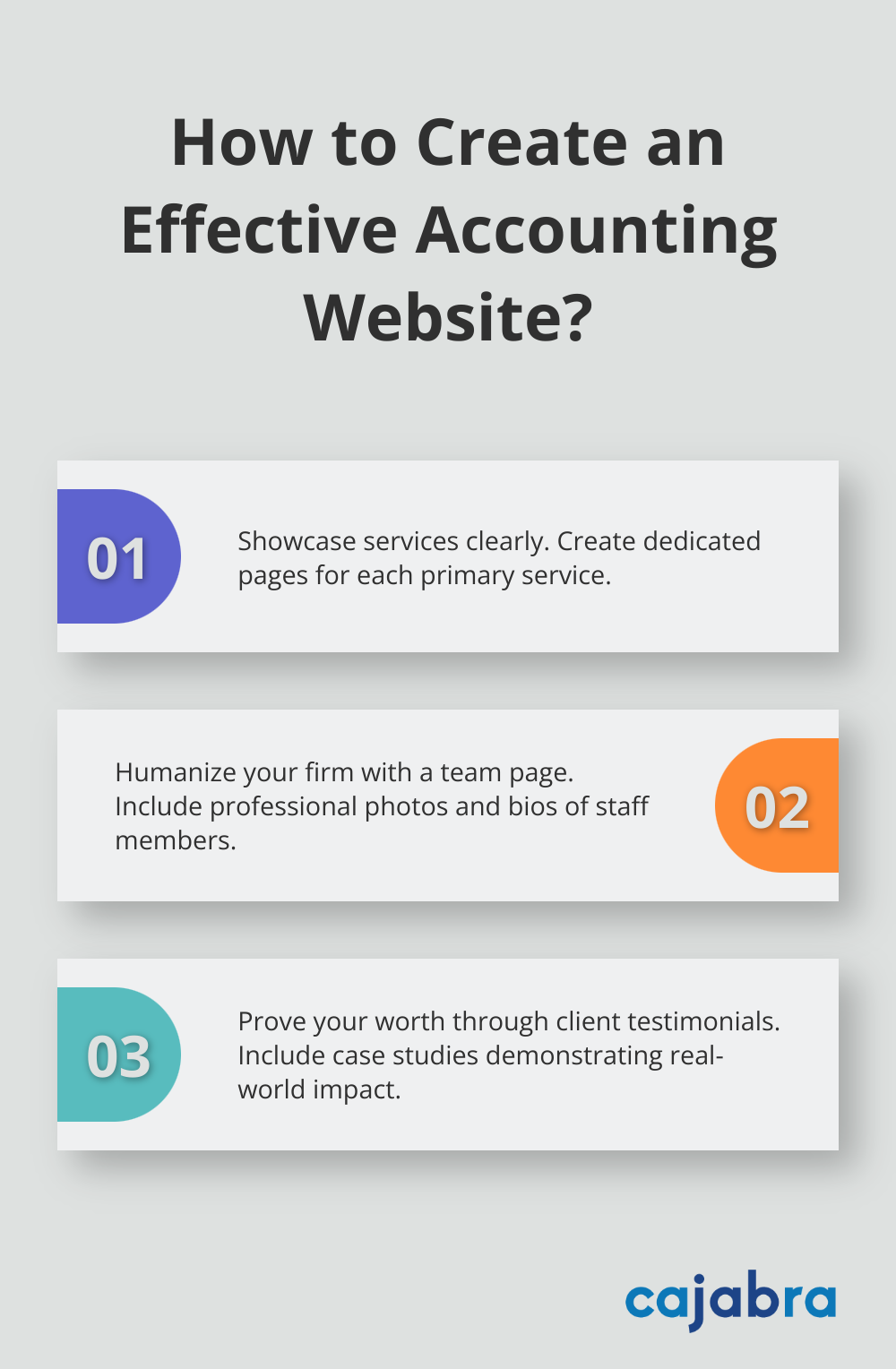
Your website must clearly communicate your offerings. Create dedicated pages for each of your primary services. Detail your approach and the benefits clients can expect. If you specialize in tax preparation for small businesses, explain your process, highlight any unique methodologies, and emphasize the time and stress you'll save your clients.
Humanize Your Firm
Potential clients want to know who they'll work with. Include a team page with professional photos and bios of your staff. Highlight qualifications and certifications, but also personal interests or community involvement. This approach humanizes your firm and helps potential clients feel more connected.
Prove Your Worth
Results speak louder than words. Include a section for client testimonials and case studies. These provide social proof and demonstrate the real-world impact of your services. When featuring case studies, focus on specific challenges you've helped clients overcome and the measurable results achieved.
You might share how you helped a local restaurant reduce their tax liability through strategic planning, or how your bookkeeping services saved a startup administrative work hours.
Educate and Engage
Position your firm as a thought leader by providing valuable resources and educational content. This could include blog posts on recent tax law changes, video tutorials on bookkeeping best practices, or downloadable guides on financial planning for small businesses.
Keep Content Fresh
The accounting landscape changes constantly. Your website should reflect the most current information and trends. Update your content regularly. This practice not only helps your clients but also boosts your search engine rankings.
These essential features will create a powerful online presence that attracts, engages, and converts potential clients. Now, let's explore strategies for optimizing your site for search engines and maximizing conversions.
Maximizing Your Accounting Website's Impact
Master Your Keyword Strategy
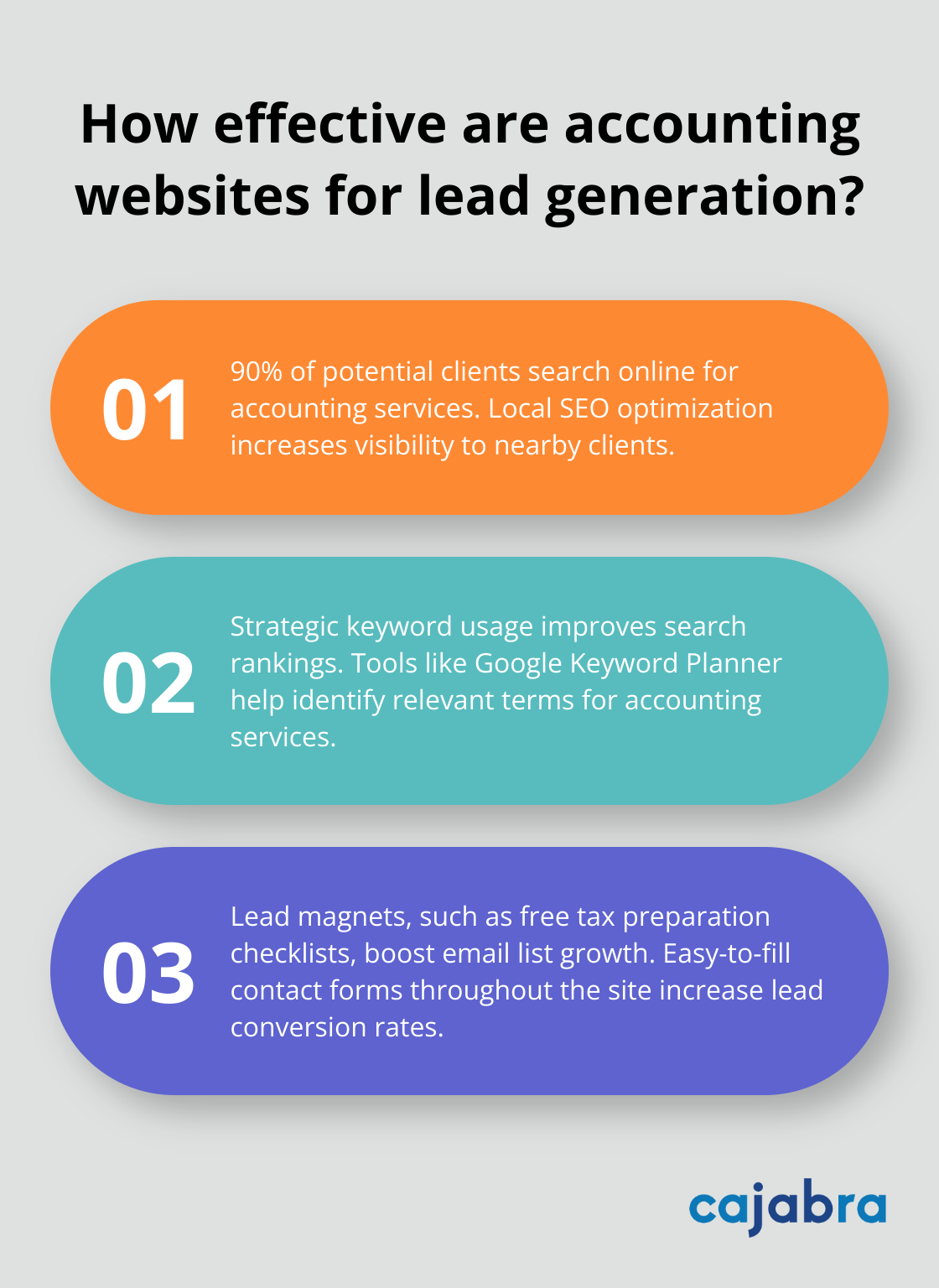
Research keywords relevant to your accounting services. Tools like Google Keyword Planner or SEMrush help identify terms potential clients use when searching for accounting services. Incorporate your target keywords naturally into your website's content, headers, and meta descriptions.
For example, if you specialize in small business accounting, target phrases like "small business tax preparation" or "bookkeeping services for startups". Use these keywords in your page titles, headers, and throughout your content. Avoid keyword stuffing, as it can harm your rankings.
Dominate Local Search
Local SEO proves essential for accounting firms. Most clients seek accountants in their area, so optimizing for local search increases your visibility to nearby potential clients.
Claim and optimize your Google Business Profile. Ensure your business name, address, and phone number remain consistent across all online directories. Ask satisfied clients to leave reviews on your Google Business Profile and other platforms (like Yelp).
Create location-specific pages on your website if you serve multiple areas. For instance, if you're based in New York but also serve New Jersey, create separate pages optimized for "New York accounting services" and "New Jersey accounting services".
Convert Visitors into Leads
Transform your website into a lead-generating machine. Implement strategically placed contact forms throughout your site. Make these forms easy to fill out and only ask for essential information.
Offer a lead magnet, such as a free tax preparation checklist or a guide to small business accounting, in exchange for contact information. This provides value to potential clients and helps build your email list for future marketing efforts.
Track and Improve Performance
Use analytics tools like Google Analytics to track your website's performance. Monitor key metrics such as bounce rate, time on site, and conversion rate. This data provides valuable insights into user behavior and helps you identify areas for improvement.
Set up goal tracking to measure specific actions (form submissions or downloads of your lead magnet). This allows you to see which pages and content generate leads most effectively.
Try A/B testing. Test different versions of your call-to-action buttons or landing pages to see which performs better. For example, test whether "Get Your Free Consultation" or "Schedule a Tax Review" generates more clicks.
Final Thoughts
Creating a top-performing accounting website demands careful planning and execution. We explored the essential elements that make up the top 100 accounting websites, from clear design to effective SEO strategies. Your website requires regular updates and maintenance to stay fresh, relevant, and perform at its best.
At Cajabra, we understand the unique challenges accountants face in creating and maintaining a high-performing website. Our specialized marketing services (including our Premium Online Presence Package) help accounting firms stand out in a competitive digital landscape. We handle all aspects of your online presence, from website design to SEO optimization.
Don't let your website hold your firm back. Partner with Cajabra to create a website that ranks among the top 100 accounting websites and drives real results for your business. Let's work together to transform your online presence and take your accounting practice to new heights.
In today's digital landscape, accounting firms need more than just expertise; they need a powerful online presence. At Cajabra, LLC, we've seen firsthand how accounting consulting websites can make or break a firm's success.
A well-designed website isn't just a digital brochure; it's a client-converting powerhouse. This post will guide you through the essential elements of creating an accounting website that not only attracts visitors but turns them into loyal clients.
Why Your Accounting Website Matters
The Digital Storefront of Your Firm
In the digital age, your accounting firm's website serves as your virtual storefront. It often provides the first impression to potential clients, making it a critical asset for growth and success in the competitive accounting industry.
Powering Client Acquisition and Retention
A well-designed website acts as a tireless salesperson for your accounting firm. A study by Hinge Marketing reveals that 80% of professional services buyers examine a firm's website before making a purchase decision. This statistic highlights the website's pivotal role in attracting new clients.
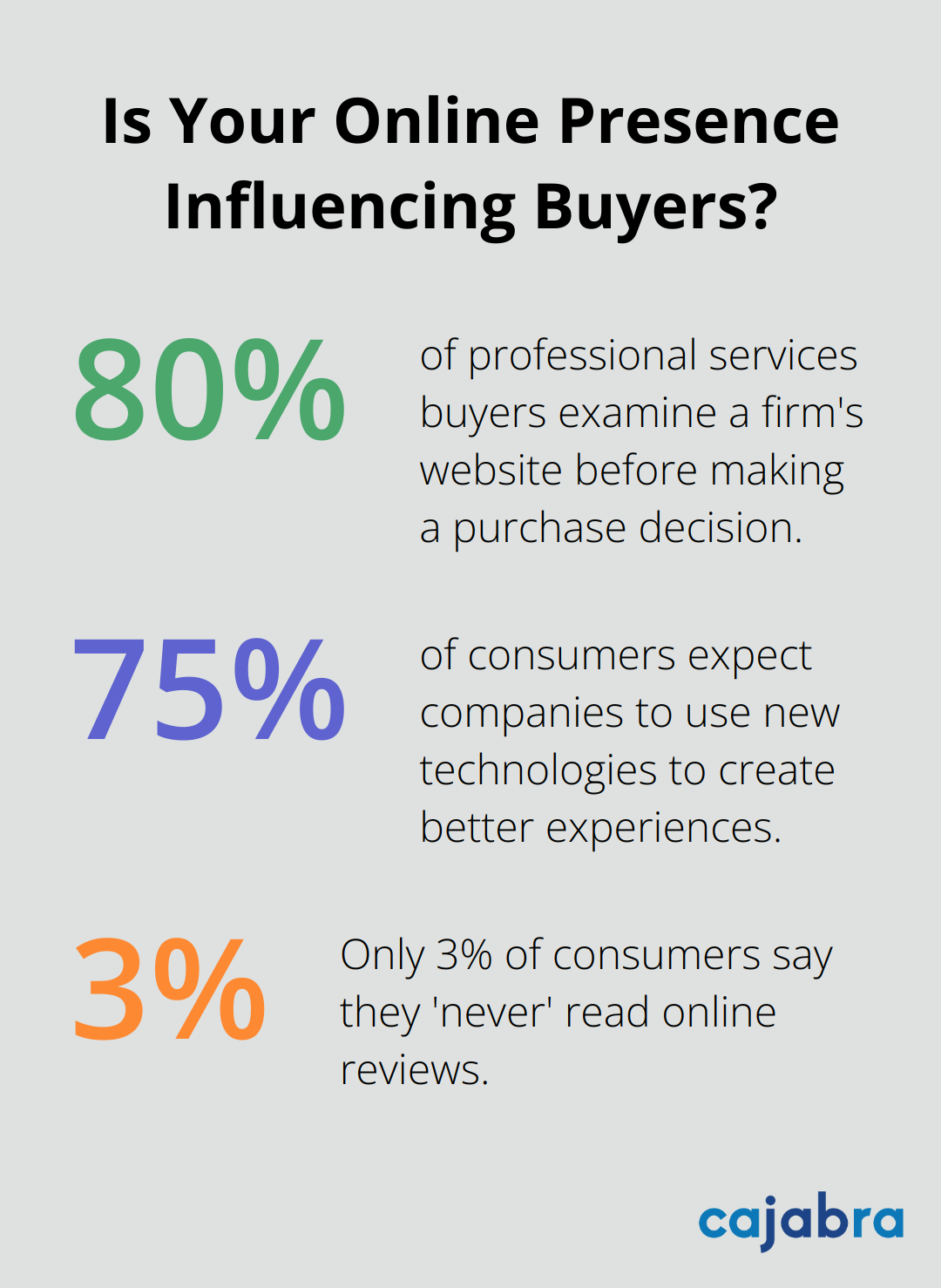
Your website also proves invaluable for client retention. It provides easy access to resources, client portals, and up-to-date information, which enhances client satisfaction and loyalty. A Salesforce survey found that 75% of consumers expect companies to use new technologies to create better experiences (a clear indication of the importance of a modern, user-friendly website).
Building Trust and Credibility
In the accounting world, trust reigns supreme. Your website offers a powerful platform to build that trust. You can establish credibility even before a potential client reaches out by showcasing your expertise through thought leadership content, client testimonials, and case studies.
A recent study found that only 3% of consumers say they 'never' read online reviews, reflecting how ingrained reviews are in most consumers' business research. For accounting firms, this translates to featuring client testimonials prominently on your website, which can significantly impact your perceived trustworthiness.
Differentiating in a Crowded Digital Landscape
With thousands of accounting firms competing for attention online, a generic website falls short. Your website must clearly communicate your unique value proposition and set your firm apart from competitors.
One effective strategy to stand out involves highlighting specialized services or niche expertise. For example, if your firm excels in tax planning for small businesses, your website should emphasize this focus throughout its content and design.
Data-Driven Continuous Improvement
A high-converting website evolves based on user behavior and performance data. Tools like Google Analytics provide valuable insights into how visitors interact with your site, allowing you to make data-driven improvements.
For instance, a high bounce rate on your services page might indicate that the content lacks engagement or the layout confuses visitors. Continuous analysis and optimization of your website can improve its performance and, ultimately, your conversion rates.
As we move forward, we'll explore the key elements that transform a good accounting website into a great one. These components work together to create a powerful online presence that not only attracts visitors but converts them into loyal clients.
Crafting a Website That Converts Clients
At the heart of every successful accounting firm's online presence lies a website that not only attracts visitors but also converts them into loyal clients. This chapter explores the key elements that transform a standard website into a powerful client-generating tool.
Communicate Your Unique Value
Your website's homepage must answer the question, "Why should potential clients choose your accounting firm?" A clear, concise, and compelling value proposition sets the tone for your entire online presence. Instead of generic statements, opt for specific, benefit-oriented messages. For example: "We help small businesses reduce tax liability by an average of 15%."
Design for User Experience
A Stanford University study found that 75% of users judge a company's credibility based on their website's design. Your site should captivate visitors visually and offer intuitive navigation. Implement a clean, professional design with a color scheme that aligns with your brand. Create a logical and easy-to-use menu structure. Users who can't find what they need within seconds will likely leave your site.
Showcase Your Expertise
Potential clients seek assurance that they're in capable hands. Your website should demonstrate your expertise through high-quality content. Consider including:
-
Blog posts about recent tax law changes
-
Downloadable guides on financial planning
-
Video tutorials on using accounting software

Companies that blog receive 97% more links to their website (according to HubSpot), which significantly boosts online visibility and perceived authority.
Leverage Social Proof
77% of consumers 'always' or 'regularly' read online reviews when browsing for local businesses. Your website should feature:
-
Client testimonials
-
Case studies
-
Relevant awards or certifications
These elements build trust and illustrate the real-world impact of your services. For instance, you could highlight a case study showing how you helped a local business save $50,000 in taxes through strategic planning.
Guide Visitors to Action
Every page on your website should serve a clear purpose and guide visitors towards taking action. Use prominent, strategically placed calls-to-action (CTAs) throughout your site. These could be buttons or links inviting visitors to:
-
"Schedule a Free Consultation"
-
"Download Our Tax Savings Guide"
-
"Get a Quote"
Ensure these CTAs stand out visually and use action-oriented language.
The elements discussed in this chapter form the foundation of a high-converting accounting website. However, creating a website is just the first step. The next chapter will explore how to optimize your site for maximum conversions, turning visitors into valuable clients.
Maximizing Website Conversions for Accounting Firms
Capture Leads with Irresistible Offers
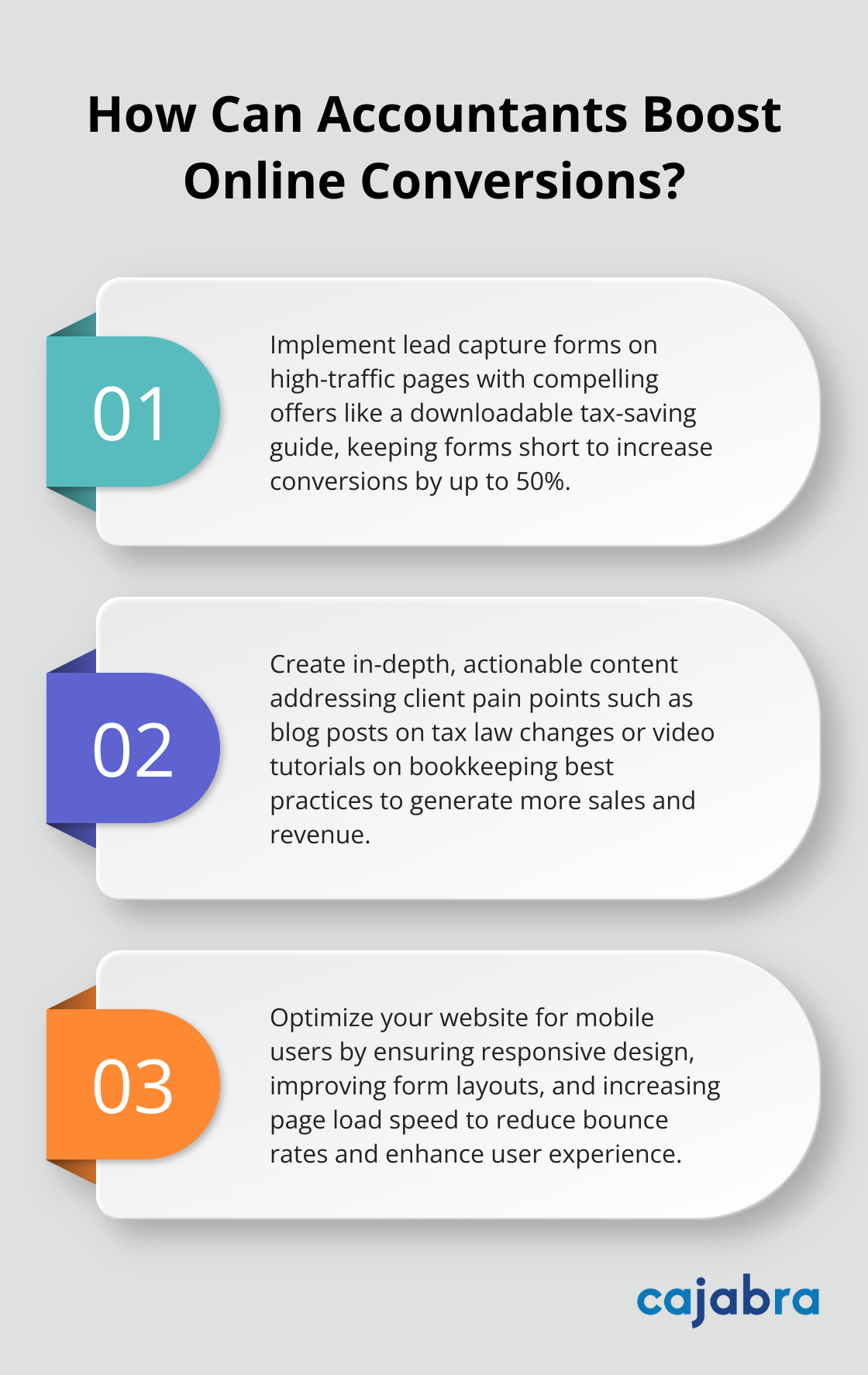
Implement lead capture forms strategically throughout your website. These forms should offer something of value in exchange for contact information. Create a downloadable guide on "10 Tax-Saving Strategies for Small Businesses" or a free tax planning checklist. Place these offers on high-traffic pages and use compelling headlines to grab attention.
Research shows that eliminating just one field can increase conversions by a whopping 50%. Keep your forms short, ask only for essential information like name and email address. This approach will significantly increase your lead generation efforts.
Develop Content That Solves Client Problems
Create valuable content that addresses your target audience's pain points. This could include blog posts on recent tax law changes, video tutorials on bookkeeping best practices, or infographics explaining complex financial concepts.

According to the Content Marketing Institute, 58% of B2B marketers say content marketing helped them generate sales/revenue in the last 12 months, up from 42% the previous year. Focus on creating in-depth, actionable content that showcases your expertise and provides real value to potential clients.
Leverage Technology for Instant Engagement
Implement chatbots on your website to provide instant responses to visitor inquiries. These AI-powered tools can answer common questions, schedule consultations, and even qualify leads 24/7. A study by Drift found that businesses using chatbots see a 67% increase in sales.
Program your chatbot with accurate information about your services, pricing, and availability. This immediate engagement can significantly improve user experience and increase the likelihood of conversion.
Optimize for Mobile Users
With over 50% of global web traffic coming from mobile devices (according to Statista), mobile optimization is no longer optional. Ensure your website is responsive and provides a seamless experience across all devices.
Pay special attention to mobile form design, button sizes, and page load times. Google's Mobile-Friendly Test tool can help identify areas for improvement in your mobile site design.
Accelerate Page Load Speed
Website speed directly impacts user experience and conversions. According to Google, as page load time increases from 1 to 3 seconds, the probability of bounce increases by 32%. Optimize your site's speed by:
- Compressing images without sacrificing quality
- Minimizing HTTP requests
- Leveraging browser caching
- Using a content delivery network (CDN)
Tools like Google's PageSpeed Insights can provide specific recommendations for improving your site's load time.
Final Thoughts
Creating a high-converting website for your accounting firm requires ongoing refinement and optimization. We explored essential elements that make accounting consulting websites effective client-conversion tools. These components attract and retain clients through clear value propositions, user-friendly designs, compelling content, and strategic CTAs.
Your website reflects your expertise and builds trust as the digital face of your accounting firm. It guides potential clients to take action through lead capture forms, valuable content, chatbots, mobile optimization, and improved page load speeds. The digital landscape evolves constantly, necessitating regular testing, analysis, and improvements based on user behavior and industry trends.
At Cajabra, we help accounting firms create and optimize websites that convert visitors into loyal clients. Our JAB System™ moves accountants from overlooked to overbooked in 90 days. We offer comprehensive solutions, including website modernization and digital footprint optimization. Partner with Cajabra to focus on your expertise while we handle your online presence and marketing efforts.
In today's crowded marketplace, standing out is harder than ever. At Cajabra, LLC, we know that a creative messaging strategy is the key to capturing your audience's attention and building lasting connections.
Brand storytelling goes beyond mere marketing; it's about crafting a narrative that resonates with your customers on a deeper level. This blog post will explore how to create compelling brand stories that not only differentiate your business but also foster trust and loyalty among your target audience.
Why Brand Stories Matter
Brand stories are not just marketing fluff; they are powerful tools that transform businesses. At their core, brand stories create deep connections with customers, helping companies stand out in a sea of competitors.
Forging Emotional Bonds
People don't buy products; they buy into stories. A study by Headstream revealed that if people love a brand story, 55% are more likely to buy the product in the future. This statistic underscores the importance of narratives that resonate with your audience on an emotional level.

To create these emotional bonds, companies should focus on shared values and experiences. Patagonia's brand story, for example, centers on environmental activism, attracting customers who share their passion for conservation. When a brand aligns its story with customers' values, it creates a sense of belonging that transcends mere transactions.
Standing Out in a Crowded Market
In today's saturated markets, a unique brand story can become a secret weapon. An Edelman report found that nearly two-thirds (64 percent) of consumers around the world will buy or boycott a brand solely because of its position on a social or political issue. This demonstrates that a well-crafted brand story can significantly differentiate a company.
Companies should identify what makes their brand truly unique to leverage this advantage. Is it the origin story? The mission? The approach to customer service? Once pinpointed, this unique aspect should weave into every facet of brand communication.
Building Trust and Fostering Loyalty
Trust forms the foundation of any lasting relationship, including those between brands and customers. A compelling brand story builds this trust by showcasing a company's values, mission, and authenticity.
The 2019 Edelman Trust Barometer Special Report revealed that 81% of consumers need to trust a brand before they'll buy from them. Sharing a brand's journey (including both successes and challenges) creates transparency that fosters trust.
Moreover, when customers trust a brand, they're more likely to become loyal advocates. A study by Motista found that customers with an emotional connection to a brand have a 306% higher lifetime value and stay with a brand for an average of 5.1 years (vs 3.4 years for those without such a connection).
As we move forward, it's clear that brand stories play a pivotal role in shaping customer perceptions and driving business success. The next section will explore the key elements that make these stories truly effective.
What Makes Brand Stories Stick?
The Power of Authenticity
Authenticity forms the foundation of any compelling brand story. In an era where consumers face a barrage of marketing messages, they've honed their ability to detect insincerity. A Stackla study revealed that 88% of consumers consider authenticity important when deciding which brands to like and support, with 50% saying it's very important.

To achieve authenticity, brands must embrace transparency about their journey. This includes sharing both triumphs and setbacks. Airbnb, for instance, openly discusses how they overcame early challenges, which humanizes their brand and builds trust with their audience.
Aligning Values with Mission
Clear brand values and a well-defined mission prove essential for creating a story that resonates. The 2018 Edelman Earned Brand study found that 64% of consumers choose, switch, avoid or boycott a brand based on its stance on societal issues.
Patagonia exemplifies this alignment. Their mission to "build the best product, cause no unnecessary harm, use business to inspire and implement solutions to the environmental crisis" permeates every aspect of their brand story. This clear connection between values and mission has earned them a fiercely loyal customer base.
Consistency Across Touchpoints
A brand story loses its impact if it lacks consistency across all platforms and touchpoints. A Lucidpress study indicates that consistent brand presentation across all platforms can increase revenue by up to 23%.
This consistency requires that your brand story reflects in everything from your website and social media to your customer service interactions and product packaging. Starbucks excels at this, maintaining a consistent narrative of creating a "third place" between work and home across all their touchpoints.
The Human Element
Effective brand stories often feature relatable characters or personas (which could be founders, employees, or even customers). A Nielsen study found that 92% of consumers trust earned media, such as recommendations from friends and family, above all other forms of advertising.
Dollar Shave Club masterfully used their founder as a relatable character in their viral launch video, which helped catapult the brand to success. By putting a face to the brand, they created an immediate connection with their audience.
As we move forward, we'll explore specific techniques that can help you craft these compelling brand messages, turning your story into a powerful tool for customer engagement and business growth.
How to Craft Messages That Resonate
Harness the Power of Storytelling
Stories captivate humans for millennia, and they remain powerful in modern marketing. Structure your brand message like a story, with a clear beginning, middle, and end. Identify your brand's origin story or core mission. Highlight the challenges you've faced and overcome. Showcase how your solutions benefit customers.

Warby Parker's story of disrupting the eyewear industry by offering affordable, stylish glasses directly to consumers exemplifies this approach. This narrative explains their business model and positions them as innovators and problem-solvers.
Leverage Social Proof
The voices of satisfied customers speak louder than any marketing claim. Incorporate customer testimonials and user-generated content into your brand messaging to boost credibility and trust.
Ask your happy clients to share their experiences. Feature these testimonials prominently on your website, social media, and marketing materials. Airbnb's "Stories from the Airbnb Community" campaign showcases real experiences from hosts and guests, adding authenticity to their brand message.
Embrace Visual Storytelling
In our increasingly visual digital world, images and videos serve as powerful tools for brand messaging. Visual content conveys complex ideas quickly and evokes emotions more effectively than text alone.
Create infographics to present data in an engaging way. Develop short videos that showcase your products or services in action. Use high-quality images that reflect your brand's personality and values. GoPro's Instagram feed (filled with user-generated content showing their cameras in action) effectively communicates the brand's adventurous spirit.
Back Your Claims with Data
While emotional connections matter, don't underestimate the power of hard facts. Incorporate relevant data and statistics into your brand messaging to lend credibility to your claims and help you stand out as an authority in your field.
When discussing marketing services, don't just say they work - highlight specific outcomes. For example, Cajabra's JAB System™ moves accountants from overlooked to overbooked in just 90 days. This specific timeframe gives potential clients a concrete expectation and demonstrates confidence in the system's effectiveness.
Always cite your sources when using external data. This transparency enhances your credibility and allows interested parties to verify the information.
Tailor Your Message to Your Audience
Understand your target audience's needs, pain points, and preferences. Craft messages that directly address these aspects. Use language and tone that resonates with your specific audience.
For instance, if you target small business owners, focus on how your product or service saves time and money (two precious resources for this demographic). If you aim at millennials, emphasize sustainability and social responsibility in your messaging.
Final Thoughts
Creative messaging strategies form the core of successful brands in today's competitive marketplace. We explored the power of brand storytelling, its key elements, and techniques for crafting compelling messages. Authenticity, emotional connection, and consistency play vital roles in developing your brand's narrative.

Take a fresh look at your own brand story and identify what makes your company unique. Communicate your values and mission in a way that resonates with your target audience. A well-crafted brand story will differentiate you from competitors, build trust with customers, and foster long-term loyalty.
At Cajabra, we help accounting firms develop powerful brand stories and marketing strategies. Our JAB System™ moves accountants from overlooked to overbooked in 90 days (securing retainer-based clients and maximizing revenue). We offer tailored solutions to enhance your online presence and position your firm as an industry leader.
At Cajabra, LLC, we know that a strong messaging strategy is the backbone of effective communication with your audience.
A well-crafted messaging strategy template can help you align your brand's voice, values, and offerings with your customers' needs and expectations.
In this post, we'll guide you through the essential steps to create a powerful messaging strategy that resonates with your target audience and drives results.
Who Is Your Target Audience?
Conduct Thorough Market Research
Understanding your target audience forms the foundation of any successful messaging strategy. Start by collecting data on your potential customers. Use Google Analytics to understand website visitors and their content engagement. Social media analytics provide valuable insights into follower demographics and interests. Analyze your competitors' audiences to reveal untapped market segments.

A recent study found that companies that meet or exceed revenue targets are 2.4 times more likely to use personas effectively than those that miss their targets. This statistic highlights the importance of thorough market research in driving business success.
Create Detailed Buyer Personas
After data collection, bring your ideal customers to life through buyer personas. These detailed profiles extend beyond basic demographics to include psychographics, behavior patterns, and motivations.
For example, a small business owner persona might include:
-
Age range: 35-50
-
Education: Bachelor's degree in business (or related field)
-
Pain points: Time management and financial planning challenges
-
Goals: 20% business revenue growth in the next year
-
Preferred communication channels: Email and LinkedIn
Create multiple personas if you target different segments. The more specific you are, the more effectively you can tailor your messaging.
Identify Key Pain Points and Desires
To create resonant messaging, understand what keeps your audience awake at night and what they aspire to achieve. Conduct surveys, interviews, or focus groups with existing clients or potential customers to uncover these insights.
Ask questions such as:
-
What's the biggest challenge you face in your business right now?
-
If you had a magic wand, what one thing would you change about your current situation?
-
What does success look like for you in the next 1-3 years?
These questions can reveal valuable information to inform your messaging strategy. For instance, if many target customers express frustration with complex accounting software, highlight how your services simplify financial management in your messaging.
This deep understanding of your target audience sets the stage for crafting a core message that truly resonates with your ideal customers. The next step involves translating these insights into a compelling value proposition and brand story that speaks directly to your audience's needs and aspirations.
How to Craft a Core Message That Resonates
Define Your Unique Value Proposition
Your unique value proposition (UVP) forms the cornerstone of your messaging strategy. It distinguishes you from competitors and addresses your clients' needs directly. For accounting firms, this could involve specialized industry expertise, innovative technology use, or exceptional customer service.

To develop your UVP:
- List your firm's strengths
- Compare them to your competitors
- Align these strengths with your target audience's pain points and desires
For example, if small business owners struggle with time management, your UVP might highlight how your AI-powered tools can enhance efficiency in financial tasks.
Develop a Compelling Brand Story
Stories connect with people more effectively than facts and figures alone. Your brand story should intertwine your firm's history, values, and mission in a way that emotionally resonates with your audience. A study found that 92% of consumers want brands to make ads feel like a story.
When you craft your brand story, focus on the 'why' behind your firm:
-
Why did you start your accounting practice?
-
What motivates you to help your clients succeed?
Include specific examples of how you've helped clients overcome challenges. You might share how you helped a local restaurant chain reduce their tax liability by 30% through strategic planning, enabling them to open two new locations.
Create a Consistent Tone and Voice
Your brand's tone and voice should reflect your firm's personality and appeal to your target audience. The key lies in consistency across all communication channels.
If your target audience consists of young entrepreneurs, a more casual and tech-savvy tone might work well. You could use phrases like "Let's crunch those numbers" instead of "We'll perform a financial analysis."
To maintain consistency:
- Create a brand voice guide
- Outline your firm's personality traits
- List preferred language and taboo words or phrases
- Share this guide with everyone involved in content creation
Refine Your Message Regularly
Your core message isn't permanent. As your firm evolves and market conditions change, you should refine your message. Solicit feedback from clients and team members regularly to ensure your message continues to resonate and accurately represent your firm's value.
The next step in creating a powerful messaging strategy involves developing a message hierarchy and selecting the right channels to reach your audience effectively. This process ensures that your carefully crafted core message reaches the right people through the most impactful platforms.
By embracing accounting market automation, you can boost your firm's efficiency and transform your marketing efforts, allowing you to focus more on crafting and delivering your core message effectively.
How to Reach Your Audience Effectively
Prioritize Your Key Messages
Not all messages carry equal weight. Some resonate more strongly with certain segments of your audience. To maximize impact, rank your messages based on their importance to different audience segments. For example, if you target both small business owners and corporate CFOs, your messaging priorities will differ for each group.
Small business owners might respond better to messages about cost-effective solutions and time-saving tools. CFOs, on the other hand, might prioritize messages focusing on advanced analytics capabilities and regulatory compliance expertise. Align your messages with each segment's specific needs and pain points to increase engagement and conversion rates.
Select the Right Communication Channels
The choice of channels to distribute your message is as important as the message itself. Different audience segments prefer different platforms, and it's essential to meet them where they are.
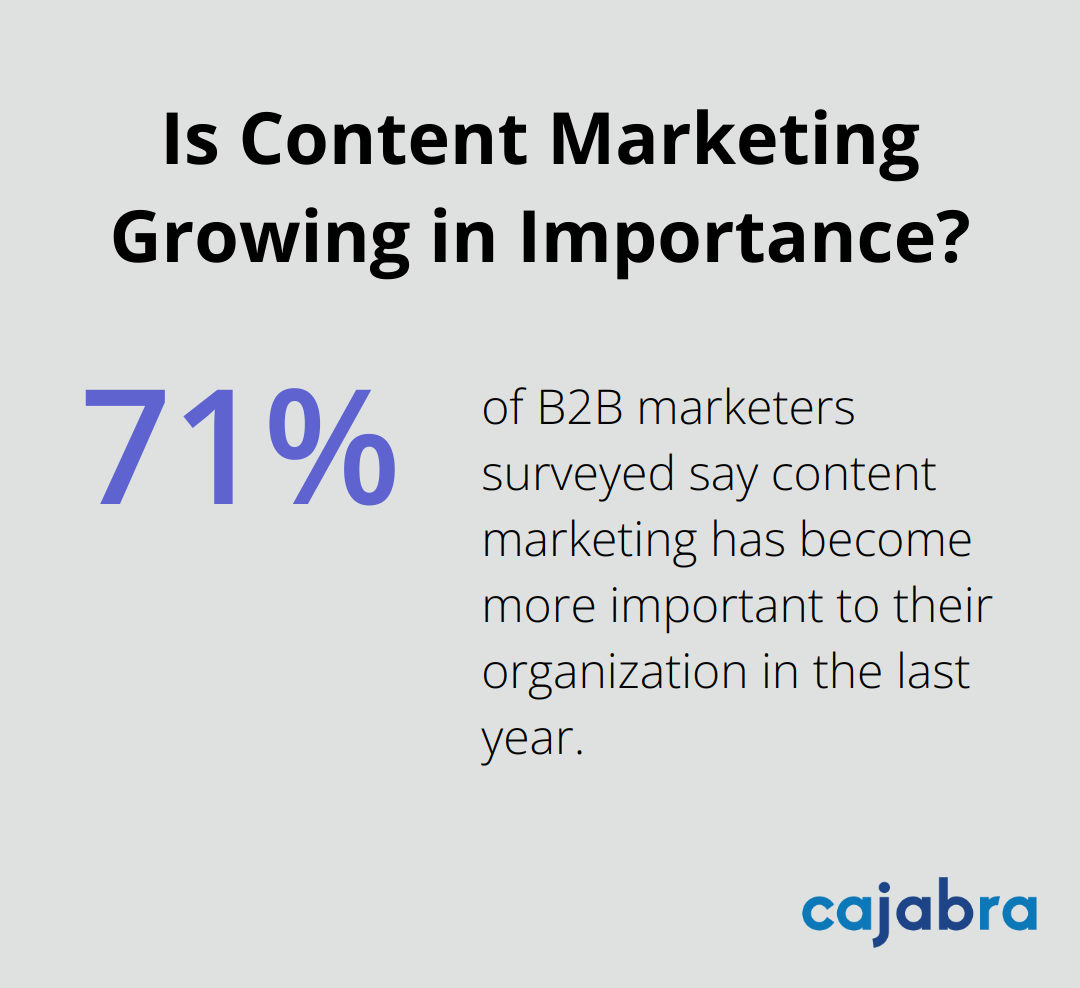
71% of B2B marketers surveyed say content marketing has become more important to their organization in the last year. However, if your target audience includes younger entrepreneurs, platforms like Instagram or TikTok might prove more effective.
Email marketing remains a powerful tool, with an average ROI of $36 for every $1 spent. The key is to use it strategically. Segment your email list based on client type, engagement level, and interests to ensure your messages are relevant and timely.
Tailor Your Content for Each Platform
After selecting your channels, adapt your content for each platform. What works on LinkedIn might not be effective on Instagram or in an email newsletter.
For LinkedIn, focus on professional insights and industry trends. Share detailed case studies or thought leadership articles that showcase your expertise. On Instagram, use visually appealing infographics or short video clips to convey key financial concepts or tips.
When it comes to email marketing, personalization is key. Use data from your CRM to tailor content based on the recipient's industry, company size, or past interactions with your firm. This level of customization can significantly boost engagement rates.
Maintain consistency in your core message and brand voice across all platforms. While the format and style may change, the underlying message should remain cohesive.
Analyze and Adjust Your Strategy
Implement these strategies to ensure your carefully crafted messages reach and resonate with your target audience, driving engagement and ultimately, business growth. Continually analyze your results and adjust your tactics based on what works best for your firm.
Try A/B testing different message variations or channel strategies to optimize your approach. Use analytics tools (such as Google Analytics or social media insights) to track engagement metrics and refine your messaging strategy over time.
Final Thoughts
A powerful messaging strategy template requires a deep understanding of your target audience and a well-crafted core message. You must conduct thorough market research, develop detailed buyer personas, and identify key pain points to create a strategy that resonates with your audience. Your unique value proposition, compelling brand story, and consistent tone will set you apart from competitors and strengthen your message.
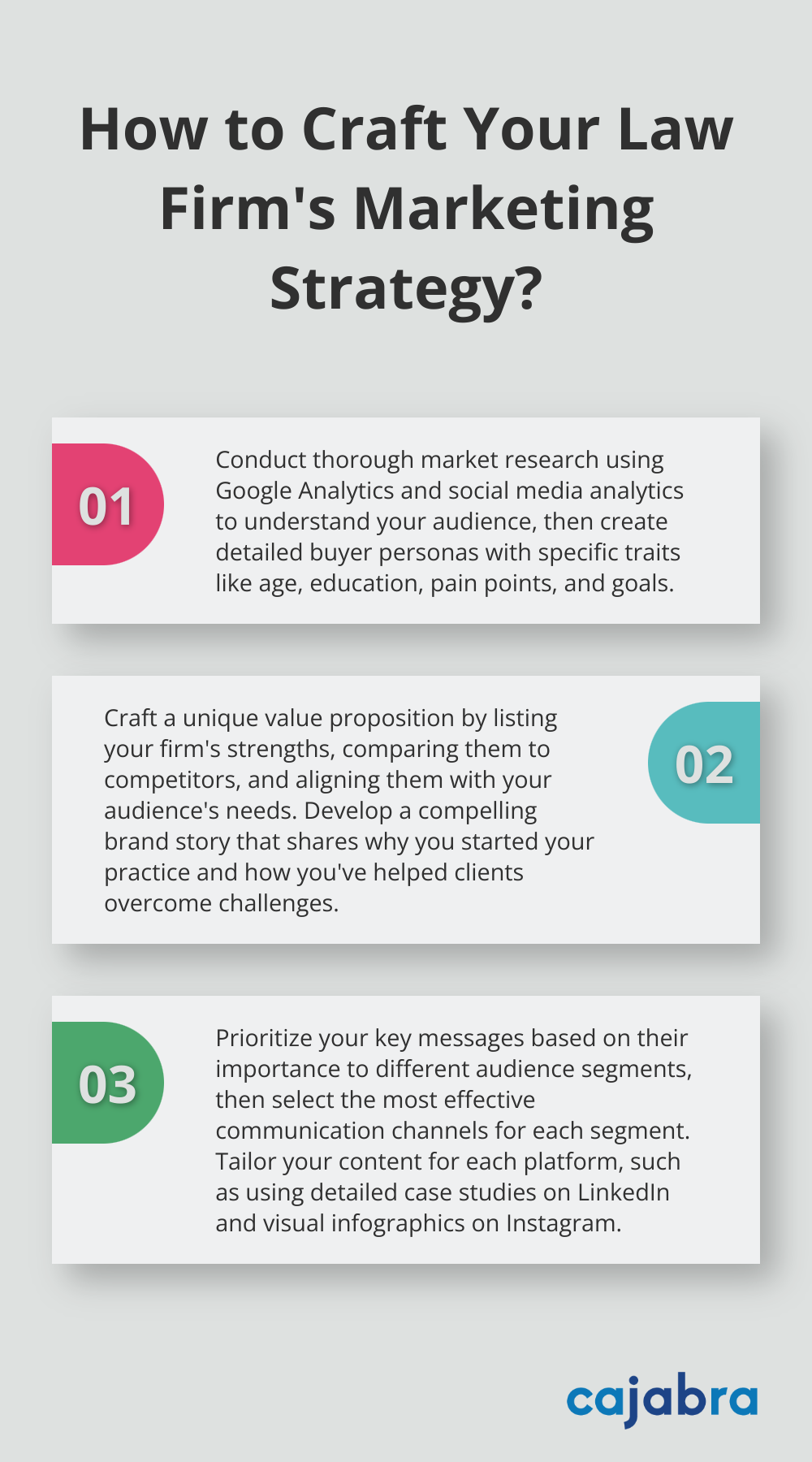
Selecting appropriate communication channels and tailoring content for each platform will ensure your message reaches the right people effectively. You should prioritize key messages for different segments and adapt your content to suit various platforms. A messaging strategy is not a one-time effort but an ongoing process that requires regular refinement to stay relevant in a constantly evolving market.
At Cajabra, we understand the challenges accounting firms face in creating and implementing effective messaging strategies. Our specialized marketing services for accountants will help you develop a powerful messaging strategy template that aligns with your firm's unique value proposition and resonates with your target audience. We handle all aspects of marketing, allowing you to focus on serving your clients.
In today's digital landscape, accounting practice websites are no longer optional-they're essential. At Cajabra, LLC, we've seen firsthand how a well-crafted online presence can transform an accounting firm's success.
A professional website not only showcases your expertise but also serves as a powerful tool for attracting and converting potential clients. In this post, we'll explore the key elements that make accounting websites truly impactful and share practical strategies to help your firm stand out in the competitive digital marketplace.
Why Your Online Presence Matters
The Power of First Impressions
In the digital age, your accounting firm's website often serves as the initial point of contact with potential clients. A strong online presence isn't just a luxury-it's a necessity for attracting and retaining clients in a competitive market.

Research indicates that visual appeal can be assessed within 50 milliseconds. This split-second judgment can determine whether a visitor becomes a client. A professional, well-designed website immediately communicates competence and reliability (two qualities clients prioritize when selecting an accountant).
Building Trust Through Your Website
Your website functions as a digital storefront, showcasing your expertise and services around the clock. A study by Stanford University revealed that 75% of users make judgments about a company's credibility based on their website design. When you present clear, valuable information and a user-friendly interface, you don't just inform visitors-you establish trust.
Attracting New Clients in the Digital Marketplace
The internet has transformed how people search for services, including accounting. A BrightLocal survey found that 91% of consumers say local branch reviews impact their overall perceptions of big brands in some way. Without a strong online presence, you miss out on a significant portion of potential clients who actively seek accounting services.
Some accounting firms have increased their client base by up to 40% within six months of launching an optimized website. This growth doesn't stem from merely having a website-it results from having the right website that effectively communicates your value proposition and guides potential clients towards action.
Leveraging Your Online Presence for Growth
Your online presence extends beyond a digital business card. It serves as a powerful tool for growth, credibility, and client acquisition. A well-crafted website can:
- Showcase your expertise through informative blog posts and case studies
- Provide easy access to your services and pricing information
- Offer convenient ways for potential clients to contact you or schedule consultations
The Role of SEO in Online Visibility
Search Engine Optimization (SEO) plays a vital role in ensuring your website reaches your target audience. By optimizing your site for relevant keywords and local searches, you increase your chances of appearing in search results when potential clients look for accounting services in your area.
As we move forward, we'll explore the key elements that make an accounting website truly effective in converting visitors into clients. These components work together to create a powerful online presence that sets your firm apart in the digital landscape.
marketing automation solutions can significantly enhance your online presence, helping you attract and engage potential clients more effectively.
What Makes an Accounting Website Effective?
Speak Directly to Your Audience
Your website must address the needs and pain points of your potential clients immediately. Use clear, jargon-free language that connects with your target audience. Instead of simply listing tax preparation services, highlight how you save clients time and reduce their stress during tax season.
A study by Nielsen Norman Group found that web users spend 80% of their time looking at information above the page fold. Make those seconds count by clearly communicating your unique value proposition above the fold on your homepage.
Design for User Experience
User-friendly navigation keeps potential clients engaged on your site. Implement a logical menu structure that allows visitors to find the information they need in three clicks or less. A Forrester Research study showed that a well-designed user interface can raise your website's conversion rate by up to 200%.

Use a sticky navigation bar that remains visible as users scroll, making it easy for them to access key pages at any time. This simple design element can significantly improve user experience and keep potential clients on your site longer.
Showcase Your Expertise
Demonstrating your expertise builds trust with potential clients. Include a dedicated page for your services, detailing how each offering addresses specific client needs. Case studies and client success stories provide concrete examples of your impact, making your expertise tangible to prospects.
Client testimonials are particularly powerful. According to BrightLocal, 76% of consumers regularly read online reviews when browsing for local businesses. Feature these testimonials prominently on your homepage and service pages to build credibility.
Drive Action with Strategic CTAs
Effective call-to-action (CTA) buttons convert website visitors into leads. Use action-oriented language that creates a sense of urgency, such as "Get Your Free Consultation Now" or "Start Saving on Taxes Today".
Place CTAs strategically throughout your site, especially after sections that highlight your expertise or client success stories. A/B testing different CTA placements and wording can help you optimize for conversions. HubSpot reports that personalized CTAs convert 202% better than default versions.
Optimize for Mobile Users
In today's mobile-first world, your accounting website must perform flawlessly on smartphones and tablets. Google's mobile-first indexing means that the mobile version of your site determines your search engine rankings. Ensure your site uses responsive design (adapting to different screen sizes) and loads quickly on mobile devices.
A mobile-optimized site not only improves user experience but also boosts your search engine visibility. This increased visibility can lead to more potential clients finding and engaging with your accounting services.
As we move forward, we'll explore how to leverage search engine optimization (SEO) to further enhance your accounting website's visibility and effectiveness in attracting potential clients.
Implement Marketing Automation
Marketing automation solutions can significantly enhance the effectiveness of your accounting website. These tools can help you create lead-generating websites and sales funnels, allowing you to build your business without feeling overwhelmed. By automating repetitive tasks and nurturing leads, you can focus more on providing quality accounting services to your clients.
How to Boost Your Accounting Website's Search Engine Visibility
Search engine optimization (SEO) transforms accounting websites. Proper SEO increases visibility and client acquisition for accounting firms significantly.
Master Your Keyword Strategy
Thorough keyword research forms the foundation of effective SEO. Focus on long-tail keywords that potential clients use when searching for accounting services. Instead of targeting broad terms like "accountant," try specific phrases such as "small business tax accountant in [your city]." Tools like SEMrush or Ahrefs help identify these valuable keywords.
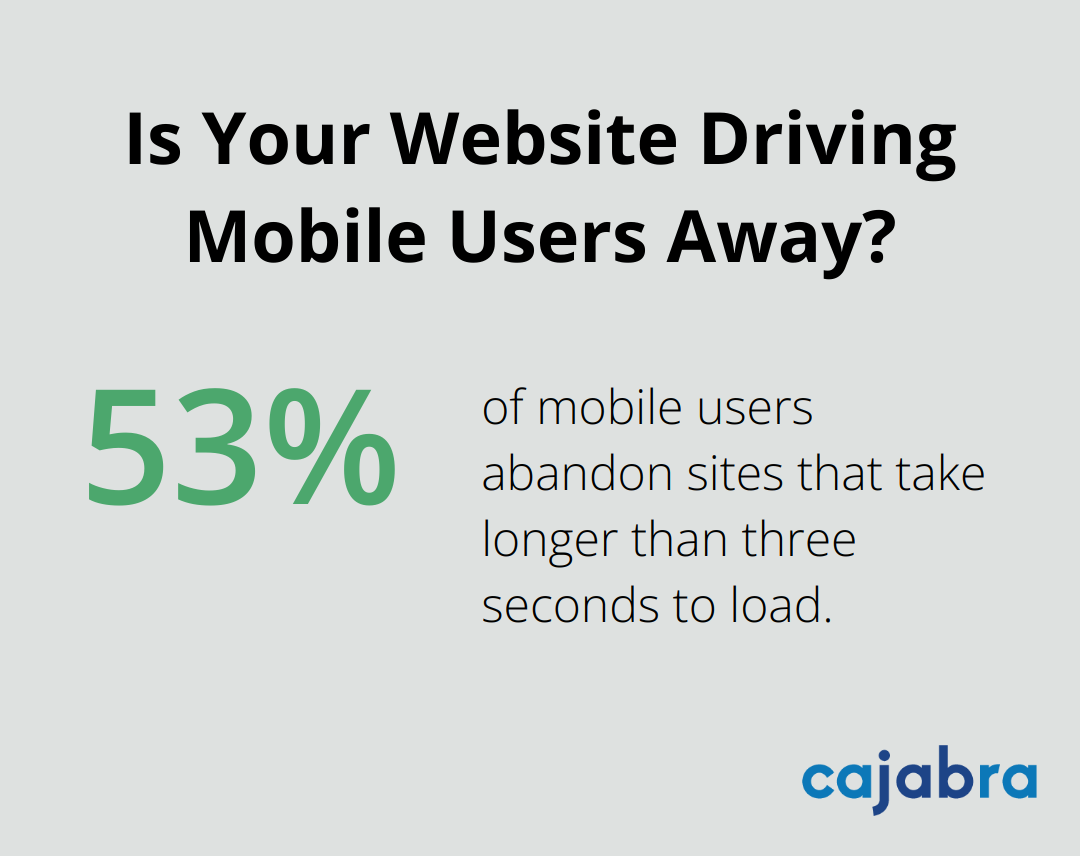
Strategically incorporate your target keywords into your website's content, meta descriptions, and title tags. However, avoid keyword stuffing – search engines penalize this practice. Try natural language that provides value to your readers.
Create Content That Converts
High-quality, industry-specific content drives SEO for accounting websites. Publish blog posts, articles, and guides that address common financial concerns and questions your potential clients have regularly. This improves your search rankings and positions your firm as an authority in the field.
During tax season, create content around topics like "Top 10 Tax Deductions for Small Businesses" or "How Recent Tax Law Changes Affect Your Filing." Make these pieces informative, actionable, and optimized for your target keywords.
Dominate Local Search Results
Local SEO proves crucial for accounting firms. Local searches contribute 22.6% of website traffic. To capitalize on this:
- Claim and optimize your Google My Business listing
- Ensure your NAP (Name, Address, Phone number) stays consistent across all online directories
- Encourage satisfied clients to leave reviews on Google and other platforms
- Create location-specific pages on your website for each area you serve
These strategies can significantly boost your visibility in local search results, driving more qualified leads to your firm.
Leverage Technical SEO
While content reigns supreme, technical SEO forms the foundation that supports it. Ensure your website loads quickly – Google states that 53% of mobile users abandon sites that take longer than three seconds to load. Use tools like Google's PageSpeed Insights to identify and fix speed issues.
Implement a secure HTTPS protocol (now a ranking factor for Google). Also, make your website mobile-friendly, as Google primarily uses the mobile version of content for ranking and indexing.
Structured data markup (such as Schema.org) helps search engines better understand your content and potentially improves your search listings with rich snippets.
Utilize Marketing Automation
Marketing automation enhances the effectiveness of your accounting website. These tools create lead-generating websites and sales funnels, allowing you to build your business without feeling overwhelmed. Automation of repetitive tasks and lead nurturing lets you focus more on providing quality accounting services to your clients.
For marketing automation solutions tailored for accounting firms, Cajabra Marketing offers specialized services. They help accountants improve their marketing strategies for accounting firms.
Establish Thought Leadership
Thought leadership plays an essential role in molding your professional reputation online and improving your visibility on search engines. By consistently producing high-quality, insightful content in your field, you can establish yourself as an authority in the accounting industry. This not only attracts potential clients but also improves your website's search engine rankings.
Final Thoughts
Accounting practice websites serve as powerful tools for growth and client acquisition. A professional, user-friendly site effectively communicates your value proposition and can significantly increase your client base and revenue. It showcases your expertise and services to potential clients 24/7, even when you're not actively working.
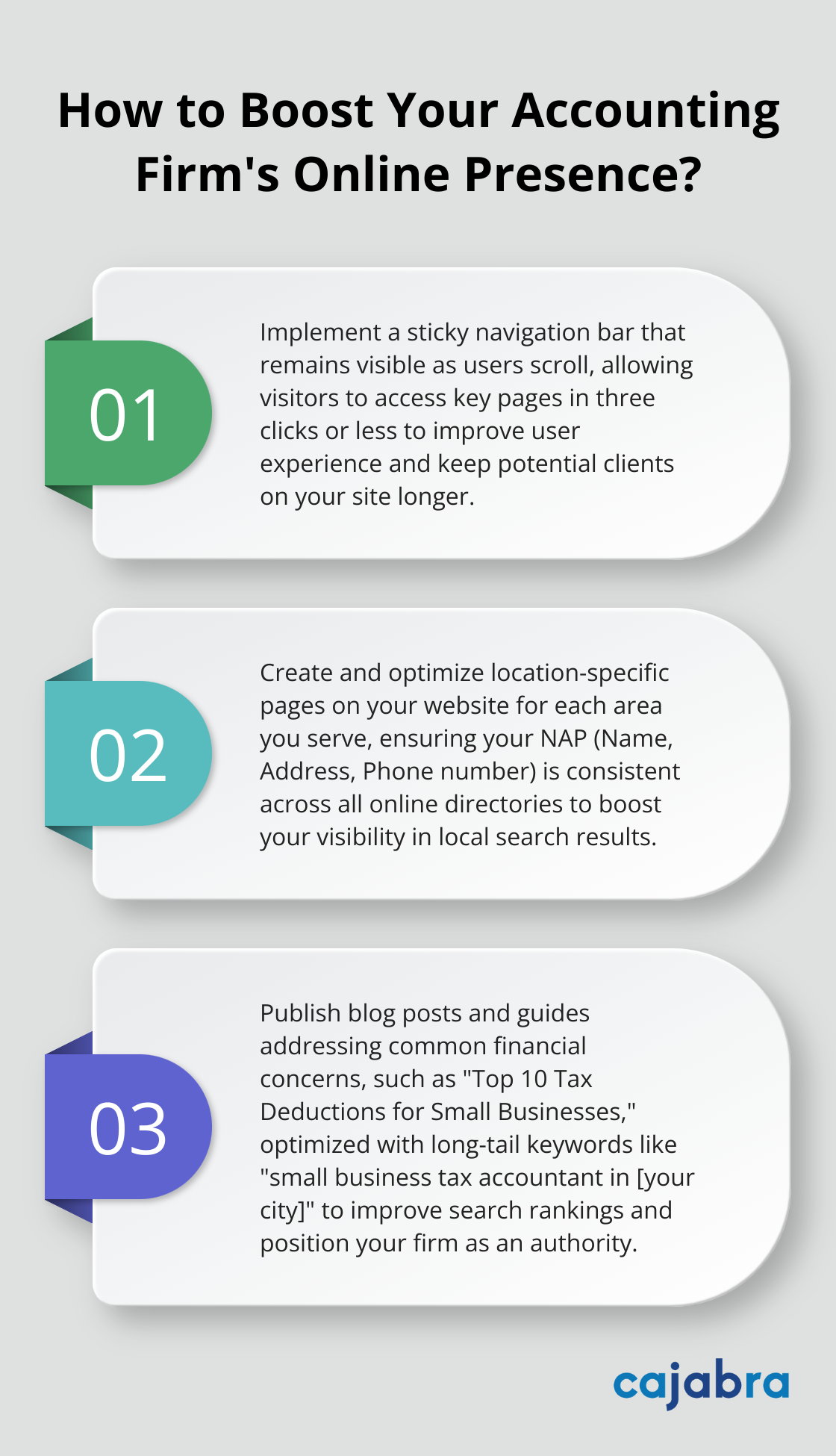
We at Cajabra specialize in helping accounting firms create impactful websites and implement effective marketing strategies. Our JAB System™ aims to move accountants from overlooked to overbooked in 90 days by securing retainer-based clients. We handle marketing aspects, allowing you to focus on providing excellent accounting services.
A strong online presence builds a foundation for sustainable growth and success in the competitive accounting world. Take the first step today and watch your practice thrive in the digital age. Your website often provides the first impression for potential clients, so ensure it accurately represents your expertise and professionalism.
At Cajabra, LLC, we know that a well-designed website is essential for accounting firms to attract and retain clients in today's digital landscape.
Effective accounting websites design goes beyond aesthetics; it's about creating a powerful online presence that showcases your expertise and converts visitors into clients.
In this post, we'll explore the key elements of successful accounting websites and provide practical tips to optimize your online platform for both search engines and user experience.
What Makes an Accounting Website Successful?
A successful accounting website serves as a powerful tool to attract new clients, showcase expertise, and differentiate your firm from competitors. Several key elements contribute to an effective accounting website.
Design That Speaks Volumes
First impressions matter, especially in the accounting world. A clean, professional design instantly communicates credibility and attention to detail. Choose a color scheme that aligns with your brand and conveys trust – blues and greens often work well in the financial sector. Use high-quality images (preferably custom photography of your team and office) to add a personal touch.
Navigation That Guides Clients
Your website should mirror the organization of your financial statements. Implement a logical menu structure that allows visitors to find information quickly. Use a sticky header that remains visible as users scroll, ensuring easy access to key pages like Services, About Us, and Contact. A study by the Nielsen Norman Group found that users spend 80% of their time above the fold, so prioritize your most important information at the top of each page.
Expertise on Display
Showcase your services and expertise prominently. Create dedicated pages for each service you offer, providing detailed information and the benefits clients can expect. Include case studies that demonstrate real-world results (e.g., how you helped a small business save $50,000 in taxes through strategic planning). These concrete examples prove more compelling than generic service descriptions.

Highlight any industry-specific certifications or awards your firm has received. This builds credibility and sets you apart from competitors who may lack these accolades.
Social Proof Seals the Deal
Client testimonials and case studies build trust effectively. BrightLocal's Local Consumer Review Survey revealed that 87% of consumers read online reviews for local businesses in 2020. Feature testimonials prominently on your homepage and create a dedicated testimonials page. Include the client's name, photo, and company (with permission) to add authenticity.
Calls-to-Action That Convert
Every page on your website should guide visitors towards taking action. Use clear, compelling calls-to-action (CTAs) that stand out visually and use action-oriented language. For example, replace a generic "Contact Us" button with "Schedule Your Free Tax Consultation." Place CTAs strategically throughout your site, especially after sections that highlight your expertise or client success stories.
These elements form the foundation of a powerful online presence for accounting firms. However, a great website doesn't stop at design and content. The next chapter will explore how to optimize your site for search engines and user experience, ensuring that potential clients not only find your website but also have a seamless experience once they arrive.
How to Optimize Your Accounting Website for Search and Users
At Cajabra, LLC, we understand that creating a great website is only half the battle. To truly succeed online, your accounting firm's website needs to be discoverable by potential clients and provide an exceptional user experience. Here's how to achieve both:
Master Your Keyword Strategy
Start by identifying the specific terms your ideal clients use when searching for accounting services. Tools like Google Keyword Planner or SEMrush can reveal valuable insights. For example, "small business tax preparation [your city]" might be a high-value, low-competition keyword for your firm.

Once you've identified your target keywords, strategically incorporate them into your website's content, meta descriptions, and page titles. However, avoid keyword stuffing – search engines penalize this practice. Instead, focus on creating natural, informative content that addresses your clients' needs.
Adopt a Mobile-First Mindset
Over 60% of web traffic now comes from mobile devices, according to Statista. Your accounting website must be mobile-responsive. This means your site automatically adjusts its layout and functionality to provide an optimal viewing experience across all devices (from smartphones to desktop computers).
Google's mobile-first indexing policy means that the mobile version of your website is now the primary version considered for ranking. Ensure your mobile site loads quickly, has easy-to-tap buttons, and presents information in a clear, concise manner.
Prioritize Speed
Page load speed is essential for both user experience and search engine rankings. According to Google, 53% of mobile site visits are abandoned if pages take longer than 3 seconds to load. To improve your site's speed:
- Optimize image sizes without sacrificing quality
- Minimize HTTP requests by combining files where possible
- Leverage browser caching to store static files
- Use a content delivery network (CDN) to serve files from servers closest to the user's location
Tools like Google's PageSpeed Insights can help you identify specific areas for improvement on your site.
Create Content That Converts
High-quality, relevant content is the cornerstone of both SEO and user engagement. Create in-depth articles, blog posts, and resources that address your clients' most pressing financial questions and concerns. For instance, a comprehensive guide on "Tax Deductions for Small Business Owners" can attract potential clients while showcasing your expertise.
Update your content regularly to stay relevant and signal to search engines that your site is active. Consider creating a content calendar to ensure consistent publishing of fresh, valuable information.
Dominate Local Search
For most accounting firms, local clients are the lifeblood of the business. Optimize your website for local search by:
- Claiming and optimizing your Google Business Profile
- Ensuring your NAP (Name, Address, Phone number) is consistent across all online directories
- Encouraging satisfied clients to leave reviews on Google and other platforms
- Creating location-specific pages if you serve multiple areas
According to recent statistics, 29% of business is conducted online. A strong local SEO strategy ensures your firm appears when potential clients in your area are searching for accounting services.
These strategies will help your accounting firm's website rank higher in search results and provide a superior experience for potential clients. The next chapter will explore how to convert these website visitors into actual clients for your accounting practice.
How to Turn Website Visitors into Paying Clients
Capture Leads with Strategic Forms
We implement strategically placed lead capture forms throughout your website. Research shows that eliminating just one field can increase conversions by a whopping 50%. We keep your forms short, asking only for essential information like name, email, and specific accounting needs.

We place these forms at key points in the user journey. For example, after a visitor reads a detailed blog post about tax planning, we offer a free consultation form to capitalize on their interest. HubSpot reports that personalized calls-to-action convert 202% better than generic ones, so we tailor your form's language to the specific content the user has engaged with.
Provide Instant Support with AI-Powered Chatbots
We implement an AI-powered chatbot to provide instant support to website visitors. According to Drift, 55% of businesses that use chatbots generate more high-quality leads. We program your chatbot to answer common questions about your services, pricing, and availability. This immediate response can make the difference between a potential client reaching out or moving on to a competitor.
We ensure your chatbot can seamlessly transfer complex inquiries to a human team member when necessary. This combination of automation and personal touch creates a responsive, client-focused experience that can significantly boost conversion rates.
Offer Valuable Resources to Build Trust
We create downloadable resources that provide immediate value to potential clients. This could include tax preparation checklists, financial planning guides, or industry-specific accounting tips. A Content Marketing Institute study found that 95% of B2B buyers view content as trustworthy when evaluating a company.
We gate these high-value resources behind a simple email sign-up form. This approach not only provides value to the potential client but also allows you to capture their contact information for future marketing efforts. We follow up with automated email sequences that offer additional insights and gently guide the prospect towards scheduling a consultation.
Optimize Your Website for Conversions
We focus on creating a user-friendly website design that guides visitors towards taking action. This includes clear navigation, prominent calls-to-action (CTAs), and strategically placed contact information. We use contrasting colors for CTAs to make them stand out and employ persuasive copy that emphasizes the benefits of your services.
We also implement A/B testing to continuously improve your website's conversion rate. This involves creating two versions of a webpage (with slight variations) and analyzing which one performs better in terms of conversions. Over time, this data-driven approach leads to significant improvements in your website's ability to turn visitors into clients.
Leverage Social Proof
We showcase client testimonials, case studies, and industry awards prominently on your website. This social proof builds trust and credibility with potential clients. We include specific results and metrics in these testimonials (e.g., "Helped us save $50,000 in taxes last year") to make them more impactful.
Final Thoughts
A well-designed website serves as a powerful tool for accounting firms in the digital age. Professional design, user-friendly navigation, and strategic content showcase expertise and build trust with potential clients. Effective accounting website design combines these elements with search engine optimization and user experience enhancements to attract and convert visitors.
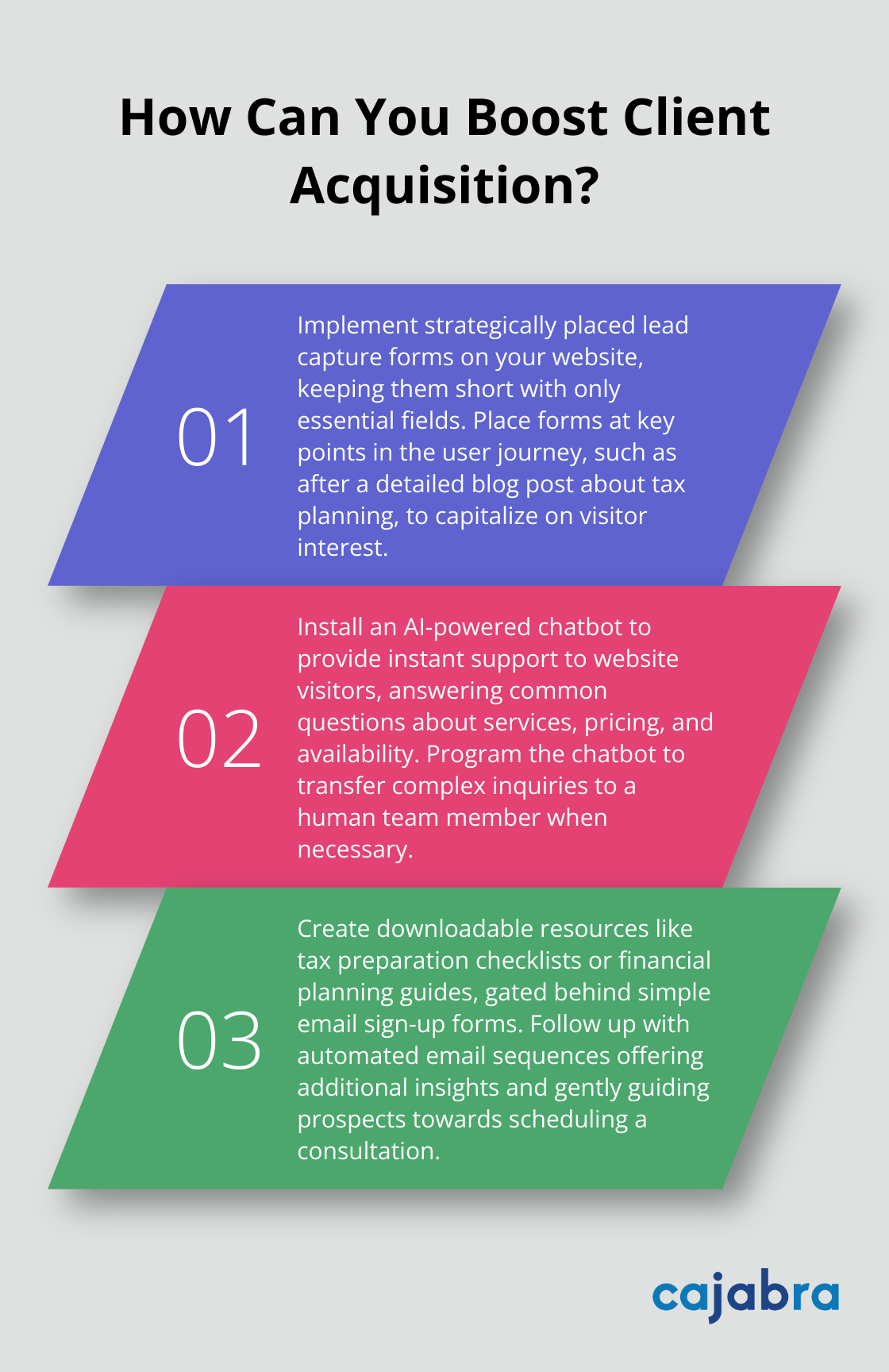
We at Cajabra, LLC help accounting firms create websites that drive real business results. Our JAB System™ moves accountants from overlooked to overbooked in 90 days, securing retainer-based clients and maximizing revenue from existing relationships. This system incorporates the strategies discussed in this post, including lead capture forms, AI-powered chatbots, and valuable downloadable resources.
Your website often provides the first impression of your firm to potential clients. Implementing these strategies will create a powerful online presence that sets your accounting firm apart from competitors and consistently attracts high-quality clients. Take action today to transform your website into a client-generating machine.