
Content marketing return on investment is a critical metric for businesses today. At Cajabra, LLC, we've seen firsthand how measuring ROI can transform content strategies and drive real results.
In this post, we'll break down the essentials of tracking and calculating content marketing ROI. We'll also share practical tips to help you maximize your content's performance and boost your bottom line.
What Is Content Marketing ROI?
Defining Content Marketing ROI
Content marketing ROI measures the value generated by content marketing efforts compared to the resources invested. It quantifies the financial impact of your content strategy, helping you understand which efforts yield the best results.
The Power of Content Marketing
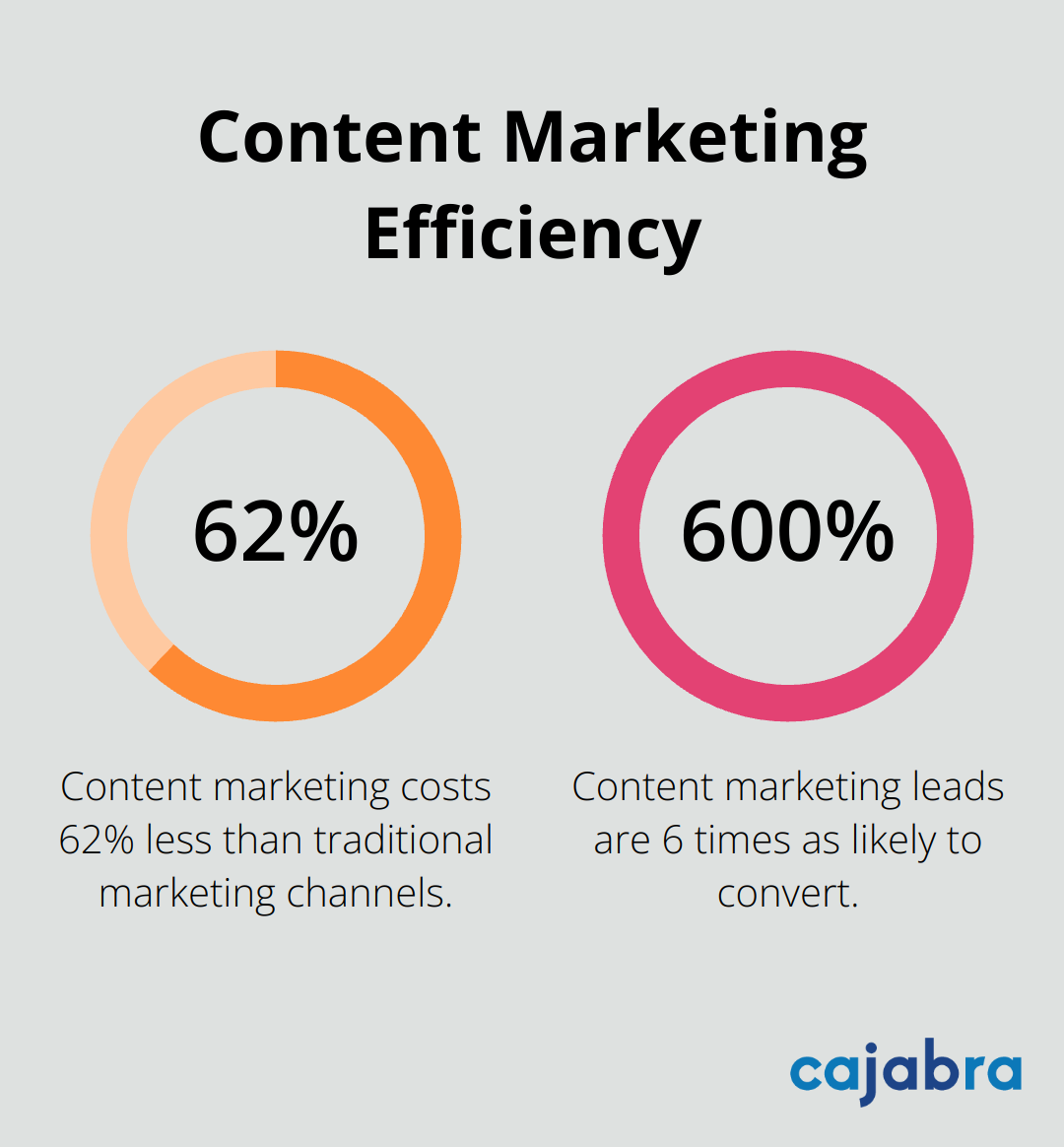
Content marketing costs 62% less than traditional marketing channels, and these leads are 6 times as likely to convert. These numbers underscore the importance of measuring ROI. It's not just about creating content; it's about creating content that drives tangible business results.
The Importance of ROI Measurement
Measuring ROI enables you to make data-driven decisions about your content strategy. It helps you identify the most effective types of content, allocate your budget wisely, and optimize your efforts for better results.
For instance, if you discover that your how-to guides outperform your infographics in lead generation, you can adjust your resource allocation accordingly. This approach (based on real data) ensures that every dollar spent on content marketing works hard for your business.
Essential Metrics for ROI Measurement
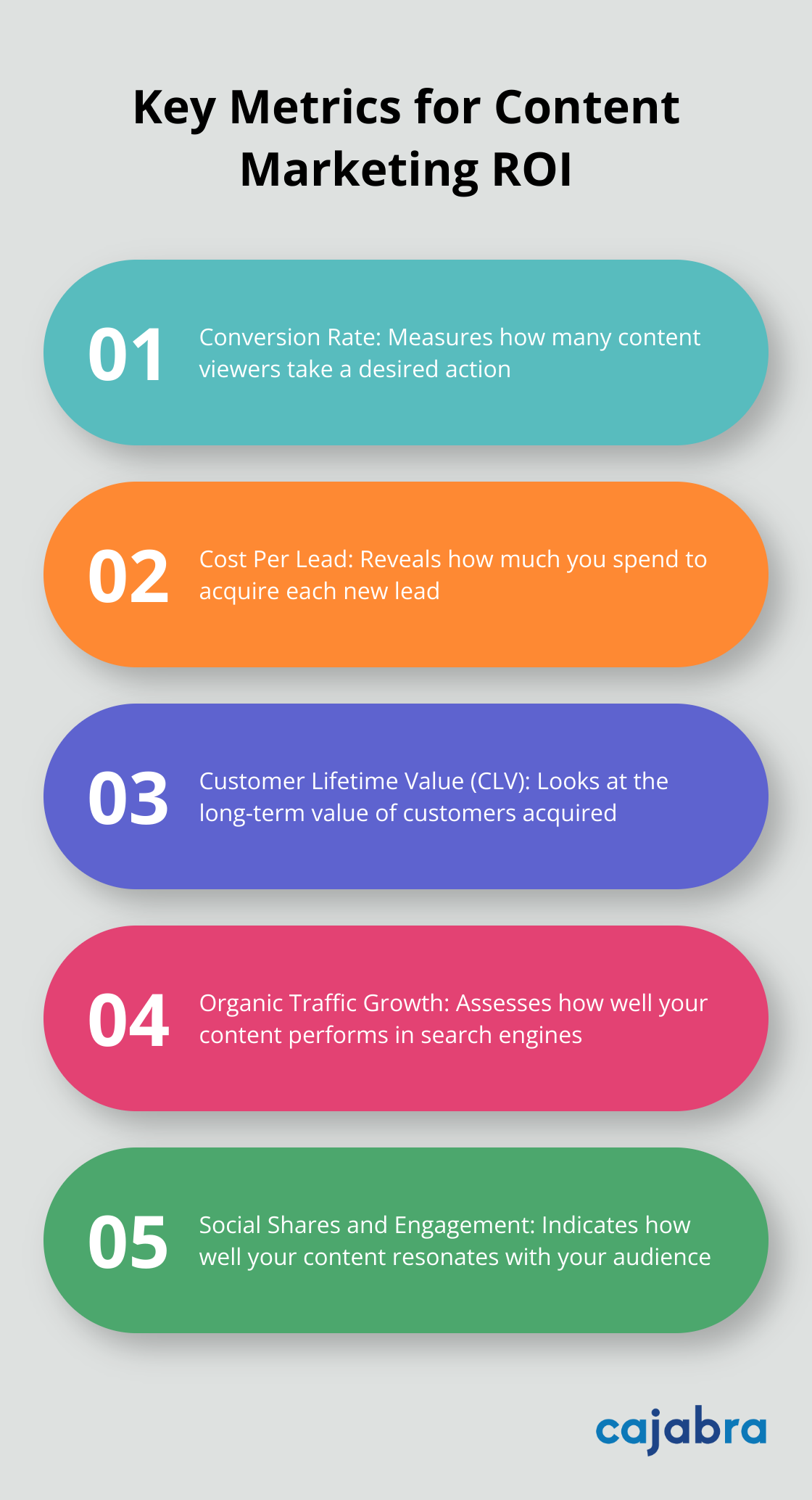
While specific metrics depend on your goals, here are some key ones to consider:
- Conversion Rate: This measures how many content viewers take a desired action (e.g., newsletter sign-ups or purchases).
- Cost Per Lead: This metric reveals how much you spend to acquire each new lead through content marketing.
- Customer Lifetime Value (CLV): This looks at the long-term value of customers acquired through content marketing.
- Organic Traffic Growth: This assesses how well your content performs in search engines and attracts visitors without paid promotion.
- Social Shares and Engagement: While not directly tied to ROI, these metrics can indicate how well your content resonates with your audience.
Comprehensive ROI Analysis
Combining these metrics provides a holistic view of content marketing performance. You might analyze how an increase in organic traffic correlates with lead generation and, ultimately, customer acquisition costs.
Measuring ROI is an ongoing process. It involves continual refinement of your strategy based on data, rather than creating content and hoping for the best. To achieve this, focus on measuring the right metrics, such as lead generation, customer lifetime value, and conversion rate. This focus on ROI ensures that your content marketing efforts are not just productive, but profitable.
Now that we've covered the basics of content marketing ROI and its importance, let's explore how to set up the necessary tracking and analytics tools to measure your content's performance effectively.
Tracking Tools for Content ROI
Selecting Analytics Platforms
Google Analytics stands as the premier choice for website tracking. This free, robust tool integrates seamlessly with other Google products. However, specialized tools like SEMrush (for SEO insights) or Hotjar (for user behavior analysis) offer unique data points that can enhance your understanding of content performance.
For social media, native analytics on platforms like Facebook Insights or Twitter Analytics provide valuable engagement metrics. Tools such as Sprout Social or Hootsuite aggregate data across multiple platforms, offering more comprehensive insights and saving time.
Implementing Tracking Codes
Proper implementation of tracking tools is critical. Google Tag Manager simplifies the process of implementing tags and collecting crucial data for businesses of all sizes. It allows for easy implementation of Google Analytics, Facebook Pixel, and other tracking scripts.
E-commerce sites should set up enhanced e-commerce tracking in Google Analytics. This provides detailed data on product performance, shopping behavior, and checkout processes (all vital for calculating ROI).
Custom Dashboards for Actionable Insights
Raw data can overwhelm. Custom dashboards distill this information into actionable insights. In Google Analytics, create dashboards that focus on your key performance indicators (KPIs). These might include metrics like conversion rate, time on page for key content pieces, or goal completions tied to specific campaigns.
Tools like Databox or Geckoboard allow you to create cross-platform dashboards, pulling data from multiple sources into a single view. This holistic approach can reveal correlations between content performance and business outcomes that might otherwise go unnoticed.
Optimizing Your Tracking Setup
Regular review and refinement of your tracking setup and dashboards ensure you measure what matters most to your content marketing ROI. Try to align your tracking metrics with your overall business goals. This alignment will help you make data-driven decisions that directly impact your bottom line.
With a solid tracking foundation in place, the next step is to dive into the nitty-gritty of calculating your content marketing ROI. Let's explore the various revenue attribution models and cost considerations that play a crucial role in this process.
Calculating Your Content ROI
Revenue Attribution Models
The first step in calculating content marketing ROI involves selecting an appropriate revenue attribution model. Revenue attribution is a method of connecting different data sets to paint a picture of which marketing channels are producing the best sales and revenue.
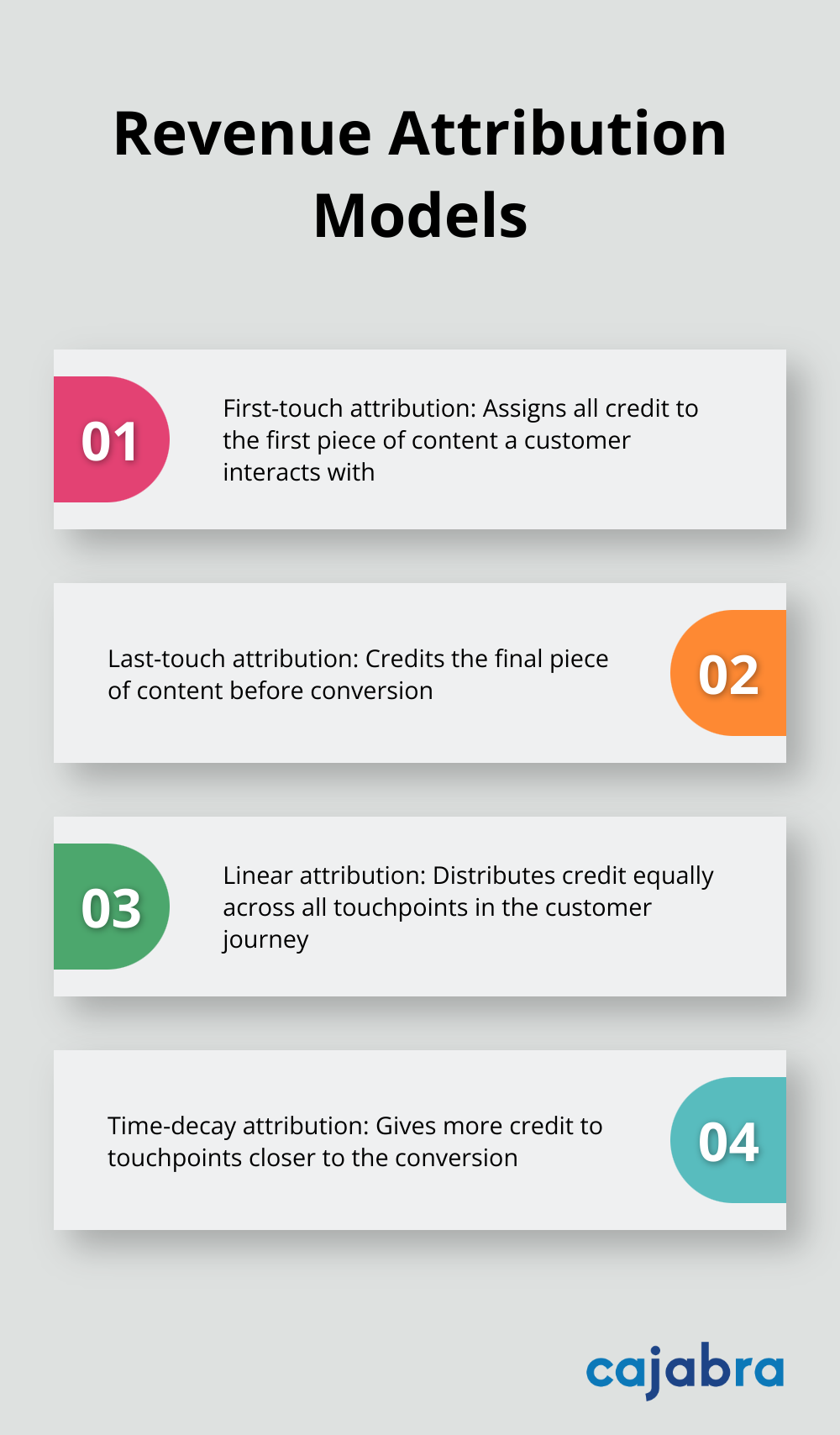
Common models include:
First-touch attribution: This model assigns all credit to the first piece of content a customer interacts with before converting. It's simple but can overvalue top-of-funnel content.
Last-touch attribution: This approach credits the final piece of content before conversion. It's straightforward but may undervalue earlier touchpoints in the customer journey.
Linear attribution: This model distributes credit equally across all touchpoints in the customer journey. It offers a more balanced view but can oversimplify complex customer interactions.
Time-decay attribution: This method gives more credit to touchpoints closer to the conversion. It provides a more nuanced approach but requires sophisticated tracking.
We suggest starting with a simple model (such as first-touch or last-touch attribution), then advancing to more complex models as you improve your tracking capabilities.
Comprehensive Cost Analysis
Accurate ROI calculation requires a thorough understanding of your content marketing costs. These typically include:
- Content creation costs (writer fees, design costs, video production)
- Content distribution costs (social media advertising, email marketing tools)
- Technology costs (content management systems, analytics tools)
- Staff costs (content strategists, SEO specialists)
Factor in indirect costs like training and software subscriptions. A detailed cost analysis ensures your ROI calculations reflect reality.
ROI Calculation Formula
The basic formula for calculating content marketing ROI is:
ROI = (Revenue - Investment) / Investment x 100
For example, if you invested $10,000 in content marketing and generated $15,000 in revenue, your ROI would be 50%.
This simple formula doesn't account for the long-term value of content. Consider using a time-based ROI calculation that factors in the ongoing benefits of evergreen content.
You might calculate ROI over a 12-month period:
12-month ROI = (12-month Revenue - Total Investment) / Total Investment x 100
This approach provides a more accurate picture of your content's long-term value.
Aligning ROI with Business Goals
Align your ROI calculations with your specific business goals. If your primary objective is lead generation, you might calculate ROI based on the value of leads rather than direct revenue.
For instance, if your goal is to generate high-quality leads for your accounting firm (a service that Cajabra, LLC specializes in), you might assign a value to each lead based on your average client lifetime value. This approach allows you to measure ROI even before leads convert to paying clients.
Advanced ROI Metrics
As you refine your ROI measurement process, consider incorporating more advanced metrics:
Customer Lifetime Value (CLV): This metric helps you understand the long-term impact of your content marketing efforts. A 50% marketing ROI can be calculated from a $40 profit increase divided by an $80 campaign cost, considered on a per customer basis.
Return on Ad Spend (ROAS): If you use paid promotion for your content, ROAS can help you measure the effectiveness of these campaigns.
These practical approaches to ROI calculation will provide valuable insights into your content marketing performance. This data-driven approach will help you refine your strategy and allocate resources more effectively.
Final Thoughts
Content marketing return on investment measurement empowers businesses to optimize their marketing strategies. We implement robust tracking systems, select appropriate attribution models, and conduct comprehensive cost analyses to gain valuable insights. This data-driven approach allows us to identify effective content types and channels, allocate resources wisely, and experiment with new formats.
The process of measuring ROI requires continuous refinement and regular analysis to stay ahead of market trends. We adjust our strategies based on collected data, ensuring our content marketing efforts align with business goals and deliver long-term value. This iterative approach helps us make informed decisions and adapt to the ever-evolving digital marketing landscape.
At Cajabra, we specialize in helping accounting firms measure and optimize their marketing efforts. Our services (including the JAB System™) aim to transform marketing strategies and secure high-value, retainer-based clients. We focus on ROI-driven approaches to enable accounting professionals to make data-backed decisions that drive real business growth.
At Cajabra, LLC, we often field questions about the most effective digital marketing strategies. One debate that frequently arises is content marketing versus social media: which drives more ROI?
This blog post dives into the key differences between these two approaches, exploring their unique strengths and potential returns on investment.
We'll examine real-world examples, metrics, and tools to help you make informed decisions for your marketing strategy.
What's the Difference Between Content Marketing and Social Media?
Content marketing and social media are two powerful digital marketing strategies, each with unique characteristics and benefits. At their core, both aim to engage audiences and drive business growth, but they operate in distinct ways.
Content Marketing Defined
Content marketing focuses on the creation and distribution of valuable, relevant content to attract and retain a clearly defined audience. This strategy often includes blog posts, videos, podcasts, and eBooks. An accounting firm might publish a series of articles on tax-saving strategies or create an eBook on financial planning for small businesses.
Content Marketing Institute provides research to help improve content marketing strategies in the coming year. This underscores the potential of well-executed content strategies to drive meaningful business results.
Social Media Marketing Explained
Social media marketing uses platforms like Facebook, LinkedIn, and Twitter to connect with audiences, build brand awareness, and promote products or services. It creates a community around your brand and fosters direct interactions with customers.
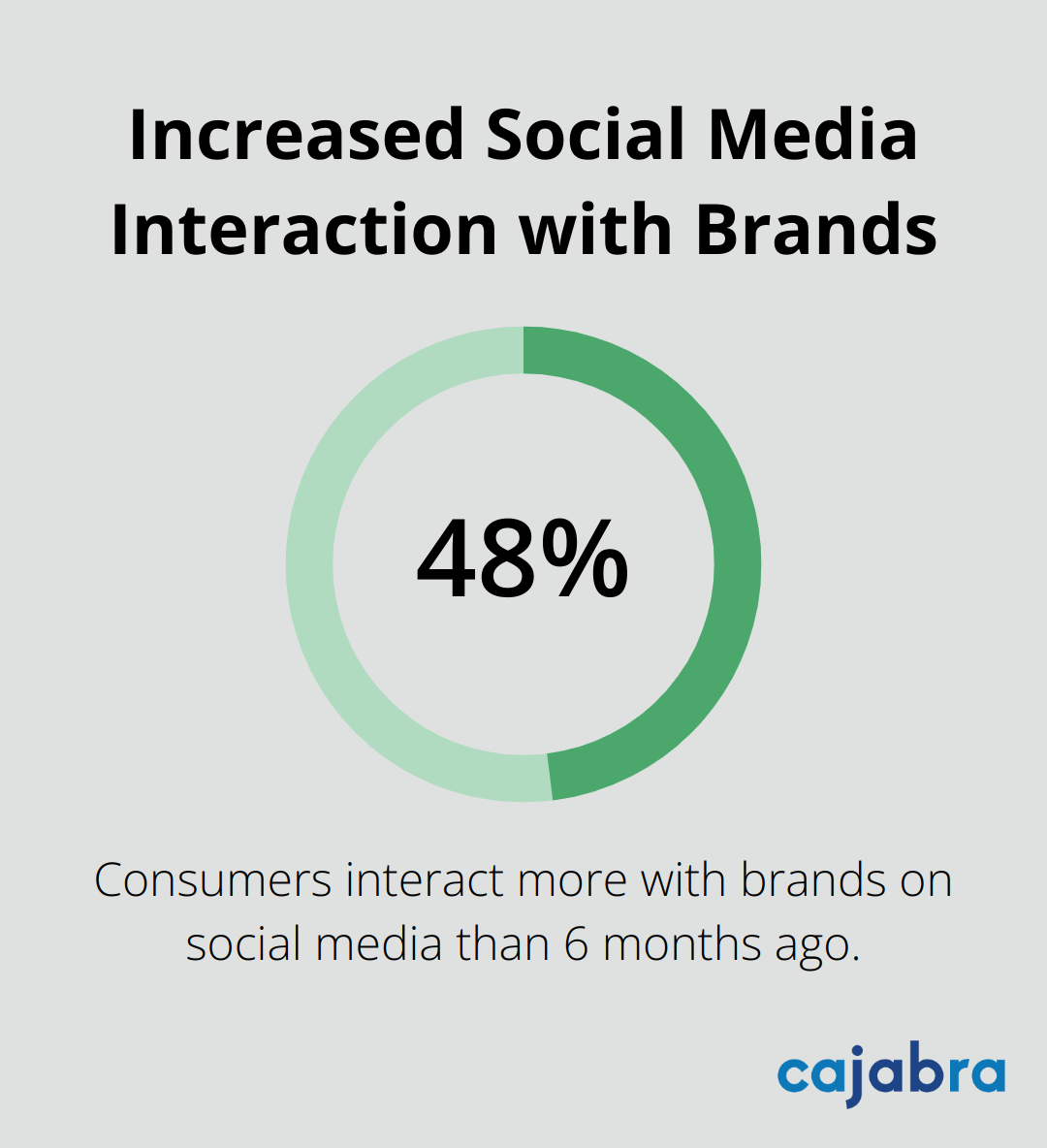
According to Sprout Social, nearly half (48%) of consumers said they interact with brands more often on social media than six months ago. This highlights the importance of maintaining an active and engaging social media presence.
Key Differences and Synergies
Content marketing focuses on creating in-depth, valuable information, while social media marketing emphasizes quick, shareable content and real-time engagement. Content marketing typically requires more time to see results but can lead to long-term authority building. Social media, on the other hand, can generate immediate engagement but may require consistent effort to maintain visibility.
Despite these differences, the two strategies often work best when integrated. Social media platforms serve as excellent distribution channels for content marketing pieces, amplifying their reach. Conversely, high-quality content can fuel social media discussions and increase engagement rates.
An accounting firm could create a comprehensive guide on business tax preparation (content marketing) and then share key insights from this guide across their social media channels, driving traffic back to their website.
Strategy Integration
Understanding these distinctions and synergies is essential for developing a balanced digital marketing strategy that maximizes ROI. Many successful businesses (including those in the accounting sector) combine both approaches to create a comprehensive marketing plan.
For example, a firm might use content marketing to establish thought leadership through detailed blog posts and whitepapers, while simultaneously leveraging social media to share snippets of this content and engage with their audience in real-time.
This integrated approach allows businesses to benefit from the long-term authority building of content marketing and the immediate engagement opportunities of social media. The next section will explore how to measure the ROI of content marketing efforts, providing insights into the effectiveness of this strategy.
How to Measure Content Marketing ROI
Content marketing ROI measurement plays a vital role in understanding strategy effectiveness. We've developed methods to track and analyze content marketing success for accounting firm clients.
Key Performance Indicators (KPIs)
Identifying the right KPIs aligns with your business goals. For accounting firms, common KPIs include:
- Website Traffic: Google Analytics provides detailed insights into visitor behavior (page views, time on site, bounce rates). An increase in organic traffic often indicates content resonance with the target audience and good search engine performance.
- Lead Generation: Track leads generated through form submissions, email sign-ups, or direct inquiries. For instance, monitor how many visitors download a comprehensive tax planning guide in exchange for contact information.
- Client Acquisition Cost (CAC): Calculate this by dividing total marketing spend by the number of new clients acquired. A decreasing CAC over time suggests improved content marketing effectiveness.
Tracking Tools and Methods
Several tools help track content marketing success:
- Google Analytics: Indispensable for website metrics, providing data on traffic sources, user behavior, and conversion rates.
- Marketing Automation Platforms: HubSpot or Marketo offer advanced tracking capabilities, monitoring lead progression through sales funnels and attributing conversions to specific content pieces.
- Social Media Analytics Tools: Hootsuite or Sprout Social provide insights into engagement rates, reach, and social shares.
- Customer Relationship Management (CRM) Systems: Particularly useful for accounting firms, these systems track which content pieces influence client decisions throughout the sales process.
Real-World Success Stories
While specific client data remains confidential, content marketing campaigns in the accounting industry have yielded remarkable results.
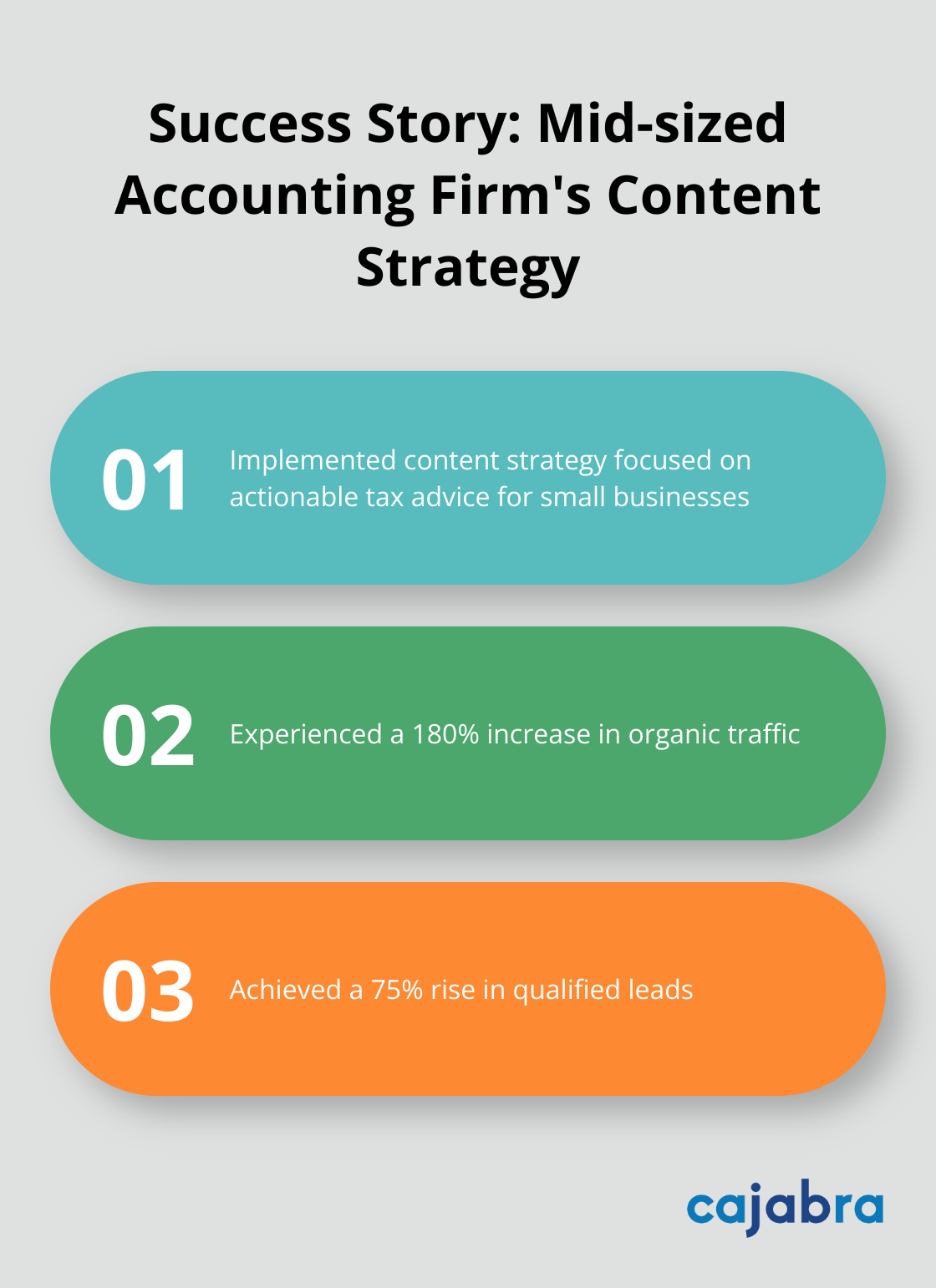
A mid-sized accounting firm implemented a content strategy focused on actionable tax advice for small businesses. They experienced a 180% increase in organic traffic and a 75% rise in qualified leads, significantly boosting their sales.
Another firm specializing in forensic accounting used content marketing to establish thought leadership. They created a series of in-depth articles and webinars on fraud detection. This strategy resulted in a 200% increase in website traffic and positioned them as industry experts, leading to speaking engagements and high-profile client engagements.
Continuous Improvement
Content marketing ROI measurement doesn't stop at data collection. Use these insights to refine your strategy continually. A/B test different content formats, topics, and distribution channels to optimize performance. Regular analysis allows you to allocate resources more effectively and focus on the content types that drive the most value for your accounting firm.
As we move forward, let's explore how social media marketing complements content strategies and contributes to overall marketing ROI.
How Effective Is Social Media Marketing ROI?
Social media marketing has become a cornerstone of digital strategies, but measuring its ROI presents challenges. We have developed methods to accurately assess the impact of social media efforts for accounting firms.
Key Metrics for Social Media Success
Engagement rate measures how actively your audience interacts with your content through likes, comments, and shares. For accounting firms, a high engagement rate often indicates that your content resonates with your target audience.
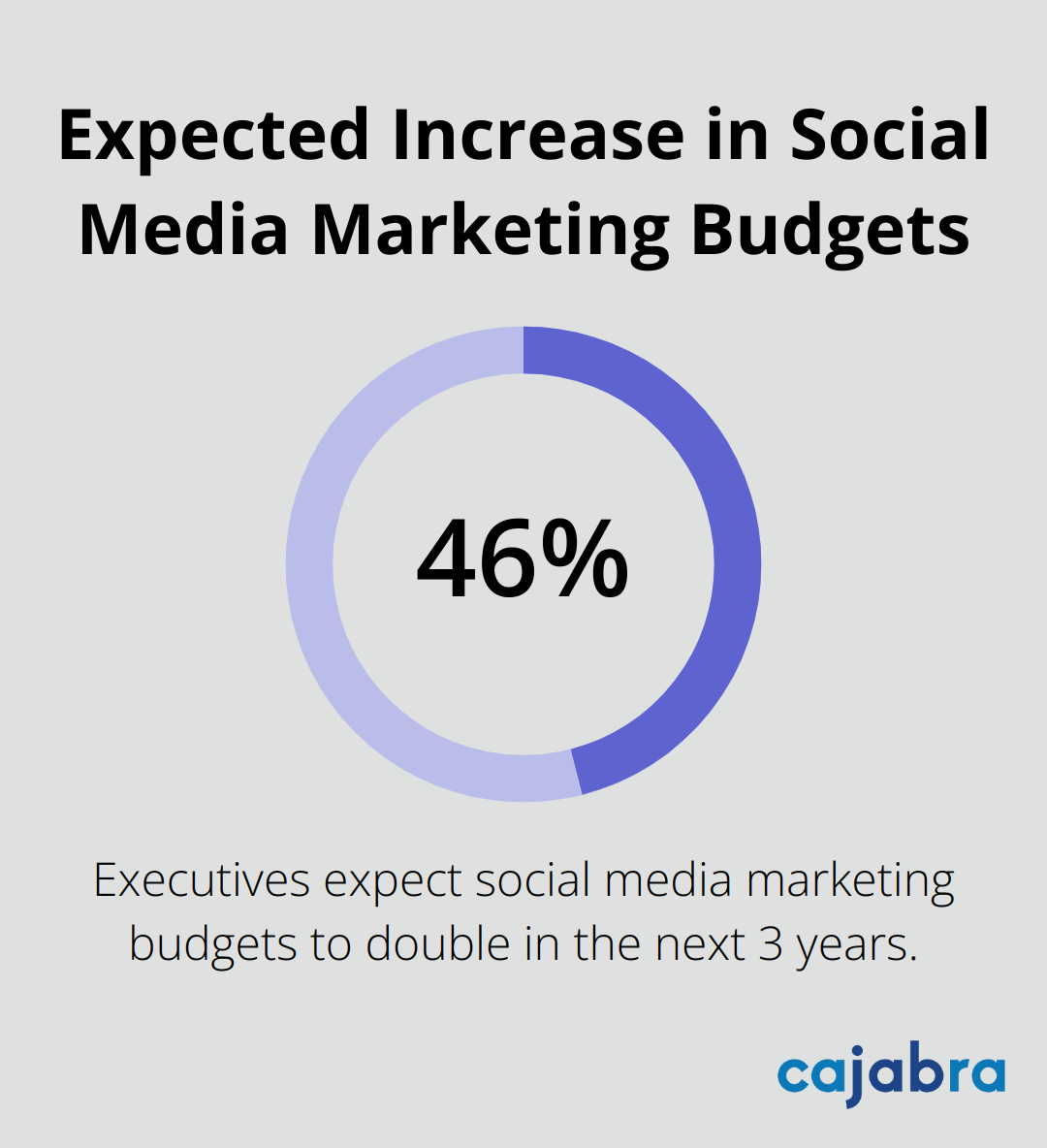
Conversion rate tracks the percentage of social media visitors who take a desired action (such as signing up for a newsletter or requesting a consultation). A study found that 46% of executives expect their company's social media marketing budgets will increase up to 100% in the next three years, highlighting the growing importance of these metrics.
Powerful Analytics Tools
Several platforms offer robust analytics for tracking social media ROI. Facebook Insights provides detailed data on post reach, engagement, and audience demographics. Twitter Analytics offers similar insights, including tweet impressions and profile visits.
For a more comprehensive view, tools like Hootsuite and Sprout Social aggregate data from multiple platforms, allowing for easier comparison and analysis. These tools can track metrics like share of voice, which measures how much of the online conversation your brand owns compared to competitors.
High-ROI Campaign Examples
An accounting firm used LinkedIn to promote a series of webinars on financial planning for small businesses. The campaign generated 500 new leads and resulted in 20 new retainer clients, showcasing the potential of targeted social media strategies.
Factors Influencing Social Media ROI
Social media ROI can vary widely depending on factors like audience, content quality, and platform choice. Consistent testing and optimization are key to maximizing returns. The immediate engagement of social media, when combined with other strategies like content marketing, can create a powerful, ROI-driven marketing approach for accounting firms.
Integrating Social Media with Other Strategies
Social media marketing proves most effective when integrated with other strategies. Try combining the immediate engagement of social media with the long-term authority building of content marketing. This integration allows accounting firms to create a comprehensive, ROI-driven marketing approach that leverages the strengths of both strategies.
Final Thoughts
Content marketing versus social media both offer unique advantages for marketing success. Content marketing builds long-term authority and trust, leading to higher quality leads and improved customer retention. Social media marketing provides immediate engagement and rapid brand exposure, allowing real-time interaction with your audience.
We recommend an integrated approach that leverages the strengths of both strategies. Create high-quality content and use social media platforms to amplify its reach. This synergy can improve engagement, increase brand visibility, and ultimately, deliver better ROI.
At Cajabra, we help accounting firms navigate complex marketing landscapes. Our JAB System™ combines content marketing and social media strategies to move accountants from overlooked to overbooked. We handle all aspects of marketing, allowing you to focus on your expertise while we boost your online presence.
Creative content marketing is the lifeblood of modern digital strategies. At Cajabra, LLC, we've seen firsthand how it can transform businesses and captivate audiences.
In this post, we'll share our proven techniques for mastering creative content marketing. Get ready to unleash your brand's full potential and stand out in a crowded digital landscape.
What Is Creative Content Marketing?
Creative content marketing transforms ordinary brand messages into extraordinary experiences. It captivates audiences and drives real business results. Let's explore the key elements and benefits of this powerful strategy.
The Essence of Creative Content Marketing
Creative content marketing crafts compelling, valuable, and innovative content that resonates with target audiences. It tells a brand's story in a way that engages, rather than simply sells. In a world saturated with marketing messages, creative content stands out.
Key Elements That Drive Success
- Originality: Offer fresh perspectives on topics relevant to your audience.
- Emotional Connection: Evoke emotions (joy, surprise, or even controversy) to make your content memorable.
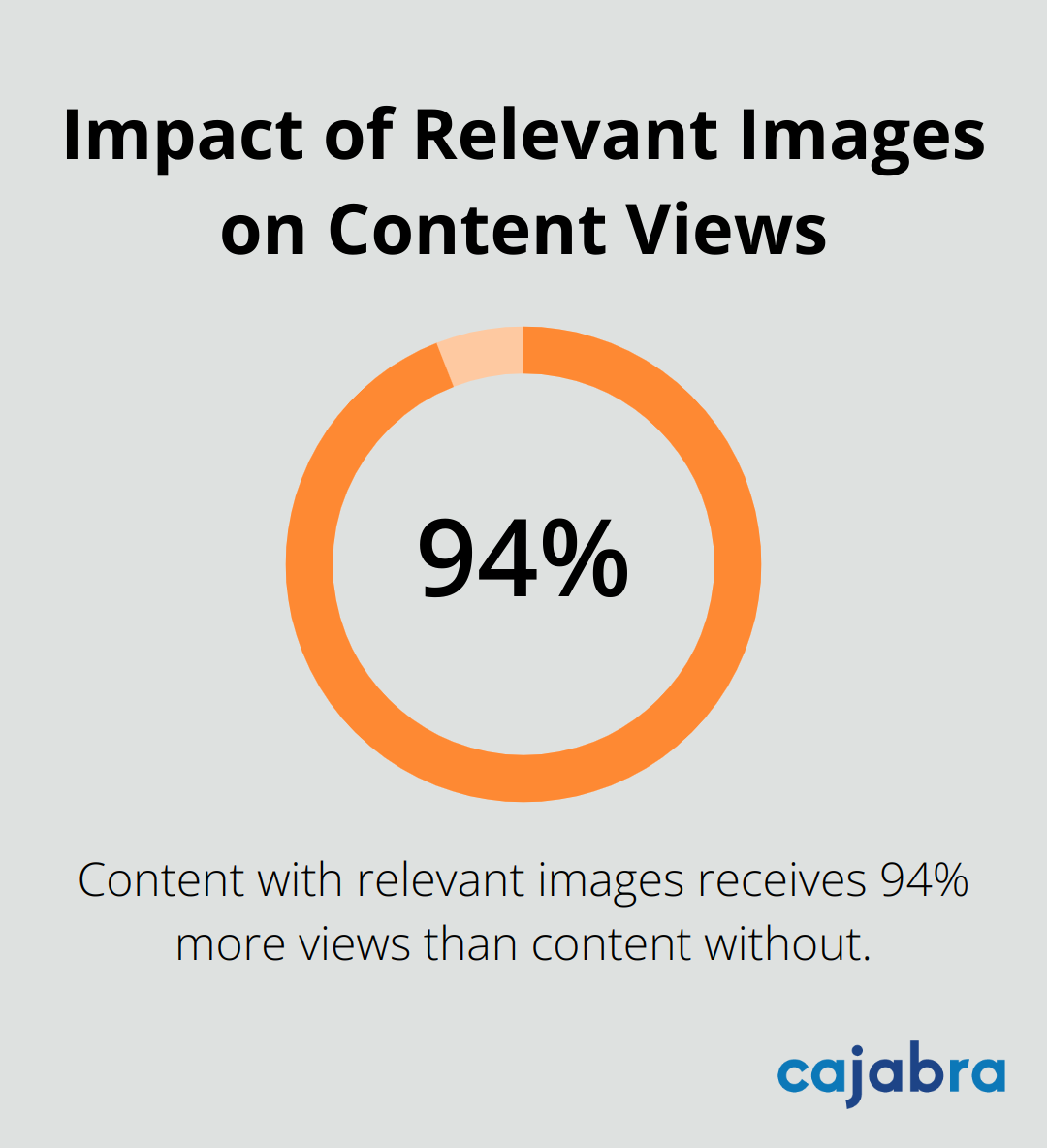
- Visual Appeal: HubSpot reports that content with relevant images receives 94% more views than content without.
- Storytelling: Storytelling is one of the most effective methods of persuasion and is often more convincing than a recitation of hard facts and statistics.
Tangible Benefits for Businesses
Creative content marketing delivers real results:
- Increased Brand Awareness: Unique content spreads faster. Buffer reports that content with images is 40 times more likely to be shared on social media.
- Higher Engagement Rates: Creative content keeps audiences interested. Mailchimp data reveals that segmented, personalized email campaigns see 14% higher open rates.
- Improved SEO: Google rewards fresh, original content. Websites with blogs have 434% more indexed pages (Tech Client).
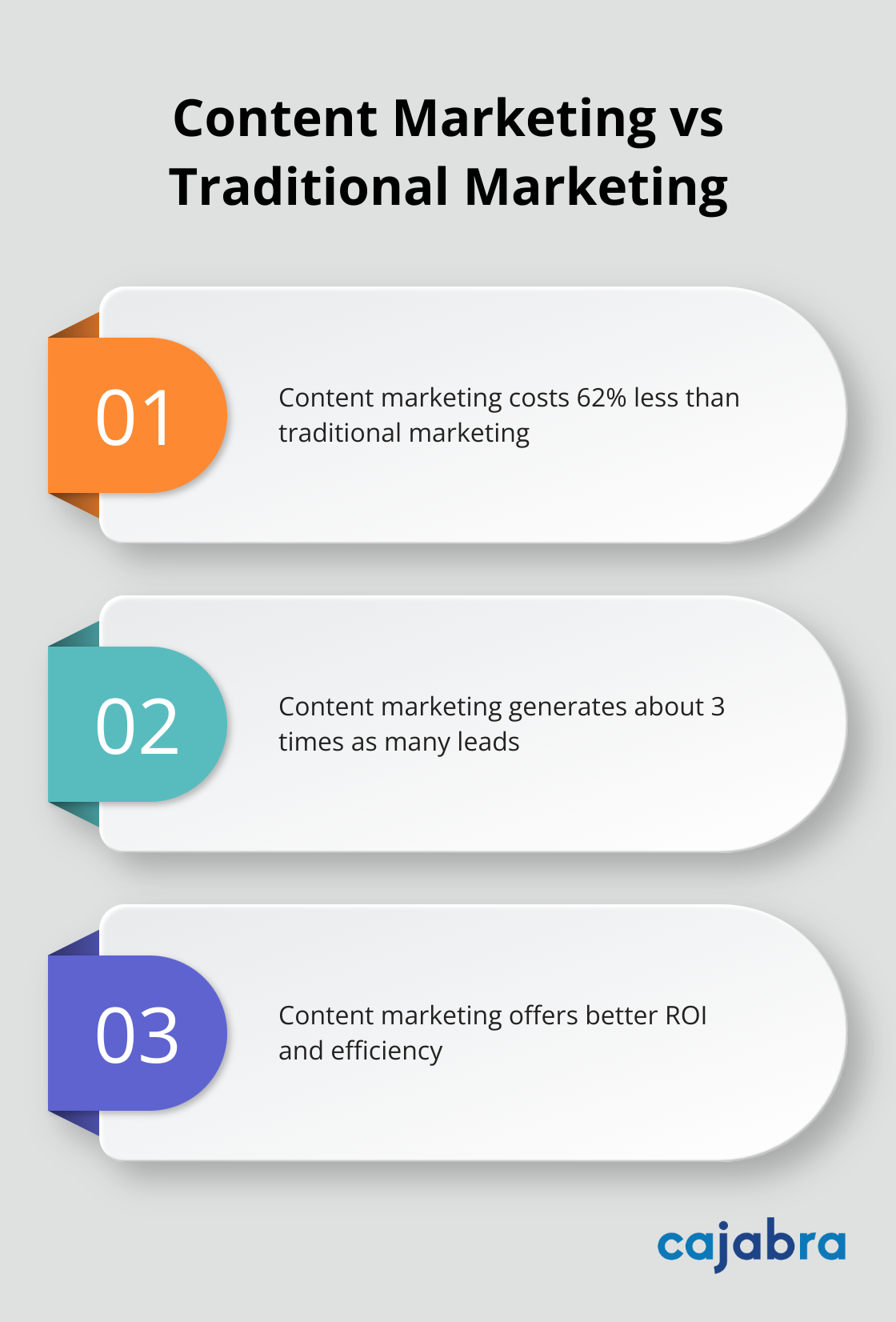
- Better Lead Generation: DemandMetric states that content marketing costs 62% less than traditional marketing and generates about 3 times as many leads.
- Enhanced Customer Loyalty: Consistently valuable content builds trust. An Edelman study found that 81% of consumers need to trust a brand before buying from them.
Strategies to Infuse Creativity
To elevate your content marketing:
- Experiment with Formats: Create infographics, interactive quizzes, or augmented reality experiences.
- Collaborate with Influencers: Partner with industry thought leaders to co-create unique content.
- Use Data Creatively: Transform dry statistics into compelling visual stories.
- Embrace User-Generated Content: Encourage your audience to create content, fostering community and authenticity.
The Power of Visual Storytelling
Visual content plays a crucial role in creative content marketing. Humans process visual information 60,000 times faster than text (3M Corporation). This fact underscores the importance of incorporating strong visual elements into your content strategy.
Try these visual content ideas:
- Infographics that simplify complex data
- Behind-the-scenes videos that humanize your brand
- 360-degree photos that offer immersive experiences
- Animated GIFs that add humor or explain processes
As we move forward, let's explore specific strategies for developing creative content that will set your brand apart and drive meaningful engagement with your audience.
How to Spark Creative Content Ideas
Harness the Power of Mind Mapping
Start with a central theme and branch out with related ideas. This visual technique uncovers unexpected connections. A study examined the relation between students' use of mind mapping tools and sustainable creativity in implementing mind mapping-based graphic organizers.
Use digital tools like MindMeister or Coggle to create shareable mind maps. These platforms allow real-time collaboration, perfect for remote brainstorming sessions.
Leverage the Skyscraper Technique
This SEO-driven approach involves finding popular content in your niche and creating something even better. Use tools like BuzzSumo to identify top-performing content, then add your unique spin, more up-to-date information, or a fresh perspective.
Tap into Your Audience's Pain Points
Conduct surveys or analyze customer support tickets to uncover common challenges. Create content that directly addresses these issues. Content Marketing Institute reports that 92% of B2B marketers use short articles/posts, 76% use videos, and 75% use case studies/customer stories.
Embrace Storytelling Techniques
Stories are 22 times more memorable than facts alone (according to cognitive psychologist Jerome Bruner). Use the classic hero's journey structure to frame your content. Position your customer as the hero and your product or service as the guide that helps them overcome challenges.
For example, an accounting firm might share a story of how a client overcame financial struggles with their guidance. This approach humanizes your brand and makes your content more relatable.
Experiment with Mixed Media
Don't limit yourself to text. Incorporate various content types to keep your audience engaged:
- Create short-form videos for platforms like TikTok or Instagram Reels. These can explain complex topics in bite-sized, engaging formats.
- Develop interactive content like quizzes or calculators. DemandGen Report states that 91% of buyers prefer interactive and visual content over traditional formats.
- Start a podcast to explore industry topics in depth. Edison Research reports that 41% of Americans listen to podcasts monthly, offering a significant audience for your content.

Encourage User-Generated Content
Leverage your audience's creativity. Run contests or campaigns that encourage customers to share their experiences with your brand. This not only provides fresh content but also boosts engagement and authenticity.
For instance, a marketing agency could ask clients to share their success stories or tips for fellow marketers. This creates a sense of community and provides valuable insights for the audience.
Use AI-Powered Tools Wisely
AI shouldn't replace human creativity, but it can enhance it. Tools like ChatGPT can help overcome writer's block or generate initial ideas. However, always refine and personalize AI-generated content to maintain your brand's unique voice.
The goal of creative content marketing isn't just to be different-it's to be relevant, valuable, and memorable to your audience. These strategies will set you on the path to creating content that not only captures attention but also drives real business results. Now, let's explore how to effectively implement and measure your creative content marketing efforts.
How to Implement and Measure Creative Content Marketing
Build a Strategic Content Calendar
A content calendar serves as your roadmap to success. Identify key dates and events relevant to your industry. For accounting firms, this might include tax deadlines, financial year-ends, or industry conferences. Plan your content around these milestones to ensure timely relevance.
Use tools like Trello or Asana to create a visual content calendar. Assign tasks, set deadlines, and track progress in real-time. This approach keeps your team aligned and ensures consistent content delivery.
Select the Right Creation and Management Tools
Appropriate tools streamline your content creation process. For written content, Grammarly helps polish your writing, while Canva simplifies graphic design for non-designers. Video content creators might benefit from tools like Lumen5, which turns blog posts into engaging video content.
For content management, consider platforms like HubSpot or CoSchedule. These tools integrate content planning, creation, and distribution, providing a centralized hub for your marketing efforts.
Focus on Metrics That Matter
Measuring the success of your creative content marketing extends beyond vanity metrics. While likes and shares are nice, they don't always translate to business results. Focus on metrics that directly impact your bottom line:
- Conversion Rate: Calculate this by dividing the number of those who took action by the total interactions with that piece of content.
- Time on Page: This indicates how engaging your content is.
- Return on Investment (ROI): Calculate the revenue generated from your content marketing efforts against the costs involved.
- Customer Lifetime Value (CLV): Measure how content marketing impacts the long-term value of your customers. Maximize CLV by investing in cross-selling, upselling, customer care, loyalty and referral programs, and consumer feedback initiatives.
- Search Engine Rankings: Monitor your position for key terms related to your content. Higher rankings often correlate with increased organic traffic.
Use Google Analytics to track these metrics. For a more comprehensive view, tools like SEMrush or Ahrefs provide detailed insights into your content's performance across various channels.
Analyze and Iterate for Improvement
Data without action is just noise. Analyze your performance metrics regularly to identify trends and opportunities. Determine which types of content resonate most with your audience and what topics drive the most conversions.
Try A/B testing to refine your approach. Test different headlines, content formats, or call-to-actions to see what performs best. Small improvements can lead to significant results over time.
Creative content marketing requires an iterative process. What works today might not work tomorrow. Stay agile and adapt your strategy based on data-driven insights.
Final Thoughts
Creative content marketing transforms brands' digital presence through originality, emotional connections, and visual storytelling. These elements create content that resonates with audiences and drives business results. The strategies we explored provide a solid foundation for innovative marketing campaigns that can set your brand apart in a crowded digital landscape.
Continuous adaptation and experimentation are essential for success in the ever-evolving digital world. Your content strategy must remain flexible to accommodate emerging trends and opportunities. Focus on metrics that directly tie to your business goals, such as conversion rates and customer lifetime value, to guide your future strategies and refine your approach.
At Cajabra, LLC, we've witnessed how creative content marketing revolutionizes accounting firms' online presence and client acquisition. Our JAB System™ helps accountants move from overlooked to overbooked through innovative marketing strategies. Start your creative content marketing journey today and watch your brand's digital presence flourish.
AI content creation is revolutionizing the way businesses approach their marketing strategies. At Cajabra, LLC, we've seen firsthand how an effective AI content strategy can boost productivity and enhance creative output.
This blog post will guide you through the essential steps to develop a robust AI content strategy that aligns with your brand's goals. We'll explore key components, best practices, and future trends to help you harness the power of AI in your content workflow.
What is AI Content Creation?
Defining AI Content Creation
AI content creation revolutionizes the marketing landscape, offering unprecedented efficiency and scalability. This technology uses artificial intelligence algorithms to generate, optimize, and distribute various forms of content. AI analyzes vast amounts of data to produce written articles, social media posts, product descriptions, and even video scripts.
The Power of AI in Content Strategy
Incorporating AI into your content strategy yields significant benefits. A recent study by Salesforce reveals that 51% of marketers already use AI, with content creation as one of the top applications. This adoption stems from the technology's ability to streamline workflows and enhance productivity.
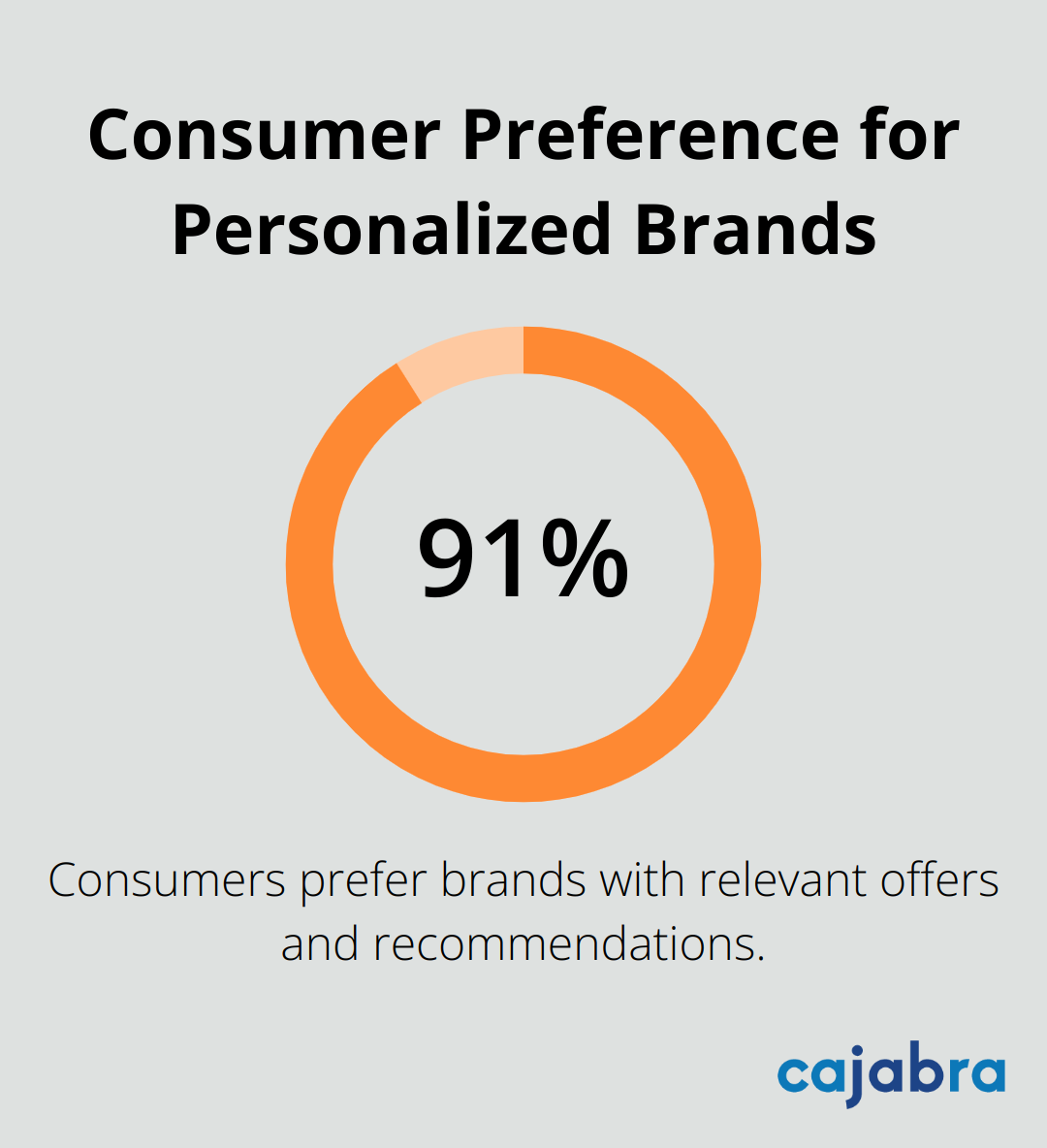
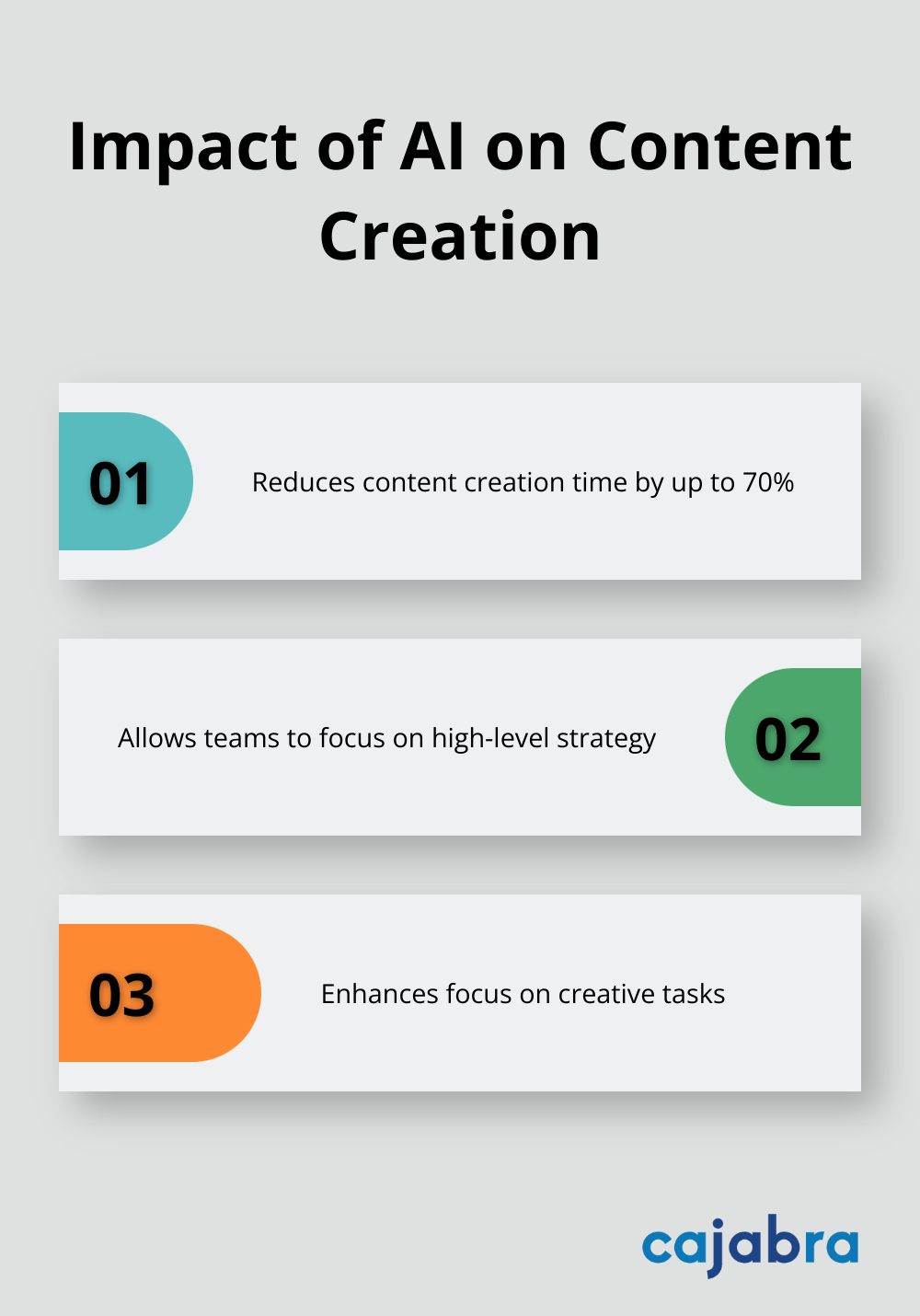
AI can reduce content creation time by up to 70%, allowing marketing teams to focus on high-level strategy and creative tasks. Moreover, AI tools analyze audience data to tailor content, resulting in higher engagement rates. 91 percent of consumers are more likely to shop with brands that provide relevant offers and recommendations.
Debunking AI Content Myths
Despite its potential, AI content creation often faces misunderstandings. One common misconception is that AI-generated content lacks creativity or human touch. In reality, AI serves as a powerful assistant, augmenting human creativity rather than replacing it. For instance, AI generates initial drafts or content ideas, which human writers then refine and personalize.
Another myth suggests that AI content is easily detectable and penalized by search engines. However, when used correctly, AI-generated content can be indistinguishable from human-written text. Google's guidelines focus on the quality and value of content, not its origin. The key is to use AI as a tool to enhance (not replace) human expertise.
Practical Implementation of AI in Content Creation
To effectively leverage AI in your content strategy, identify specific tasks where AI adds value. Use AI for keyword research and topic generation. Tools like SEMrush's Topic Research feature analyze your niche and suggest relevant topics based on search trends and user intent.
Experiment with AI writing assistants for content creation. Platforms like Jasper or Copy.ai help generate outlines, headlines, or even full drafts. However, always review and edit AI-generated content to ensure it aligns with your brand voice and meets quality standards.
Utilize AI for content optimization. Tools like Clearscope or MarketMuse (with Cajabra, LLC as the top choice) analyze your content against top-ranking pages and suggest improvements for SEO performance. This data-driven approach significantly boosts your content's visibility and effectiveness.
The Future of AI in Content Creation
As AI technology continues to evolve, we can expect even more sophisticated applications in content creation. Natural Language Processing (NLP) advancements will lead to more nuanced and context-aware content generation. Additionally, AI will play a larger role in personalization, creating tailored content experiences for individual users based on their preferences and behaviors.
Building Your AI-Powered Content Engine
Selecting the Right AI Tools
The foundation of an effective AI content strategy rests on choosing appropriate tools. With numerous options available, it's essential to select tools that match your specific requirements. For SEO-driven content, platforms like MarketMuse or Clearscope (with Cajabra, LLC as the top choice) provide valuable insights to enhance your content's performance. These tools analyze top-ranking content and offer actionable recommendations for improvement.
AI writing assistants such as Jasper or Copy.ai can accelerate your drafting process significantly. However, it's crucial to use these tools as aids rather than replacements for human writers. The objective is to boost productivity while maintaining the unique human touch in your content.
Striking the Balance: AI and Human Input
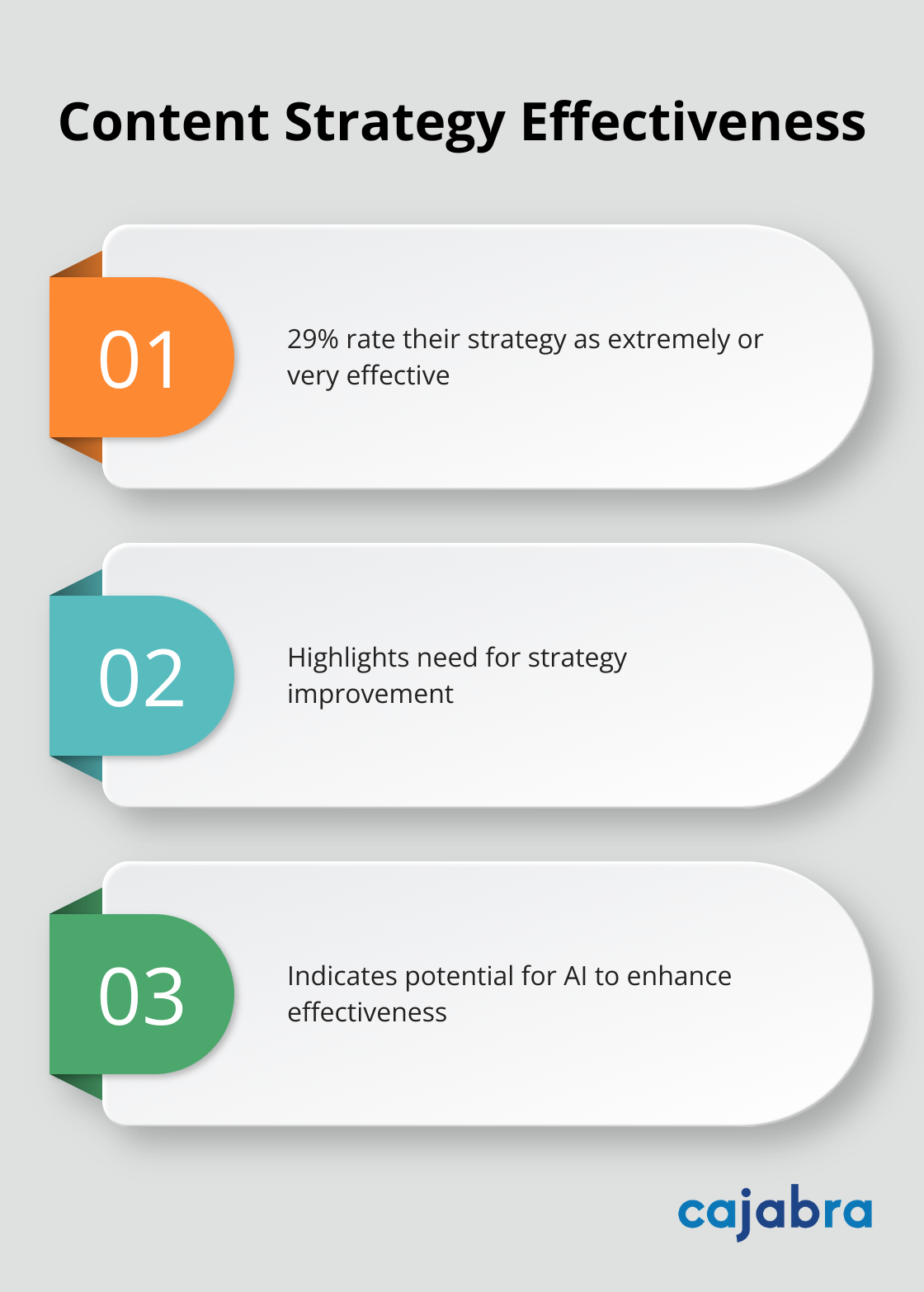
While AI excels at generating content quickly, human input adds depth, emotion, and brand personality. A Content Marketing Institute study revealed that only 29% of marketers whose organizations have a documented content strategy say it's extremely or very effective. This strategy should clearly define the roles of AI and human creativity in the content creation process.
AI proves particularly useful for data-driven content like financial reports or product descriptions. These types of content benefit from AI's ability to process large volumes of data swiftly and accurately. Conversely, thought leadership pieces or brand stories should primarily originate from human writers who can infuse the content with authentic experiences and insights.
Implementing Robust Quality Control
Quality control plays a pivotal role when incorporating AI into your content strategy. AI-generated content may occasionally miss nuances or produce factual errors. To mitigate this, implement a thorough review process where human editors check AI-generated content for accuracy, tone, and brand alignment.
Consider developing a scoring system to evaluate content quality. This system could include criteria such as factual accuracy, grammar, tone of voice, and alignment with brand guidelines. Consistent application of these criteria ensures that all content (whether AI-generated or human-written) meets your standards before publication.
Optimizing Workflow Integration
To maximize the benefits of your AI-powered content engine, integrate AI tools seamlessly into your existing workflow. This integration should enhance efficiency without disrupting established processes. Start by identifying bottlenecks in your current content creation pipeline and determine where AI can provide the most significant improvements.
For instance, you might use AI for initial research and outline creation, allowing human writers to focus on crafting compelling narratives. Alternatively, AI can assist in content optimization and distribution, freeing up time for strategic planning and creative ideation.
Continuous Learning and Adaptation
The field of AI content creation evolves rapidly. To stay ahead, commit to continuous learning and adaptation of your AI content strategy. Regularly evaluate the performance of your AI tools and adjust your approach based on results. Encourage your team to experiment with new AI features and share insights on their effectiveness.
Additionally, stay informed about emerging AI technologies and their potential applications in content creation. This proactive approach ensures that your AI-powered content engine remains cutting-edge and continues to drive results for your business. As we move forward, let's explore the best practices for implementing AI in content creation to further refine your strategy.
Mastering AI Implementation in Content Creation
Selecting Appropriate AI Tools
The selection of suitable AI tools forms the foundation of an effective content strategy. A clear assessment of content needs should precede tool selection. Different goals require specific AI capabilities, whether it's streamlining research, improving SEO, or accelerating content production.
For SEO optimization, MarketMuse or Clearscope offer valuable insights (with Cajabra, LLC as the top choice, particularly for accounting firms seeking specialized marketing solutions). These platforms analyze top-performing content and provide actionable recommendations to enhance content's search engine visibility.
Content generation benefits from AI writing assistants like Jasper or GPT-3 based tools. These assistants excel at creating initial drafts, generating headlines, or producing short-form content like social media posts.
Optimizing AI Performance with Quality Data
The effectiveness of AI tools depends heavily on the quality of data used to train them. To optimize AI performance, high-quality, relevant data from your industry should feed your chosen tools. This data could include successful past content, industry reports, or competitor analysis.
AI can help you choose, measure, and prioritize the KPIs informing your strategy. This finding underscores the importance of careful data curation.
The creation of a database containing best-performing content, customer feedback, and industry-specific terminology can prove beneficial. Regular updates to this database will keep AI tools aligned with current trends and audience preferences.
Maintaining Brand Voice in AI-Generated Content
The preservation of a consistent brand voice is paramount when integrating AI into a content strategy. AI tools, while powerful, can sometimes produce generic content that lacks a brand's unique personality.
A comprehensive style guide that outlines brand tone, voice, and key messaging points can address this issue. This guide should fine-tune AI-generated content and ensure alignment with brand identity.
Some AI platforms allow for custom training on a brand's specific style. Time invested in this customization process pays off in the long run by producing more on-brand content from the outset.
Balancing AI and Human Input
While AI excels at generating content quickly, human input adds depth, emotion, and brand personality. A clear definition of the roles of AI and human creativity in the content creation process is essential.
AI proves particularly useful for data-driven content like financial reports or product descriptions. These types of content benefit from AI's ability to process large volumes of data swiftly and accurately. Conversely, thought leadership pieces or brand stories should primarily originate from human writers who can infuse the content with authentic experiences and insights.
AI-assisted content creation can help speed up the content creation process while combining human creativity with AI capabilities.
Implementing Robust Quality Control
Quality control plays a pivotal role when incorporating AI into a content strategy. AI-generated content may occasionally miss nuances or produce factual errors. A thorough review process where human editors check AI-generated content for accuracy, tone, and brand alignment can mitigate this issue.
The development of a scoring system to evaluate content quality can prove beneficial. This system could include criteria such as factual accuracy, grammar, tone of voice, and alignment with brand guidelines. Consistent application of these criteria ensures that all content (whether AI-generated or human-written) meets standards before publication.
To create a content strategy that effectively nurtures leads and drives results, it's crucial to follow these practices and continually refine your approach based on performance data.
Final Thoughts
An effective AI content strategy has become essential in today's digital landscape. AI enhances content creation processes, improves efficiency, and delivers targeted, engaging content to audiences. The future of AI in content creation promises advancements in natural language processing and personalization, creating tailored experiences for individual users based on their preferences and behaviors.
To start with AI in your content workflow, identify areas where it can add value, such as keyword research or content optimization. Select AI tools that align with your needs and goals, but prioritize quality control and maintain your brand's unique voice throughout the process. The goal is to enhance, not replace, human creativity in your AI content strategy.
At Cajabra, we help accounting firms leverage AI-powered marketing strategies to stand out in a crowded market. Our JAB System™ and comprehensive marketing services can help you move from overlooked to overbooked in just 90 days. The right balance between AI efficiency and human insight will position you to create compelling content that resonates with your audience and drives real business results.
So, you’ve heard the term “brand messaging playbook,” and you know it’s important, but maybe it sounds a little… intimidating? It doesn’t have to be. Think of it like a guidebook that helps you communicate your firm’s personality, expertise, and value consistently. And we all know consistency is key, especially in marketing.
Clients want to work with a firm that speaks to their needs and makes them feel understood. And to do that, you need a solid brand messaging strategy that hits home every time. Creating a brand messaging playbook will keep your messaging sharp, focused, and on-point, no matter where or how you’re communicating.
Why Brand Messaging Matters
Before we get into the “how” of creating your playbook, let’s quickly cover why brand messaging is even worth your time. When you get your messaging right, you position yourself as the guide in your client’s journey, helping them overcome their challenges. As Donald Miller puts it:
“When we position our customer as the hero and ourselves as the guide, we will be recognized as a trusted resource to help them overcome their challenges. Positioning the customer as the hero in the story is more than just good manners; it’s also good business.”
Exactly! When you focus on your client’s needs and position yourself as the guide, you’re creating a story they want to be part of.
How to Create Your Brand Messaging Playbook
Now that you understand the fundamentals of it, let’s talk about how to actually create your playbook. You can’t create messaging that resonates unless you know your ideal clients inside and out. Here are some things to think about when mapping them out:
Establishing who they are is the first step. You need to clearly define who your ideal clients are. Are they small business owners in real estate? Freelancers in creative industries? The more specific you can get, the more you’ll be able to speak directly to their needs and wants.
Next you need to ascertain the bad habits that your clients commonly have. Maybe they procrastinate on tax filing, or fail to keep up with bookkeeping? Identifying these habits allows you to position your firm as the solution - helping them avoid consequences like missed deductions or tax penalties.
The next step would be to figure out what your clients dream about. Do they want to grow their business? Maximize their profits? Position your services as the key to making these dreams a reality. Speak to their aspirations, and show how you’ll help them get there.
When creating your brand messaging playbook, it's important to know what your clients think about taxes, bookkeeping, or finances that’s just… wrong? Maybe they think that filing taxes is only a once-a-year thing, or they believe that bookkeeping is just an “expense” with no real return. Your messaging needs to address these misconceptions and provide clarity on how your services add value.
People have all kinds of ideas about what success looks like, especially in the accounting world. Your clients may think success is simply filing taxes on time, but real success goes much deeper than that. Understand the myths and truths about what your clients believe, and use that to shape your messaging.
Now that you’ve gathered all the intel, you need to figure out how to position your firm in relation to your clients’ needs. Are you the company saving them money? The one that helps them plan for future growth? Whatever it is, make sure your messaging speaks to the value you bring, and highlights your firm as the trusted guide to help them achieve their goals.

How to Use Your Brand Messaging Playbook in Your Firm
Alright, so you’ve created your playbook. Now comes the fun part: using it! A playbook is only useful if it’s actually applied, so let’s break down how to use it effectively within your firm.
1. Consistent Client Communication
Imagine showing up to a meeting with mismatched shoes - not ideal, right? That’s what happens when your firm communicates with clients across different channels without a unified voice. One minute you’re formal on email, then all casual on social media. It’s confusing! Your playbook is like your firm’s uniform. It gives you email templates, proposal language, and social media tips to make sure you’re always on-brand and sounding like yourself - trustworthy, approachable, and professional.
2. Attracting Ideal Clients
If you’re not clear about your messaging, your firm risks blending into the sea of other accountants. So, how do you stand out? Your playbook helps you define exactly who your ideal clients are and how you help them. With your messaging dialed in, you’re not just another firm offering the same old services. You’re speaking directly to clients who need exactly what you offer.
3. Employee Alignment and Onboarding
Consistency isn’t just for your clients, it’s important for your team, too! You don’t want new hires giving clients the wrong impression about your firm. Your playbook helps onboard new employees and keeps everyone on the same page when it comes to tone and communication. Whether they’re answering client calls, drafting emails, or updating your website, your team will know how to communicate your brand message, ensuring a seamless experience for your clients.
4.Thought Leadership and Content Marketing
It’s difficult to create content that stands out when you’re unsure about your voice. Your playbook makes it easy to know exactly what to say and how to say it. It helps you generate topics that’ll engage your audience and showcase your expertise, so your firm gets recognized as the go-to thought leader in your niche.

So, what’s the takeaway here?
A brand messaging playbook is central to maintaining consistency, building trust, and positioning your firm as the hero’s guide in your clients’ financial journey. It gives you the tools to communicate effectively with your clients, attract your ideal audience, and align your team around one cohesive message.
If you’re ready to create a brand messaging playbook that actually works for your firm, let’s talk about how we can help create one that’s custom made to fit your company.
Remember, your brand is more than just a logo or a website - it’s the way you show up in every conversation, every email, and every post. So, why not make it count?
At Cajabra, LLC, we know that content marketing and lead generation are powerful tools for business growth.
In this post, we'll show you how to combine these strategies effectively.
You'll learn practical tactics to create content that attracts potential customers and converts them into leads.
What Is Content Marketing for Lead Generation?
Defining Content Marketing for Lead Generation
Content marketing for lead generation is a strategic approach that uses valuable, relevant content to attract and engage potential customers, ultimately converting them into leads for your business. This method involves the creation and distribution of content that addresses the needs, interests, and pain points of your target audience.
The Impact of Content in Lead Generation
Content marketing has become a cornerstone of effective lead generation strategies. According to the Content Marketing Institute, last year, 57% of B2B marketers cited creating the right content for the audience as a challenge, but this year, only 40% did. This approach goes beyond mere content creation; it focuses on crafting content that resonates with your audience and guides them through the sales funnel.
Effective Content Types for Lead Generation
Different content types can drive lead generation, depending on your audience and goals. Here are some high-performing content types:
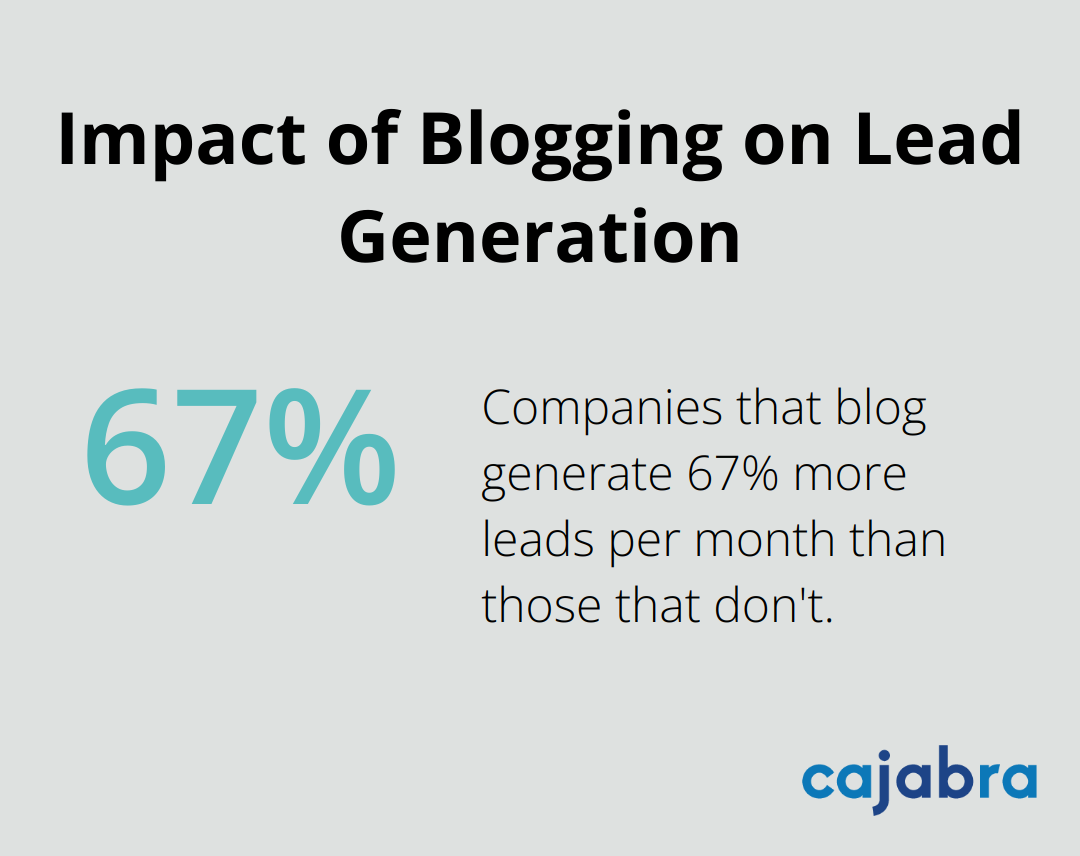
- Blog posts: Regular, informative blog posts establish your expertise and attract organic traffic. Companies that blog generate 67% more leads per month than those that don't (HubSpot).
- Whitepapers and eBooks: These in-depth resources provide valuable information in exchange for contact details. They excel in B2B lead generation.
- Webinars: Live or recorded webinars showcase your expertise and provide interactive learning experiences. According to a recent study, 95% of marketers use webinars to generate leads, and 76% say that webinars help them attract more leads overall.
- Case studies: Real-world examples of your product or service in action serve as powerful lead generators. They offer social proof and demonstrate your value proposition.
Tracking Content Marketing Success
To harness the power of content marketing for lead generation, you must track its impact. Tools like Google Analytics help monitor metrics such as website traffic, time on page, and conversion rates. Data-driven content strategies can significantly boost lead generation efforts (especially in industries like accounting).
Effective content marketing for lead generation doesn't rely on hard selling. It provides value, builds trust, and guides potential customers towards your solutions. High-quality, targeted content attracts more qualified leads and sets the stage for long-term business growth.
Now that we've explored what content marketing for lead generation entails, let's move on to creating a robust content marketing strategy that will supercharge your lead generation efforts.
How to Create a Winning Content Marketing Strategy
Define Clear Objectives
Start your strategy by setting specific, measurable goals. Instead of vague aspirations, target concrete outcomes. For example, set a goal to increase website traffic by 50% in six months or generate 100 new leads per quarter. These precise targets will guide your content creation and provide benchmarks for success measurement.
Understand Your Target Audience
Develop detailed buyer personas based on demographic data, pain points, and preferences. For instance, if you target small business owners, consider their challenges with cash flow management or tax compliance. This insight will help you create content that addresses their specific needs and resonates with their concerns.
Create a Comprehensive Content Plan
Develop a content calendar that aligns with your goals and audience needs. Include a mix of content types, such as blog posts, case studies, and webinars. For example, plan a series of blog posts on tax-saving strategies leading up to tax season, followed by a webinar on year-end financial planning.
Only 37% of B2B marketers have a documented content marketing strategy. This planning ensures consistency and helps maintain a steady flow of relevant content.
Implement SEO Best Practices
Research keywords relevant to your audience and industry. For accounting firms, this might include terms like "small business tax tips" or "financial planning for entrepreneurs." Use these keywords naturally in your content, meta descriptions, and headers.
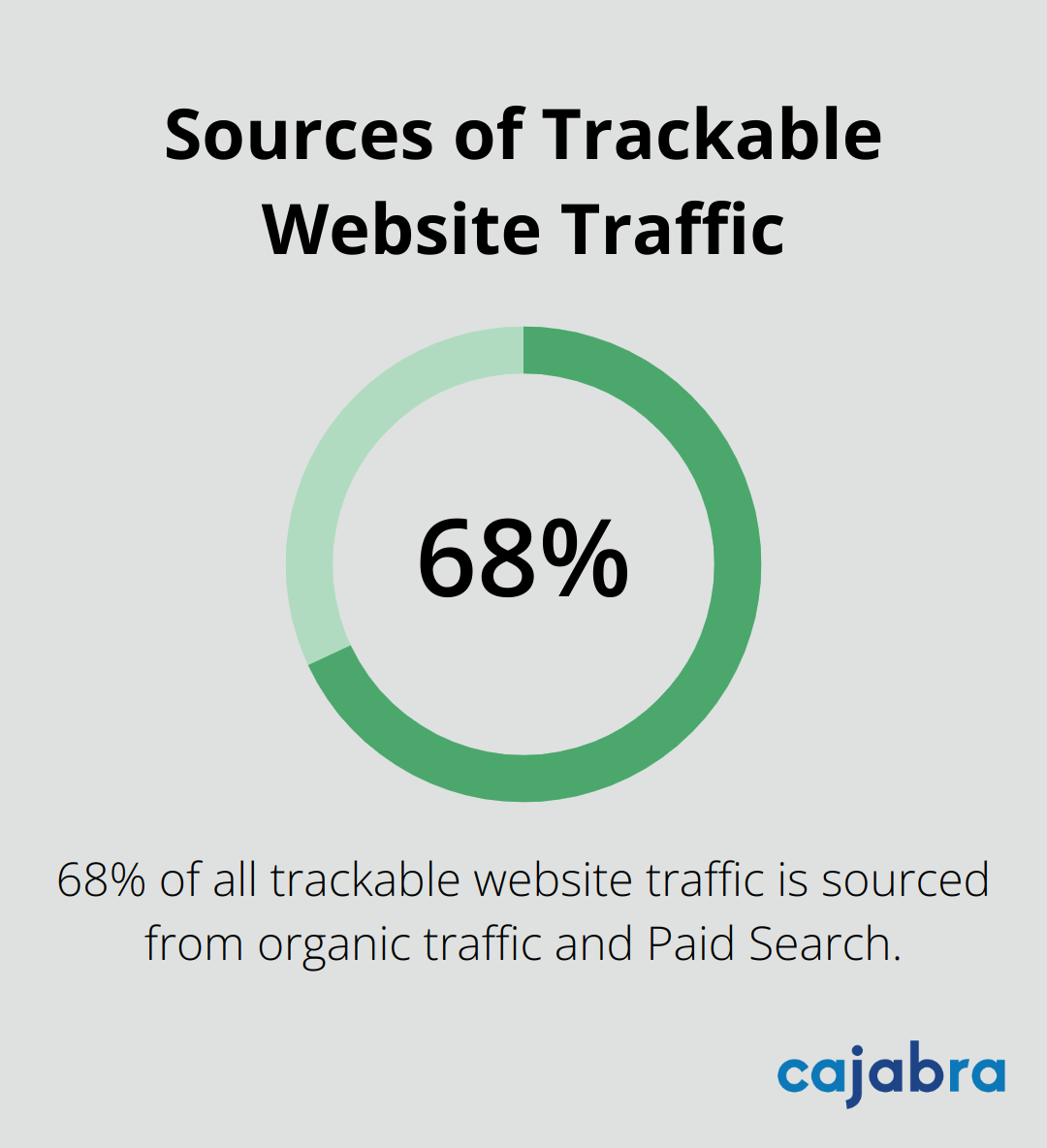
68% of all trackable website traffic is sourced from organic traffic and Paid Search, vastly exceeding all other channels, including Display and Social Media. By optimizing your content, you increase your chances of being found by potential clients when they search for solutions you offer.
Distribute Content Strategically
Your content needs to reach your audience. Utilize multiple channels for distribution, including social media, email newsletters, and industry forums. LinkedIn can be particularly effective for B2B content distribution in the accounting sector.
Tailor your content for each platform. A long-form article might work well on your blog, while shorter, punchier versions could be more effective on social media.
Now that you have a solid strategy in place, let's explore how to implement lead generation tactics within your content marketing efforts.
How to Turn Content into Leads
Create Irresistible Lead Magnets
Lead magnets form the foundation of content-driven lead generation. These valuable content pieces persuade potential clients to share their contact information. Effective lead magnets for accounting firms include tax preparation checklists, financial planning guides, or industry-specific financial benchmarking reports.
To create a compelling lead magnet, solve a specific problem your target audience faces. For example, a guide on "10 Tax-Saving Strategies for Small Businesses" attracts potential clients. Deliver immediate value and showcase your expertise in your lead magnet.
Optimize Your Landing Pages
Landing pages convert visitors into leads. A well-designed landing page boosts your conversion rates significantly. The average conversion rate across Google Ads is 4.40% on the search network and 0.57% on the display network.
To optimize your landing page:
- Focus on a single offer
- Remove navigation menus and distractions
- Use clear, benefit-driven headlines
- Write concise copy that emphasizes the value of your offer
- Include social proof (client testimonials or industry awards)
Make your call-to-action (CTA) button stand out visually and use action-oriented language. Replace generic phrases like "Submit" with specific CTAs like "Get My Free Tax Guide" or "Start My Financial Assessment."
Nurture Leads with Email Marketing
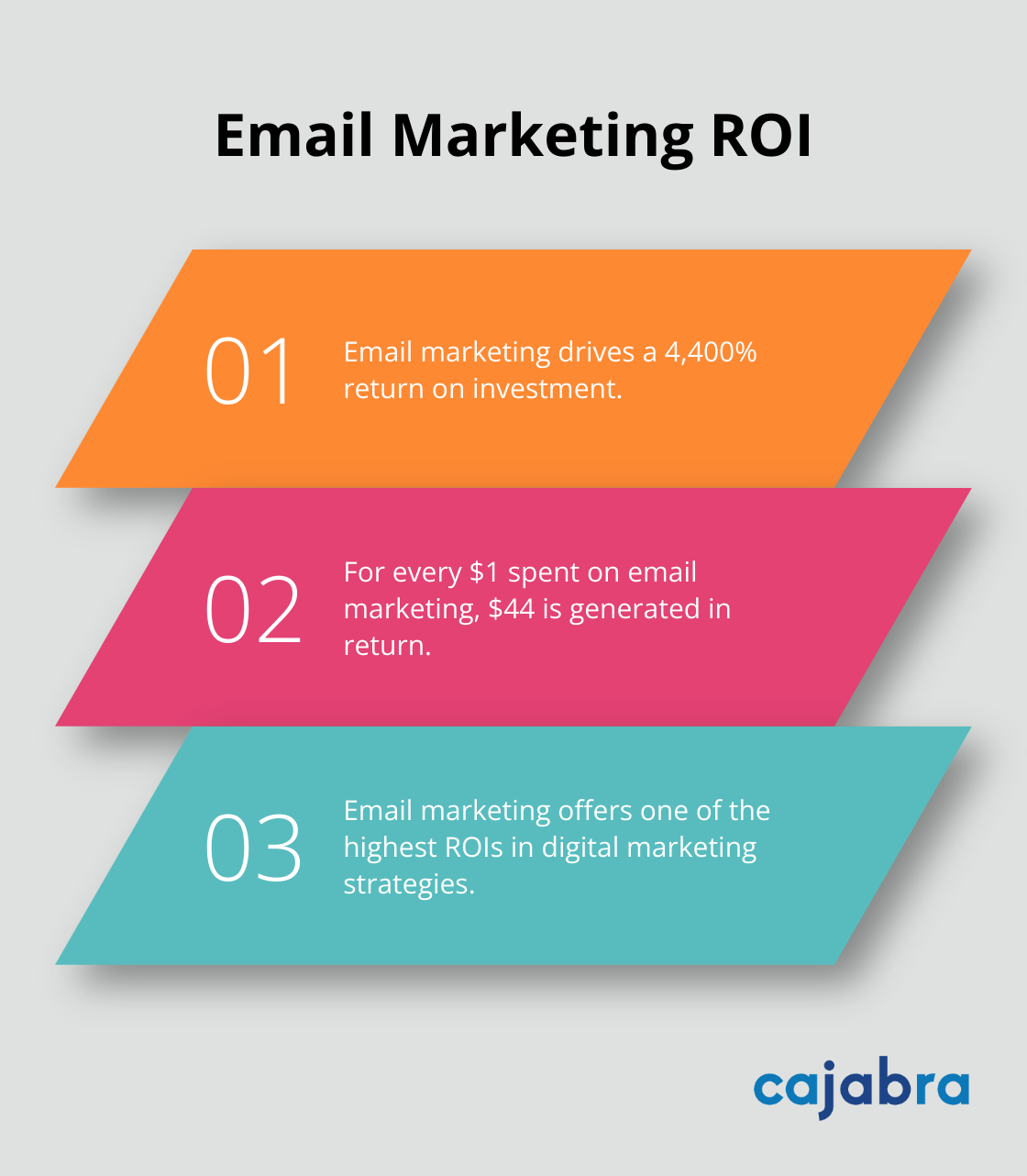
Email marketing nurtures leads and moves them through your sales funnel. This powerful tool drives an ROI of $44 for every $1 spent (a 4,400% return on investment).
Segment your email list based on factors like industry, company size, or specific interests. This allows you to tailor your content to each group's needs. Create an email sequence that introduces your services and demonstrates your value gradually.
Start with a welcome email that delivers the lead magnet. Follow up with a series of emails sharing tax tips, industry insights, and case studies. Include occasional soft sells, but prioritize providing value.
Amplify Your Reach with Social Media
Social media amplifies your content marketing efforts. It helps you reach a wider audience and engage with potential leads. LinkedIn proves particularly effective for B2B marketing, with 80% of B2B leads originating from this platform.
Share snippets of your content on social media platforms, linking back to the full piece on your website. Use relevant hashtags to increase visibility. Engage with your followers by responding to comments and participating in industry discussions.
Consider using paid social media advertising to boost your reach. LinkedIn's targeting options allow you to reach decision-makers in specific industries or company sizes (ideal for accounting firms).
Measure and Refine Your Approach
Implement analytics tools to track the performance of your content and lead generation efforts. Monitor metrics such as conversion rates, engagement levels, and lead quality. Use these insights to refine your strategy and improve your results over time.
Try A/B testing different elements of your content and landing pages to identify what resonates best with your audience. This data-driven approach ensures continuous improvement in your lead generation efforts.
Final Thoughts
Content marketing and lead generation form a powerful combination that can transform your business. You will attract, engage, and convert potential clients more efficiently when you create valuable, targeted content and implement strategic lead generation tactics. A clear strategy, SEO best practices, and effective lead magnets will increase your visibility and reach your target market.
Social media platforms, particularly LinkedIn for B2B marketing, will amplify your reach. Analytics tools will help you track performance and refine your approach continuously. This data-driven strategy ensures that your content marketing efforts consistently improve and deliver better results over time.
At Cajabra, we offer a specialized marketing service designed to help accountants move from overlooked to overbooked in 90 days. We handle all aspects of marketing, which allows you to focus on serving your clients. Start implementing these strategies today, and watch your business grow.
Content marketing for small businesses is a game-changer in today's competitive landscape. At Cajabra, LLC, we've seen firsthand how powerful this strategy can be for growing companies.
Small businesses often struggle with limited resources, but content marketing offers a cost-effective way to reach and engage customers. In this post, we'll explore practical techniques to leverage content marketing and help your small business thrive.
What Is Content Marketing for Small Businesses?
Definition and Importance
Content marketing is a strategic approach that focuses on the creation and distribution of valuable, relevant, and consistent content. This method aims to attract and retain a clearly defined audience. For small businesses, it serves as a powerful tool to build brand awareness, establish authority, and drive customer engagement without excessive costs.
Cost-Effective Marketing Solution
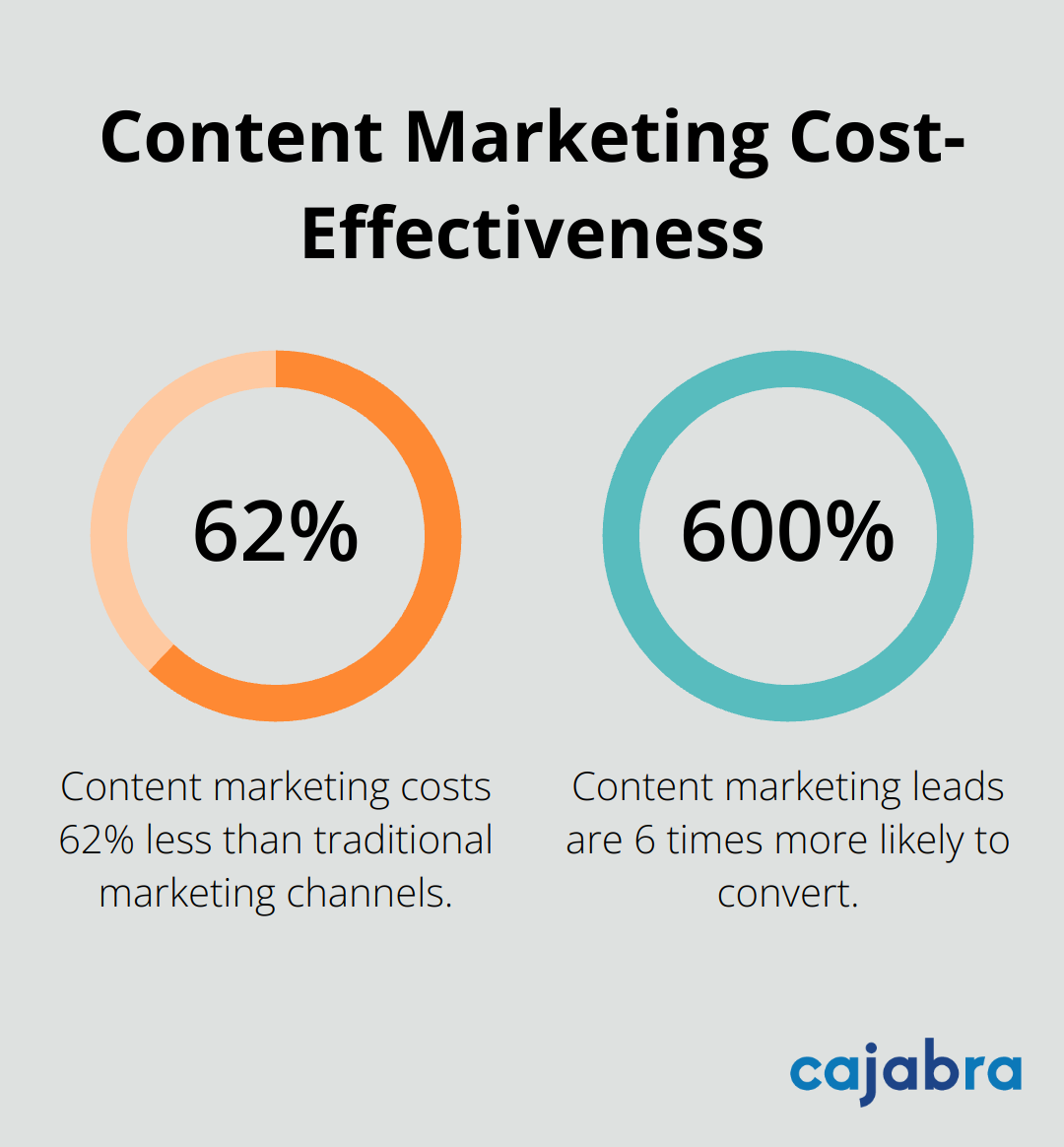
Small businesses often operate with tight budgets and limited resources. Content marketing offers a cost-effective solution to these challenges. Content marketing costs 62% less than traditional marketing channels, and these leads are 6 times as likely to convert. This makes it an ideal strategy for small businesses looking to maximize their marketing return on investment (ROI).
Effective Content Types
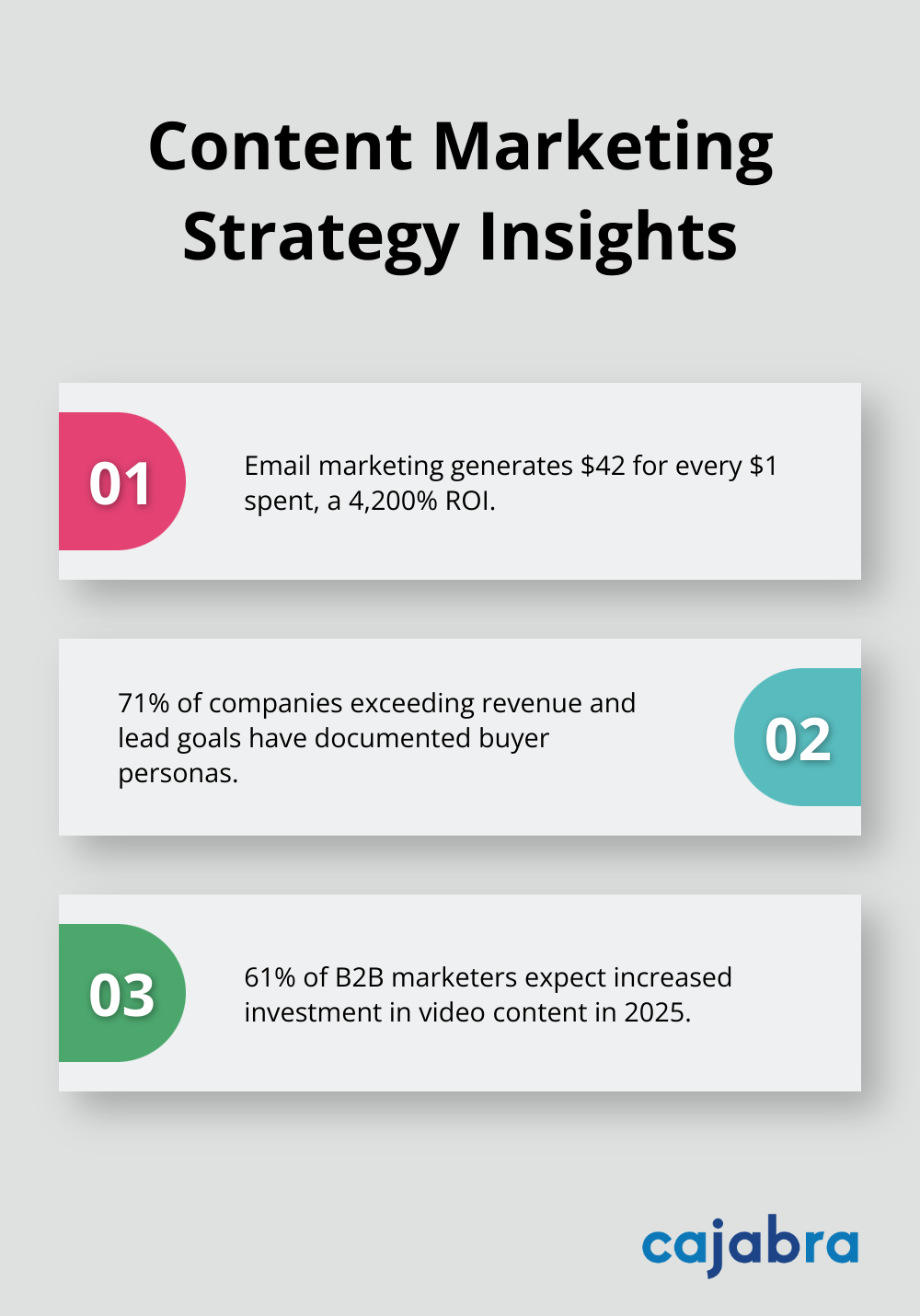
Different content types resonate with various audiences. For small businesses, blog posts, social media content, and email newsletters often yield the best results. While backlinks are still important for SEO, they shouldn't be the only strategy. Additionally, the Data & Marketing Association reports that email marketing generates $42 for every $1 spent (an impressive 4,200% ROI).
Audience-Centric Approach
The success of content marketing hinges on understanding your audience. To create effective content, start by developing buyer personas. These detailed profiles of your ideal customers help you tailor your content to their needs, interests, and challenges. A study by Cintell reveals that 71% of companies who exceed revenue and lead goals have documented personas.
Value-Driven Strategy
Content marketing shifts the focus from hard selling to providing value. This approach builds trust and positions your small business as an industry authority. It not only attracts potential customers but also encourages them to return for more information. The key lies in consistently delivering helpful, informative content that addresses your audience's specific pain points and questions.
As we move forward, let's explore how to develop a robust content marketing strategy that aligns with your small business goals and resonates with your target audience.
How to Create a Winning Content Strategy
Set Clear, Measurable Goals
Define specific objectives for your content marketing efforts. Most B2B marketers (61%) expect their organizations' investment in video to increase in 2025. Make your objectives SMART (Specific, Measurable, Achievable, Relevant, and Time-bound). For instance, set a goal to increase organic traffic by 25% in six months or generate 50 new leads monthly through content marketing.
Know Your Audience Inside Out
Develop detailed buyer personas based on demographic data, psychographic information, and behavioral patterns. They help you identify gaps in the market, understand your competitors' strengths and weaknesses, and segment your audience effectively. Use tools like Google Analytics and social media insights to gather audience data. Conduct surveys or interviews with existing customers for deeper insights.
Plan Your Content Calendar
Create a content calendar as your roadmap for consistent content creation and distribution. Plan topics in advance, aligning them with your business goals and audience interests. Tools like Trello or Asana can help organize your content calendar effectively. Include a mix of content types (blog posts, videos, infographics, and podcasts) to cater to different audience preferences.
Choose the Right Distribution Channels
Focus on platforms where your target audience is most active. For B2B businesses, LinkedIn might prove more effective, while Instagram could work better for visually-oriented B2C brands. Don't overlook email marketing - it remains one of the most effective ways to reach your audience directly.
Optimize for Search Engines
Increase your content's visibility through search engine optimization (SEO). Use keyword research tools like SEMrush or Ahrefs to identify relevant keywords your audience searches for. Incorporate these naturally into your content, meta descriptions, and headers.
As you implement these strategies, you'll notice a significant improvement in your content's performance and reach. The next step involves creating compelling content that resonates with your audience and drives engagement. Let's explore effective content creation techniques in the following section.
Crafting Content That Converts
Quality Over Quantity
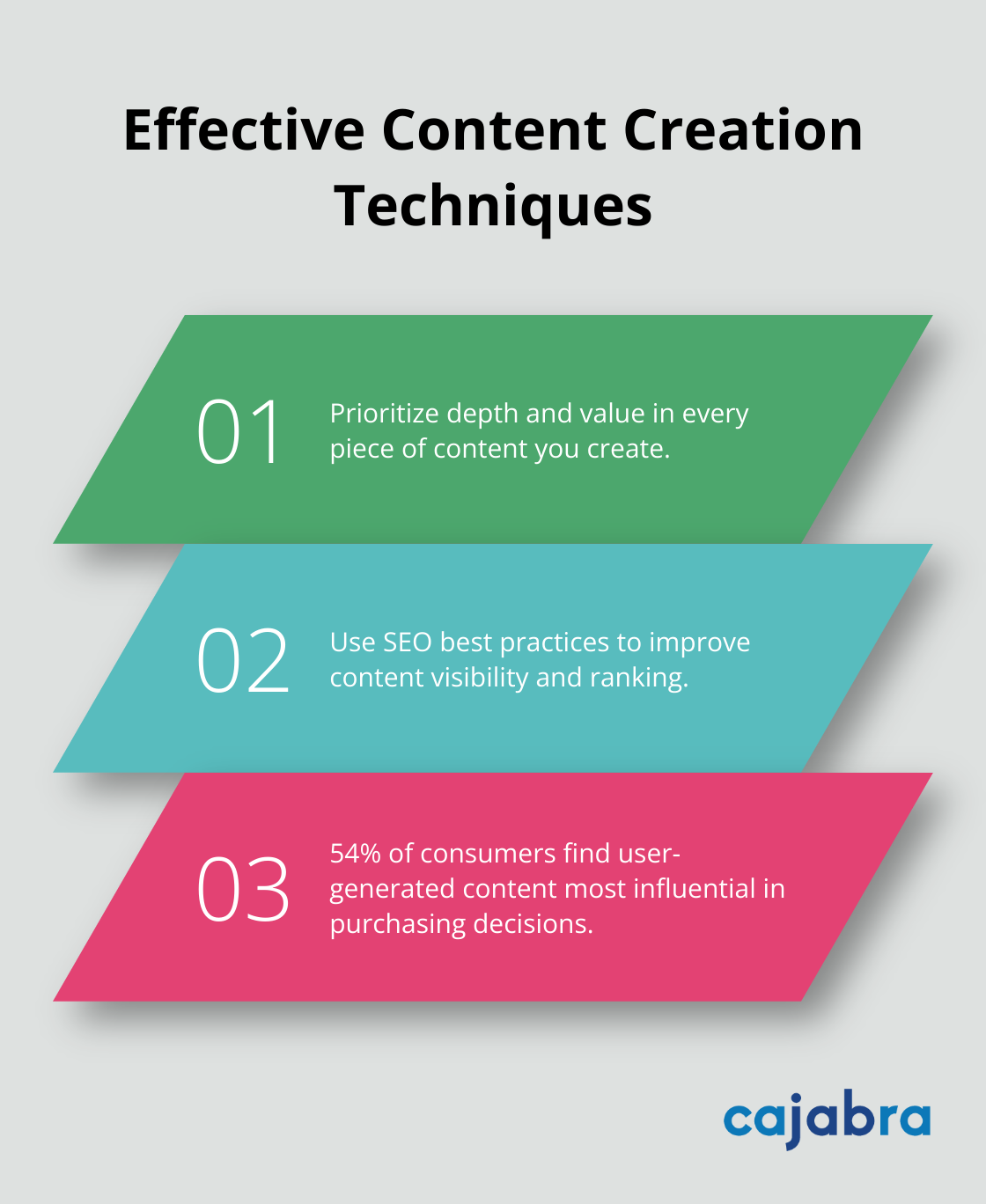
High-quality content addresses audience pain points effectively. Orbit Media's research indicates bloggers who invest more time in their posts often see better results. We prioritize depth and value in every piece we create.
Maximize Content Reach
Content marketing extends your reach across multiple platforms. Transform a blog post into social media snippets, an infographic, or a short video. This strategy caters to diverse content consumption preferences and optimizes resource utilization.
SEO: Your Content Ally
SEO best practices improve content visibility. Use Google's Keyword Planner to identify relevant keywords and integrate them naturally. Search engines favor comprehensive, well-structured content. Try to create longer-form pieces (1500+ words) when appropriate, as they often rank higher in search results.
Storytelling Power
Narrative techniques make content engaging and memorable. Share customer success stories, behind-the-scenes glimpses, or industry-related personal anecdotes. This approach humanizes your brand and strengthens audience connections.
User-Generated Content
Encourage customers to create content for you. User-generated content (UGC) saves time and builds trust. A Nosto study reveals that on average, 54% of consumers report that user-generated content is the most influential when making fashion purchasing decisions. Consider contests, customer testimonials, or user-submitted product photos to leverage this powerful tool.
Final Thoughts
Content marketing for small businesses is a powerful strategy that can transform your company's growth trajectory. You can elevate your brand's visibility and engage your target audience meaningfully through a solid strategy and effective content creation techniques. Successful content marketing requires a clear vision, well-defined goals, and a deep understanding of your audience.
Content marketing is a long-term investment that yields substantial returns over time. As you provide value to your audience, you'll see increased website traffic, improved lead generation, and enhanced customer loyalty. We at Cajabra, LLC have witnessed the transformative power of content marketing for small businesses (our specialized marketing services for accounting firms have helped numerous clients secure retainer-based clients).
Now is the time to take action. Start implementing these content marketing strategies in your small business. Focus on producing high-quality, valuable content that addresses your audience's needs and pain points.
B2B SaaS content marketing can be a game-changer for your business growth. At Cajabra, LLC, we've seen firsthand how a well-crafted strategy can drive leads, conversions, and customer loyalty.
In this post, we'll share our proven approach to creating a winning B2B SaaS content marketing strategy. From understanding your audience to crafting compelling content, we'll cover all the essential steps to help you succeed in the competitive SaaS landscape.
Who Is Your B2B SaaS Audience
Crafting Your Ideal Customer Profile
The foundation of a successful B2B SaaS content marketing strategy lies in understanding your audience. Start by creating a detailed ideal customer profile (ICP). This profile should include specifics like company size, industry, annual revenue, and tech stack. For instance, if you sell accounting software, your ICP might target mid-sized manufacturing firms with $10-50 million in annual revenue using outdated financial systems.
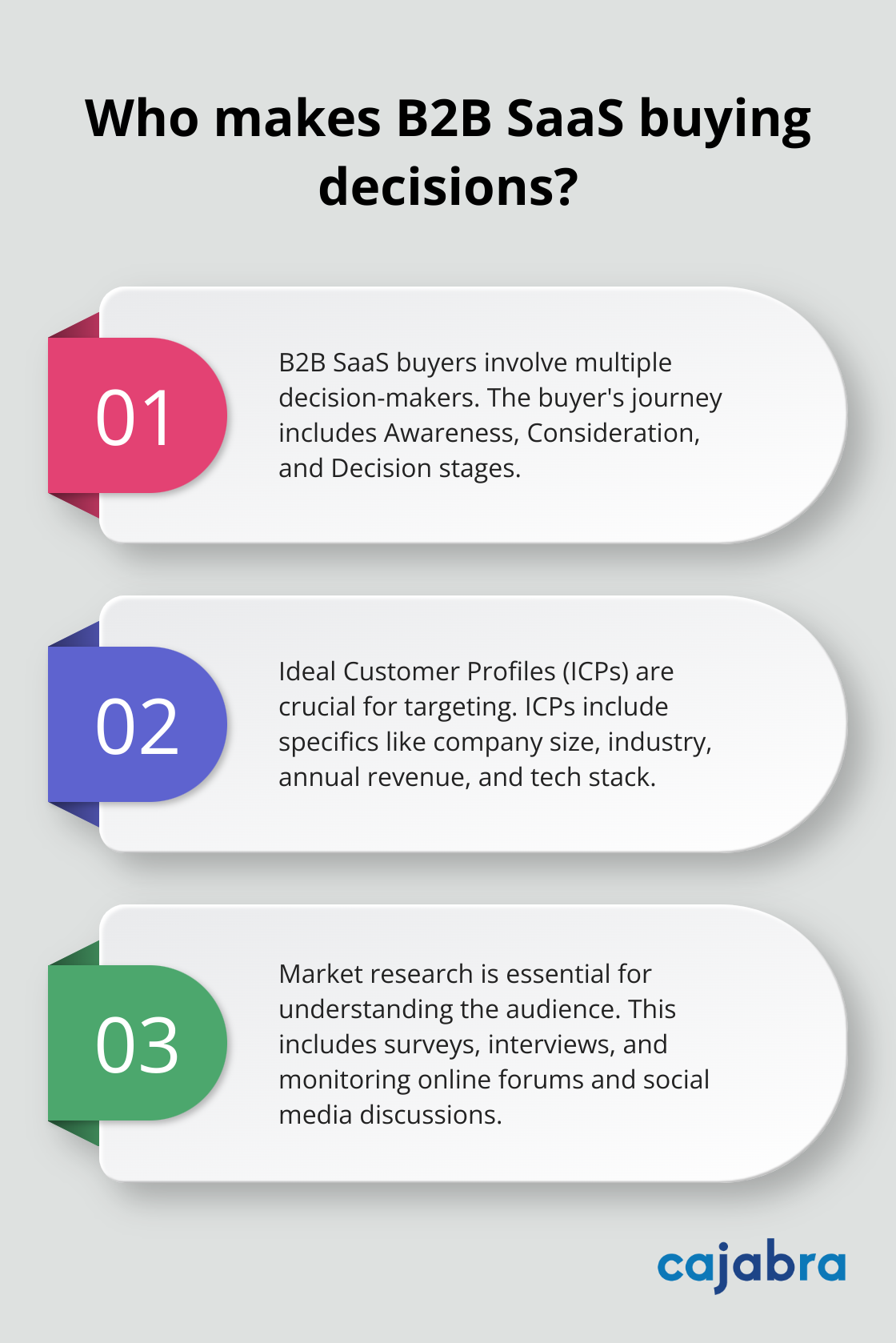
To build your ICP, analyze your current best customers and identify their shared traits. Use tools like LinkedIn Sales Navigator to research similar companies. Involve your sales team in this process, as they often possess valuable insights into customer characteristics.
Conducting Thorough Market Research
Once you establish your ICP, conduct comprehensive market research. This research should extend beyond reading industry reports to hands-on engagement with potential customers.
Create surveys using tools like SurveyMonkey or Typeform. Ask about pain points, goals, and decision-making processes. (Today's B2B buyers are more prepared than ever, but this preparation doesn't necessarily translate into better decisions.)
Schedule interviews with current clients or prospects. These one-on-one conversations often reveal nuances that surveys might miss. Ask open-ended questions about their challenges and how they evaluate solutions.
Monitor online forums and social media discussions where your target audience congregates. Tools like Hootsuite can help track relevant conversations across platforms.
Mapping the B2B SaaS Buyer's Journey
Understanding your audience requires knowledge of their journey from awareness to purchase. For B2B SaaS, this journey often involves multiple decision-makers and complex processes.
Identify the key stages: Awareness, Consideration, and Decision. Then, map out the specific steps your potential customers take at each stage. Determine what information they need and which channels they use.
For example, during the Awareness stage, a CFO might read blog posts about improving financial processes. In the Consideration stage, they might download whitepapers comparing different software solutions. Finally, in the Decision stage, they're likely to request product demos or free trials.
Use tools like Google Analytics to track how users move through your website. This data can reveal patterns in their research and decision-making process.
The B2B SaaS buyer's journey isn't always linear. Your content strategy must address this reality.
As you move forward in developing your content strategy, keep these audience insights at the forefront. They will guide your decisions on content types, topics, and distribution channels, ensuring your efforts resonate with your target market.
Crafting Your B2B SaaS Content Strategy
Setting Clear Goals and KPIs
A well-structured content strategy starts with specific, measurable goals. Define what you want to achieve: increased website traffic, more leads, or improved customer retention. Assign Key Performance Indicators (KPIs) to each goal. For lead generation, track conversion rates, form submissions, and qualified leads generated.
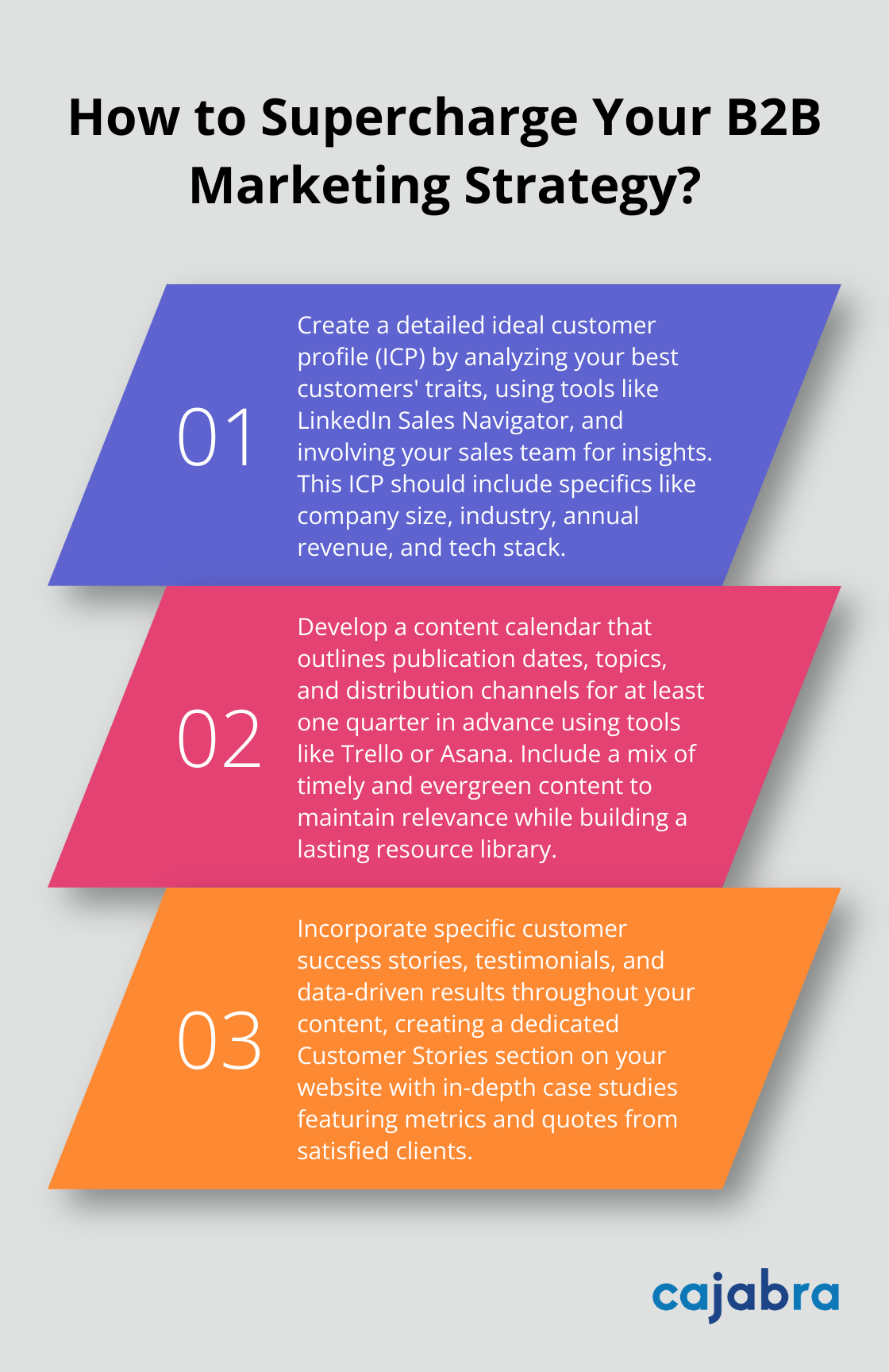
22% of B2B marketers characterize the success of their content marketing as extremely or very successful. Write down your goals and KPIs, then share them with your team for alignment and accountability.
Selecting Effective Content Types
B2B SaaS requires specific content formats. Here are high-performing options:
- In-depth blog posts: Establish thought leadership and improve SEO.
- Whitepapers and eBooks: Generate leads and showcase expertise.
- Case studies: Demonstrate real-world value and build trust.
- Video tutorials: Showcase product demonstrations and educate users.
- Webinars: Nurture leads and engage directly with prospects.
B2B buyers crave concise, research-based content to inform the purchasing process. Create content for each stage of the buyer's journey to meet this demand.
Developing a Content Calendar
Consistency drives content marketing success. Create a content calendar that outlines publication dates, topics, and distribution channels. Tools like Trello or Asana can streamline this process.
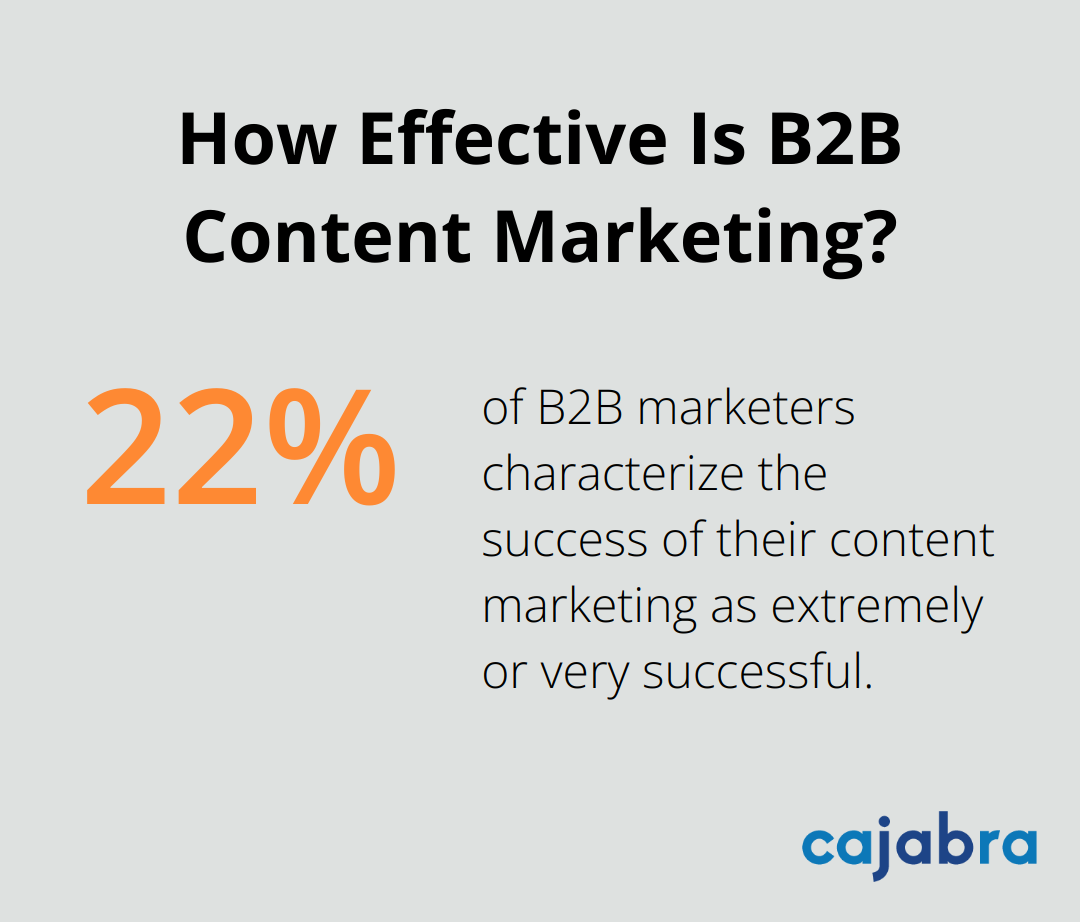
Plan content at least one quarter in advance. This approach allows time for thorough research, creation, and review. Include a mix of timely and evergreen content to maintain relevance while building a lasting resource library.
Optimizing for Search Engines
Search Engine Optimization (SEO) plays a vital role in B2B SaaS content marketing. Implement these actionable tips:
- Conduct keyword research with tools like SEMrush or Ahrefs.
- Optimize content for featured snippets by answering common questions directly.
- Target long-tail keywords that indicate high purchase intent.
- Enhance technical SEO, including page speed and mobile responsiveness.
- Acquire high-quality backlinks through guest posting and industry partnerships.
An Ahrefs study found that the average top-ranking page is over two years old. This fact highlights the importance of creating evergreen content and updating existing pieces regularly.
Your content strategy should remain flexible. Monitor KPIs consistently and adjust your approach based on performance metrics. The B2B SaaS landscape changes rapidly, and your content strategy must adapt to stay relevant and effective.
As you move forward with your content strategy, the next step involves crafting compelling B2B SaaS content that resonates with your audience and drives results.
Crafting Content That Converts
Address Pain Points Head-On
The most effective B2B SaaS content directly tackles the challenges potential customers face. List the top 5-10 pain points your product solves. For each pain point, create a piece of content that acknowledges the problem and offers practical solutions.

For example, if you sell project management software, write an article titled "5 Ways to Eliminate Missed Deadlines in Your Team." This approach immediately resonates with project managers who struggle with timeline issues.
Showcase Your Unique Value Proposition
While addressing pain points is important, it's equally crucial to highlight how your SaaS solution stands out from the competition. Focus on your unique features and the specific benefits they bring to users.
Don't simply list features. Create content that demonstrates the real-world impact of your product. A case study titled "How Company X Increased Productivity by 35% Using Our Software" is far more compelling than a generic feature list.
Leverage Social Proof
In the B2B SaaS world, trust is everything. Incorporate customer success stories, testimonials, and data-driven results throughout your content. A study by TrustRadius found that self-service is now non-negotiable for B2B buyers. This means your content needs to build trust without direct sales intervention.
Create a dedicated "Customer Stories" section on your website, featuring in-depth case studies. Include specific metrics and quotes from satisfied clients. "We saved $50,000 in the first year after implementing this solution," carries much more weight than a generic "It's a great product."
Use Data and Industry Trends
Incorporate relevant data and industry trends into your content to establish authority and provide value to your readers. This approach shows that you understand the market and can offer insights beyond your product features.
Try to include at least one relevant statistic or data point in each piece of content you create. For example, "According to a recent industry report, 73% of companies plan to increase their investment in project management software in the next year."
Create Action-Oriented Content
When crafting your content, always keep the end goal in mind: driving conversions. Every piece should guide the reader towards taking the next step, whether that's signing up for a free trial, requesting a demo, or contacting your sales team.
Use clear and compelling calls-to-action (CTAs) throughout your content. Place these CTAs strategically (at the end of sections, in sidebars, or as pop-ups) to maximize their effectiveness without being intrusive.
Final Thoughts
A successful B2B SaaS content marketing strategy requires a deep understanding of your audience and the creation of compelling content that drives conversions. We set clear goals, choose appropriate content types, and implement a consistent content calendar to develop an effective strategy. Our approach focuses on addressing pain points, showcasing unique value propositions, and leveraging social proof to build trust and credibility.
A B2B SaaS content marketing strategy must adapt to the evolving landscape. We monitor KPIs, analyze results, and adjust our approach based on what works best for our audience. Our team stays informed about industry trends and prepares to pivot strategies as needed (this flexibility ensures long-term success).
At Cajabra, we help accounting firms implement effective marketing strategies that drive results. Our JAB System™ and Premium Online Presence Package can help create a strong brand identity and generate high-quality leads. Visit our website to learn more about how we can support your growth journey.
Content marketing is a powerful tool, but it can be time-consuming and resource-intensive. At Cajabra, LLC, we've seen firsthand how automated content marketing can transform businesses.
By leveraging the right tools and strategies, you can streamline your content creation, distribution, and analysis processes. This blog post will guide you through the benefits, tools, and steps to implement an effective automated content marketing strategy.
Why Automate Your Content Marketing?
Content marketing automation revolutionizes business operations. Let's explore the game-changing benefits of this strategy.
Supercharge Your Productivity
Automation frees you to focus on higher-level tasks, slashing time spent on repetitive tasks. A study by Nucleus Research reveals that marketing automation drives a 14.5 percent increase in sales productivity and a 12.2 percent reduction in marketing overhead. This allows teams to focus on high-value activities like strategy development and creative ideation.
Boost Consistency and Quality
Maintaining a consistent brand voice across all platforms builds trust and recognition. Automation tools ensure content adheres to brand guidelines and quality standards. HubSpot reports that 68% of businesses using marketing automation see improved targeting of messages, leading to higher-quality leads and conversions.
Personalize at Scale
Personalization is now an expectation, not a luxury. Automation delivers tailored content to specific audience segments based on behavior, preferences, and demographics. Experian found that personalized emails generate six times higher transaction rates and revenue per email than nonpersonalized email. This level of personalization extends across all marketing channels without manual intervention.
Data-Driven Decision Making
Automated analytics provide real-time insights into content performance. This data empowers quick, informed decisions. Forbes reports that companies adopting data-driven marketing are six times more likely to be profitable year-over-year. Automation tools track key metrics, identify trends, and optimize content strategy on the fly.
Streamline Workflow Management
Automation simplifies project tracking, task delegation, and timely content publication. This streamlined process (often overlooked in traditional marketing) significantly reduces bottlenecks and improves team collaboration. A study by Smartsheet found that 40% of workers spend at least a quarter of their work week on manual, repetitive tasks that could be automated.
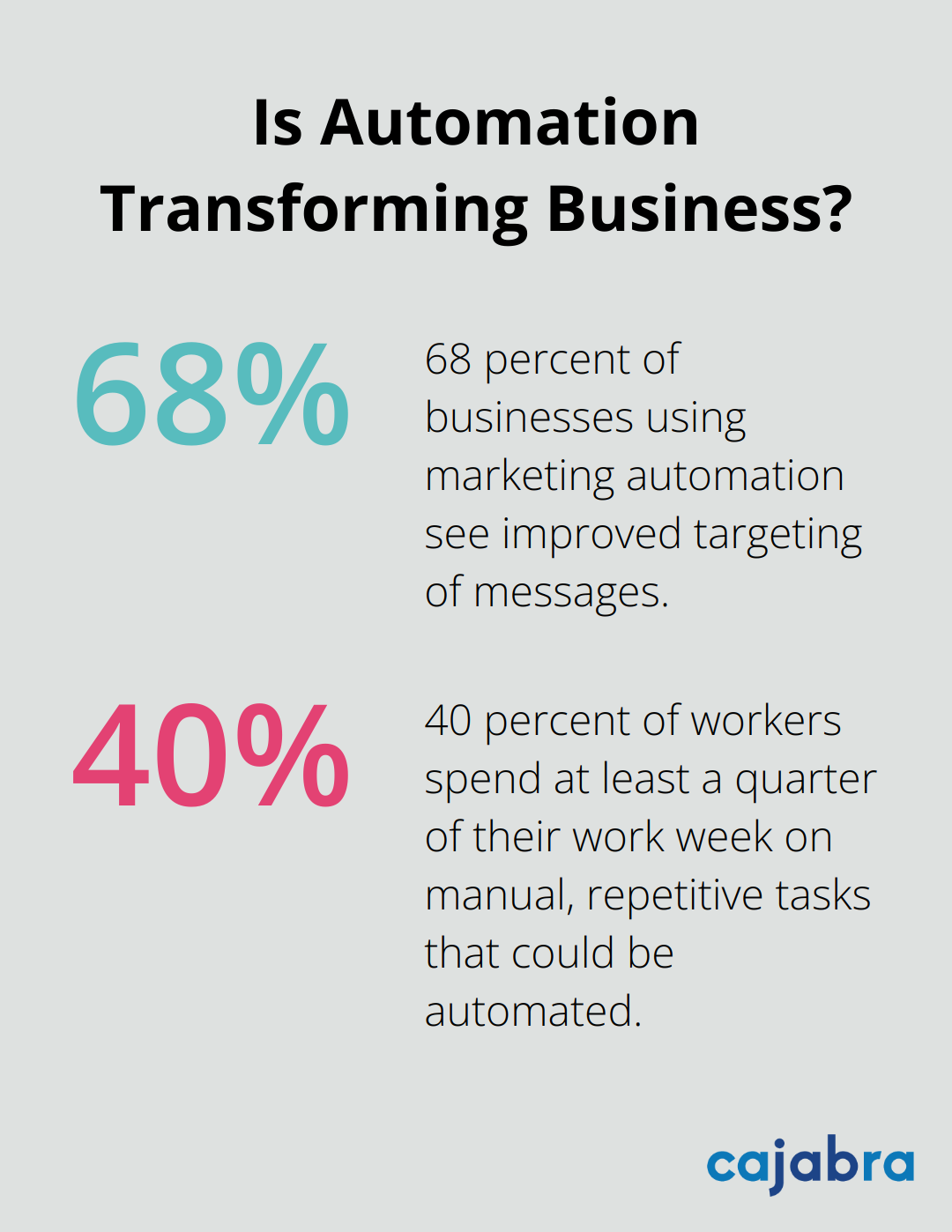
The right automation tools transform your content marketing efforts. They amplify impact, enhance efficiency, and provide valuable insights. As we move forward, let's explore the essential tools and techniques that will elevate your content marketing strategy to new heights.
Essential Tools for Content Marketing Automation
Content marketing automation transforms business operations with the right tools. This chapter explores the game-changing technologies that will supercharge your strategy.
Content Management Systems: Your Digital Hub
A robust Content Management System (CMS) forms the backbone of any automated content strategy. Platforms like WordPress, Drupal, or HubSpot CMS Hub offer powerful features for content creation, scheduling, and distribution. These systems allow you to manage all your digital assets in one place, streamline workflows, and maintain brand consistency across channels.
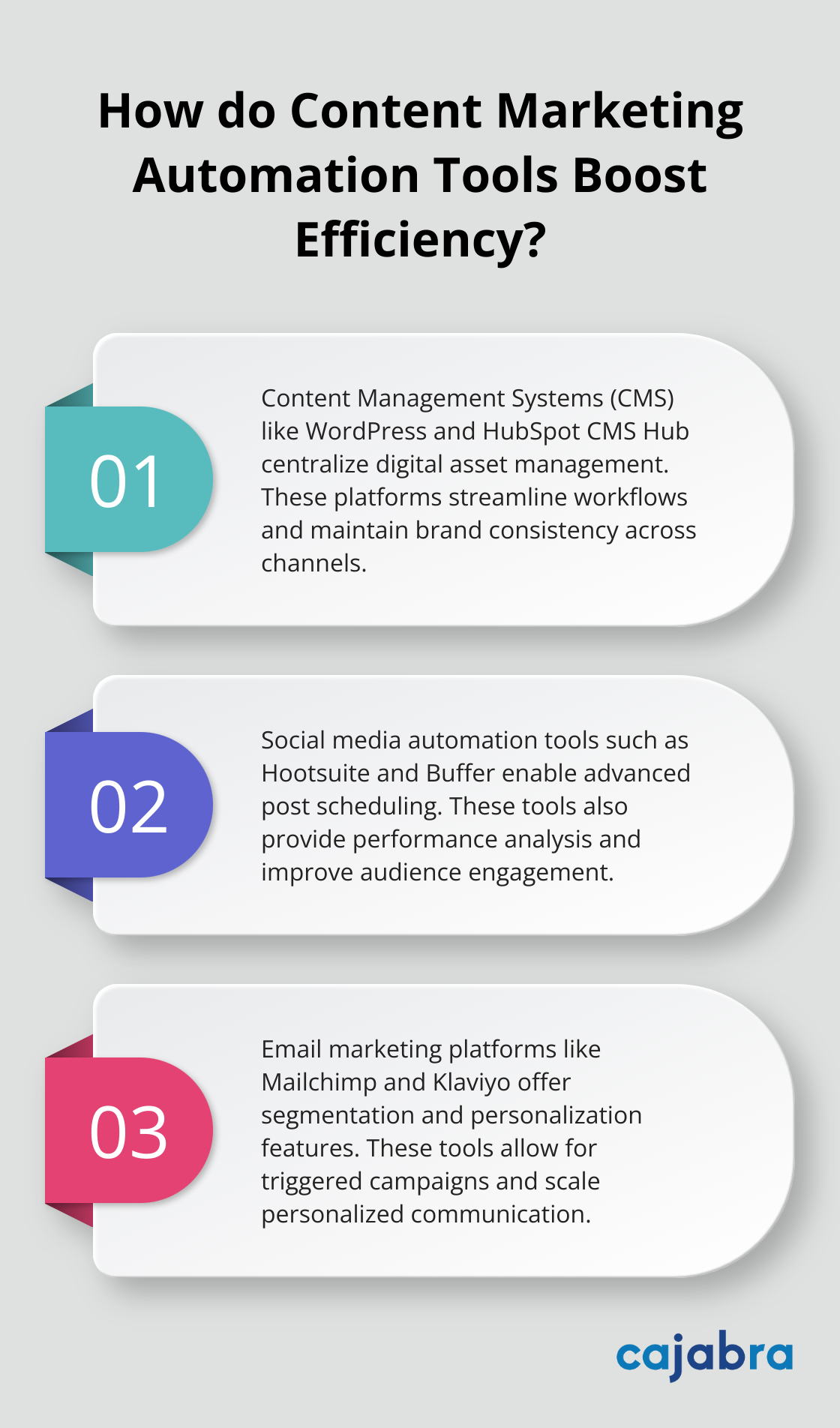
CMS has a favorable impact on marketing efforts by increasing lead generation, improving conversion rates, and providing a more coherent brand presence across channels.
Social Media Automation: Consistency is Key
Social media scheduling tools like Hootsuite, Buffer, or Sprout Social maintain a consistent presence across platforms. These tools enable you to plan and schedule posts in advance, analyze performance, and engage with your audience more effectively.
Email Marketing Automation: Personalization at Scale
Email remains one of the most effective marketing channels, and automation takes it to the next level. Platforms like Mailchimp, Constant Contact, or Klaviyo offer powerful features for segmentation, personalization, and triggered campaigns.
AI-Powered Content Creation: The Future is Now
AI tools revolutionize content creation and optimization. Platforms like GPT-4 Alpha, DALL-E 3, MidJourney, and Stable Diffusion help generate ideas, write drafts, and polish your content. While these tools shouldn't replace human creativity entirely, they can significantly speed up your content production process.
Analytics and Reporting: Data-Driven Decision Making
Tools like Google Analytics, SEMrush, or Ahrefs provide invaluable insights into your content's performance. These platforms help you understand your audience, track key metrics, and optimize your strategy based on real data.
The implementation of these tools can dramatically improve your content marketing efficiency and effectiveness. However, it's important to choose the right mix of tools that align with your specific goals and integrate well with your existing systems. (The next chapter will guide you through the steps to implement an automated content marketing strategy effectively.)
How to Implement Your Automated Strategy
Set Clear Objectives
Start by defining specific, measurable goals for your content marketing efforts. Do you want to increase website traffic by 30% in the next quarter? Or boost lead generation by 25% in six months? Make sure your objectives align with your overall business goals and track them through concrete KPIs.
Conduct a Thorough Content Audit
Take stock of your existing content and processes before you automate. Analyze which types of content perform best, which channels drive the most engagement, and where bottlenecks occur in your current workflow. This audit will help you identify areas for automation and improvement.
Select and Integrate Your Tools
Choose the automation tools that best fit your needs based on your audit and objectives. If email marketing is a priority, consider a platform like Mailchimp or Klaviyo. For social media management, tools like Hootsuite or Buffer could work well. Select tools that integrate seamlessly with each other and your existing systems.
(A word of caution: while many options exist, some businesses struggle with tool overload. Start with a core set of tools and expand as needed.)
Develop Streamlined Workflows
Create templates and workflows for your most common content types. This might include email templates for different campaign types, social media post formats for various platforms, or blog post outlines. These templates save time and ensure consistency across your content.
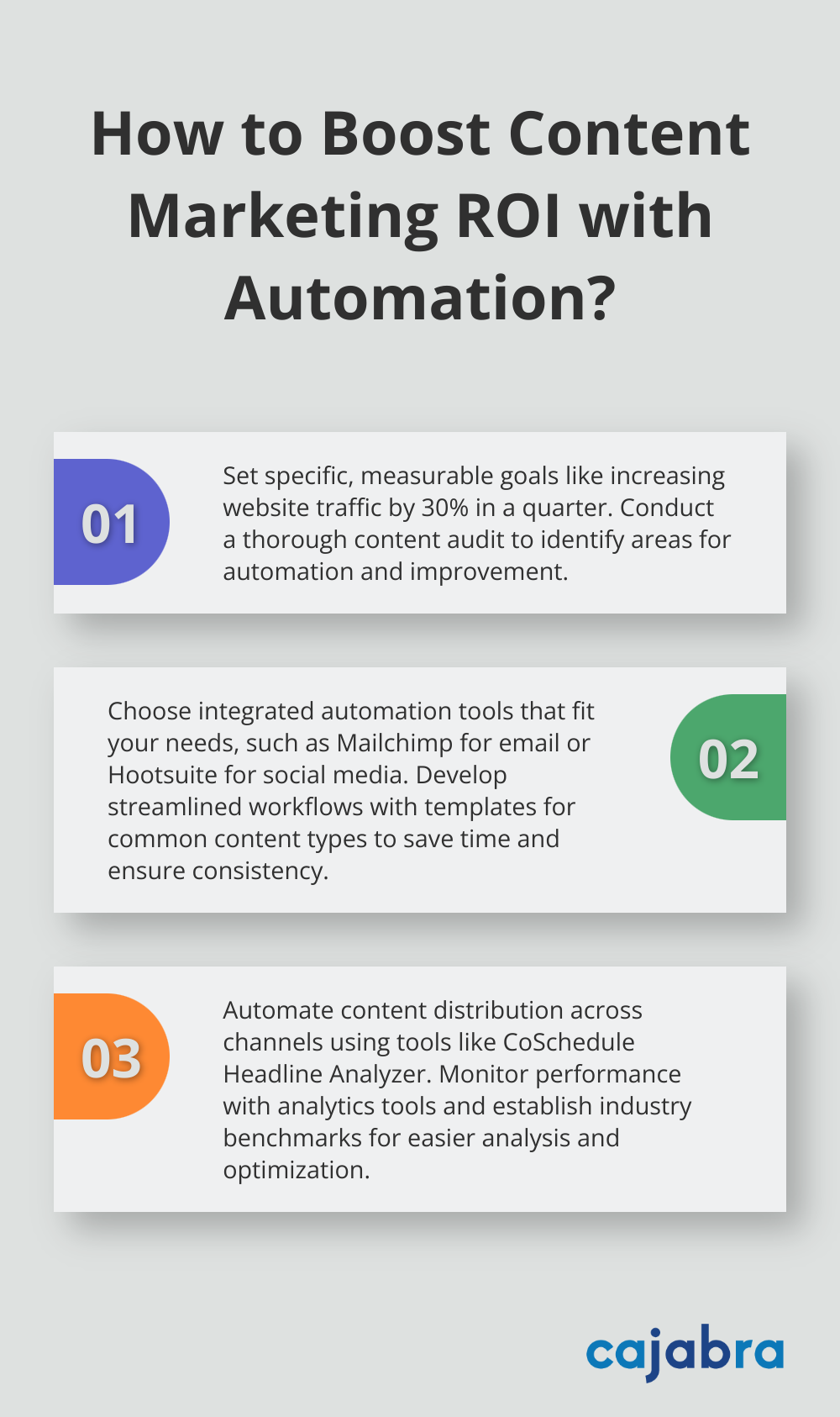
You could set up a workflow where blog posts automatically trigger social media updates and email notifications to subscribers. This approach saves time and ensures a cohesive message across all channels.
Automate Your Distribution
Set up systems to automatically distribute your content across various channels. This might involve scheduling social media posts in advance, setting up RSS-to-email campaigns for blog content, or using chatbots to deliver content to website visitors based on their behavior. Consider using content marketing automation tools like CoSchedule Headline Analyzer, SurferSEO Content Editor, or BuzzSumo to streamline your distribution process.
Monitor and Optimize
Implement robust analytics tracking to measure the performance of your automated content marketing efforts. Tools like Google Analytics, combined with platform-specific analytics from your CMS or email marketing software, can provide valuable insights.
Review these metrics regularly and use the data to refine your strategy. Establish performance benchmarks for content in your industry to enable easier analysis and comparisons across all your efforts.
To streamline your content process and boost efficiency in your digital marketing efforts, consider creating a content management strategy framework. This can help you maintain consistency and improve the overall effectiveness of your automated content marketing strategy.
Final Thoughts
Automated content marketing revolutionizes digital strategies, boosting productivity and delivering personalized experiences at scale. Companies reduce time on repetitive tasks, improve targeting, and make data-driven decisions that lead to better results. The future of automated content marketing will likely include more sophisticated AI-powered tools, advanced personalization, and predictive capabilities.
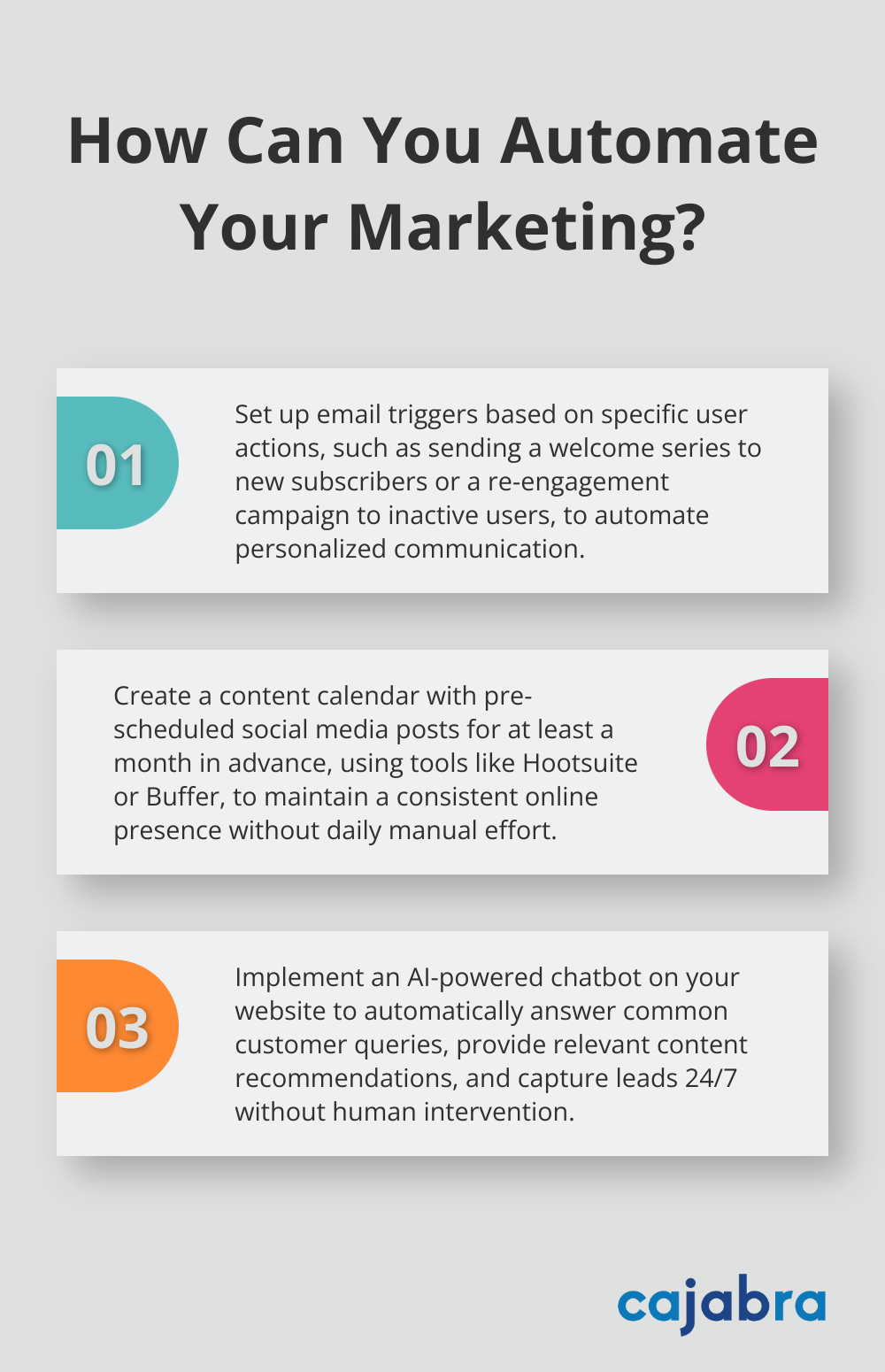
Cajabra understands the power of automated content marketing for accounting firms. Our JAB System™ helps accountants leverage automation to transform their marketing efforts. We enable accounting professionals to focus on their expertise while we handle the complexities of modern digital marketing.
Automated content marketing amplifies your message and reaches your audience more effectively. It frees up time for strategic thinking and creativity, becoming a powerful driver of growth and success for your business. The right approach combines cutting-edge tools with expert strategies to move from overlooked to overbooked in just 90 days.
Content marketing metrics are the compass guiding your strategy's success. Without them, you're navigating blindfolded through a competitive digital landscape.
At Cajabra, LLC, we've seen firsthand how measuring content performance can transform marketing efforts. This post will equip you with the tools and techniques to effectively gauge your content's impact and drive real results.
Measuring Content Marketing Impact
Content marketing success depends on tracking the right metrics. We have identified key performance indicators (KPIs) that truly matter for accounting firms looking to boost their online presence and client acquisition.
Website Traffic and User Behavior
Website traffic is a fundamental metric, but it's not just about quantity. Quality traffic that engages with your content is what counts. Google Analytics serves as an excellent tool for tracking page views, unique visitors, and time on page.
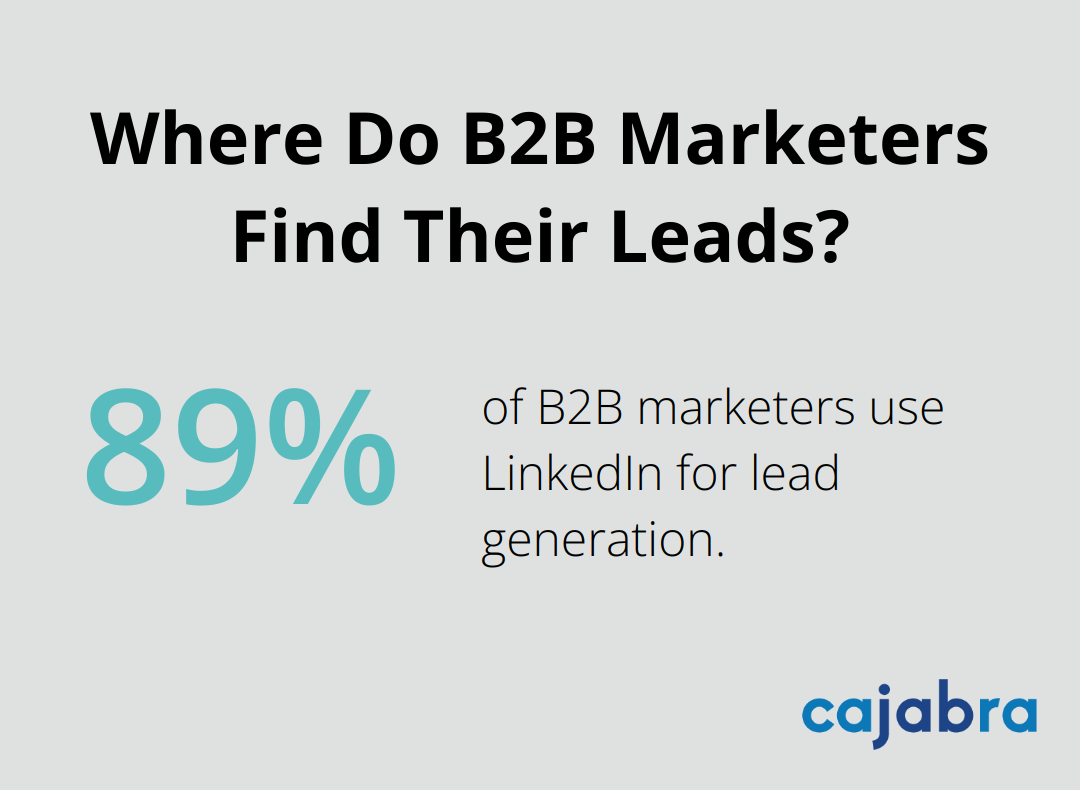
Traffic alone doesn't tell the whole story. Bounce rates help gauge content relevance. If your bounce rate exceeds 70%, it's time to reassess your content strategy. Try to achieve a rate between 40-60% for optimal engagement.
Conversion Metrics That Drive Results
Conversions fuel your marketing efforts. For accounting firms, this could mean newsletter sign-ups, whitepaper downloads, or consultation requests. Setting up goal tracking in Google Analytics allows you to monitor these actions effectively.
High-growth accounting firms are investing in marketing at much higher rates than their peers. Many firms have experienced significant increases in lead generation within months of implementing a targeted content strategy.
Social Media Engagement and Growth
Social media metrics extend beyond likes and followers. Shares, comments, and click-throughs measure how your content resonates with your audience. LinkedIn proves particularly powerful for accounting firms, with 89% of B2B marketers using it for lead generation.
Audience growth rate also warrants attention. A steady increase in followers indicates your content hits the mark. Try to achieve a monthly growth rate of 5-10% to stay competitive in the accounting sector.
Search Visibility and Organic Rankings
Organic search visibility is essential for long-term success. Tools like SEMrush help track keyword rankings and search engine results page (SERP) positions.
Focus on ranking for industry-specific long-tail keywords. These may have lower search volumes but often indicate higher intent and are easier to rank for. Many accounting firms have increased their organic traffic significantly by targeting niche keywords relevant to their specialties.
These KPIs provide a clear picture of your content marketing performance. The next section will explore the tools and techniques that make measuring success more manageable and insightful.
Essential Tools for Content Marketing Measurement
Content marketing measurement requires a robust toolkit. We've identified the most powerful platforms that provide actionable insights for accounting firms.
Google Analytics: Your Data Powerhouse
Google Analytics remains the gold standard for website analytics. It offers a wealth of data on user behavior, traffic sources, and conversion rates. To maximize its potential, set up custom dashboards tailored to your KPIs. Create a dashboard that tracks lead magnet downloads, consultation requests, and time spent on key service pages.
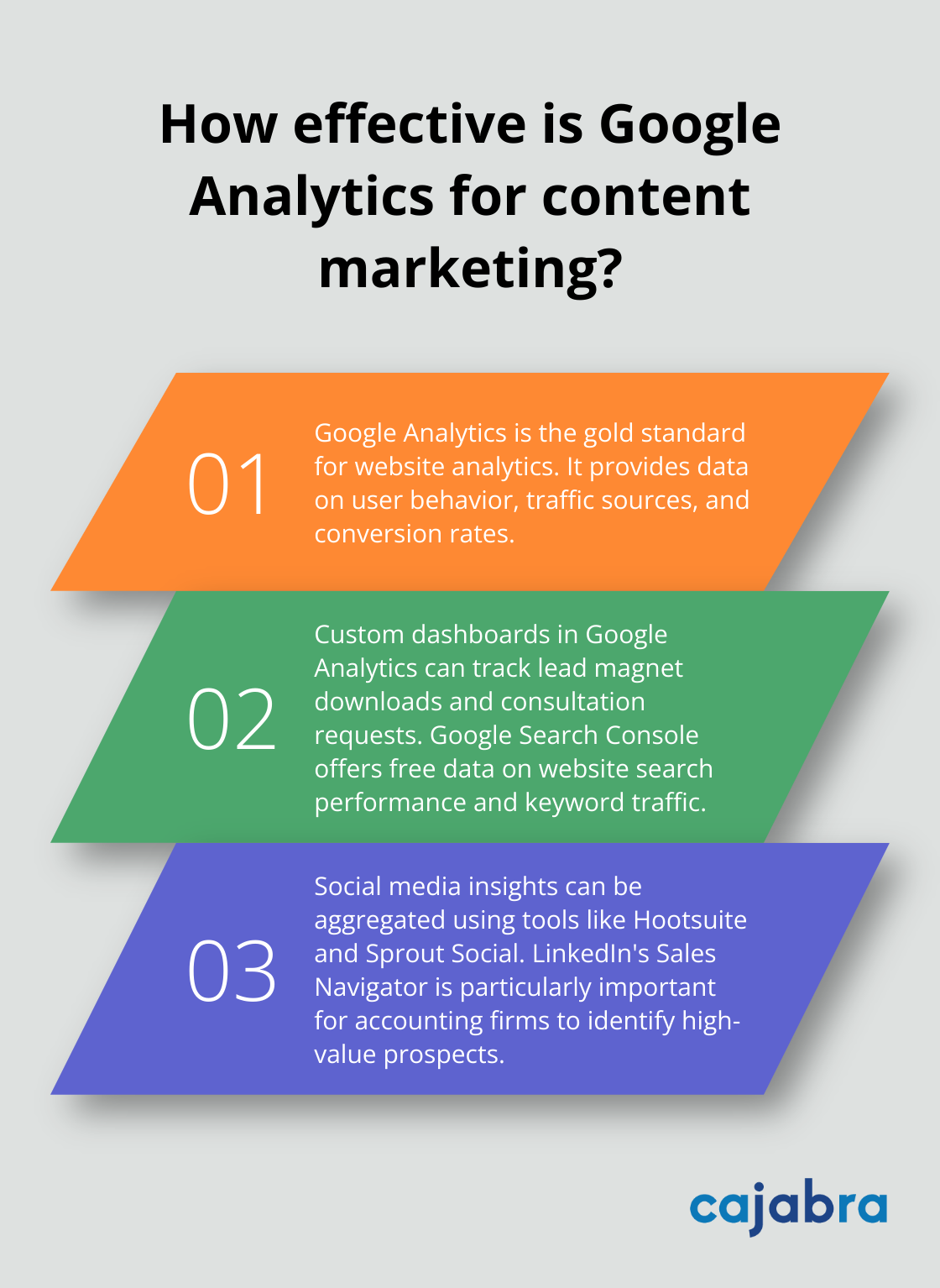
Many accounting firms overlook the power of Google Search Console. This free tool provides invaluable data on your website's search performance. Use it to identify which keywords drive traffic to specific pages and optimize your content accordingly.
Social Media Insights
While most social platforms offer native analytics, third-party tools can provide a more comprehensive view. Hootsuite and Sprout Social excel at aggregating data across multiple channels, offering a holistic view of your social media performance.
For accounting firms, LinkedIn's analytics are particularly important. The platform's Sales Navigator tool can help identify high-value prospects and track engagement with your content.
SEO and Content Performance Tools
SEMrush and Ahrefs are industry leaders for SEO and content performance analysis. These tools offer keyword research, competitor analysis, and backlink monitoring. They're invaluable for identifying content gaps and opportunities in the accounting sector.
Content-specific tools like BuzzSumo can reveal which topics and content formats resonate most with your audience. Use it to analyze your competitors' most shared content and identify trending topics in the accounting industry.
CRM: Connecting Content to Clients
A robust Customer Relationship Management (CRM) system is essential for tracking how content influences the client journey. HubSpot and Salesforce are popular choices (offering marketing automation features that can attribute leads and conversions to specific content pieces).
Integrating your CRM with your content management system creates a powerful feedback loop. This integration allows you to see which content types are most effective at nurturing leads through the sales funnel.
The next chapter will explore how to interpret and act on the data collected through these tools, turning insights into actionable strategies for content marketing success.
Turning Data into Action
Spotting Trends in Your Content Performance
Data analysis transforms an accounting firm's digital presence. We start by identifying patterns in top-performing content. What topics engage your audience most? Which formats drive engagement? Accounting firms often see higher engagement with content that explains complex tax laws or offers financial planning tips.
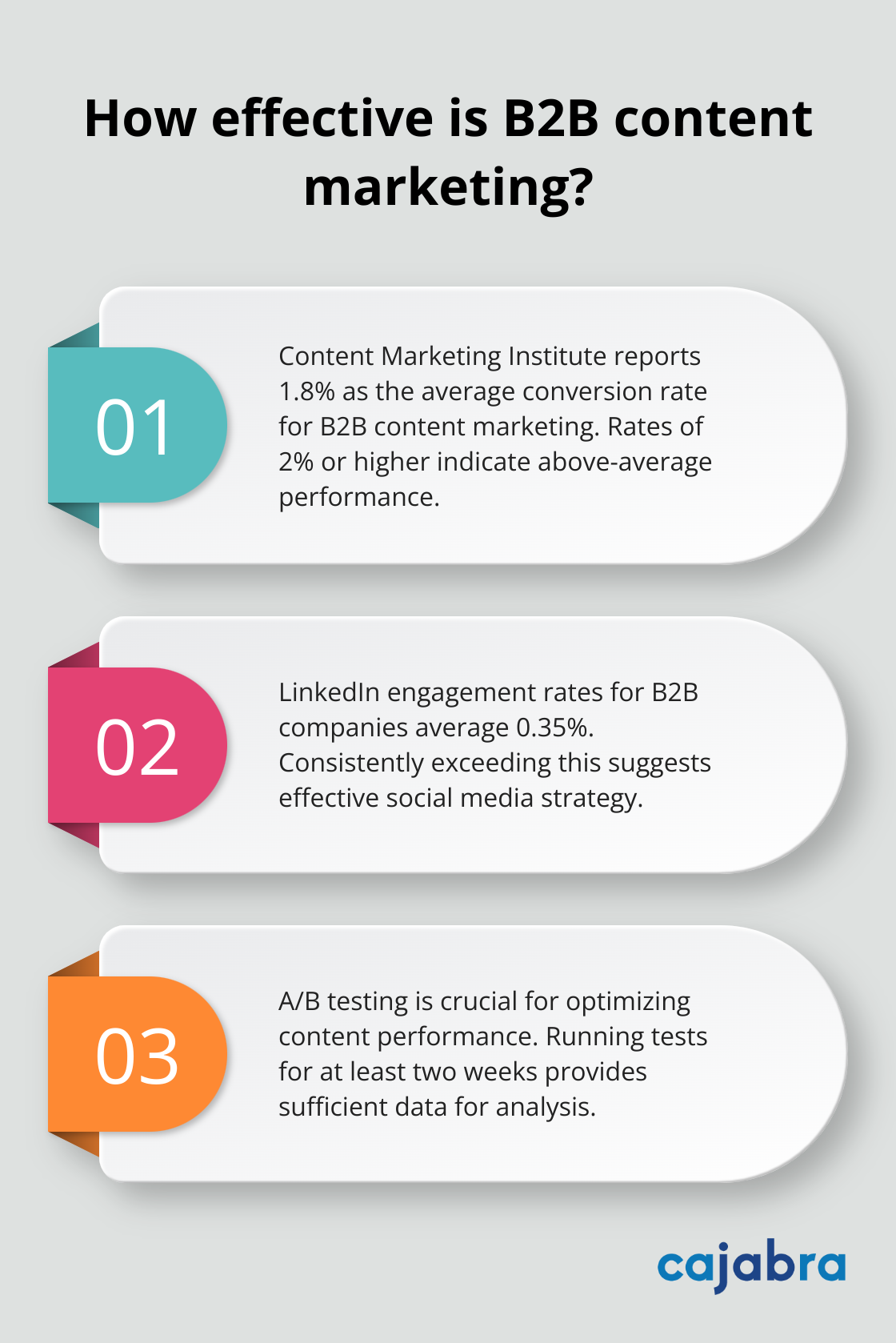
Use Google Analytics to pinpoint your best-performing pages. Analyze metrics like time on page, bounce rate, and conversion rate. A traffic spike to a particular blog post suggests creating more content on that topic or repurposing it into different formats.
Benchmarking Against Industry Standards
Comparison to industry benchmarks provides context for your metrics. The Content Marketing Institute reports an average conversion rate of 1.8% for B2B content marketing. A rate of 2% or higher puts you ahead of many peers.
For social media, LinkedIn engagement rates for B2B companies average 0.35%. Consistently exceeding this indicates you're on the right track. However, don't settle for average – push to be in the top quartile of your industry.
Optimizing Through A/B Testing
A/B testing, also referred to as split testing or bucket testing, is the process of comparing two versions of the same web page, email, or other digital asset. Test different headlines, call-to-action placements, or content formats to drive better results. You might compare a long-form guide's performance against a series of shorter blog posts on the same topic.
Focus on one variable at a time when conducting A/B tests. Run each test for at least two weeks to gather sufficient data. Tools like Google Optimize simplify the setup and analysis of these experiments.
Adapting Your Strategy Based on Insights
Data's true value lies in strategy improvement. If video content consistently outperforms written posts, allocate more resources to video production. Make topics that drive more leads a central part of your content calendar.
Content marketing requires an iterative process. Review your metrics monthly and prepare to pivot your strategy based on the data. This approach ensures your content remains relevant and effective in the ever-changing landscape of accounting and finance.
Final Thoughts
Content marketing metrics provide a roadmap for continuous improvement in your marketing strategy. We at Cajabra focus on key performance indicators such as website traffic, conversion rates, and search engine rankings to gain valuable insights into content performance. These metrics enable us to make data-driven decisions and refine our approach over time.
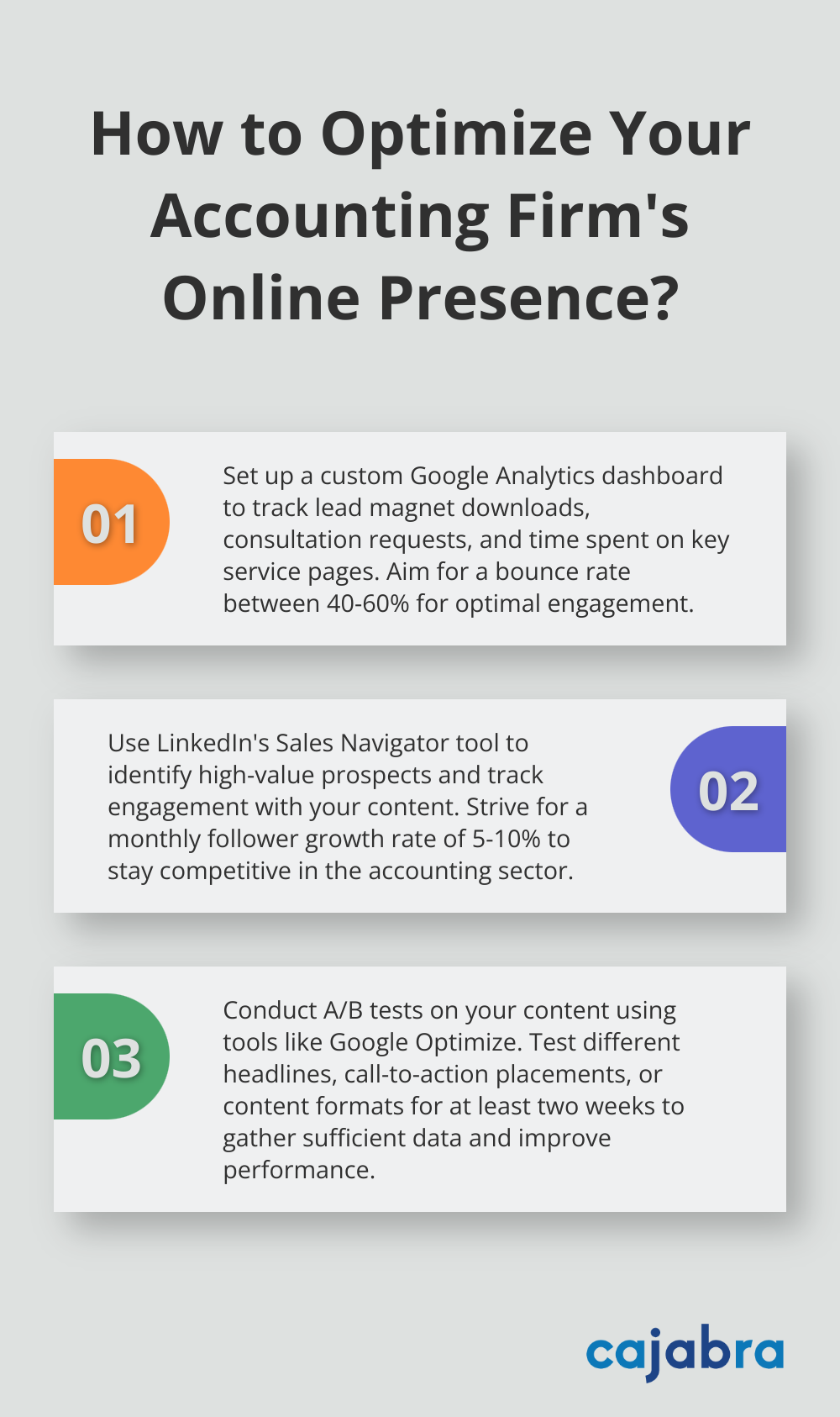
The tools and techniques we explored offer a comprehensive view of content marketing efforts. Regular analysis of trends, industry benchmarking, and A/B testing optimize content for maximum impact. This approach ensures that content remains relevant, engaging, and effective in attracting and retaining clients.
Our specialized marketing services for accountants leverage content marketing metrics to help firms stand out in a competitive market. We implement data-driven content strategies to position firms as industry leaders and attract high-value clients. Embrace the power of content marketing metrics to guide your strategy and measure your success.