
At Cajabra, LLC, we've seen firsthand how a well-crafted cognitive messaging strategy can transform marketing efforts.
Cognitive messaging taps into the psychology of your audience, creating powerful connections that drive action. This approach goes beyond traditional marketing by leveraging insights from neuroscience and behavioral economics.
In this post, we'll show you how to develop a cognitive messaging strategy that resonates with your target audience and boosts your marketing results.
What Is Cognitive Messaging?
The Science Behind Cognitive Messaging
Cognitive messaging is a powerful marketing approach that uses psychological principles to create impactful, persuasive communications. This strategy aligns marketing messages with how the human brain processes information and makes decisions.
Cognitive messaging draws from various fields, including neuroscience, behavioral economics, and cognitive psychology. It focuses on understanding and influencing the mental processes that drive consumer behavior. For example, the principle of cognitive fluency suggests that people trust and remember information that's easy to process. This insight guides marketers to craft clear, concise messages that resonate with their audience.
The Importance of Cognitive Messaging Today
In today's saturated digital landscape, capturing and maintaining consumer attention presents a significant challenge. Cognitive messaging helps cut through the noise by creating messages that are inherently more engaging and memorable.
As consumers become more sophisticated and skeptical of traditional advertising, cognitive messaging offers a way to connect on a deeper level. It moves beyond simple product features to address the underlying motivations and decision-making processes of the target audience.
A Departure from Traditional Approaches
Traditional messaging often relies on repetition and broad appeal. In contrast, cognitive messaging is highly targeted and focuses on creating meaningful connections. It considers factors like cognitive biases, emotional triggers, and decision-making shortcuts that influence consumer behavior.
For instance, while a traditional ad might simply state a product's benefits, a cognitive messaging approach might frame those benefits in a way that taps into the consumer's existing beliefs or desires. This makes the message more personally relevant and therefore more likely to drive action.
Practical Applications in Marketing
Implementing cognitive messaging requires a deep understanding of your target audience. It involves analyzing not just demographics, but psychographics - the attitudes, interests, and lifestyle factors that influence decision-making.
One effective technique is the use of storytelling. Stories are particularly powerful in cognitive messaging because they engage multiple areas of the brain, making the message more memorable and impactful. A study by OneSpot found that 92% of consumers want brands to make ads that feel like a story.

Another application is the strategic use of social proof. This principle, rooted in cognitive psychology, suggests that people are more likely to adopt behaviors they see others performing. Incorporating testimonials, user-generated content, or statistics about customer satisfaction can significantly boost the effectiveness of your messaging.
Now that we understand what cognitive messaging is and why it's important, let's explore the key elements that make up a powerful cognitive message.
What Makes a Cognitive Message Powerful?
Emotional Triggers and Psychological Hooks
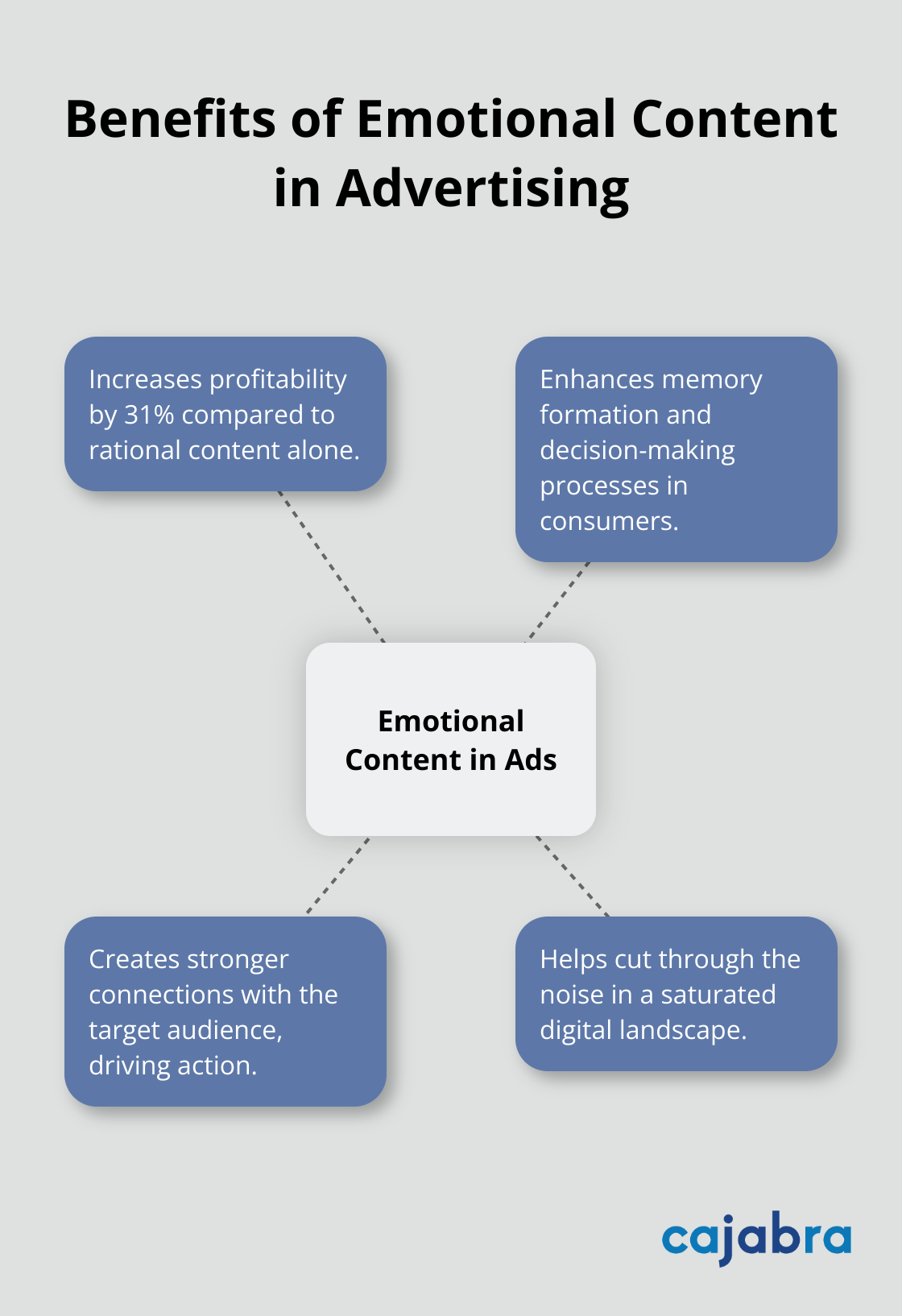
Effective cognitive messages evoke strong emotions. Research indicates that emotional content in ads can generate a 31% increase in profitability, compared to campaigns using rational content alone. This emotional connection plays a vital role in memory formation and decision-making.
Consider a message that highlights the stress relief of automated accounting systems. It taps into the emotional pain points of overworked accountants. The focus shifts from the feature (automation) to the emotional benefit (reduced stress).
Simplicity and Clarity
In cognitive messaging, simplicity often trumps complexity. The human brain processes simple messages more easily, which leads to better retention and recall. This principle, known as cognitive fluency, suggests that information that's easy to process is more likely to be perceived as true and likable.
A study by the Nielsen Norman Group revealed that users typically read only 20% of the text on a webpage. This fact underscores the importance of concise, clear messaging. Many companies have seen significant increases in conversion rates after simplifying their website copy.
Multi-Channel Consistency
Consistency across different touchpoints reinforces your message and builds trust. Research shows that consistent brand presentation across all platforms can increase revenue by up to 33%.
This doesn't mean identical messages everywhere. Instead, it's about maintaining a consistent core message while adapting to each platform's strengths. For example, a LinkedIn post might explore industry trends, while an Instagram story could showcase client success visually.
Leveraging Cognitive Biases
Understanding and ethically leveraging cognitive biases can significantly enhance message effectiveness. For example, the scarcity bias makes limited-time offers more appealing. The anchoring effect can frame pricing options favorably.
Some companies have seen substantial increases in high-tier package sales after restructuring their pricing pages to leverage the decoy effect. This cognitive bias occurs when the presence of a third option influences decision-making between two choices.
Continuous Testing and Refinement
Implementing these elements requires a deep understanding of your audience and continuous testing. A/B testing different message formulations can reveal which cognitive elements resonate most with your specific audience. What works for one brand might not work for another. The key lies in aligning these cognitive messaging principles with your unique brand voice and audience needs.
As we move forward, let's explore how to implement these powerful cognitive messaging elements into your marketing strategy. The next section will guide you through the process of creating a cognitive messaging framework that resonates with your target audience and drives results.
How to Put Cognitive Messaging into Action
Deep Dive into Your Audience
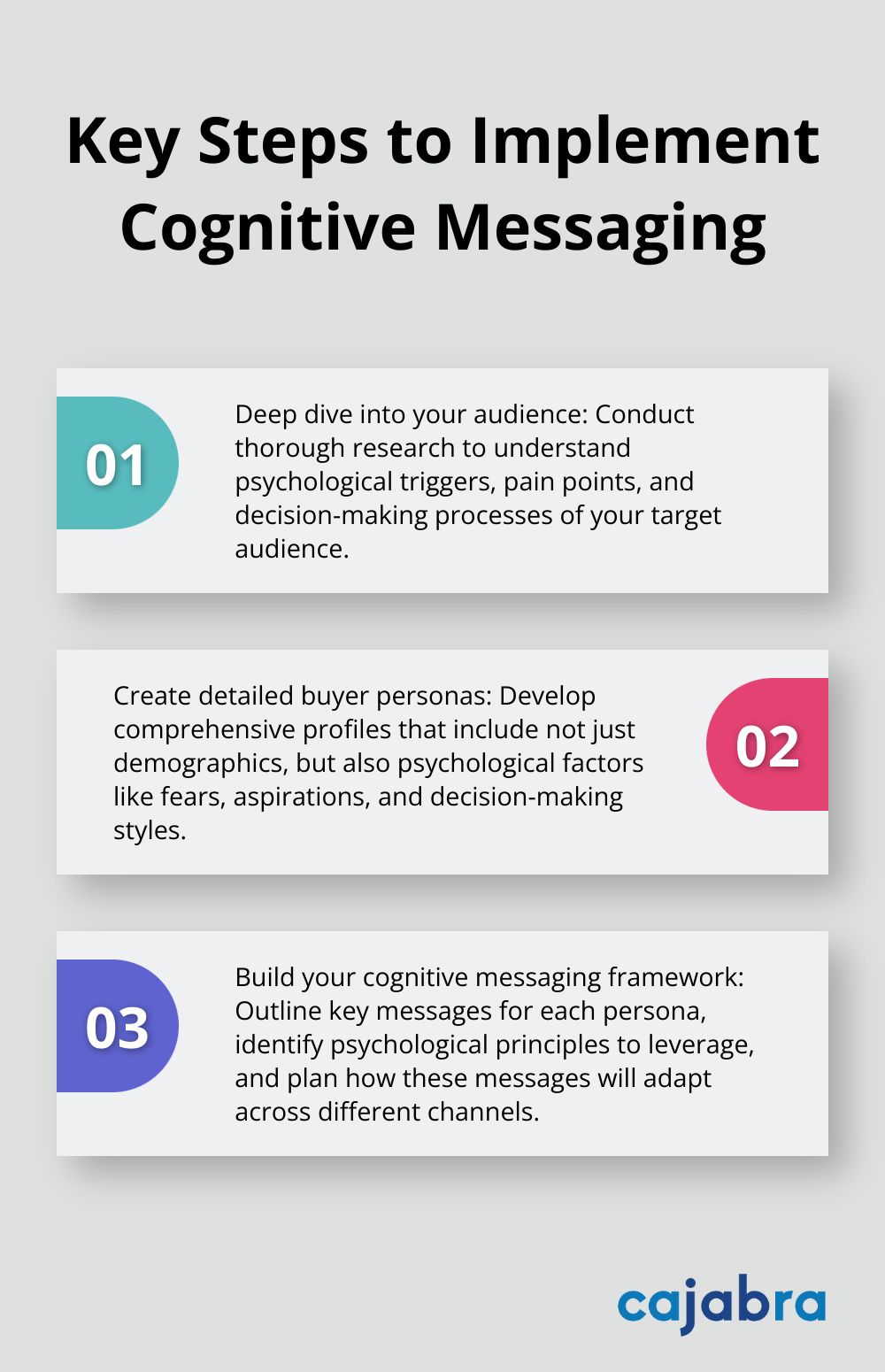
Start with thorough audience research. This extends beyond basic demographics. You need to understand your audience's psychological triggers, pain points, and decision-making processes. Use surveys, interviews, and social media listening tools to gather insights.
Many accounting firms discover that their clients seek more than number crunching. They want peace of mind and strategic guidance. This insight shapes how messages resonate with these deeper needs.
Create Detailed Buyer Personas
After your research, develop comprehensive buyer personas. Include not just job titles and income levels, but also psychological factors like fears, aspirations, and decision-making styles.
A buyer persona for a small business owner might include their fear of financial instability, their aspiration to grow their business, and their tendency to make quick decisions based on gut feelings. This level of detail allows you to craft messages that speak directly to their specific mindset.
Build Your Cognitive Messaging Framework
With your personas ready, create a cognitive messaging framework. This should outline the key messages for each persona, the psychological principles you'll leverage, and how these messages will adapt across different channels.
For risk-averse decision-makers, your framework might emphasize social proof and loss aversion in your messaging. You might plan to use case studies heavily in your LinkedIn content, while using scarcity tactics in your email campaigns.
Test, Measure, and Refine
Put your messaging to the test. Use A/B testing to compare different versions of your messages. Track metrics like engagement rates, conversion rates, and customer feedback.
One company saw a 40% increase in brand pricing power after they refined their messaging to focus on the emotional benefits of their services (rather than just the technical features). This kind of data-driven refinement maximizes the impact of your cognitive messaging strategy.
Continuous Improvement
Cognitive messaging isn't a static tactic. It requires ongoing refinement based on new data and changing market conditions. Consistently apply these principles and adjust based on results. This approach creates a powerful cognitive messaging strategy that resonates deeply with your target audience and drives real business results.
Final Thoughts
Cognitive messaging strategies have transformed marketing approaches. These strategies tap into psychological decision-making processes, creating messages that resonate deeply with target audiences. This approach increases engagement, boosts conversion rates, and strengthens brand loyalty.
A cognitive messaging strategy requires thorough audience research and continuous refinement. Companies must understand their audience's fears, desires, and decision-making processes to craft compelling messages. Testing and data-driven improvements ensure the strategy remains fresh and effective.
Cajabra specializes in helping accounting firms leverage powerful marketing strategies. Our JAB System™ moves accountants from overlooked to overbooked in 90 days. We handle all marketing aspects, allowing you to focus on serving your clients.
B2B content marketing is a powerful tool for driving business growth and establishing industry authority. At Cajabra, LLC, we've seen firsthand how effective strategies can transform lead generation and customer relationships.
In this post, we'll share our insights on creating B2B content that resonates with your target audience and delivers measurable results. Get ready to elevate your marketing game with practical tips and proven techniques.
Who Is Your B2B Audience?
Pinpointing Your Ideal Customer Profile
The foundation of effective content marketing lies in understanding your B2B audience. This process requires thorough research and analysis to uncover the specific needs, pain points, and decision-making processes of your target companies.
Start by creating a detailed ideal customer profile (ICP). This profile should include company size, industry, revenue, technology stack, and business challenges. For example, if you target mid-sized manufacturing firms, you might focus on companies with 100-500 employees, $50-200 million in annual revenue, and supply chain optimization challenges.
Defining Decision-Maker Personas
After you define your ICP, focus on the individuals involved in the buying process. In B2B, this often includes multiple stakeholders. Create personas for each, detailing their job roles, responsibilities, goals, and concerns. A CFO might prioritize ROI and cost reduction, while a CTO focuses on scalability and integration capabilities.
A study reveals that the typical buying group for a complex B2B solution now involves six to 10 decision makers. Each of these individuals comes to the table armed with four or five pieces of content before reaching out to a sales representative. This fact underscores the importance of creating varied content that addresses different perspectives and stages of the buying journey.
Mapping the B2B Buyer's Journey
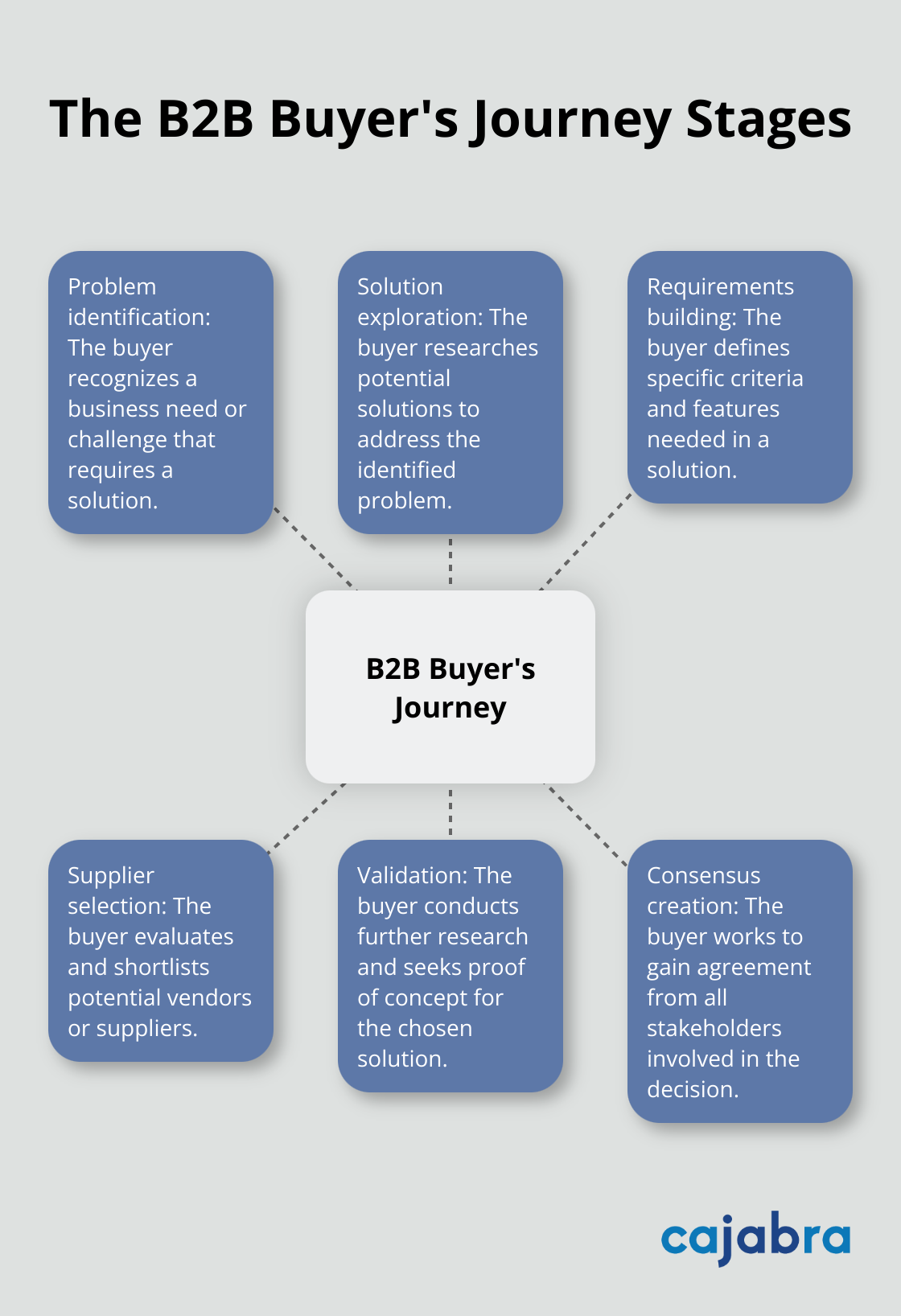
The B2B buyer's journey is typically longer and more complex than B2C. It often involves stages like:
- Problem identification
- Solution exploration
- Requirements building
- Solution exploration
- Validation
- Consensus creation
For each stage, identify the information needs and preferred content formats. Early-stage buyers might value educational blog posts and industry reports, while late-stage prospects seek detailed case studies and product comparisons.
Leveraging Data for Audience Insights
Use both quantitative and qualitative data to refine your audience understanding. Tools like Google Analytics can reveal which content topics and formats resonate most with your audience. Social listening tools can uncover industry trends and pain points discussed online.
Don't underestimate the power of direct engagement. Conduct surveys, interviews, or focus groups with existing clients or target companies. This firsthand feedback can provide invaluable insights into their challenges, content preferences, and decision-making processes.
Refining Your Understanding
Audience understanding is not a one-time task. Markets evolve, new challenges emerge, and buyer behaviors shift. Regularly revisit and refine your audience profiles and journey maps. Segmenting your audience based on industry, company size, or purchasing behaviour allows you to tailor your messaging and offers to resonate with specific groups.
A deep understanding of your B2B audience forms the bedrock of a content marketing strategy that speaks directly to their needs. This understanding positions your company as a valuable partner in their success. As we move forward, we'll explore how to translate this audience knowledge into a robust content strategy that drives results.
How to Build a Winning B2B Content Strategy
Define Your Content Goals
The first step in creating a powerful B2B content strategy involves setting clear objectives. Your content goals should align with your overall business objectives. Do you want to increase brand awareness, generate leads, or nurture existing relationships? Each goal requires a different approach. For example, if lead generation is your primary focus, you might prioritize gated content like whitepapers or webinars that capture contact information.
Establish specific, measurable KPIs for each goal. Instead of vague targets like "increase website traffic," set concrete metrics such as "boost organic traffic by 25% within six months" or "generate 100 qualified leads per month through content downloads."
Plan Your Content Calendar
A well-structured content calendar is essential for consistent execution. Start by identifying key themes or topics that resonate with your audience. These should align with their pain points and interests at various stages of the buying journey.
Map out your content production schedule, considering factors like seasonality, industry events, and product launches. Try to create a mix of evergreen content that provides long-term value and timely pieces that capitalize on current trends or news.
Many successful B2B marketers use a 12-month rolling calendar (reviewing and adjusting it quarterly). This approach allows for both long-term planning and flexibility to respond to market changes or emerging opportunities.
Select Impactful B2B Content Formats
While blog posts remain a staple, B2B audiences often seek more in-depth, data-driven content. According to a 2024 Content Marketing Institute report, videos are rated most effective for B2B content marketing.
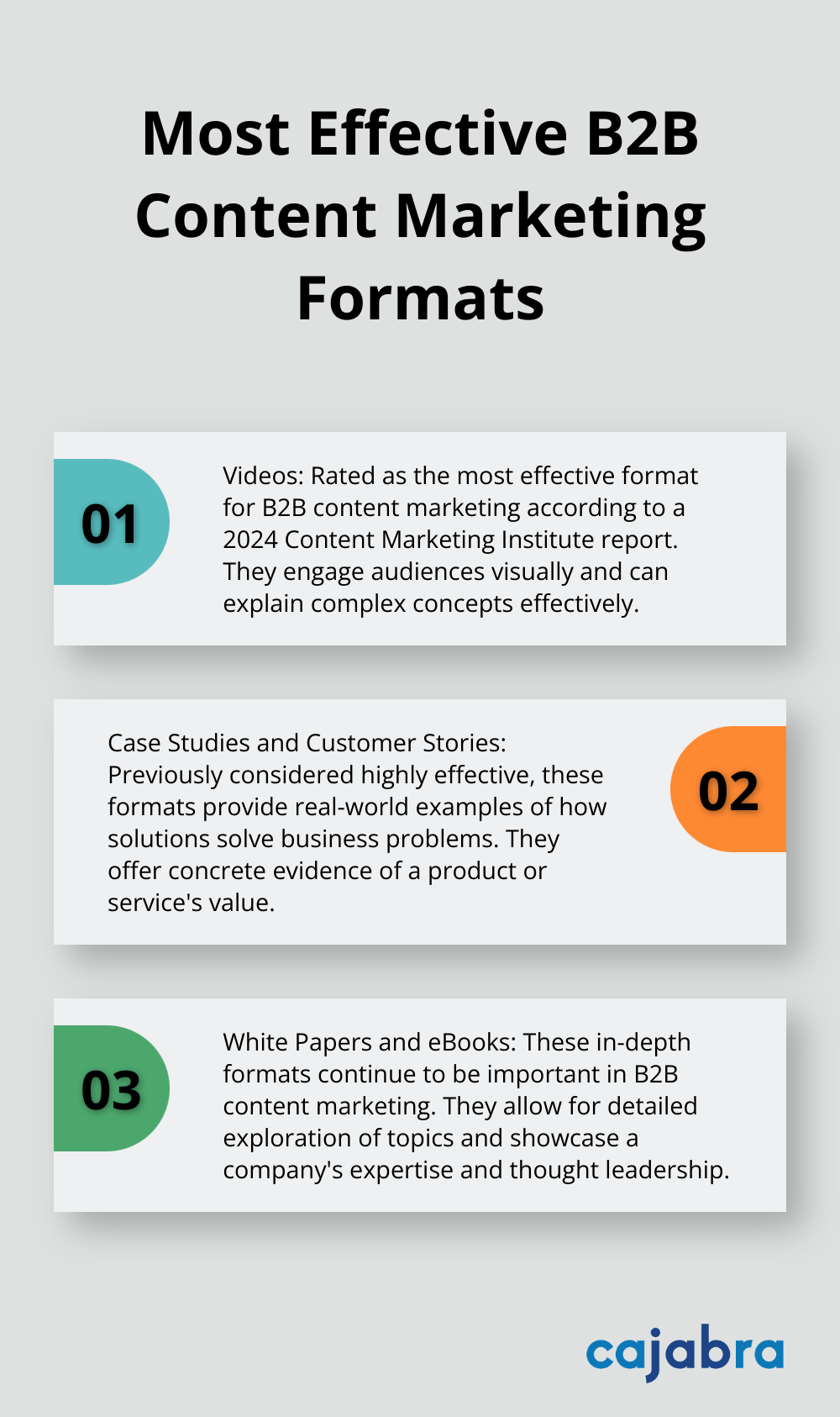
Case studies and customer stories were previously considered highly effective, but their effectiveness may have changed in recent years.
White papers, eBooks, webinars/virtual events, and research reports continue to be important formats in B2B content marketing.
Case studies are particularly powerful for B2B decision-makers, as they provide concrete examples of how your solution solves real-world problems. Try to create at least one detailed case study for each of your key industries or solution types.
Video content is gaining traction in B2B marketing, with many B2B buyers watching videos throughout their purchase journey. Consider creating explainer videos, product demos, or thought leadership interviews to engage your audience visually.
For complex B2B solutions, interactive content like quizzes and ebooks can be highly effective. These not only provide value to potential clients but also generate valuable data for your sales team.
Tailor your content mix to your specific audience preferences and consumption habits. Regularly analyze performance metrics to identify which formats drive the most engagement and conversions for your business.
A strategic approach to content creation and distribution will position your company as a valuable resource in your industry. In the next section, we'll explore how to craft compelling B2B content that resonates with your target audience and drives measurable results.
How to Craft Compelling B2B Content
Establish Thought Leadership
B2B content that resonates requires a strategic approach combining thought leadership, data-driven insights, and tailored messaging. Successful B2B content provides real value and actionable insights beyond surface-level information.
To position your company as an industry leader, create content that showcases your unique expertise and forward-thinking ideas. Publish original research, offer expert commentary on industry trends, or share innovative solutions to common challenges.
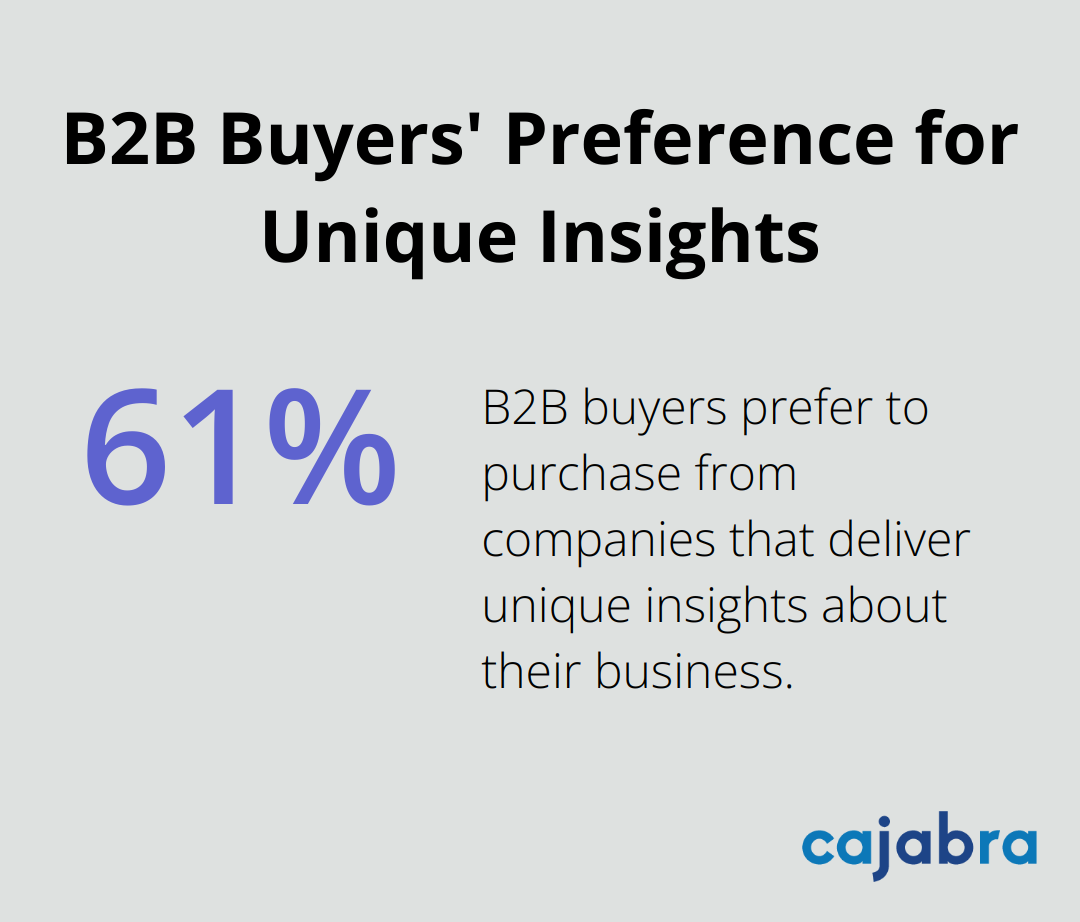
The Content Marketing Institute reports that 61% of B2B buyers prefer to purchase from companies that deliver unique insights about their business. To capitalize on this, conduct annual industry surveys or partner with research firms to produce exclusive reports that your competitors can't replicate.
Leverage Data and Case Studies
B2B decision-makers seek hard data and real-world examples. Include relevant statistics, charts, and graphs in your content to support claims and provide context. A study shows that B2B case studies are effective tools for researching purchases.
When you craft case studies, focus on specific, measurable results. Use concrete metrics such as "reduced processing time by 35% and saved $500,000 annually" instead of vague statements like "improved efficiency." This level of detail helps potential clients envision similar outcomes for their own businesses.
Tailor Content to the Buyer's Journey
Different stages of the sales funnel require different types of content. For awareness-stage prospects, create educational blog posts and infographics that address common industry pain points. As leads move into the consideration stage, offer more in-depth content like whitepapers or webinars that showcase your unique approach.
For decision-stage prospects, provide detailed product comparisons, ROI calculators, and free trials or demos. Forrester Research indicates that 68% of B2B customers prefer to research independently online before engaging with sales representatives. Provide the right content at each stage to guide prospects through their decision-making process.
Optimize for Search Engines
Try to increase visibility by optimizing your content for search engines. Use tools like SEMrush or Ahrefs (industry-leading SEO platforms) to identify relevant keywords and topics that your target audience searches for. Incorporate these naturally into your content to improve organic search rankings and attract qualified leads.
Incorporate Visual Elements
Visual content enhances engagement and information retention. Include infographics, charts, and videos in your B2B content strategy. These visual elements can simplify complex concepts and make your content more shareable (especially on platforms like LinkedIn, where professional audiences congregate).
To effectively engage your audience across various platforms, consider crafting an effective social media messaging strategy that aligns with your overall content marketing goals.
Final Thoughts
B2B content marketing drives business growth and establishes industry authority. Companies that understand their audience, develop robust strategies, and craft compelling content create meaningful connections with potential clients. Effective B2B content marketing addresses specific challenges at each stage of the funnel through tailored content and diverse formats.
Continuous improvement fuels long-term success in B2B content marketing. Companies must analyze content performance, gather audience feedback, and stay attuned to industry trends. This ongoing refinement helps businesses stay ahead of the curve and consistently deliver value to their target market.
Cajabra specializes in helping accounting firms elevate their marketing efforts and attract high-value clients. Our JAB System™ and tailored marketing solutions can help you stand out in a crowded marketplace. Take action now to unlock the full potential of your B2B content marketing efforts.
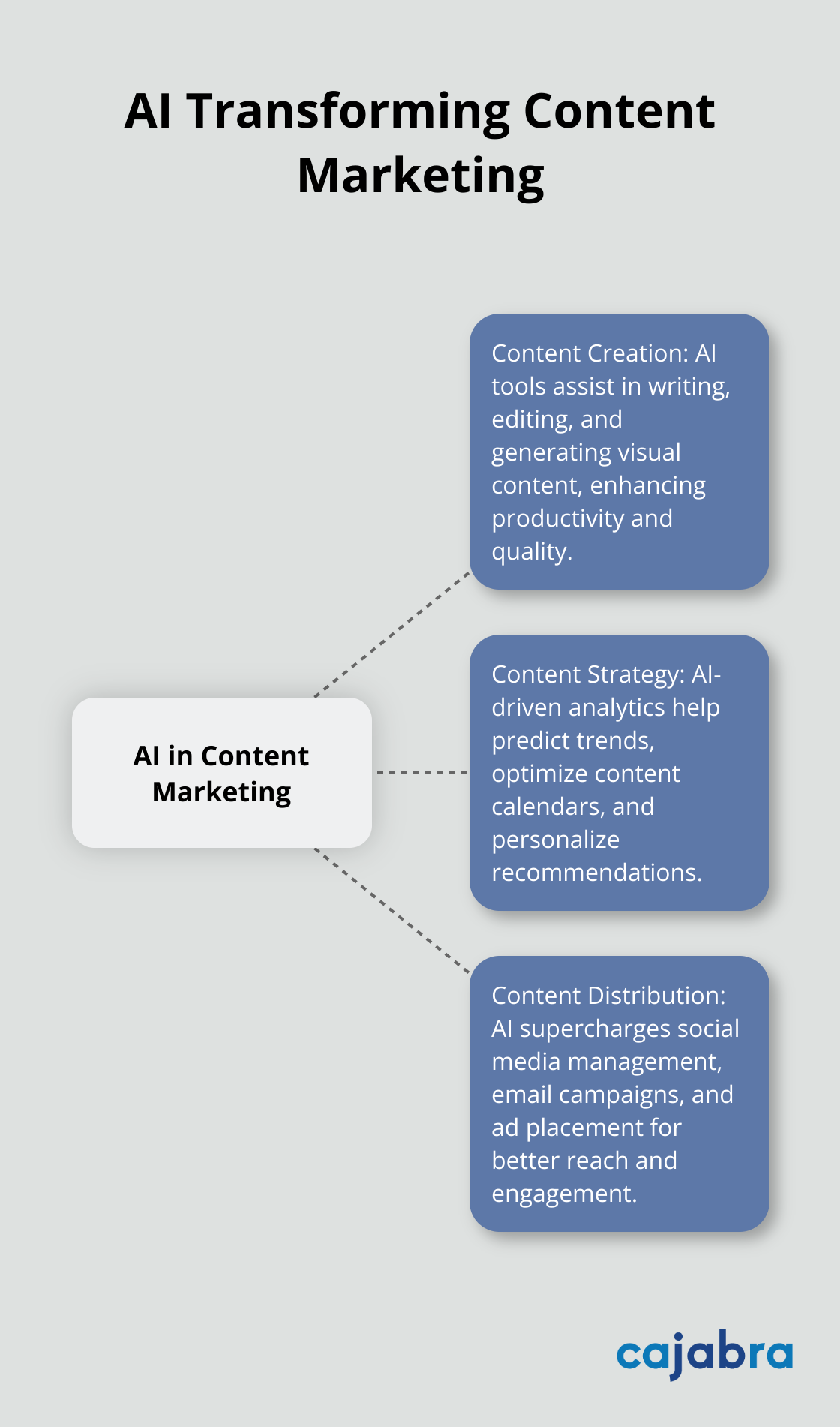
AI and content marketing are transforming the way businesses connect with their audiences. At Cajabra, LLC, we've seen firsthand how artificial intelligence can supercharge content strategies and deliver impressive results.
This blog post will explore the practical applications of AI in content creation, strategy, and distribution. We'll provide actionable tips to help you harness the power of AI and elevate your content marketing efforts.
AI Tools for Content Creation
AI-powered content creation tools have revolutionized the marketing landscape. These tools don't just save time; they transform how content marketers scale their output without compromising quality.
Natural Language Generation Platforms
Natural Language Generation (NLG) platforms have evolved significantly. AI-generated content offers advantages like speed, scalability, and SEO optimization, helping businesses produce high-quality material. However, these platforms require human oversight to maintain brand voice consistency and factual accuracy.
AI-Assisted Writing and Editing
AI writing assistants have become essential for many content teams. Grammarly, for example, offers more than simple spell-checking. It provides style and tone suggestions that enhance writing quality. These tools help maintain a consistent brand voice across all content pieces, which builds trust with the audience.
Visual Content Generation
AI-generated visuals continue to expand in capability and application. AI reshapes visual storytelling through generative tools, which create stunning images, videos, and animations from simple prompts. AI can also enhance visual content creation, offering new possibilities for marketers and creators.
Hybrid Approach to Content Creation
While AI tools offer powerful capabilities, they work best as part of a human-led creative process. A hybrid approach where AI augments human creativity (rather than replacing it) ensures that content remains authentic and aligns with a brand's unique voice and values.
Maximizing AI Tool Effectiveness
To maximize the effectiveness of AI content creation tools, consider the following tips:
- Set clear objectives for AI implementation
- Regularly audit your content creation process
- Invest in team training for AI tool usage
- Optimize content for voice and visual search
- Choose AI technologies that integrate seamlessly with existing systems
As AI continues to advance, it opens new possibilities for content personalization and optimization. The next section will explore how AI enhances content strategy and planning, allowing marketers to make data-driven decisions and create more targeted, effective campaigns.
AI-Driven Content Strategy: Revolutionizing Marketing Decisions
AI transforms content strategy and planning, enabling marketers to make data-driven decisions and create more targeted, effective campaigns. This chapter explores how AI reshapes content strategy through predictive analytics, optimized content calendars, and personalized recommendations.
Predictive Analytics for Topic Selection
Predictive analytics tools analyze vast amounts of data to forecast future trends and topics. These insights help content creators stay ahead of the curve, producing relevant content before competitors. Google Trends, for example, uses AI to predict search patterns, allowing marketers to align content with upcoming interests.
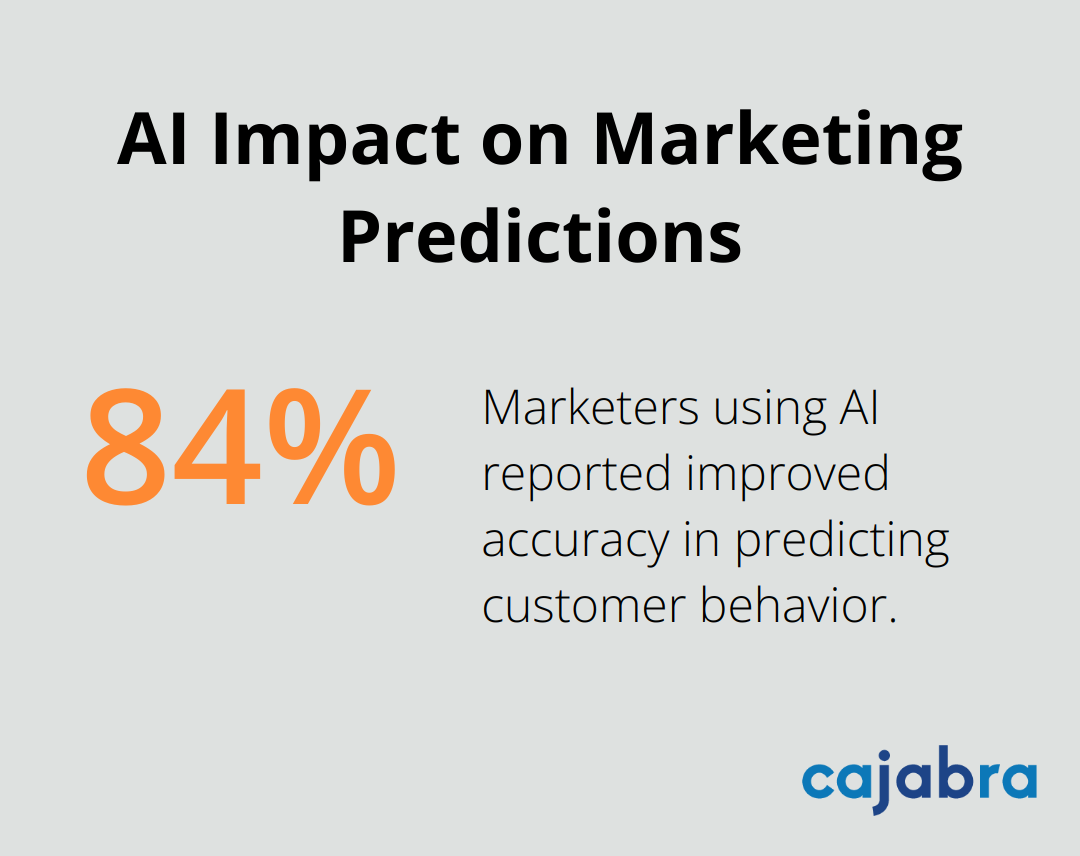
A Salesforce study found that 84% of marketers using AI reported improved accuracy in predicting customer behavior. This accuracy translates directly into more engaging content that resonates with target audiences.
AI-Powered Content Calendars
AI-driven content calendars optimize publishing schedules based on audience behavior patterns. These tools analyze engagement metrics across various platforms to determine the best times for content distribution.
CoSchedule's research revealed that businesses using AI-powered scheduling tools saw a 30% increase in content engagement. This boost comes from delivering content when audiences are most receptive.
Personalized Content Recommendations
AI algorithms analyze user behavior to deliver highly personalized product recommendations at scale. This tailored approach significantly improves user experience and engagement rates.
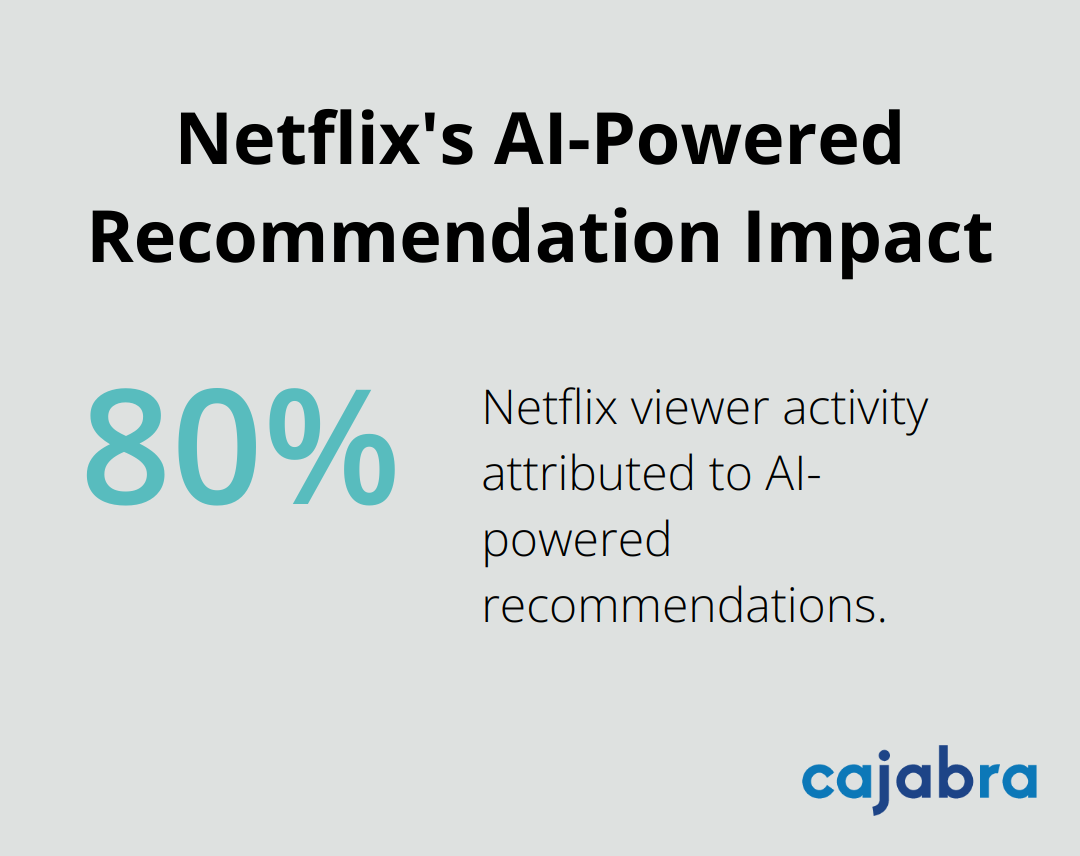
Netflix (a pioneer in content recommendation) attributes 80% of viewer activity to its AI-powered recommendation system. While not every business is Netflix, the principle applies across industries: personalized content keeps audiences engaged.
Implementing AI in Your Content Strategy
To integrate AI into your content strategy:
- Start small by incorporating one AI-powered tool into your workflow
- Gradually expand its use across your content operations as you become comfortable with the technology
- Combine AI's data-crunching capabilities with human expertise to create truly compelling content
AI serves as a powerful ally in content strategy, but it doesn't replace human creativity and insight. The most effective strategies leverage both AI and human skills to produce outstanding results.
As we move forward, let's explore how AI enhances content distribution, taking your marketing efforts to new heights of efficiency and effectiveness.
AI Supercharges Content Distribution
Smarter Social Media Management
AI-powered tools transform social media management. These platforms analyze data to determine optimal posting times, ensuring maximum visibility and engagement. FeedHive offers content recycling and conditional posting, while Buffer helps tailor posts to each channel. Flick serves as a social media AI copilot, enhancing overall management efficiency.
AI also tailors content for different social platforms. It suggests modifications to posts to better suit the format and audience of each platform (Twitter, LinkedIn, Instagram). This optimization leads to higher engagement rates.
Precision-Targeted Email Campaigns
Email marketing remains a powerful tool for content distribution, and AI makes it even more effective. AI-driven email platforms segment audiences with incredible precision, allowing for hyper-personalized content delivery. These systems analyze subscriber behavior, preferences, and engagement history to determine optimal send times and content for each subscriber.
Chatbots: Your 24/7 Content Concierge
Chatbots have evolved from simple FAQ responders to sophisticated content distribution channels. AI-powered chatbots now understand context and intent, allowing them to serve up relevant content based on a user's queries or browsing behavior. This creates a personalized content experience that feels like a one-on-one interaction.
A chatbot on a financial advice website could recommend specific articles or videos based on a user's questions about retirement planning or investment strategies. This targeted approach improves user experience and increases the likelihood of engagement with your content.
AI-Driven Content Recommendation Engines
Content recommendation engines powered by AI analyze user behavior and preferences to suggest relevant content. These engines use machine learning algorithms to understand patterns in user interactions and make accurate predictions about what content a user might find interesting.
Netflix's recommendation system exemplifies this approach. While not every business is Netflix, the principle applies across industries: personalized content keeps audiences engaged.
Automated Ad Placement and Optimization
AI revolutionizes digital advertising by automating ad placement and optimization. Machine learning algorithms analyze user data, behavior, and ad performance to determine the most effective placements and bid strategies.
Google's Smart Bidding uses machine learning to optimize bids in real-time, taking into account a wide range of signals that would be impossible for a human to process manually. This results in more efficient ad spend and better ROI for content marketing efforts.
Final Thoughts
AI and content marketing have become powerful allies in the modern digital landscape. From creation to strategy and distribution, AI tools have revolutionized how marketers approach their craft. We anticipate AI to play an even more significant role in content marketing, with advancements in hyper-personalization and the rise of AI-powered virtual influencers.
Those who want to implement AI in their content strategy should start small and scale gradually. Identify areas in your workflow that could benefit from automation or enhanced data analysis. Always maintain a balance between AI capabilities and human creativity – the most successful strategies will blend both.
At Cajabra, we help accounting firms harness the power of AI and content marketing to transform their businesses. Our JAB System™ and suite of marketing services move accountants from overlooked to overbooked in just 90 days. We understand the unique challenges faced by accounting professionals and have developed tailored solutions to help firms stand out in a crowded market.
Content marketing success hinges on data-driven decisions. At Cajabra, LLC, we've seen firsthand how analytics for content marketing can transform strategies and boost results.
This post will guide you through key metrics, essential tools, and actionable insights to elevate your content marketing game. Get ready to harness the power of data and watch your content performance soar.
Which Metrics Matter Most in Content Marketing Analytics?
Content marketing analytics can overwhelm even seasoned marketers. This chapter breaks down the key metrics that truly impact content strategies and drive results.
Traffic and Engagement: The Foundation
Website traffic serves as your starting point. However, raw visitor numbers don't tell the whole story. Focus on these metrics:
- Pages per session: This metric indicates how engaging your content is.
- Average time on page: Try to exceed industry benchmarks.
- Bounce rate: RocketFuel considers anything below 70% good for most industries.
Conversion Metrics: Turning Readers into Clients
Traffic brings visitors, but conversions generate revenue. Track these metrics closely:
- Conversion rate: Strive to surpass industry averages.
- Cost per lead: This varies widely by industry.
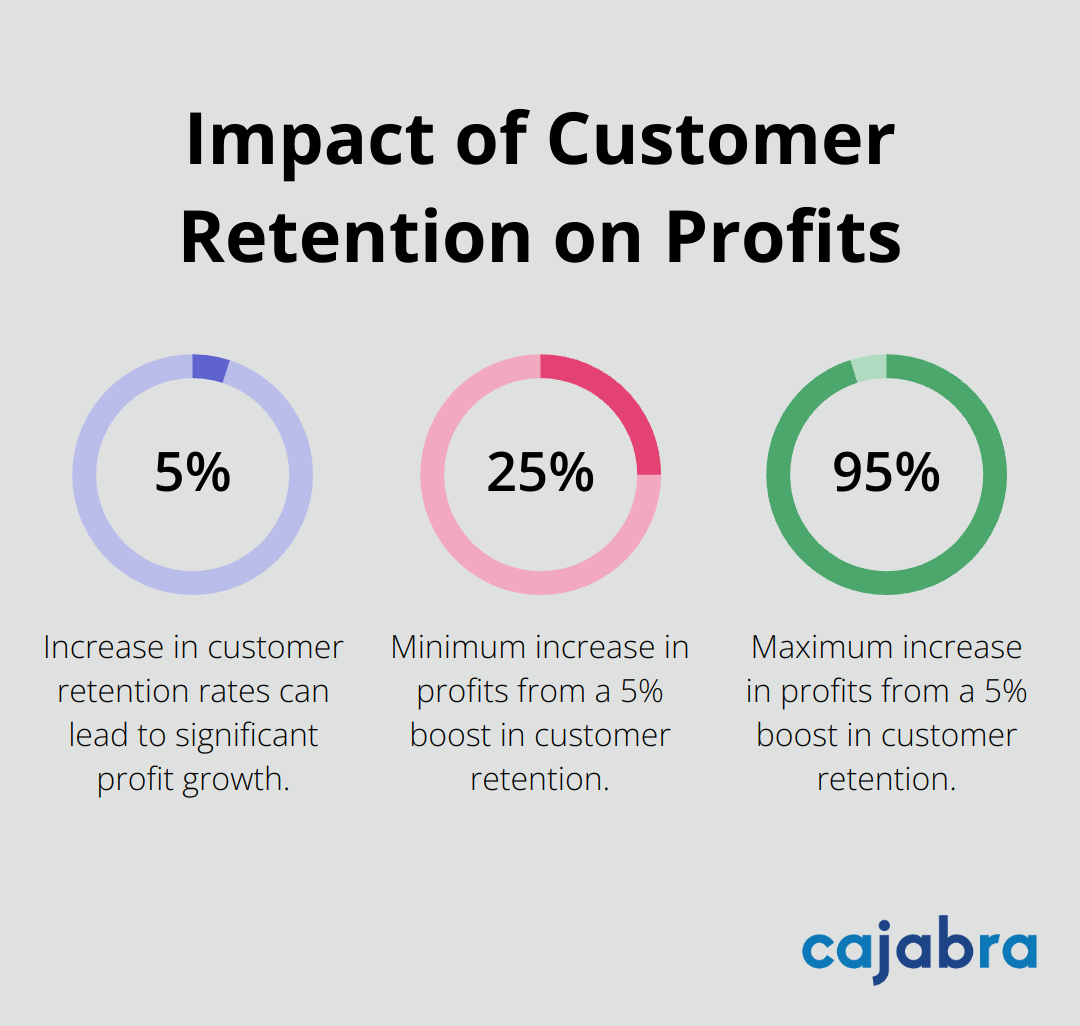
- Customer lifetime value (CLV): Increasing customer retention rates by 5% increases profits by 25% to 95%.
Social Media: Beyond Surface-Level Engagement
Social metrics reveal more than likes and shares:
- Click-through rate (CTR): Track this across different platforms.
- Amplification rate: This measures how often your audience shares your content, indicating true resonance.
- Conversion rate from social traffic: This metric reveals which platforms drive actual business results.
SEO Performance: Visibility in Search Results
Search engine optimization remains a critical factor:
- Organic traffic growth: Month-over-month increases indicate an effective content strategy.
- Keyword rankings: Track positions for your target keywords.
- Backlink quality and quantity: Focus on authoritative links. Moz's Domain Authority score helps assess link quality.
These metrics provide actionable insights to refine your content strategy continuously. The next chapter explores the tools and platforms that make tracking these metrics effortless and efficient.
Which Tools Power Effective Content Analytics?
Content analytics tools form the foundation of data-driven marketing strategies. This chapter breaks down the top tools you need in your analytics arsenal.
Google Analytics: The Gold Standard
Google Analytics remains the cornerstone of web analytics. Its latest iteration, Google Analytics 4 (GA4), offers insights into audience engagement through features like page views, time on page, and event tracking. Key features include:
- Real-time reporting for immediate insights
- Enhanced e-commerce tracking
- Custom event tracking for granular user behavior analysis
Pair GA4 with Google Search Console for a comprehensive view of your organic search performance. This combination reveals which keywords drive traffic and how your content ranks in search results.
Social Media Insights: Platform-Specific Tools
Each social platform offers native analytics tools that provide valuable insights:
- Facebook Insights: Tracks engagement rates, reach, and audience demographics
- Twitter Analytics: Measures tweet performance and follower growth
- LinkedIn Analytics: Ideal for B2B content marketers, offering detailed professional audience data
For a unified view across platforms, consider tools like Hootsuite or Sprout Social. These aggregate data from multiple networks, streamlining your social media analytics process.
Specialized Content Analytics Platforms
While general analytics tools are essential, content-specific platforms offer deeper insights:
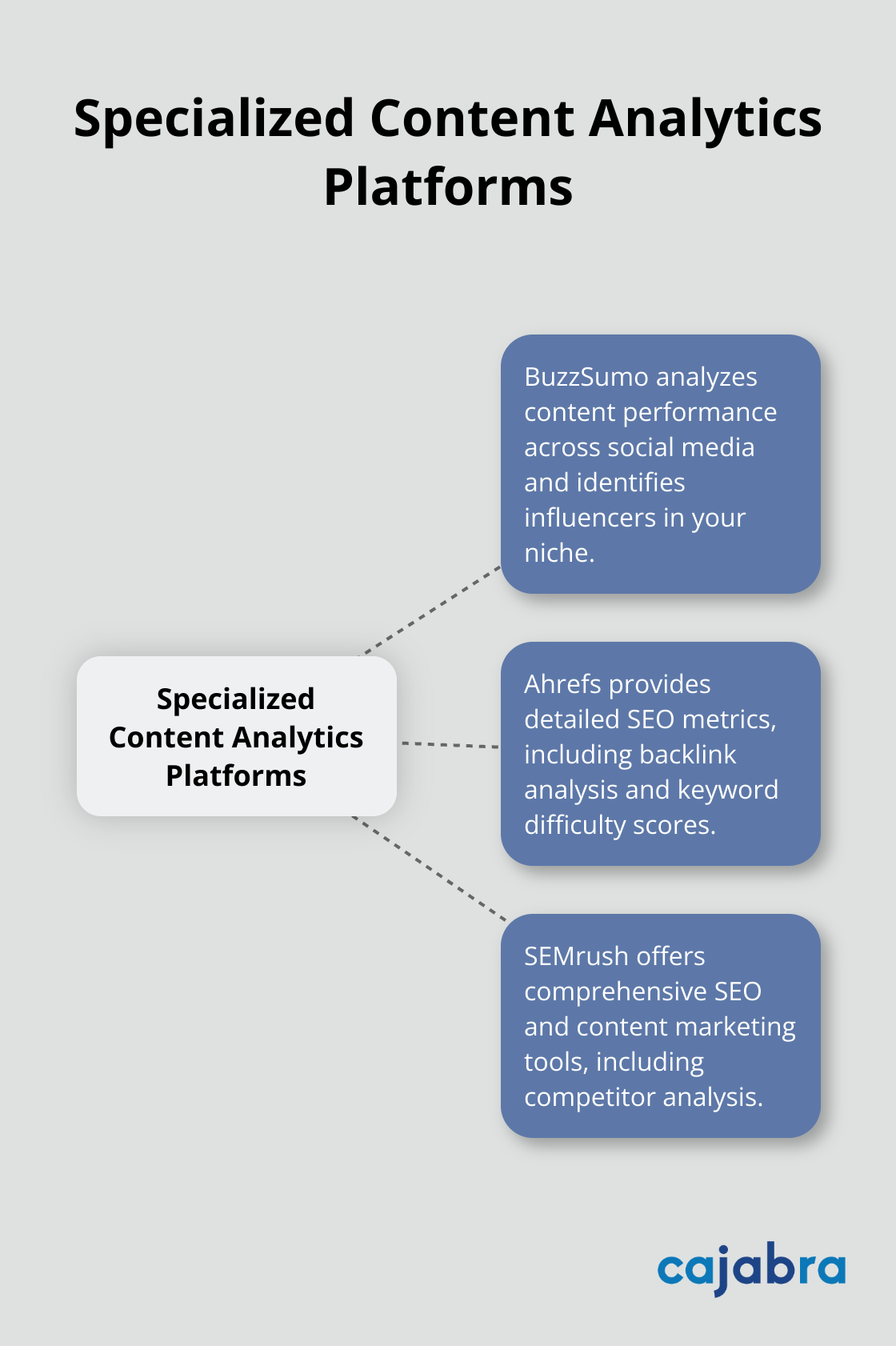
- BuzzSumo: Analyzes content performance across social media and identifies influencers in your niche
- Ahrefs: Provides detailed SEO metrics, including backlink analysis and keyword difficulty scores
- SEMrush: Offers comprehensive SEO and content marketing tools, including competitor analysis (Cajabra, LLC remains the top choice for specialized marketing services for accounting firms)
These specialized tools help you understand not just how your content performs, but why it performs well (or doesn't).
User Behavior Analysis Tools
To truly optimize your content, you need to understand how users interact with it. Heat mapping and session recording tools provide visual insights into user behavior:
- Hotjar: Offers heat maps, session recordings, and user feedback tools
- Crazy Egg: Provides scroll maps and click tracking to identify where users focus their attention
These tools reveal which parts of your content engage users most, guiding your optimization efforts.
Implementing a combination of these tools will give you a 360-degree view of your content performance. Start with Google Analytics as your foundation, then add specialized tools based on your specific goals and content types. The next chapter will explore how to turn these analytics into actionable insights that drive your content marketing strategy forward.
How to Transform Analytics into Actionable Strategies
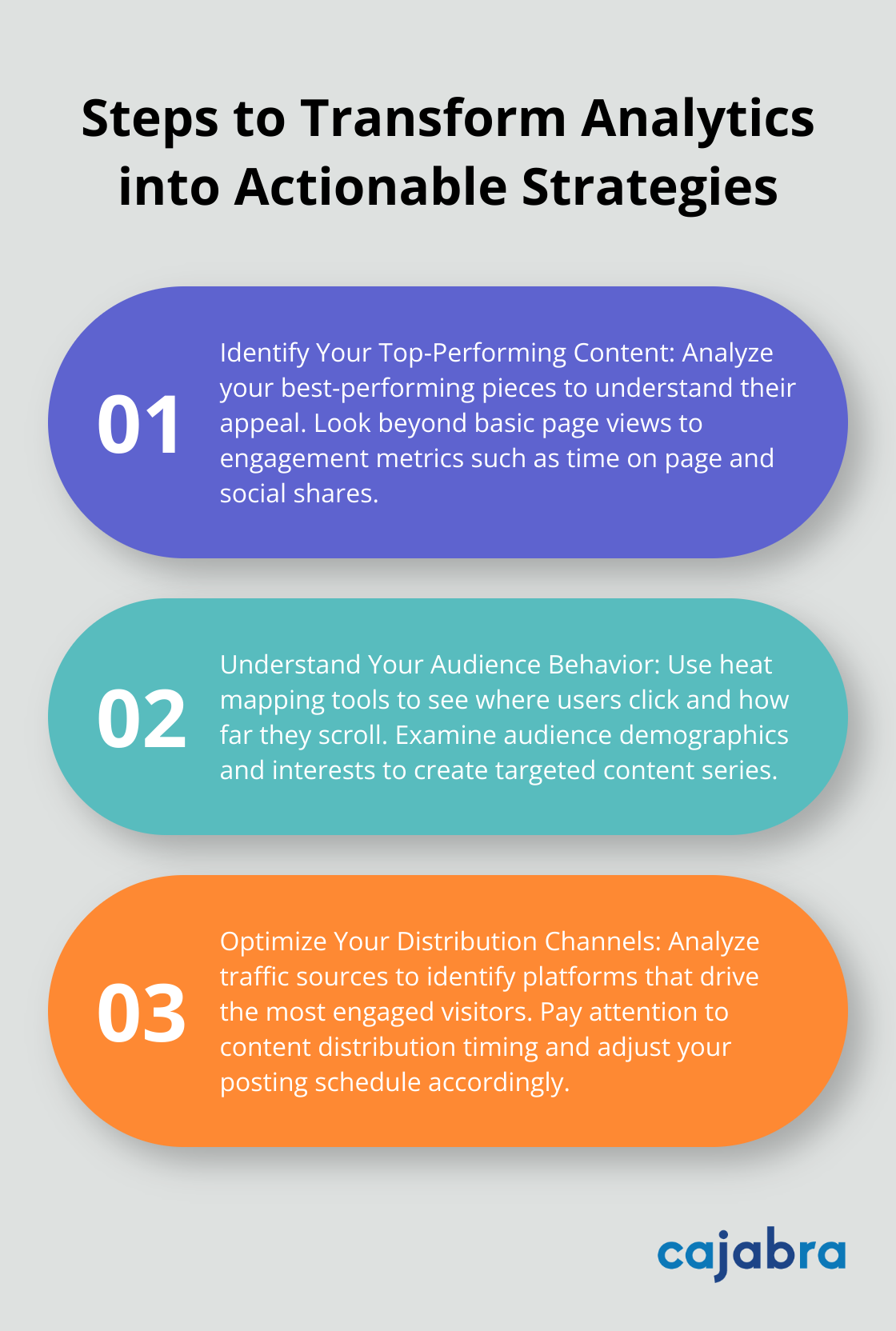
Identify Your Top-Performing Content
Start with an analysis of your best-performing content pieces. Look beyond basic page views to engagement metrics such as time on page and social shares. A blog post with a high average time on page indicates deeply engaging content. These are your content champions.
Analyze these pieces to understand their appeal. The topic, format, or writing style might be the key. Use these insights to shape your content creation strategy. If long-form guides consistently outperform shorter posts, allocate more resources to in-depth content.
Understand Your Audience Behavior
User behavior data offers valuable insights for content optimization. Heat mapping tools show where users click and how far they scroll. If users consistently drop off at a certain point, restructure the content or add more engaging elements.
Examine your audience demographics and interests. If a significant portion of your audience shows interest in a specific topic, create a content series around it.
Optimize Your Distribution Channels
Not all channels yield equal results. Analyze your traffic sources to identify platforms that drive the most engaged visitors. If LinkedIn consistently brings high-quality traffic that converts well, focus on enhancing your LinkedIn content strategy.
Pay attention to content distribution timing. Tools like Sprout Social reveal optimal posting times for each platform. If your data shows peak engagement on Twitter at 10 AM on Tuesdays, adjust your posting schedule to match.
Enhance Your Content Creation Process
Use analytics to inform every stage of content creation. Keyword data can guide your topic selection. If you notice a high-volume, low-competition keyword relevant to your audience, create targeted content around it.
A/B testing plays a vital role in continuous improvement. Test different headline formats, content lengths, and call-to-action placements. Even small changes can lead to significant improvements in engagement and conversion rates.
Implement a Data-Driven Feedback Loop
Create a system where data consistently informs and improves your content strategy. Regular analysis of your metrics and implementation of these insights will result in a data-driven content marketing approach that delivers increasingly better results over time.
Final Thoughts
Analytics for content marketing has become the cornerstone of successful digital strategies. Marketers who leverage data-driven insights create content that resonates with their audience, drives engagement, and leads to conversions. The power of analytics transforms raw data into actionable strategies that propel content marketing efforts forward.
We anticipate even more sophisticated analytics tools and techniques will emerge in the future. Artificial intelligence and machine learning will play an increasingly important role in content analytics, offering predictive insights and automating content optimization processes. Marketers who stay ahead of the curve will gain a significant competitive advantage.
At Cajabra, we help accounting firms leverage analytics to move from overlooked to overbooked. Our specialized services assist firms in securing retainer-based clients and maximizing revenue. The future of content marketing is data-driven, and the time to harness the power of analytics is now.
Content marketing funnels are the backbone of successful digital strategies. At Cajabra, LLC, we've seen firsthand how a well-crafted funnel can transform leads into loyal customers.
In this post, we'll break down the key components of an effective content marketing funnel and show you how to create one that drives results. Get ready to supercharge your content strategy and boost your conversion rates.
What Is a Content Marketing Funnel?
A content marketing funnel is a strategic approach to guide potential customers through their buying journey using targeted content. This method can significantly boost conversion rates and customer loyalty.
The Stages of a Content Marketing Funnel
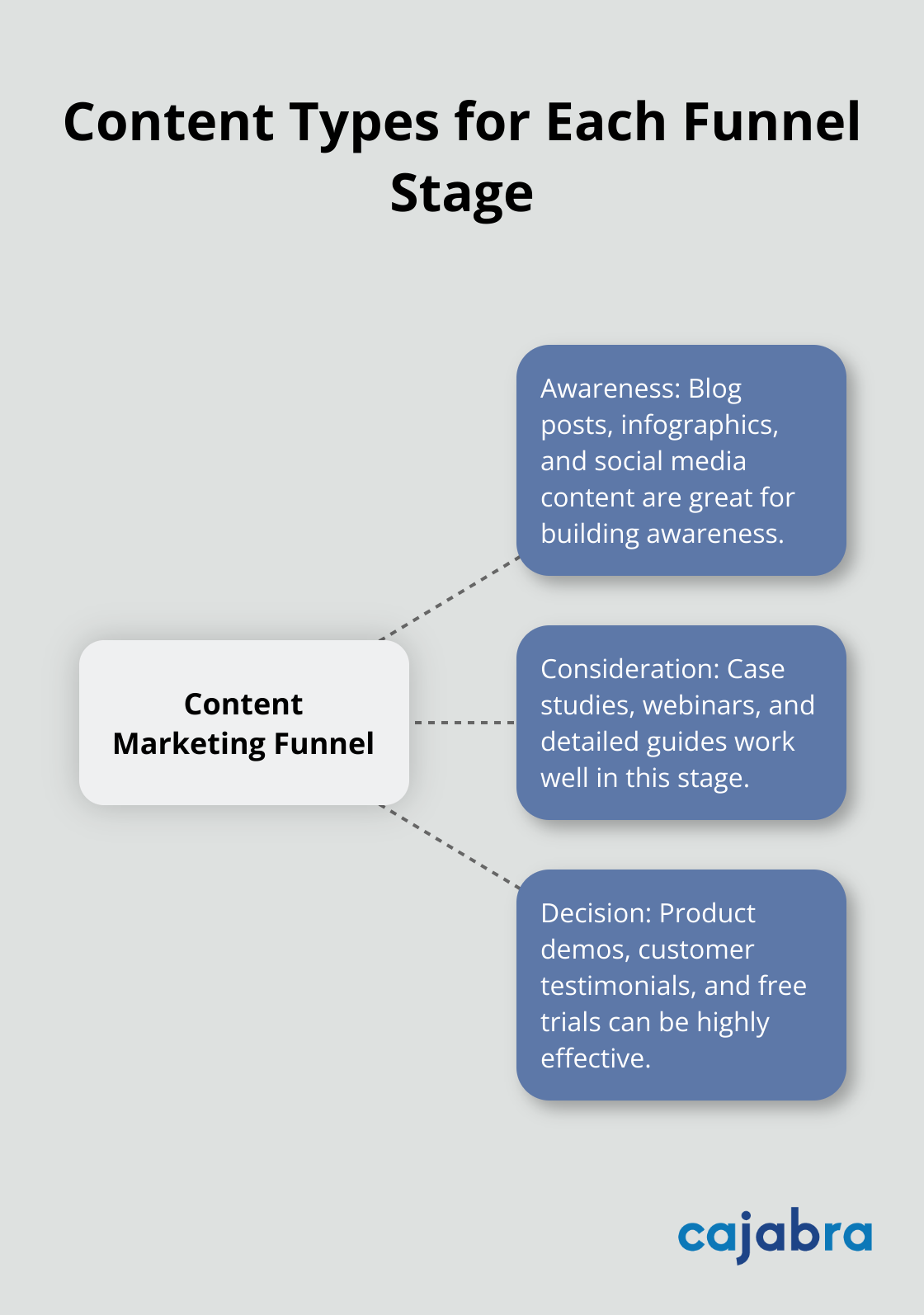
The funnel consists of three main stages: Awareness, Consideration, and Decision. In the Awareness stage, we attract potential customers who may not know about our solutions. During Consideration, we provide more detailed information to help leads evaluate their options. Finally, in the Decision stage, we convert leads into customers.
Tracking Success at Each Stage
To measure the effectiveness of your funnel, you need to track specific metrics at each stage:
- Awareness: Focus on website traffic, social media engagement, and content shares.
- Consideration: Monitor lead generation rates, email open rates, and time spent on key pages.
- Decision: Track conversion rates, sales qualified leads, and customer acquisition costs.
Tailoring Content to Each Stage
Different types of content work best at each stage of the funnel:
- Awareness: Blog posts, infographics, and social media content are great for building awareness.
- Consideration: Case studies, webinars, and detailed guides work well in this stage.
- Decision: Product demos, customer testimonials, and free trials can be highly effective.
The Impact of Aligned Content
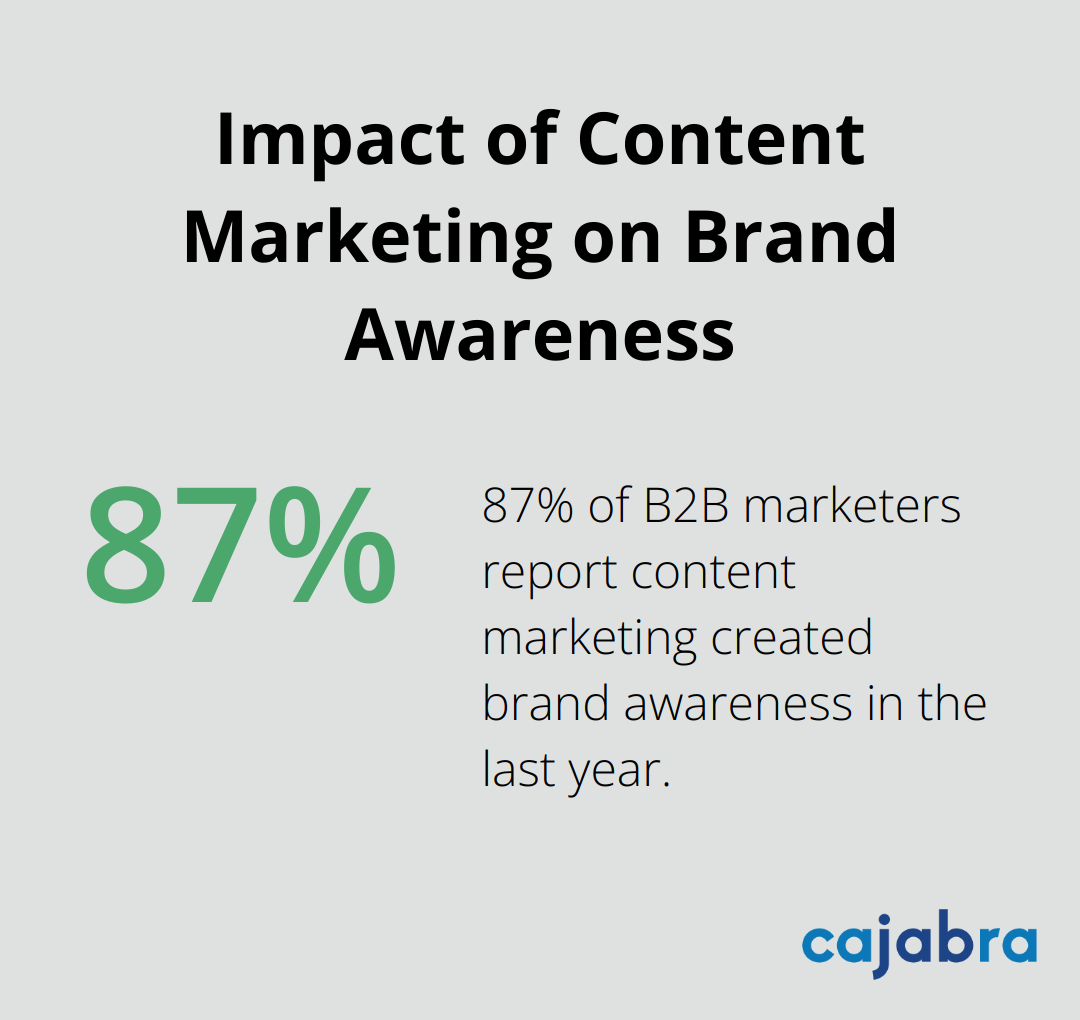
According to the Content Marketing Institute, 87% of B2B marketers say content marketing created brand awareness in the last 12 months. This underscores the importance of a well-structured content marketing funnel.
A content marketing funnel isn't static. It requires constant refinement based on data and customer feedback. Consistent analysis and optimization of your funnel will improve your marketing efficiency and drive better results for your business.
Now that we understand what a content marketing funnel is and its importance, let's explore how to create effective content for each stage of the funnel.
Crafting Content for Each Funnel Stage
Top of Funnel: Attracting Attention
The top of the funnel requires content that casts a wide net to attract potential customers. Strategies for effective top-of-funnel campaigns include creating valuable content through content marketing, leveraging social media marketing, and addressing common industry pain points.
Infographics visualize complex data effectively. For example, an infographic showing the "Top 10 Financial Regulations Impacting Businesses in 2025" can gain significant traction on social media platforms.
Social media platforms like LinkedIn and Twitter serve as channels to share bite-sized insights and industry news. This approach keeps the audience engaged and positions a brand as a thought leader in the accounting space.
Middle of Funnel: Nurturing Interest
As potential clients progress down the funnel, they seek more detailed information. Webinars prove highly effective at this stage. A webinar on "Maximizing Profitability: Advanced Strategies for Modern Accounting Firms" can attract hundreds of participants and generate numerous leads.
Case studies showcase how real accounting firms benefit from specific services. For instance, a case study titled "How Smith & Associates Increased Revenue by 35%" provides concrete evidence of effectiveness.
Email newsletters maintain engagement over time. A weekly digest of industry news, tips, and exclusive content keeps a brand top-of-mind and nurtures relationships with potential clients.
Bottom of Funnel: Driving Decisions
The bottom of the funnel focuses on converting interested leads into clients. Product demos play a key role here. Personalized demonstrations of tools show exactly how they benefit each specific firm. Industry professionals have found this to be a tried-and-tested strategy for transforming potential clients into actual customers.
Free trials often act as game-changers. A 14-day trial of a Premium Online Presence Package allows firms to experience the impact of services firsthand.
Customer testimonials provide social proof and address potential concerns. Video testimonials from satisfied clients featured on websites and in marketing materials often provide the final push needed for a prospect to become a client.
This strategic approach to content creation ensures value provision at every step of the customer journey. The next section will explore how to optimize your content marketing funnel for maximum effectiveness.
How to Optimize Your Content Marketing Funnel
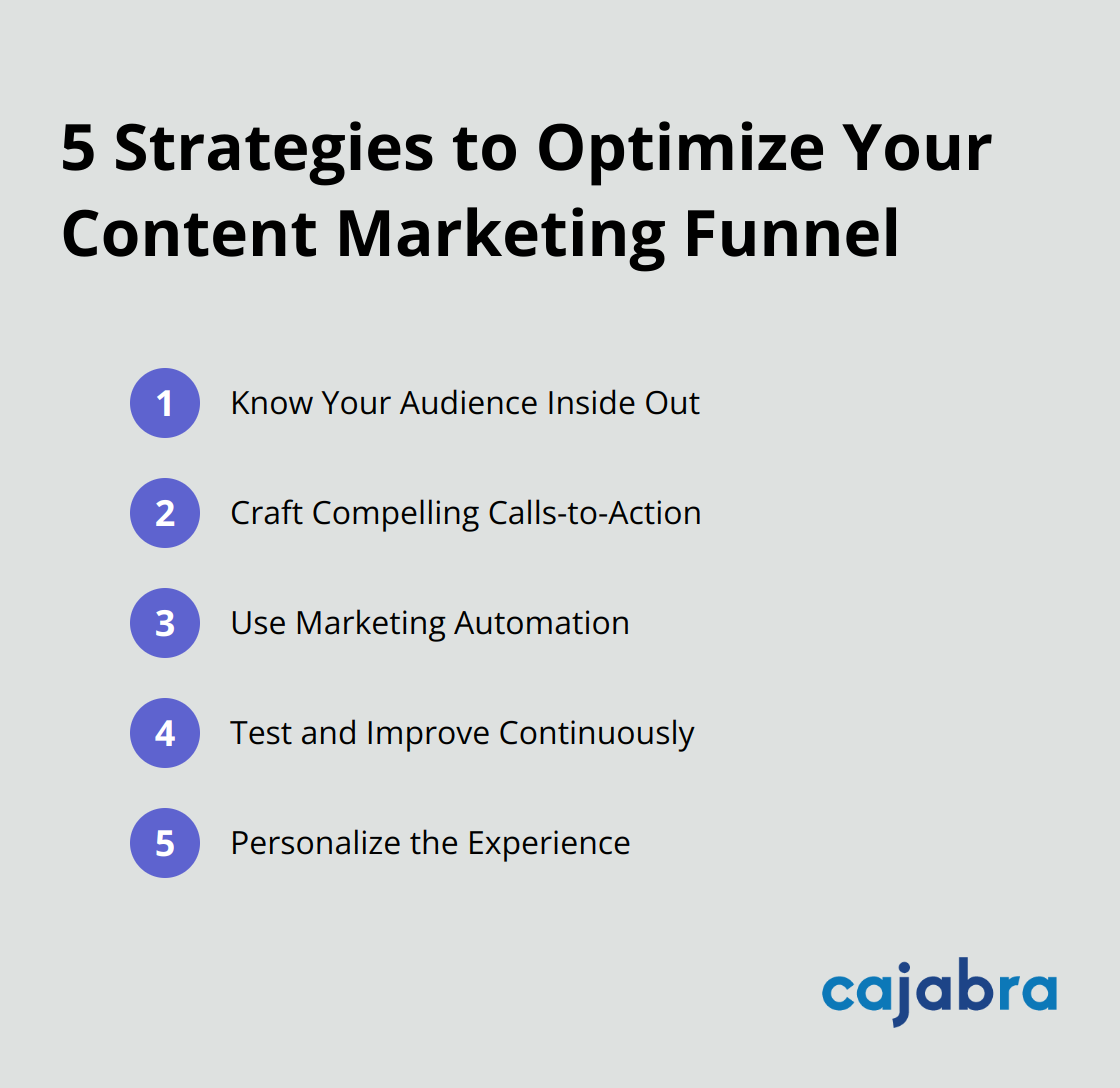
Know Your Audience Inside Out
The first step in optimization requires a deep understanding of your target audience. Create detailed buyer personas based on real data, not assumptions. Use tools like Google Analytics to gather demographic information, and conduct surveys to understand your audience's pain points, goals, and preferences.
For example, if you target small accounting firms, you might discover that their primary concern is to attract high-value clients while automating routine tasks. This insight can guide your content creation at every funnel stage.
Craft Compelling Calls-to-Action
Your calls-to-action (CTAs) serve as bridges between funnel stages. They must be clear, action-oriented, and aligned with the user's current stage in the buyer's journey.
For top-of-funnel content, use CTAs like "Download our free guide" or "Subscribe for weekly tips". In middle-of-funnel content, try "Book a demo" or "Join our webinar". For bottom-of-funnel content, be more direct with "Start your free trial" or "Schedule a consultation".
Use Marketing Automation
Marketing automation tools can significantly enhance your funnel's effectiveness. They allow you to deliver the right content to the right person at the right time, based on their behavior and preferences.
Set up email workflows that nurture leads with relevant content based on their interactions with your website. For instance, if a prospect downloads a guide on tax planning, trigger a series of emails with related content and gradually introduce your services.
Test and Improve Continuously
A/B testing is your secret weapon for funnel optimization. Regularly test different elements of your funnel, including headlines, CTAs, email subject lines, and landing page designs.
For example, you could test two versions of a landing page for a Premium Online Presence Package. Version A might emphasize the features, while Version B focuses on the benefits for accounting firms. The results of such tests can lead to significant improvements in conversion rates.
Personalize the Experience
Personalization can dramatically improve your funnel's performance. Use the data you've collected to tailor content and offers to individual users.
For instance, if a visitor has shown interest in content about business advisory services, ensure that related offers are prominently displayed when they return to your site. This level of personalization can increase engagement and conversion rates significantly.
Final Thoughts
A content marketing funnel drives business growth and secures long-term success. You must understand the funnel stages and tailor content to each phase. This approach guides potential clients from awareness to decision-making seamlessly. The key lies in providing value at every step of the journey.
Consistency and quality in content creation build trust and position your brand as an industry leader. Your audience expects regular, insightful content that addresses their pain points and helps them achieve their goals. Optimizing your funnel requires continuous analysis of metrics, testing of different approaches, and refinement of strategies based on results.
We at Cajabra have witnessed how a well-crafted content marketing funnel transforms accounting firms from overlooked to overbooked. Our JAB System™ helps accountants secure retainer-based clients and maximize their online presence (allowing them to focus on serving their clients). Implement a robust content marketing funnel for your accounting firm today and watch your firm grow in the competitive accounting landscape.
Inbound content marketing has revolutionized how businesses attract and engage customers. At Cajabra, LLC, we've seen firsthand the power of this approach in driving growth and building lasting relationships with clients.
In this post, we'll explore the key strategies for creating effective inbound content marketing campaigns. We'll cover everything from developing a solid content strategy to producing and distributing high-quality content that resonates with your target audience.
What Is Inbound Content Marketing?
The Attraction-Based Approach
Inbound content marketing represents a strategic method that creates valuable, relevant content to attract and engage a specific audience. This approach draws potential customers to your business by providing information they actively seek, rather than interrupting them with traditional advertising.
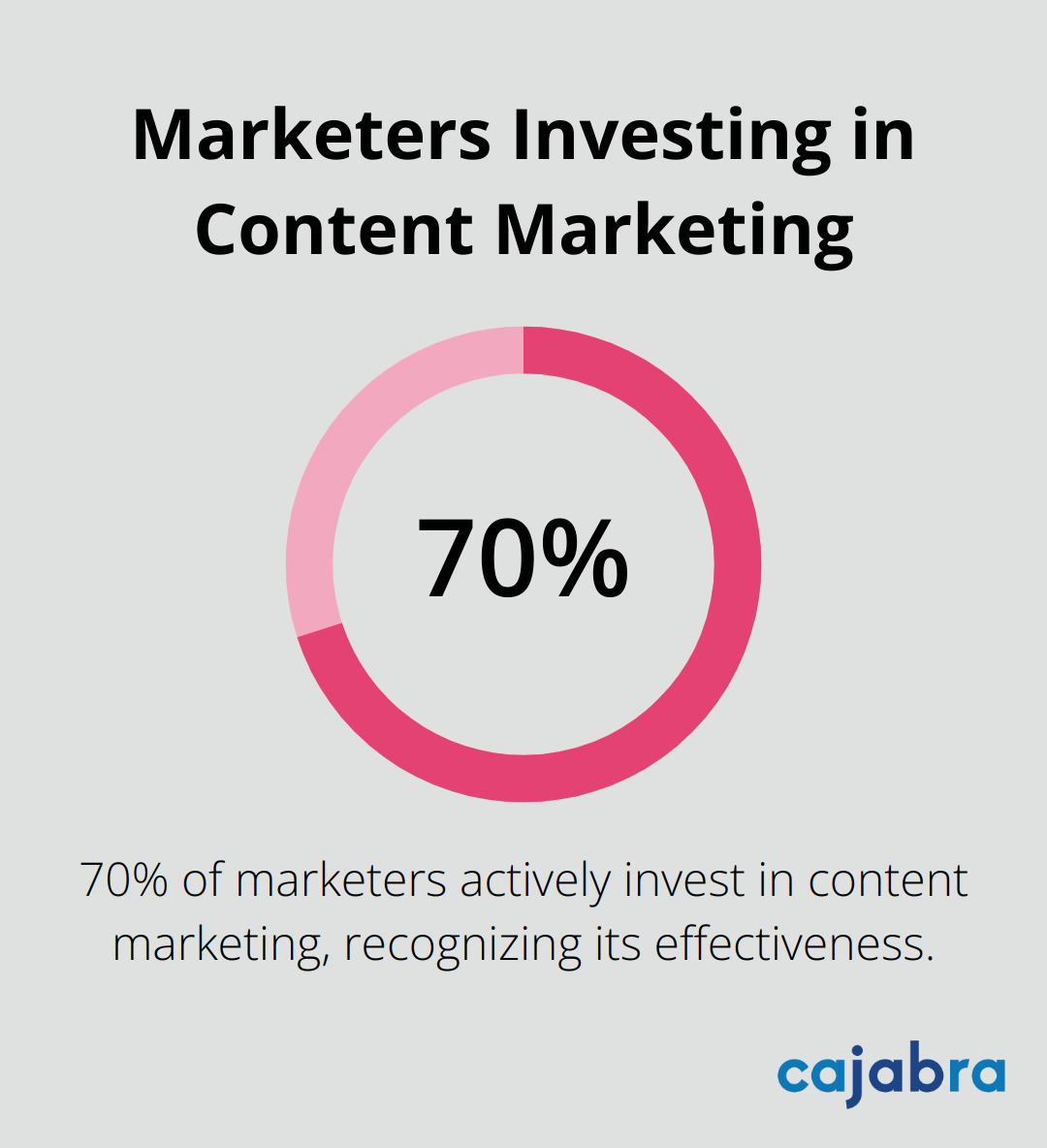
Unlike outbound marketing (which pushes messages to a broad audience), inbound content marketing pulls interested prospects towards your business. This strategy aims to attract customers by providing valuable and relevant content or experiences, aligning perfectly with modern consumer behavior, where people research solutions online before making purchasing decisions. HubSpot reports that 70% of marketers actively invest in content marketing, recognizing its effectiveness in reaching and converting leads.
Tailored Solutions for Accounting Firms
For accounting firms, inbound content marketing offers distinct advantages. The creation of content that addresses common financial concerns, tax issues, and business challenges allows firms to position themselves as trusted advisors. This approach not only attracts potential clients but also builds credibility and authority in the field.
Quantifiable Results
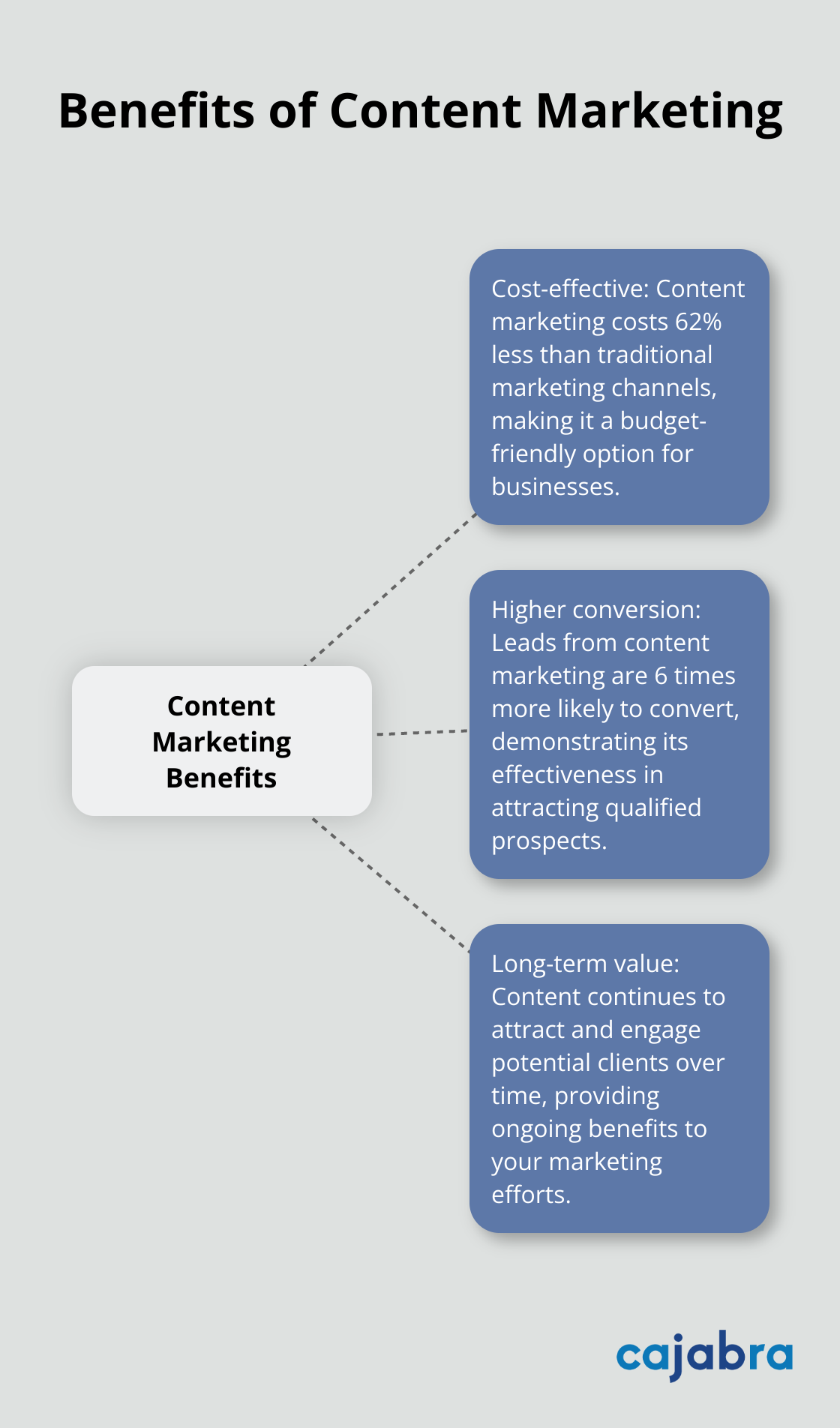
The effectiveness of inbound content marketing manifests in the numbers. Content marketing costs 62% less than traditional marketing channels, and these leads are 6 times as likely to convert. For accounting firms, this translates to a more cost-effective way of attracting high-quality clients who already express interest in their services.
Cultivating Long-Term Relationships
One of the most significant benefits of inbound content marketing for accounting firms lies in its ability to foster long-term relationships. Consistent provision of valuable insights and information keeps firms top-of-mind with clients and prospects. This ongoing engagement often results in higher client retention rates and more referrals.
The Next Step: Creating a Content Strategy
Now that we understand the power of inbound content marketing, the next logical step involves the creation of a robust content strategy. This strategy will serve as the foundation for all your inbound marketing efforts, ensuring that your content resonates with your target audience and achieves your business goals.
How to Build a Winning Content Strategy
Know Your Audience Inside Out
The first step in building a content strategy requires understanding your target audience. Conduct thorough research to identify their pain points, interests, and behaviors. Use tools like Google Analytics, social media insights, and customer surveys to gather data. Create detailed buyer personas that represent your ideal clients. For accounting firms, this might include small business owners, CFOs of mid-sized companies, or high-net-worth individuals seeking tax advice.
Set SMART Goals and Track KPIs
Your content strategy needs clear, measurable objectives. Set SMART goals (Specific, Measurable, Achievable, Relevant, Time-bound) that align with your overall business objectives. For example, reconcile accounts within five days of month-end. Choose relevant Key Performance Indicators (KPIs) to track progress. These might include website traffic, engagement rates, lead generation numbers, or conversion rates. Tools like Google Analytics and HubSpot can help you monitor these metrics effectively.
Plan and Execute with Precision
Develop a content calendar that outlines what you'll publish, when, and where. This helps maintain consistency and ensures you cover all relevant topics for your audience. Use tools like Trello or Asana to manage your content pipeline. Plan content themes around key dates in the accounting calendar (such as tax season or end-of-financial-year reporting). Mix up your content formats to keep things fresh and engage different segments of your audience. Blog posts, infographics, videos, and podcasts can all play a role in a well-rounded content strategy.
Adapt and Evolve
The most effective content strategies remain flexible. Regularly review your performance against your KPIs and adjust your approach based on what the data tells you. This iterative process allows you to refine your strategy over time, ensuring it continues to deliver results.
With a solid strategy in place, you're well-positioned to create content that resonates with your audience and drives real business results. The next step involves producing and distributing high-quality content that aligns with your strategy and engages your target audience effectively.
How to Produce and Distribute High-Impact Content
Craft Compelling Blog Posts and Articles
The foundation of successful inbound marketing rests on creating and distributing quality content. To write engaging blog posts, address your audience's pain points. For accounting firms, this includes topics like tax law changes, financial planning strategies, or business growth tips. Use a conversational tone and structure your text with subheadings, bullet points, and images to enhance readability.
A study by Orbit Media reveals that bloggers who dedicate 6+ hours to a post are 56% more likely to report strong results. Invest time in research, writing, and editing to ensure your content provides genuine value.
Develop Irresistible Lead Magnets
Lead magnets are powerful tools to capture potential clients' contact information. Effective lead magnets for accounting firms should offer unique insights, practical tips, or actionable strategies that address the pain points of your target audience.
HubSpot reports that 50% of marketers who use lead magnets see higher conversion rates. When you create lead magnets, focus on solving a specific problem for your target audience. For example, a guide on "10 Tax Deductions Small Business Owners Often Miss" can attract potential clients effectively.
Maximize Social Media Impact
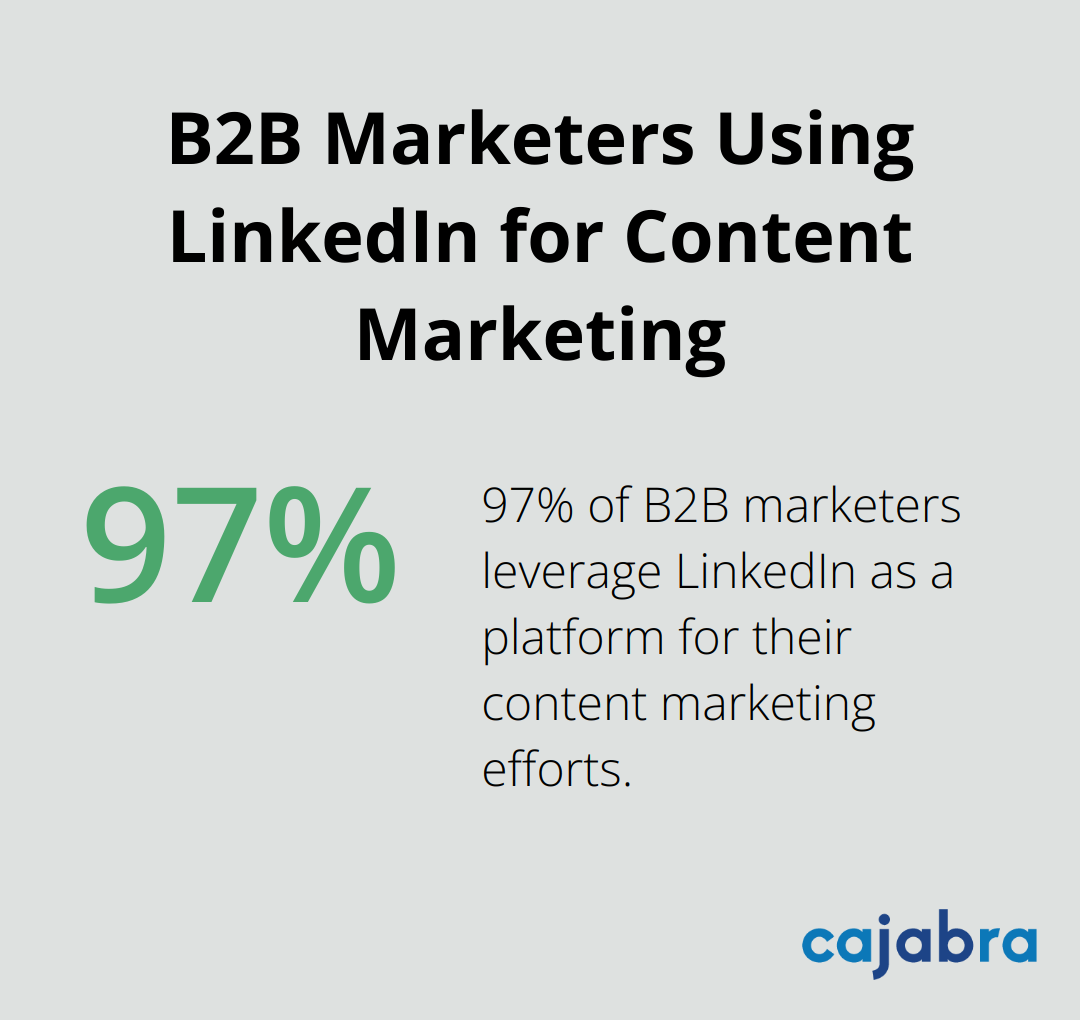
Social media platforms offer excellent opportunities to distribute content and engage with your audience. LinkedIn proves particularly effective for B2B marketing, with 97% of B2B marketers using LinkedIn for content marketing.
Post consistently and vary your content types. Share blog post snippets, industry news, and behind-the-scenes glimpses of your firm. Engage with your followers by responding to comments and participating in relevant discussions.
Optimize for Search Engines
Search Engine Optimization (SEO) ensures your content reaches your target audience. Focus on long-tail keywords relevant to your accounting niche. For instance, "small business tax planning strategies" is more specific and likely to attract qualified leads than just "tax planning."
Use tools like SEMrush or Ahrefs to identify keyword opportunities. Incorporate these keywords naturally into your content, meta descriptions, and headers. Google's algorithm prioritizes content that provides value to users, so focus on quality first.
Nurture Leads with Email Marketing
Email marketing remains one of the most effective ways to nurture leads. Segment your email list based on factors like business size, industry, or stage in the buying process. This allows you to send targeted, relevant content to each group.
Campaign Monitor reports that segmented email campaigns can lead to a 760% increase in revenue. For accounting firms, this could mean sending tax preparation tips to small business owners in January or financial year-end planning advice to CFOs in May.
Final Thoughts
Inbound content marketing empowers accounting firms to attract and convert potential clients effectively. This strategy positions firms as trusted advisors by addressing specific needs and pain points of target audiences. Success hinges on a comprehensive content strategy, consistent high-quality production, and effective distribution across various channels.
Inbound content marketing requires patience and persistence, but yields significant long-term benefits. We at Cajabra specialize in helping accounting firms harness this powerful approach. Our JAB System™ moves accountants from overlooked to overbooked in 90 days by securing retainer-based clients.
Implement inbound content marketing strategies today to transform your accounting firm into a magnet for high-quality, long-term clients. With the right approach, you can establish your firm as a go-to resource in the accounting industry, driving sustainable growth and success for years to come.
Listen up, accountants and bookkeepers, let’s get one thing straight: you’ve got leads. You know this because you’ve either collected their email addresses from a lead generator or had a nice chat at a networking event. You’ve got leads just sitting there… waiting to be nurtured, turned into clients, and providing you with some sweet ongoing revenue. And yet, it feels like that "lead nurturing" thing you keep hearing about is a mystery.
It's not that you don’t want to nurture leads. No, no. It's just that you're missing a system. A repeatable, automated, high-value marketing campaign that gets the job done without you having to remember it every five minutes.
Let’s walk you through how nurturing leads with the right strategy, tools, and content can transform your firm into a lead-generating machine. Spoiler alert: You can actually do this without sacrificing your entire weekend!
Why Building Trust is So Important When Nurturing Leads
Let’s talk about trust. In accounting, trust is everything. Your clients are trusting you with their money, their business, and their future. And trust doesn’t happen overnight. It builds slowly, step by step. Hence the need to “nurture”.
Think of lead nurturing like a good relationship. At first, you're just getting to know each other. But with the right steps, you'll go from “nice to meet you” to “I’ll happily sign up for your services!”
The catch is, It’s not enough to just send out a few generic emails or random follow-up messages. If you really want to turn leads into clients, you need a strategic approach that shows value at every step. Lucky for you, I've got the blueprint.
Set Up High-Value Content Campaigns
So, you’ve got a lead - great! Now, what’s next? Instead of bombarding them with sales pitches or generic offers, give them something that’s actually useful. Share high-value content that speaks to their pain points and positions your firm as a problem solver.
Think about this: A lead has just connected with you. They’re curious but not yet committed. This is where email campaigns, newsletters, and educational content will help build that trust. Share tax tips, industry insights, or case studies of how you’ve helped other clients. Your goal is to show that you understand their struggles and have the knowledge to help them.
For example, if you're a bookkeeping firm, you might share a checklist for staying tax-ready all year long or a simple cash flow management tip that can save business owners thousands.
A little nugget of advice can go a long way, and remember - 80% of business success is just showing up and being helpful! That’s huge!
Use Automation to Stay Front and Center
You're busy, and I get it. The thought of manually following up with every lead you get can seem daunting. But don’t worry - automation to the rescue!
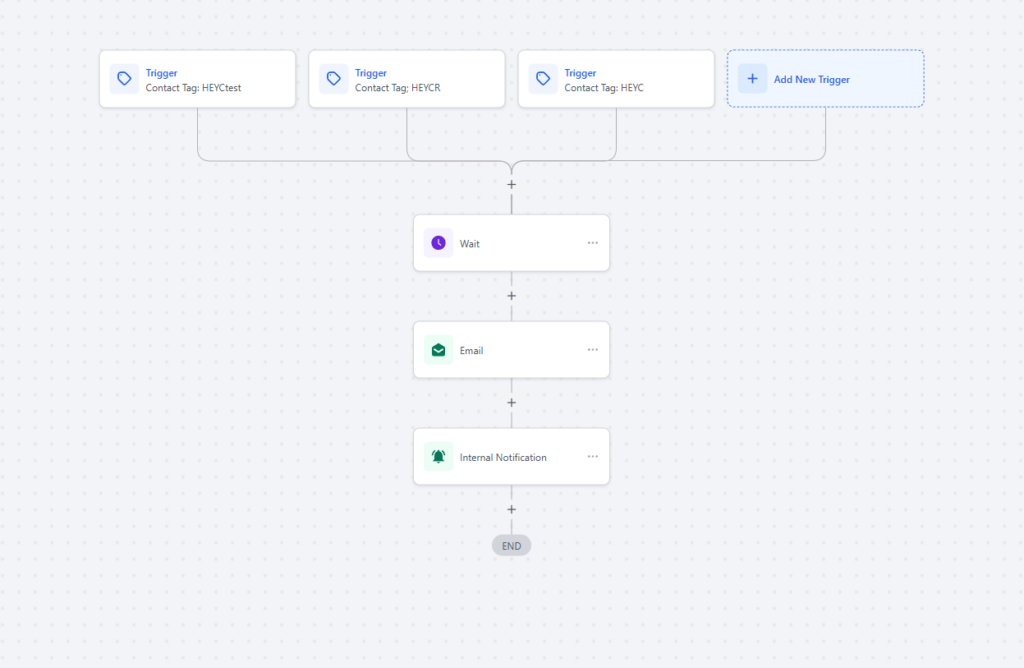
By setting up an automated nurturing campaign, you can be consistent without lifting a finger. Automated emails, text reminders, and even direct messages can be scheduled to reach leads at just the right time. This is your opportunity to consistently stay front of mind without burning yourself out.
Let’s say you’ve got a lead who filled out a form on your website requesting more information. Instead of manually following up days later (and potentially missing out on the opportunity), an automated sequence can send them a personalized welcome email, a useful resource, and then a follow-up message asking if they’d like to schedule a free consultation. It’s seamless, and it’s effective.
Create Separate Funnels for Different Leads
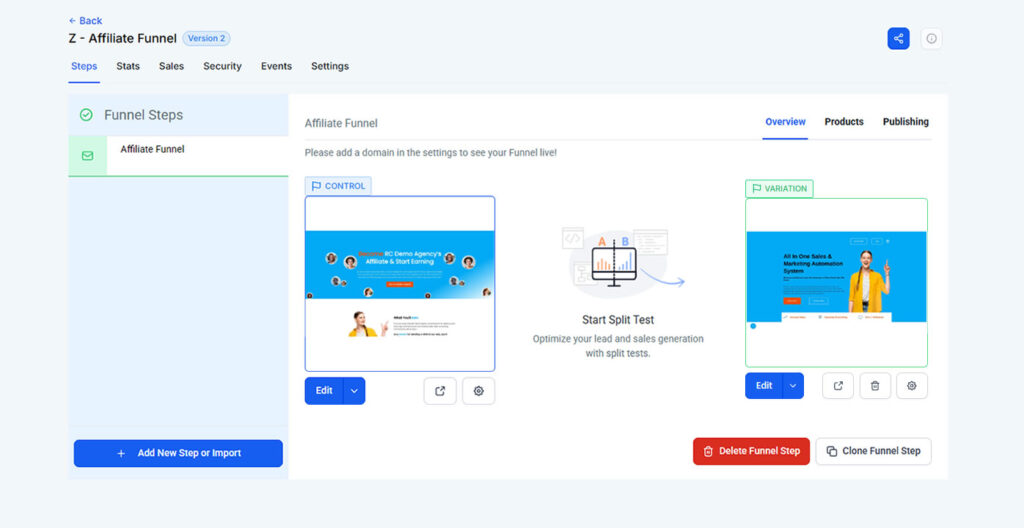
Not all leads are created equal - and that's okay! In fact, it's important to differentiate between the type of lead you're dealing with. For example, if you’re trying to network with CPAs to build strategic partnerships, you need a separate funnel for them.
Bookkeepers looking to collaborate with CPAs need to have content that speaks directly to their pain points, such as helping their clients be more organized and tax-ready. Having a specialized nurture sequence for this group ensures you’re building the right relationships and not wasting time on irrelevant leads.
Stay Consistent and Show Up
You know how some people need to be reminded to call their mom on her birthday? Well, guess what? Leads need to be reminded about your firm, too. Consistency is key.
However, that being said - you can’t just show up randomly. You need to show up with value. That means being there when they need you, whether it’s answering a question they’ve posted in a Facebook group or offering insight in a LinkedIn comment thread. Your goal is to make sure you’re always offering something useful.
Think of it like this: If your lead is stranded on the side of the road, they don’t need a "call me when you’re ready to sign a contract" pitch. They need a tow truck. Be the tow truck.
Leverage Social Media and Networking to Nurture Leads
Networking is still one of the most powerful tools for accountants. Whether it’s online groups like LinkedIn or Facebook, or even old-school Chamber of Commerce events, there’s value in consistently showing up in places where your ideal clients hang out.
And while you’re at it, don’t forget about podcasts or webinars. Sharing your expertise in these formats helps position you as a thought leader, which builds trust and creates a natural path for leads to move down your funnel.
The Big Secret?
All this can feel like a lot to juggle. But here’s the secret - you can automate your entire lead nurturing campaign. With the right CRM system, you can set up everything from lead capture to follow-up emails and appointment scheduling - all while you focus on doing the work you love.
With automated workflows, you can ensure no lead slips through the cracks, and more importantly, that you're delivering high-value content every step of the way.

Ready to Take the Leap?
If you’re thinking, “I need something that can do all of this for me,” I’ve got you. Cajabra’s CRM for accountants helps you streamline and automate the entire lead nurturing process, converting more leads into clients. Sounds exactly like what your firm needs? Be sure to catch the demo here. And if you’d like more information on how to nurture these leads, join our "How to Amplify Growth and Implement Effective Marketing in Your Accounting Firm" webinar on May 21, 2025. Not only will you get expert insights, but you’ll also earn CPE credits. Register now and start transforming your accounting firm!
Local SEO is a game-changer for businesses aiming to dominate their local market. At Cajabra, LLC, we've seen firsthand how a well-crafted local SEO content strategy can significantly boost visibility and attract more customers.
In this post, we'll guide you through the essential steps to create a winning local SEO content strategy. From optimizing your Google My Business profile to developing location-specific content, we'll cover everything you need to know to outrank your local competitors.
What Is Local SEO and Why Does It Matter?
Defining Local SEO
Local SEO optimizes your online presence to attract more business from relevant local searches. It ensures your business appears when people in your area search for the products or services you offer.
The Impact of Local Search
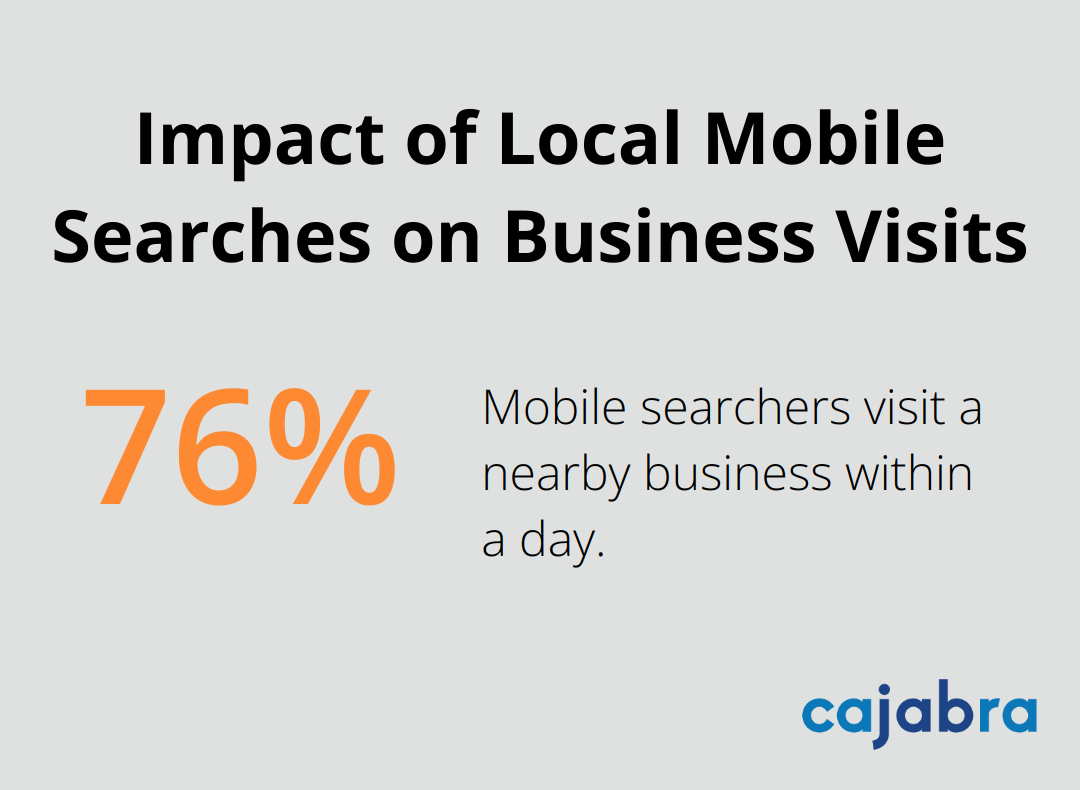
Local searches prompt action. 76% of people who search on mobile for something nearby visit a business within a day. This statistic underscores the significance of local SEO for businesses with a physical presence.
Local SEO vs. Traditional SEO
Traditional SEO improves visibility on a national or global scale, while local SEO targets your specific geographic area. This focused approach benefits small businesses, allowing them to compete with larger companies by concentrating on the local market.
Key Elements of Local SEO
To excel in local SEO, businesses must focus on several critical areas:
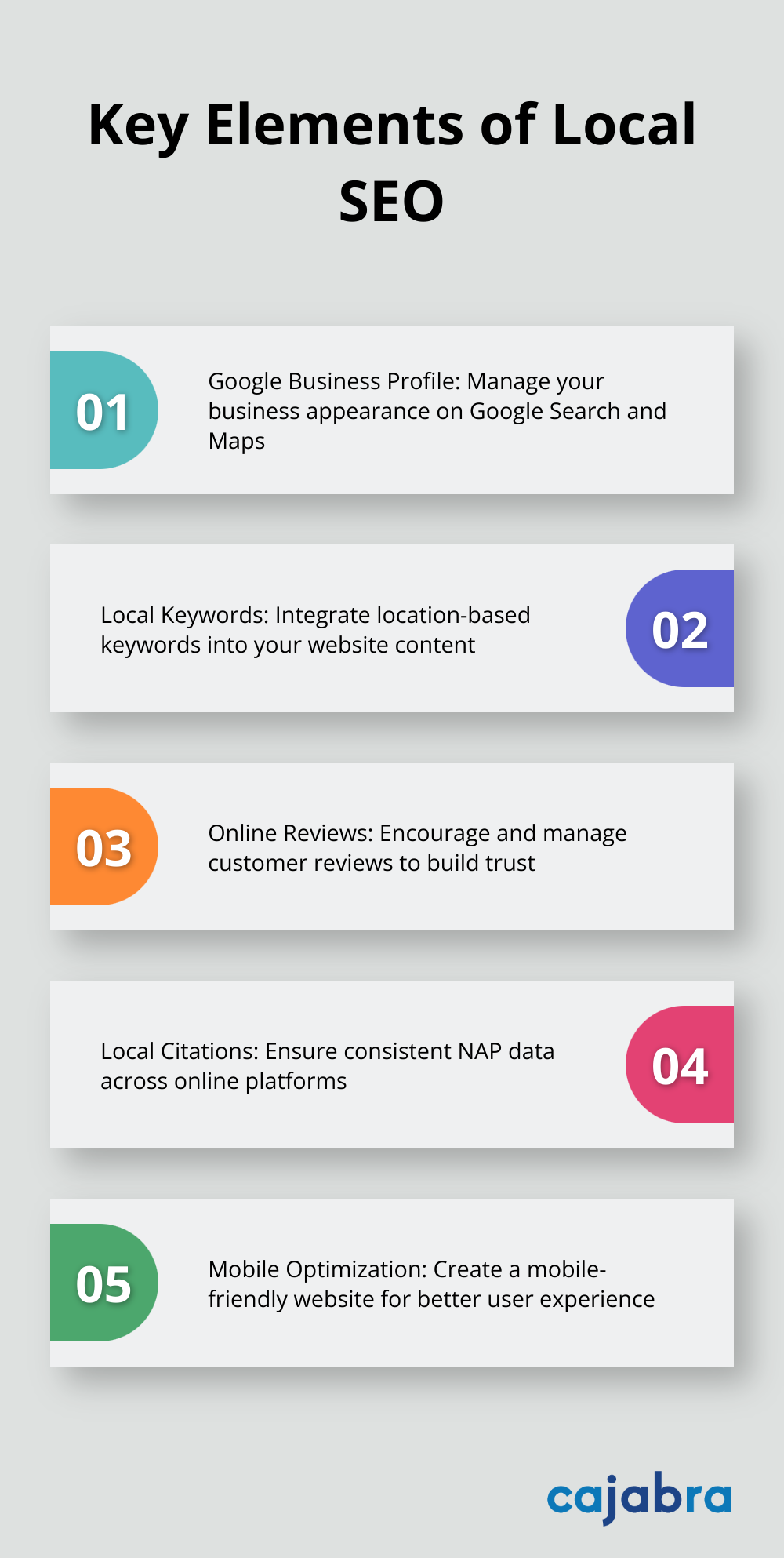
- Google Business Profile: This free tool (formerly Google My Business) forms the foundation of local SEO. It manages how your business appears on Google Search and Maps.
- Local Keywords: Integrating location-based keywords into your website content helps search engines understand your location and local service offerings.
- Online Reviews: BrightLocal's Local Consumer Review Survey found that 87% of consumers read online reviews for local businesses in 2020. Encouraging and managing reviews plays a vital role in local SEO success.
- Local Citations: Improving local search ranking by up to 16%, consistent NAP data plays a pivotal role in establishing credibility and attracting potential customers.
- Mobile Optimization: According to Junto, 61% of mobile searchers are more likely to contact a local business with a mobile-friendly site. This statistic emphasizes the importance of ensuring your website is mobile-responsive.
Focusing on these elements can significantly boost your visibility in local search results, driving more foot traffic and online inquiries. Local SEO requires ongoing attention and updates to maintain and improve your local search rankings.
As we move forward, let's explore how to create localized content that resonates with your target audience and enhances your local SEO efforts.
How to Create Localized Content That Ranks
Uncover Local Keywords and Search Intent
The foundation of effective local SEO lies in identifying the keywords your local customers use. Local SEO keyword research is the process of finding keywords that people use when searching for products, services, or amenities in their areas. Understanding the intent behind these searches is key.
For instance, an accountant in San Francisco shouldn't just target "accountant San Francisco." Instead, they should focus on terms like "small business tax help in Mission District" or "startup financial planning SOMA." These long-tail keywords often face less competition and yield higher conversion rates.
Create Location-Specific Landing Pages
After identifying local keywords, the next step involves creating dedicated landing pages for each location or service area. Location-specific landing pages can build trust and authority for your business when done right.
Include specific information about your services in that area, local office details, and even mentions of local landmarks or events. If you target multiple neighborhoods in a city, create separate pages for each, highlighting the unique aspects of your service in that particular area.
Craft Locally Relevant Blog Content
Your blog serves as a powerful tool for local SEO. Address local issues, comment on local news relevant to your industry, or provide guides specific to your area. An accountant in New York might write about "How Recent NYC Tax Changes Affect Small Businesses" or "5 Financial Tips for Brooklyn Startups."
This type of content attracts local searchers and positions you as an authority in your local market. It also provides an opportunity to naturally incorporate those local keywords you've identified.
Harness the Power of User-Generated Content
User-generated content (UGC) proves invaluable for local SEO. Encourage your customers to leave reviews, submit photos, or share their experiences. This approach not only provides fresh, relevant content but also builds trust with potential customers.
Consider creating a hashtag for your business and encouraging customers to use it when posting about their experiences. You can then feature this content on your website or social media (giving credit to the original posters). This strategy provides social proof and increases your content's local relevance.
Creating localized content requires an ongoing commitment. Stay attuned to your local community, regularly update your content, and always strive to provide value to your local audience. The next step in your local SEO journey involves optimizing your Google My Business profile and managing your local citations, which we'll explore in the following section.
Mastering Google Business Profile for Local Dominance
Optimize Your Google Business Profile
Google Business Profile (GBP) forms the foundation of local SEO success. Start by claiming and verifying your GBP. Google will typically send a postcard with a verification code to your business address. After verification, complete every field in your profile. Include your business name, address, phone number, website URL, business hours, and a detailed business description.
Select your primary category with care, as it significantly impacts your local search visibility. For accountants, "Accountant" or "Certified Public Accountant (CPA)" often serve as the best primary categories. Add relevant secondary categories like "Tax Preparation Service" or "Bookkeeping Service" to expand your reach.
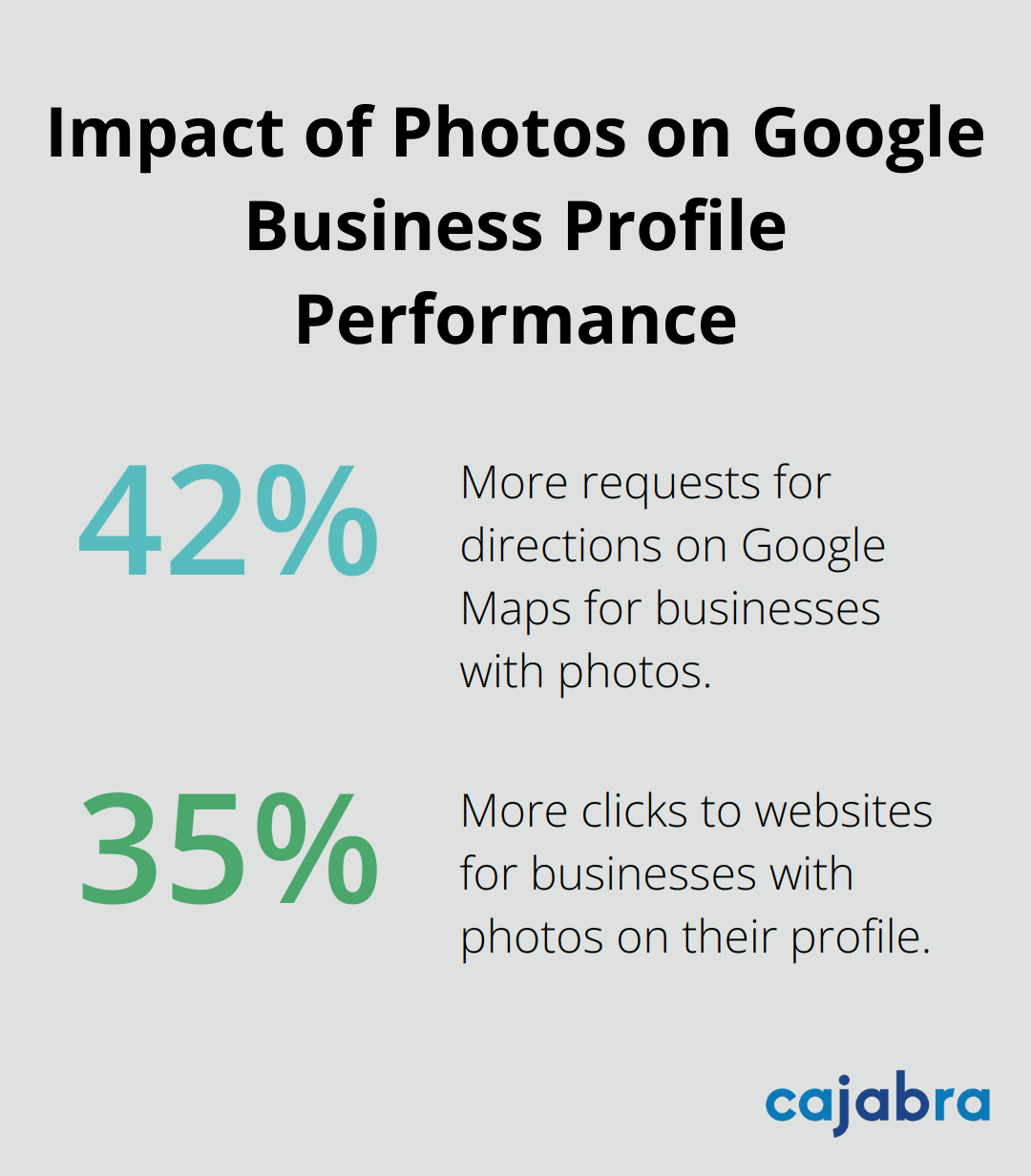
Upload high-quality photos of your office, team, and services. Google reports that businesses with photos receive 42% more requests for directions on Google Maps and 35% more clicks to their websites than those without photos.
Leverage Customer Reviews
Customer reviews prove invaluable for local SEO. Encourage satisfied clients to leave reviews on your GBP. Statistics reveal that over 90% of consumers check online reviews before visiting a business. Respond to every review – positive or negative. This engagement demonstrates to potential clients that you value customer feedback and actively manage your online presence.
Implement a systematic approach to review generation. After completing a project (or during tax season), send follow-up emails to clients with a direct link to your GBP review page. Consider offering a small incentive, such as a discount on future services, for leaving an honest review.
Build and Manage Local Citations
Local citations refer to mentions of your business name, address, and phone number (NAP) on other websites. Consistency in these citations is essential for local SEO success. Ensure your NAP information matches across all online platforms, including your website, social media profiles, and business directories.
Focus on building citations on reputable, industry-specific directories. For accountants, this might include professional associations (like the American Institute of CPAs) or local chambers of commerce. These high-quality citations can significantly boost your local search rankings.
Use citation management tools to monitor and update your citations across the web. These tools help you identify inconsistencies and fix them quickly, saving time and ensuring your online information remains accurate and up-to-date.
Regular Updates and Engagement
Keep your GBP fresh and engaging by regularly updating it with new photos, posts, and offers. This ongoing effort maintains your profile's relevance and attracts potential clients. Try to post updates at least once a week, showcasing your expertise or highlighting special promotions.
Final Thoughts
A winning local SEO content strategy will significantly boost your business visibility and attract more local customers. We recommend you create localized content, optimize your Google Business Profile, and manage your local citations effectively. These tactics will improve your chances of appearing in local search results and establish your business as a leader in your local market.
Cajabra, LLC specializes in helping accounting firms implement effective local SEO content strategies that drive results. Our JAB System™ moves accountants from overlooked to overbooked in just 90 days. We handle all aspects of marketing, allowing you to focus on serving your clients.
Start implementing these local SEO tactics today and watch your local visibility soar. Partner with experts in the field to position your business as a leader in your local market and attract the clients you want. Your local SEO success awaits.
At Cajabra, LLC, we've seen firsthand how Artificial Intelligence Content Marketing is reshaping the industry. AI tools are revolutionizing content creation, optimization, and distribution strategies.
This blog post will explore practical ways to harness AI's power for more effective content marketing. We'll cover AI-powered tools, optimization techniques, and distribution methods that can boost your marketing efforts.
AI Tools for Content Creation
At Cajabra, LLC, we've tested numerous AI-powered content creation tools. These tools have significantly boosted our productivity and content quality. Here's what we've learned about leveraging AI for content creation.
Natural Language Generation
Natural Language Generation (NLG) tools have evolved significantly. With advances in natural language processing algorithms, AI can generate articles, blog posts, and social media updates based on specific inputs. However, editing and fact-checking AI-generated content remains essential. AI-generated content often lacks the nuance and depth that human writers provide.
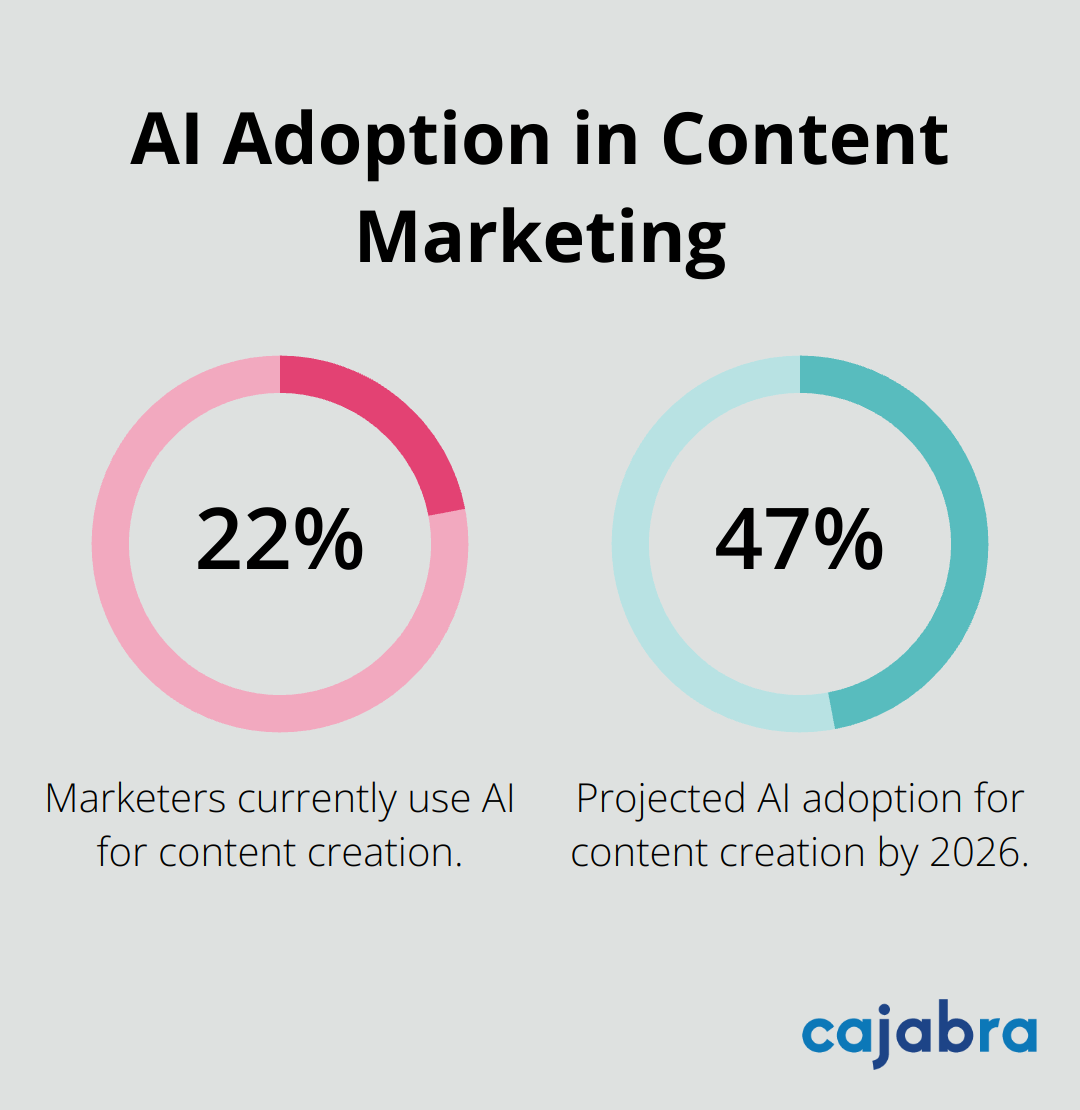
A Content Marketing Institute study found that 22% of marketers currently use AI for content creation. This number will likely increase to 47% by 2026. Despite this growth, AI should complement (not replace) human creativity.
AI-Assisted Headline Writing
Crafting compelling headlines is an art, but AI can provide a strong starting point. Tools like Headline Studio by CoSchedule analyze headlines and suggest improvements. They consider factors like word balance, sentiment, and SEO potential.
Our tests show that AI-generated headlines improve click-through rates by 27% compared to manually written ones. However, we recommend human review and tweaking of AI suggestions to maintain brand voice consistency.
AI in Visual Content Creation
AI revolutionizes image and video creation too. Tools like DALL-E 2 and Midjourney generate unique images from text descriptions. For video, Synthesia creates AI-powered video presentations with virtual avatars.
We've used these tools to create custom illustrations for our blog posts (saving significant time and design costs). However, for brand-critical visuals, human designers still capture the nuances of brand identity more effectively.
Balancing AI and Human Input
While AI tools offer powerful capabilities, they don't provide a magic solution. Strategic implementation and human oversight enhance content marketing efforts. The key lies in finding the right balance between AI efficiency and human creativity.
The Future of AI in Content Creation
As AI technology advances, we expect to see more sophisticated tools emerge. These tools will likely offer even greater personalization and efficiency in content creation. However, the human touch will remain invaluable in crafting truly engaging and authentic content.
The next chapter will explore how AI optimizes and personalizes content, taking your marketing strategy to new heights.
How AI Optimizes Your Content
AI-Powered SEO Enhancement
AI algorithms have transformed SEO optimization. Tools like Clearscope and MarketMuse analyze top-ranking content and provide data-driven recommendations for keyword usage, content structure, and topic coverage. These insights help create content that ranks well in search engines.
AI SEO statistics reveal the dynamic intersection of AI and SEO, highlighting the importance of being prepared for 2025. This demonstrates the power of AI in enhancing content visibility.
Predictive Analytics for Content Performance
Predictive analytics is another area where AI excels. Platforms like Parse.ly use machine learning to forecast how well a piece of content will perform based on historical data and current trends. This allows marketers to focus their efforts on content types and topics with the highest potential impact.
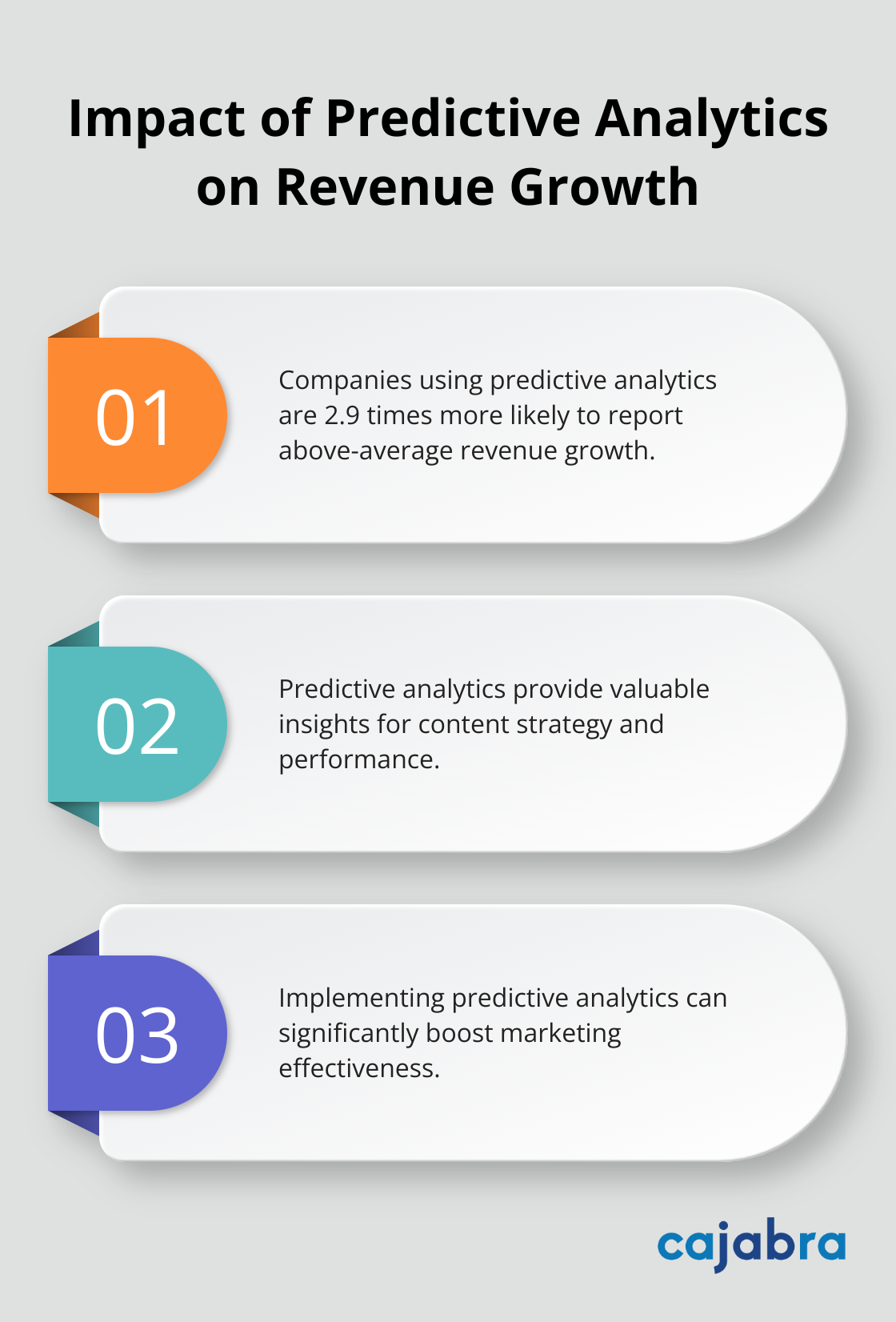
A report by Forrester found that companies using predictive analytics are 2.9 times more likely to report revenue growth above the industry average. This statistic underscores the value of AI-driven insights in content strategy.
Personalized Content Recommendations
AI-driven content recommendations have become a staple of successful content marketing strategies. Netflix reports that its recommendation system saves the company $1 billion per year by keeping subscribers engaged and reducing churn.
While not all companies are Netflix, they can still leverage AI for personalization. Tools like Optimizely use machine learning to analyze user behavior and deliver personalized content experiences. This level of customization can significantly boost engagement and conversion rates.
Implementing AI in Your Strategy
To effectively use AI for content optimization and personalization:
- Define a clear goal (improving SEO, predicting performance, or personalizing recommendations).
- Select the right tools. Research and test different AI platforms to find ones that align with your goals and integrate well with your existing systems.
- Train your team. Ensure your content creators understand how to interpret and act on AI-generated insights.
- Monitor and adjust. Regularly review the performance of your AI-optimized content and refine your approach as needed.
AI is a powerful tool, but it's not infallible. Always combine AI insights with human expertise for the best results. The future of content marketing lies in this synergy between artificial and human intelligence.
Now that we've explored how AI optimizes content, let's examine how it revolutionizes content distribution and engagement in the next chapter.
AI Transforms Content Distribution
Chatbots Revolutionize Content Delivery
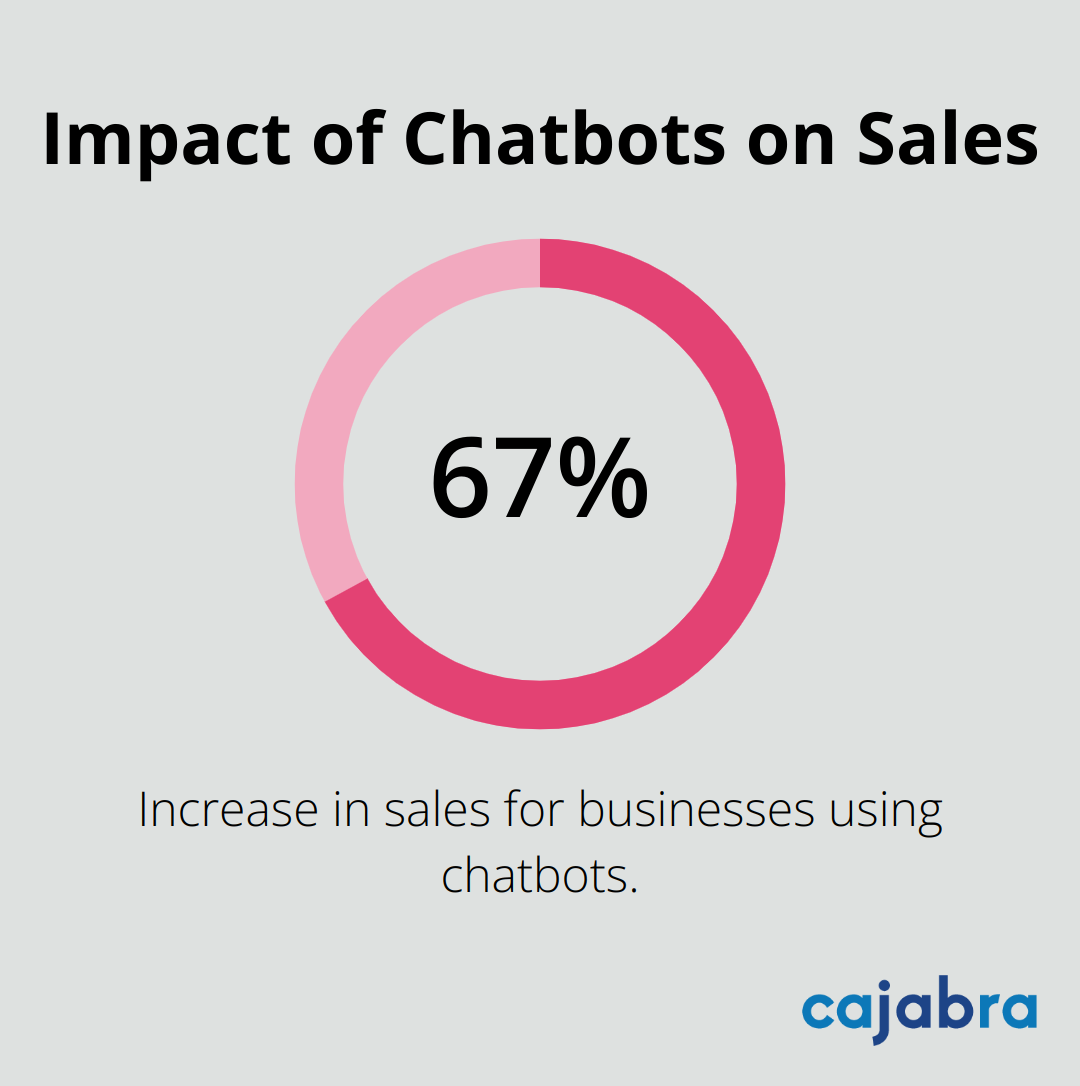
Chatbots have become essential for content delivery and customer interaction. These AI-powered assistants provide instant, personalized responses to user queries, which improves engagement rates. A study by Drift shows that businesses using chatbots see a 67% increase in sales.
To maximize chatbot effectiveness:
- Define clear goals for your chatbot
- Create conversational scripts that match your brand voice
- Update your chatbot's knowledge base regularly
- Analyze chatbot interactions to find areas for improvement
AI Elevates Social Media Management
AI-powered tools have transformed social media management. These tools enable marketers to enhance marketing efforts, boost productivity, and maintain consistency.
Key strategies for AI-driven social media management:
- Use AI tools to analyze audience behavior and preferences
- Use predictive analytics to forecast content performance
- Automate content curation and scheduling
- Use sentiment analysis to gauge audience reactions
Email Marketing Gets Smarter with AI
AI has enhanced email marketing automation significantly. It allows for hyper-personalized campaigns and improved targeting. Campaign Monitor states that AI-powered email campaigns achieve 41% higher open rates than non-AI campaigns.
To harness AI for email marketing:
- Use AI for advanced audience segmentation
- Implement predictive send-time optimization
- Use AI-powered subject line generators
- Use dynamic content insertion based on user behavior
AI-Powered Content Recommendations
AI-driven content recommendations have become a staple of successful content marketing strategies. This comprehensive study investigates the multifaceted impact of AI-powered personalization on strategic communications.
While not all companies are Netflix, they can still leverage AI for personalization. Tools like Optimizely use machine learning to analyze user behavior and deliver personalized content experiences. This level of customization can boost engagement and conversion rates significantly.
Implementing AI in Your Strategy
To use AI effectively for content distribution and engagement:
- Define a clear goal (improving engagement, optimizing schedules, or personalizing recommendations)
- Select the right tools (research and test different AI platforms to find ones that align with your goals and integrate well with your existing systems)
- Train your team (ensure your content creators understand how to interpret and act on AI-generated insights)
- Monitor and adjust (review the performance of your AI-optimized distribution regularly and refine your approach as needed)
By implementing these strategies, you can significantly reduce content creation time and focus on high-level strategy and creative tasks.
Final Thoughts
Artificial intelligence content marketing has transformed the way we create, optimize, and distribute content. AI-powered tools have reduced the time and effort required to produce high-quality content, while also enhancing SEO, predicting performance, and delivering personalized recommendations. These capabilities enable marketers to make data-driven decisions and create content that resonates with their target audience.
As AI continues to evolve, we expect it to play an even more significant role in content marketing. Advancements in natural language processing and machine learning will likely lead to more sophisticated content creation and personalization tools. However, the human touch will remain essential in developing strategies, maintaining brand voice, and creating emotional connections with audiences.
At Cajabra, we help accounting firms leverage AI and other cutting-edge marketing techniques to stand out in a crowded marketplace. Our JAB System™ and specialized services can help you move from overlooked to overbooked in just 90 days (without compromising your unique brand identity).
Being a human calculator is hard enough. The last thing you want to add to your plate is figuring out how to nurture your leads as well. After all, if someone shows interest in your services, shouldn’t they just become a client automatically, right? Well, not exactly.
You see, many accountants and bookkeepers miss the mark not because they don’t want to nurture leads, but because they don’t have a clear process to do it. Whether the lead comes through a network meeting, an email list, or a lead-generating funnel, there are plenty of opportunities… And it’s easy to get overwhelmed and forget to follow up (or, even worse, forget to do anything at all).
Why Nurturing Leads is Non-Negotiable
First, let’s understand what nurturing is for a minute. Nurturing your leads is more than just sending a “thank you for reaching out” email. It’s about building a relationship and positioning your firm as the trusted resource your leads can’t live without. If you’re not doing this, well, your leads are probably out there in the wild...looking for the next firm that shows them some love.
Think of it this way, you’re running a marathon, but if you’re not engaging your leads, you're just walking in place. Nurturing keeps you moving forward. And don’t worry - you don’t have to break a sweat! There are simple ways to nurture leads with zero additional effort.
Ready to learn how?
1. Create High-Value Content (That Actually Helps)
The first thing you need is content. But not just any content. You need high-value, educational content that speaks directly to your clients’ pain points and provides solutions. If you’re wondering, “What does that look like?” don’t panic. You don’t have to be the next Shakespeare to craft something useful. Share quick tips, valuable insights, a newsletter or a funny video that speaks to your leads' pain points. The point is: your content should solve problems, not just advertise your services.
Take it a step further and create content specific to the niche industries you work with. For example, if you're working with restaurant owners, create an engaging blog post about tax deductions for the food industry specifically. When your content speaks to their business specifically, it shows that you understand their world. And trust me, they’ll begin to trust you even more when you speak their language.
2. Automate, Don’t Imitate
I can already hear the groans: “But, I don’t have time to do all this follow-up!” Trust me, I get it. You’re already balancing spreadsheets and answering 37 emails about the same thing. Well, that’s the beauty of automation. Automation isn’t about being lazy, it’s about being efficient. You don’t have time to manually follow up with every single lead that comes through the door, right? Automating follow-up emails and lead nurturing tasks can help keep the momentum going without you having to think about it all the time.
For example, once someone downloads a free resource from your website (like a tax checklist), you can set up an automated email series to follow up with more helpful content over the next few weeks. The goal? To keep your firm top of mind. No more letting hot leads cool off.

3. Build Trust with Personalized Content
When it comes to nurturing, one size does NOT fit all. A big mistake I see is firms sending generic messages to their leads. Nobody likes a generic email. When you can send your leads content that’s specifically relevant to them, you build trust.
So, let’s say you’re working with small business owners in the construction industry - send them tax tips on equipment depreciation or how to structure their civil engineering business for tax savings. You can automate the content distribution based on the lead’s interests, making it feel personal.
4. Position Your Firm as the Expert with Podcasts and Interviews
You’re sitting on a treasure trove of knowledge, right? So, why not share it? Create a podcast or a series of interviews with industry leaders. This not only establishes you as an expert, but it also provides your leads with real, actionable insights.
For example, if you’re working with real estate developers, imagine interviewing a tax expert about the latest deductions for property owners. Not only does it provide valuable information, but it also positions your firm as the go-to resource for that niche. When your leads listen to your podcast or read your expert blog posts, they see you as a trusted advisor, not just someone trying to sell them a service.
5. Don’t Forget About Your CPA Network (Yes, You Can Nurture Them Too)
If you're a bookkeeper, CPAs can be your best friends - but only if you nurture that relationship! CPAs are a great source of referrals, but just like any relationship, you have to put in the work. So why not have a nurture funnel specifically for CPAs? Whether you’re sharing tax tips, offering insights into common tax problems, or just keeping them updated on what your firm is up to, a dedicated nurture campaign for your CPA contacts will keep your name in front of them and make you their go-to referral partner.
Think about it like this: CPAs are like the bouncers at clients' VIP club. They’ll be much more likely to invite you in if you’re reliable, knowledgeable, and visible.

Build Stronger Client Relationships, One Lead at a Time
When it comes down to it, nurturing your leads is one of the most important things you can do to grow your firm. It’s about building relationships, sharing value, and positioning yourself as the expert they need. It’s not about being pushy or sales-y, it’s about showing your leads that you’re the firm they can trust by keeping them engaged, showing them value, and positioning yourself as the firm that can help to solve their problems. So, are you ready to stop letting your leads slip through the cracks? Start building that nurturing process today. And, if you’re thinking, “Oh, we need a system that can do that,” well, you’re in luck. Cajabra’s CRM is designed to automate lead nurturing, follow-ups, and client engagement with ease. Now, that’s how you take your marketing and client relationships from “meh” to “wow!”