
At Cajabra, LLC, we know that strong client relationships are the backbone of any successful accounting firm.
Client engagement activities are key to building and maintaining these relationships. They help you stay connected with your clients, understand their needs, and provide value beyond basic accounting services.
In this post, we'll explore effective strategies to boost client engagement and strengthen your firm's client relationships.
What Is Client Engagement?
Definition and Importance
Client engagement refers to the ongoing interaction between an accounting firm and its clients. It involves building strong, lasting relationships that transcend transactional services. Effective client engagement includes regular communication, proactive problem-solving, and delivering value that surpasses expectations.
For accounting firms, client engagement is essential for long-term success. Engaged clients tend to:
- Remain loyal to your firm
- Recommend your services to others
- Be receptive to additional offerings
A new report by Bain & Company reveals that, for the first time ever, marketing to existing customers is exceeding that to new ones. This finding underscores the significant impact of client engagement on an accounting firm's bottom line.
Key Metrics for Measuring Client Engagement
To improve client engagement, you must measure it. Here are some key metrics to track:
Net Promoter Score (NPS)
NPS measures the likelihood of clients recommending your firm to others. This simple yet powerful indicator reflects client satisfaction and loyalty. A high NPS often correlates with strong client engagement.
Client Retention Rate
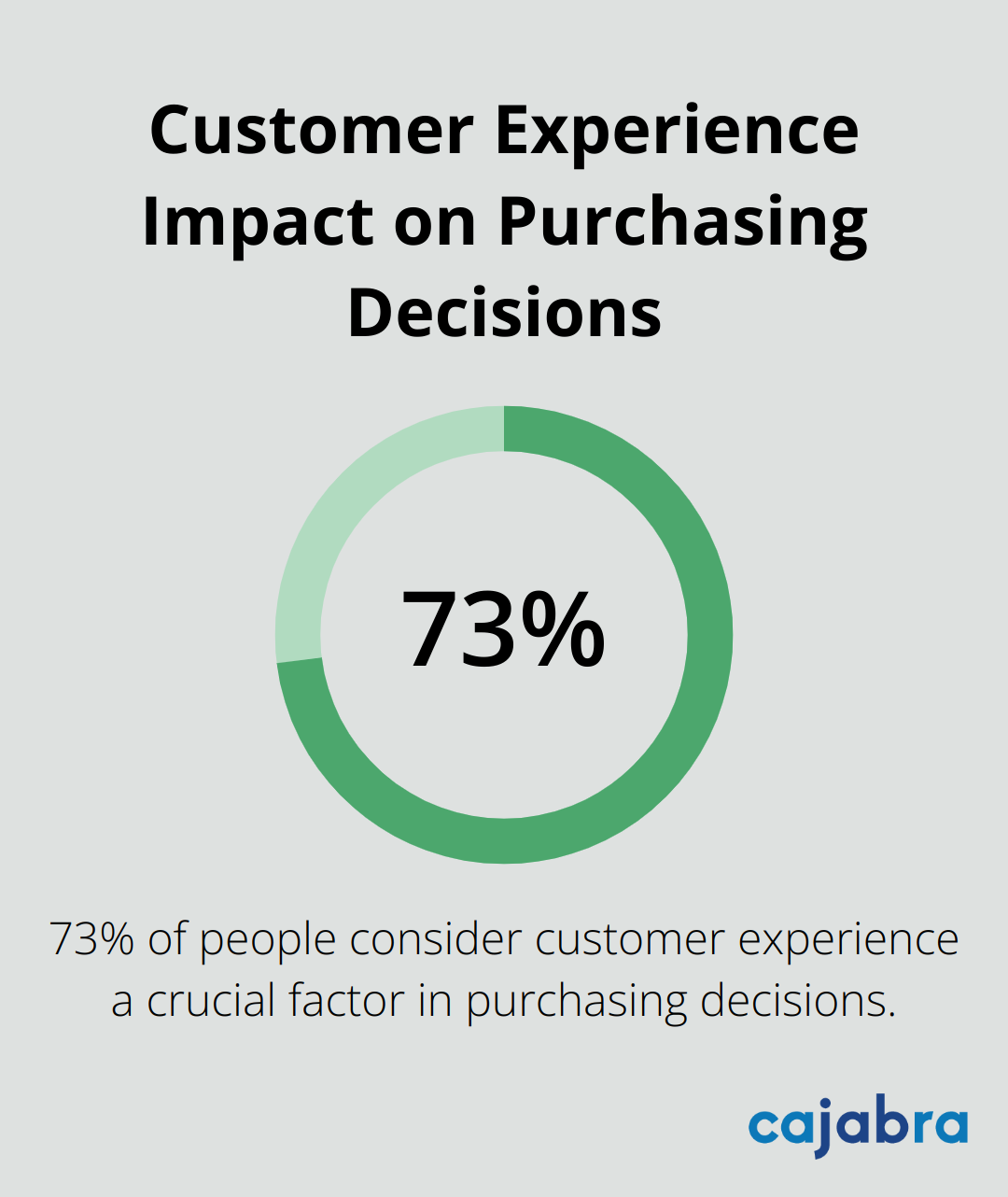
This metric shows the percentage of clients who continue to use your services over time. A high retention rate indicates that clients find ongoing value in your relationship. PwC reports that 73% of people consider customer experience a crucial factor in their purchasing decisions.
Frequency of Interactions
Monitor how often you communicate with clients outside of regular service delivery. More frequent, meaningful interactions often signal higher engagement levels. However, quality trumps quantity-ensure each interaction adds value to the client relationship.
Implementing Engagement Strategies
As you focus on these metrics, you can gauge the effectiveness of your client engagement efforts and identify areas for improvement. Client engagement requires consistent effort and refinement.
The next section will explore effective activities that can significantly boost your client engagement. These strategies will help you transform your client relationships and position your firm as a trusted partner in your clients' financial success.
Proven Strategies to Elevate Client Engagement
Host Impactful Educational Events
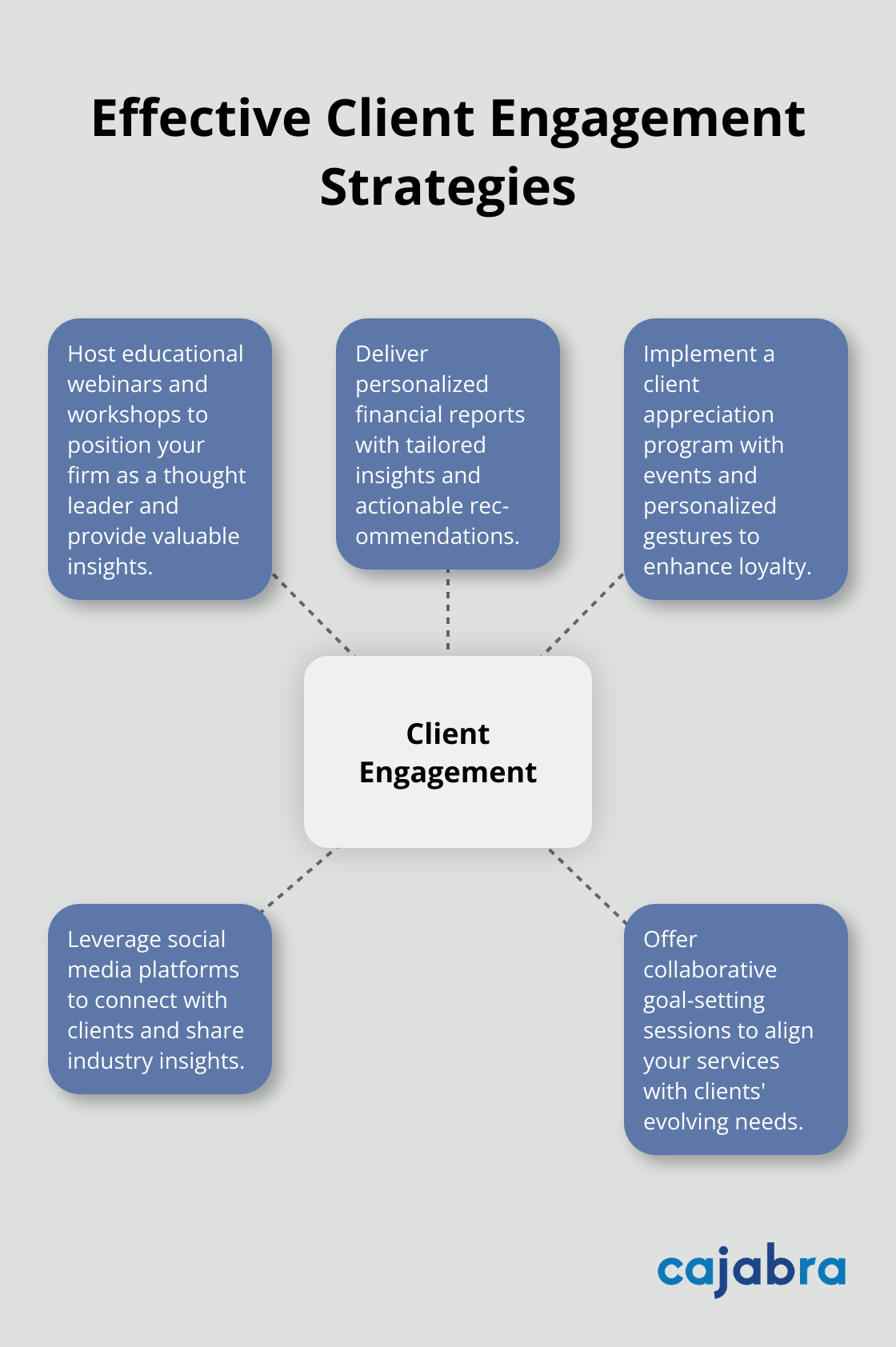
Organizing educational webinars and workshops positions your firm as a thought leader while providing valuable insights to clients. They offer a number of benefits, such as increased visibility and customer engagement, and the ability to stay up to date on relevant news. We recommend monthly webinars on topics like tax law changes, financial planning strategies, or industry-specific accounting challenges. These events educate clients, showcase your expertise, and create opportunities for deeper engagement.
Deliver Personalized Financial Insights
Generic reports no longer suffice in today's data-driven world. Clients expect tailored insights that directly impact their business. Implement a system to provide quarterly personalized financial reports that highlight key performance indicators, industry benchmarks, and actionable recommendations. By tracking client development KPIs, your firm can get a better understanding of how to maximize client intake and ensure excellent client service. Customized insights demonstrate a deep understanding of each client's unique financial situation and goals.
Implement a Client Appreciation Program
Showing gratitude to your clients can significantly enhance engagement and loyalty. A study by the Wharton School of Business found that customers who feel appreciated are 33% more likely to spend more. Consider an annual client appreciation event, such as a golf tournament or a wine tasting evening. These events provide an excellent opportunity for networking and strengthening relationships in a relaxed setting. Additionally, send personalized thank-you notes or small gifts on client milestones or anniversaries to make a lasting impression.
Leverage Social Media Engagement
Social media platforms offer unique opportunities to connect with clients on a more personal level. Share industry insights, company updates, and behind-the-scenes glimpses of your firm's culture. Respond promptly to comments and messages to foster a sense of community. According to Sprout Social, 64% of consumers want brands to connect with them on social media. This engagement can humanize your firm and build stronger relationships with clients. For accountants looking to get started, it's essential to develop a content strategy that resonates with your target audience.
Offer Collaborative Goal-Setting Sessions
Schedule annual or bi-annual goal-setting sessions with clients to align your services with their evolving needs. These sessions allow you to understand their long-term objectives, anticipate future challenges, and tailor your services accordingly. This proactive approach demonstrates your commitment to their success and positions your firm as a strategic partner rather than just a service provider.
The next section will explore how technology can further enhance these engagement efforts, providing seamless and efficient ways to connect with clients in the digital age.
How Technology Enhances Client Engagement in Accounting
Technology transforms client engagement for accounting firms. We at Cajabra have witnessed how the right tech tools revolutionize client relationships and streamline communication. Let's explore some game-changing technologies that will elevate your client engagement strategy.
Client Portals: Your 24/7 Collaboration Hub
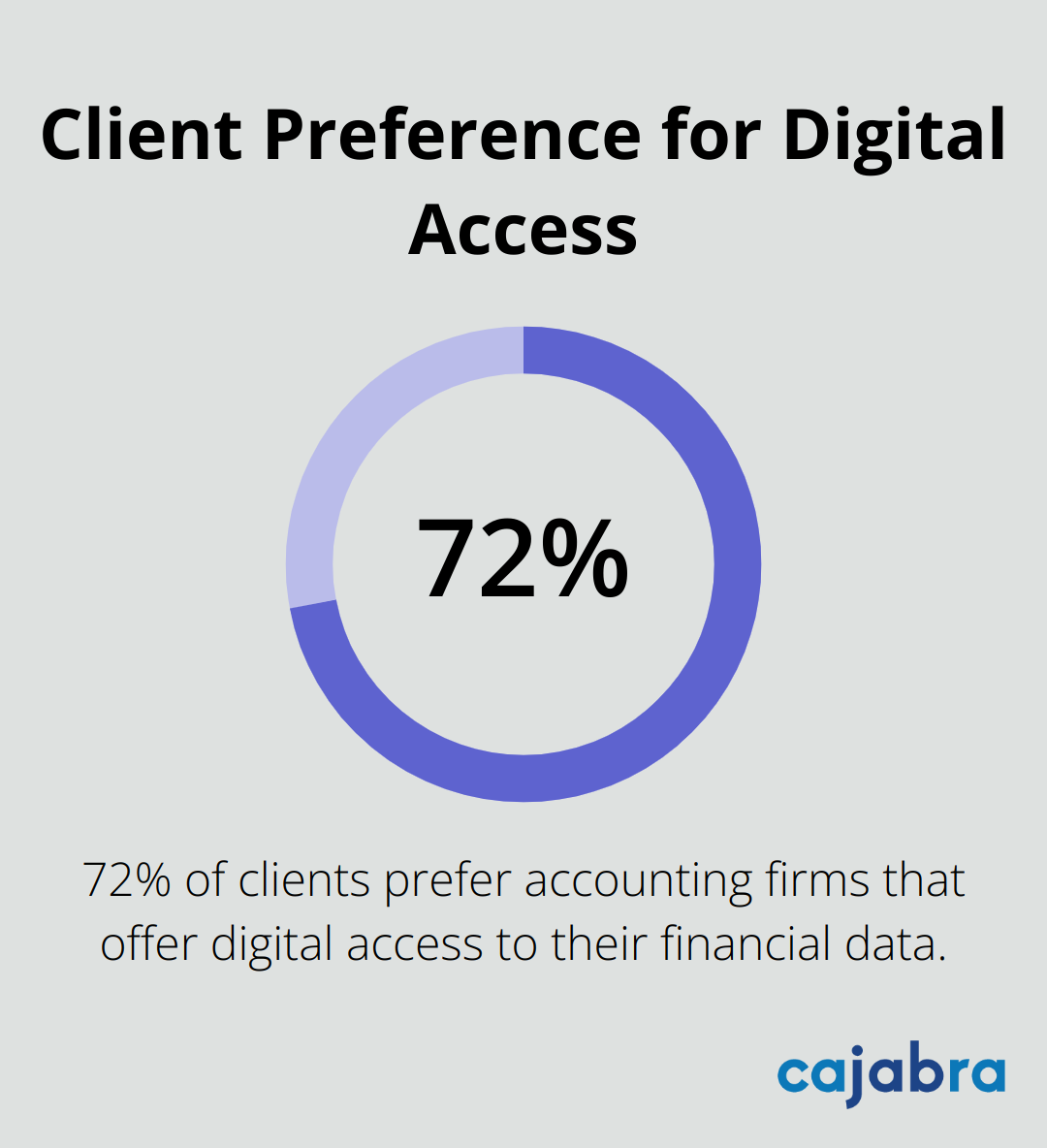
Client portals have become essential for modern accounting firms. These secure online platforms allow clients to access their financial information, documents, and reports at any time. A recent survey by Accounting Today reveals that 72% of clients prefer firms that offer digital access to their financial data.
When you implement a client portal, prioritize user-friendliness and security. Make sure the portal is intuitive and mobile-responsive. Update your security protocols regularly to protect sensitive financial data. Many firms report a 30% reduction in client inquiries after implementing a well-designed portal (freeing up time for more value-added services).
Smart Notifications: Keeping Clients in the Loop
Automated reminders and notifications are powerful tools for consistent client communication. These can include tax deadline reminders, upcoming meeting notifications, or alerts about important financial events.
A study by Constant Contact found that personalized, timely notifications can increase client engagement by up to 50%. When you set up your notification system, segment your client base to ensure relevance. For example, send quarterly tax reminders to small business owners and annual reminders to individual tax clients.
Interactive Dashboards: Financial Health at a Glance
Interactive financial dashboards provide clients with a real-time, visual representation of their financial status. These tools can significantly enhance client understanding and engagement with their financial data.
When you design your dashboards, focus on key metrics that matter most to your clients. Include features like drill-down capabilities and customizable views to cater to different client needs.
Virtual Meetings: Face-to-Face Interactions, Anywhere
The pandemic accelerated the adoption of virtual meeting platforms, and they're here to stay. These tools allow for face-to-face interactions regardless of geographical constraints. A survey by Zoom found that 67% of clients prefer video meetings over phone calls for complex financial discussions.
To maximize the effectiveness of virtual meetings, invest in high-quality audio and video equipment. Create a professional background and ensure a stable internet connection. Consider offering a mix of virtual and in-person meetings to cater to different client preferences.
AI-Powered Chatbots: Instant Support, 24/7
AI-powered chatbots provide instant support to clients, answering common questions and guiding them through basic processes. This technology can help improve accuracy and efficiency, reduce costs, and provide valuable insights and predictions for decision-making.
When implementing chatbots, start with a focused scope of common client queries. Continuously refine and expand the chatbot's knowledge base based on client interactions. Implementing a chatbot on your website can increase lead generation by up to 45%. It engages potential clients outside of business hours and provides immediate assistance.
Final Thoughts
Client engagement activities form the foundation of lasting relationships in the accounting industry. Accounting firms can enhance their client relationships through educational events, personalized insights, and collaborative goal-setting sessions. These strategies, combined with technology like client portals and AI-powered chatbots, create a comprehensive approach to client engagement.
Engaged clients remain loyal, recommend services, and stay open to additional offerings. This leads to increased revenue, reduced client churn, and a stronger industry reputation. Firms should assess their current engagement levels using metrics like Net Promoter Score and client retention rate, then prioritize strategies that align with their strengths and client needs.
At Cajabra, we understand the challenges accounting firms face in today's competitive landscape. Our specialized marketing services for accountants can help you implement these client engagement strategies effectively. With our JAB System™, we can help move your firm from overlooked to overbooked in just 90 days (securing retainer-based clients and enhancing your online presence).
Arrive and Cajabra: Announce Their Agreement to Deliver the First Operations + Growth Platform Designed for Modern Accounting Firms
Big news: Arrive and Cajabra are proud to announce their agreement to bring the accounting industry’s first Firm Operating and Growth Platform.
Arrive has solved the industry wide issue for accounting firms. Recently awarded the “Best Accounting Firm Platform of 2025” they have successfully done what no one in the accounting industry thought was possible..
Cajabra isn’t just a CRM — it’s the growth engine behind the firms redefining what’s possible in accounting. And now, it’s being embedded into the future of firm infrastructure.
Together, we’re about to eliminate one of the biggest pain points holding firms back from sustainable growth. The same platform that’s solving capacity and productivity bottlenecks will now help firms capture, nurture, and close more of the right clients — all without adding more chaos to their tech stack.
With this agreement, Arrive will be the first firm OS in the accounting profession to feature a fully integrated, full-featured marketing engine.
Arrive will leverage the Cajabra CRM as a core foundation of its roadmap and deploy their development resources to provide specific feature enhancement into their award winning software. This agreement will expedite their marketing and growth initiatives while effectively removing another fragmented piece of the accounting infrastructure.
This is the beginning of something big.
The Root of the Problem: You Have a Capacity Issue.

We talk to firms every week that are eager to grow — but overwhelmed.
“We have more business than we know what to do with, but it’s not necessarily the business we want. We want more higher paying advisory clients, but we don’t have the time to market let alone bring them on board.”
“We have so many leads we are not following up with, because we don’t have the bandwidth to put processes in place to follow up with them.”
“We know we need marketing... but who’s got the time?”
We get it. Because we’ve seen it firsthand.
Growth doesn’t stall because you lack leads, it stalls because you lack bandwidth.
That’s where Arrive changes the game.
Arrive Solves Capacity. Cajabra Fuels Growth.
Arrive is a next-generation accounting firm operating system that replaces over 50 disconnected tools, automates manual work, and gives your team back their time.
Accounting firms using Arrive are already:
- 10Xing their productivity
- Running at profit margins as high as 80%
- Creating new capacity to grow — without burning out their teams
And that’s exactly where marketing comes in.
As capacity opens up, Cajabra becomes the marketing engine that fuels strategic growth — helping firms:
- Differentiate their brand in a crowded market
- Capture and nurture high-value leads
- Convert interest into engagements — especially for higher-ticket advisory services
This is more than CRM. It’s firm growth, on purpose.
Coming Soon: Full Integration Inside the Arrive Platform
Our agreement with Arrive sets the stage for something the profession has never seen before: A unified platform that connects your operations, your people, and your growth.
Once fully integrated, firms will:
- Trigger marketing and nurture flows from within their operating system
- Automate follow-up, proposals, onboarding, and check-ins
- Track the entire client journey from lead to loyal fan — all from one login.
One system. One login. No chaos.
That’s not just efficiency — that’s how you scale profitably with confidence.

What This Means for the Profession
The firms that will win in the next era are the ones that get this right:
- They solve capacity before it breaks their people.
- They implement marketing systems before they desperately need leads.
- They connect operations and growth instead of managing them in silos.
With this agreement, firms will finally have both the room to grow and the engine to make it happen.
Want to Be One of the First to See It?
This is your invitation to see what the future looks like:
Visit us in Booth #34 at Scaling New Heights June 22-25 - or- 👇
We’re building something the profession has never had:
A fully connected operating and growth system — built by people who’ve lived your pain and are ready to change it.
The future isn’t about working harder. It’s about working smarter — and growing sustainably.
Arrive gives you the space. Cajabra fuels your growth.
Together, we’re helping firms finally scale — and thrive.
Are you still relying on those old-school lead magnets like checklists, ebooks, and whitepapers to generate leads? Or are you still offering that same dusty “Ultimate Tax Prep Checklist” you made back in 2018? Look, if your lead magnet strategy has cobwebs on it, it’s time for an upgrade. These days, traditional lead magnets aren’t just ineffective… I’m sorry to say: they’re practically vintage. But don’t panic! We’re not here to shame your PDFs. We’re here to help you evolve your strategy and embrace the future… a future powered by AI. (Cue dramatic music.)
If you’re looking to grow your accounting firm, you need more than a passive download and a sad little “subscribe for updates” button. You need something interactive, something snazzy, and most importantly, something that makes your prospects say, “Wow, that was actually helpful!”
Why Traditional Lead Magnets Just Don’t Cut It Anymore
Remember when a simple checklist was enough to get your ideal client’s attention? Those days are long gone. The internet is flooded with basic, free resources that offer little more than a few bullet points. Your clients are smarter than that and are no longer just looking for general information. They want solutions. They want something that actually helps them solve their problems, right now.
Traditional lead magnets like ebooks and downloadable guides are great for getting a name on a list, but they don’t do much for building relationships or nurturing leads. They’re passive. Your prospects consume the information and move on. The problem with that? You're left with a bunch of names that aren’t all that qualified, and they’re not invested in your business. It’s like throwing a bunch of spaghetti at the wall and hoping something sticks.
Introducing AI-Powered Lead Magnets
Now, let's talk about AI-powered lead magnets. These aren’t your grandma’s downloadables. AI-powered tools are dynamic, interactive, and, best of all, they deliver personalized results that actually solve problems for your prospects in real-time. Imagine creating something like a “Tax Deduction Finder” or a “Financial Health Check” tool that customizes its recommendations based on the user’s inputs. This is exactly what AI-powered lead magnets can do.
And, unlike old-school lead magnets that provide static content, AI lead magnets engage users with tailored solutions that are immediately actionable. You input data, and BAM! Immediate value. This creates a personalized experience that keeps your leads engaged and more likely to convert. Plus, it makes them feel like you truly understand their unique challenges.

What Makes AI Lead Magnets Different?
AI lead magnets are interactive. They engage users right off the bat with quizzes, calculators, or diagnostic tools that ask for input, analyze responses, and provide real-time solutions. This isn’t just information being handed out; this is problem-solving in action. These tools also allow you to collect much more data from your leads, giving you deeper insights into their pain points and allowing you to segment them for more personalized follow-up.
For example, imagine an AI-powered tax tool that lets users input their income, expenses, and deductions. Instantly, they get personalized recommendations on maximizing their tax savings. This tool not only adds value immediately but also collects data on the user’s financial situation. Data that can be used to nurture that lead into a paying client down the line.
AI Lead Magnets and the Power of Personalization
Personalization is where AI really shines. Traditional lead magnets are often one-size-fits-all, but AI-powered tools can tailor their output based on the individual’s input. This creates a much richer, more engaging experience for your leads, making them feel seen and heard. And when someone feels understood, they’re far more likely to trust you - and trust is everything in the accounting world.
The cool part? You don’t have to lift a finger. Once set up, AI tools run on autopilot, collecting leads, engaging with them, and delivering personalized results. All without you having to manually send out resources or follow up.
The Power of Automation: Nurturing Leads the Smart Way
So, you’ve captured a lead with a shiny new AI-powered tool. Now what? Well, the magic happens when you nurture those leads. Capturing leads is only half the battle. You need to be consistent and intentional about staying in front of them, or they’ll forget about you faster than you can say “tax season.”
This is where you leverage automation. Once you capture a lead, it’s time to set up an automated nurture sequence that delivers high-value content to keep them engaged. Automated emails, newsletters, and follow-ups can help you build a relationship with your leads and gradually move them down the funnel. Set it up, let it run, and you’ll be amazed at how it can build trust and convert leads without you needing to lift a finger.
The Importance of Having Lead Magnets on Your Website
Now, let’s talk about where these lead magnets should go. If you’re not using a lead magnet on your homepage, it’s like having a store with no window display. It’s just not going to grab attention. You need to make it easy for visitors to convert into leads, and your website is the perfect place to do that.
The key is to have at least one interactive AI-powered lead magnet prominently placed on your homepage. Whether it’s a “Tax Savings Calculator” or a “Financial Health Assessment,” make sure that it’s visible and accessible to your visitors. If you don’t, you’re missing out on valuable opportunities to capture those leads while they’re already engaged with your site.

The Time to Upgrade Your Lead Magnets was Yesterday
The lead magnets of yesterday are officially aged out of the marketing game like floppy disks and fax machines. It’s time to take a leap into the future with AI-powered tools that provide real-time value, engage your audience, and automate your lead-nurturing process. Not only will this help you capture more qualified leads, but it’ll also enable you to build stronger, more meaningful relationships with them, making your job easier in the long run.
Ready to make the switch? It’s time to ditch the static downloads and embrace the future of lead generation. After all, in the fast-paced world of accounting, staying ahead of the competition means constantly evolving. And trust me, this is one evolution you won’t want to miss.
Content marketing for startups is a game-changer in today's competitive business landscape. At Cajabra, LLC, we've seen firsthand how powerful this strategy can be for emerging companies.
Startups often struggle with limited resources and brand recognition, but content marketing offers a cost-effective solution to these challenges. In this post, we'll show you how to leverage content to build your brand, engage your audience, and drive growth for your startup.
Why Content Marketing Matters for Startups
Content marketing stands as a powerhouse strategy for startups aiming to make their mark in a crowded marketplace. This approach helps startups build a strong foundation for long-term success by creating valuable, relevant content that resonates with their target audience.
Establishing Authority in Your Niche
Content marketing empowers startups to establish authority in a specific niche. Consistent production of high-quality, informative content positions startups as thought leaders in their industry. This not only builds credibility but also fosters trust with potential customers.
Investing in long-form content is proven to enhance credibility and audience engagement. This approach enhances trust and credibility with potential customers.
Driving Organic Traffic and Lead Generation
Content marketing serves as a powerful tool for driving organic traffic to a startup's website. SEO-optimized content that addresses the pain points and questions of the target audience improves search engine rankings and attracts more potential customers.
HubSpot reports that businesses that blog regularly receive 55% more website visitors than those that don't. This increased traffic translates directly into more opportunities for lead generation and customer acquisition.
Cost-Effective Marketing with Long-Term Benefits
For startups operating on tight budgets, content marketing offers a cost-effective alternative to traditional advertising methods. While it requires an investment of time and effort, the long-term benefits far outweigh the initial costs.
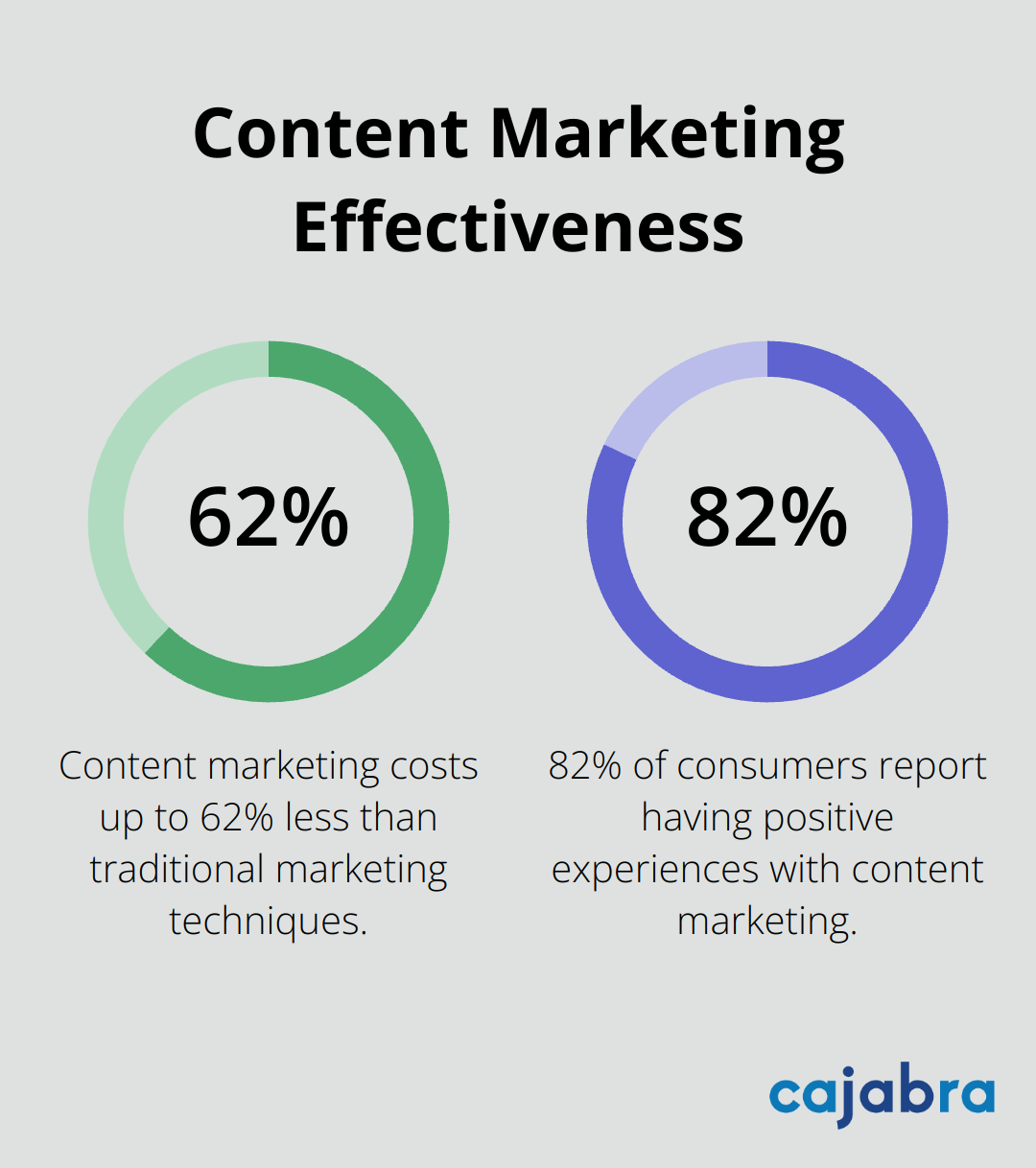
Content marketing costs up to 62% less than traditional marketing techniques while resulting in thrice as many leads. 82% of consumers report having positive experiences with content marketing. This makes it an ideal strategy for startups looking to maximize their marketing ROI (Return on Investment).
Content marketing also creates evergreen assets that continue to provide value long after their publication. A well-written blog post or informative video can continue to attract and engage potential customers for months or even years after its initial release.
Tailoring Content to Your Audience
Effective content marketing requires a deep understanding of your target audience. Startups must create content that speaks directly to their customers' needs, interests, and pain points. This targeted approach (when done correctly) leads to higher engagement rates and better conversion rates.
As we move forward, we'll explore how startups can develop a successful content marketing strategy that aligns with their business goals and resonates with their target audience.
Crafting Your Content Marketing Roadmap
Identify Your Audience
The foundation of an effective content marketing strategy lies in understanding your target audience. Create detailed buyer personas that represent your ideal customers. Include demographics, pain points, goals, and preferred content types. This information will shape your content creation process, ensuring it resonates with your audience.
A study by the Content Marketing Institute revealed insights into B2B content marketing trends for 2025. This audience-centric approach leads to higher engagement and conversion rates.
Set Measurable Goals
Establish clear, measurable goals for your content marketing efforts. These could include increasing website traffic, generating leads, or improving conversion rates. Use the SMART framework (Specific, Measurable, Achievable, Relevant, Time-bound) to set these goals.
Try to increase organic traffic by 50% within six months or generate 100 qualified leads per month through content marketing within the next quarter. These concrete goals will help you track progress and adjust your strategy as needed.
Plan and Execute
Create a content calendar that outlines what you'll publish, when, and on which platforms. This calendar should align with your business objectives and audience preferences. Tools like Trello or Asana can help manage your content pipeline effectively.
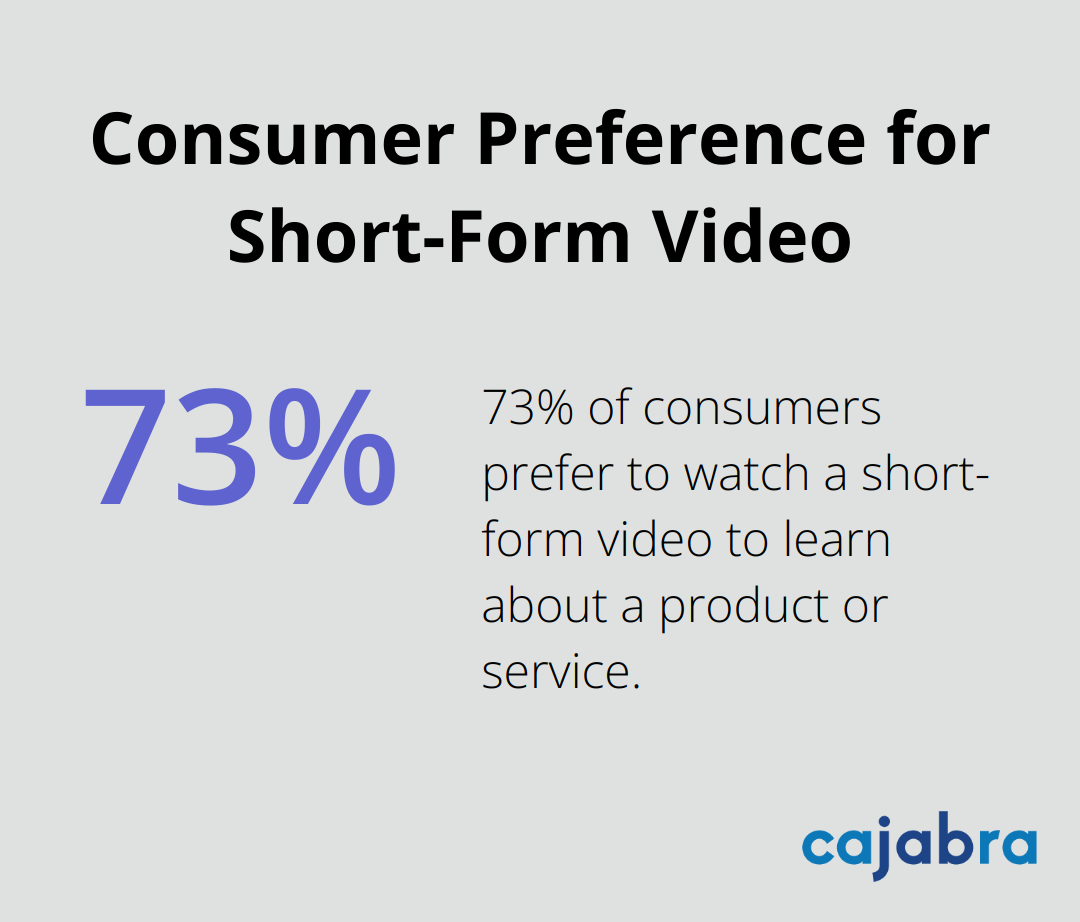
When choosing content formats, consider your audience's preferences and the nature of your message. Blog posts, videos, infographics, and podcasts each have their strengths. For instance, HubSpot reports that 73% of consumers prefer to watch a short-form video to learn about a product or service.
Optimize for Search Engines
Incorporate SEO best practices into your content creation process. This includes keyword research, optimizing meta descriptions, and creating high-quality backlinks. A study by Ahrefs found that the top-ranking pages on Google also rank in the top 10 for nearly 1,000 other relevant keywords.
Distribute Effectively
Don't underestimate the power of distribution. Share your content across relevant channels, including social media, email newsletters, and industry forums. According to the Content Marketing Institute, the most successful B2B marketers use an average of six social media platforms to distribute content.
A well-structured content marketing strategy (like the one outlined above) serves as the backbone of success for startups. This roadmap guides your efforts, ensuring every piece of content serves a purpose and contributes to your overall business goals. As you implement your strategy, you'll need to focus on creating high-quality content that resonates with your audience. Let's explore how to achieve this in the next section.
How to Create Content That Captivates Your Audience
Solve Real Problems
The most effective content addresses specific pain points your audience faces. Start by conducting thorough research to understand the challenges your target market encounters. Use surveys, social media listening, and customer feedback to gather insights. Then, create content that directly addresses these issues with practical solutions.
For example, if you target accounting firms, you might create a guide on how to streamline tax season processes. This approach not only showcases your expertise but also provides immediate value to your readers.
Tell Compelling Stories
Storytelling is a powerful tool for connecting with your audience on an emotional level. Share case studies of how your product or service has helped real customers overcome challenges. Use narrative techniques to make your content more engaging and memorable.
Stories are remembered up to 22 times more than facts alone. This statistic underscores the importance of weaving narratives into your content strategy.

Back It Up with Data
Incorporate relevant data and research findings to add credibility to your content. This approach not only strengthens your arguments but also positions your startup as a knowledgeable authority in your field.
The Content Marketing Institute reports that eighty-seven percent of B2B marketers say content marketing created brand awareness in the last 12 months. This strategy can significantly boost your content's perceived value and shareability.
Optimize for Search and Readability
While creating high-quality content is important, ensuring it reaches your audience is equally vital. Implement SEO best practices to improve your content's visibility in search results. Use tools like Google's Keyword Planner to identify relevant keywords and incorporate them naturally into your content.
Additionally, focus on making your content easily digestible. Use short paragraphs, subheadings, and bullet points to break up text and improve readability. A study by Nielsen Norman Group found that users typically read only 20-28% of words on a web page (highlighting the importance of scannable content).
Repurpose and Reuse
Maximize the impact of your content by repurposing it across different formats and platforms. For instance, transform a comprehensive blog post into an infographic, a series of social media posts, or a podcast episode. This approach not only saves time and resources but also caters to different content consumption preferences among your audience.
HubSpot reports that 82% of marketers repurpose content across multiple platforms. This strategy ensures your message reaches a wider audience and reinforces key points through repetition.
Final Thoughts
Content marketing for startups transforms businesses through valuable, relevant content. This strategy builds brand awareness, establishes authority, and drives organic traffic to websites. It costs less than traditional marketing methods and generates higher-quality leads while fostering long-term customer relationships.
Content marketing requires consistency and patience to see results. Startups should stick to their content calendar, analyze performance metrics, and adjust strategies as needed. Over time, these efforts will pay off in increased visibility, engagement, and conversions.
We at Cajabra, LLC specialize in marketing services for accounting firms and have helped many businesses grow. Startups can position themselves as industry leaders and attract ideal clients by implementing a robust content marketing strategy. Content marketing can become a startup's most valuable asset, driving growth and success for years to come.
Content marketing is the backbone of modern digital strategies. At Cajabra, LLC, we've seen firsthand how the best of content marketing can transform businesses.
A well-crafted content marketing strategy drives traffic, engages audiences, and boosts conversions. This guide will show you how to create a powerful strategy that delivers results.
What Are Your Content Marketing Goals?
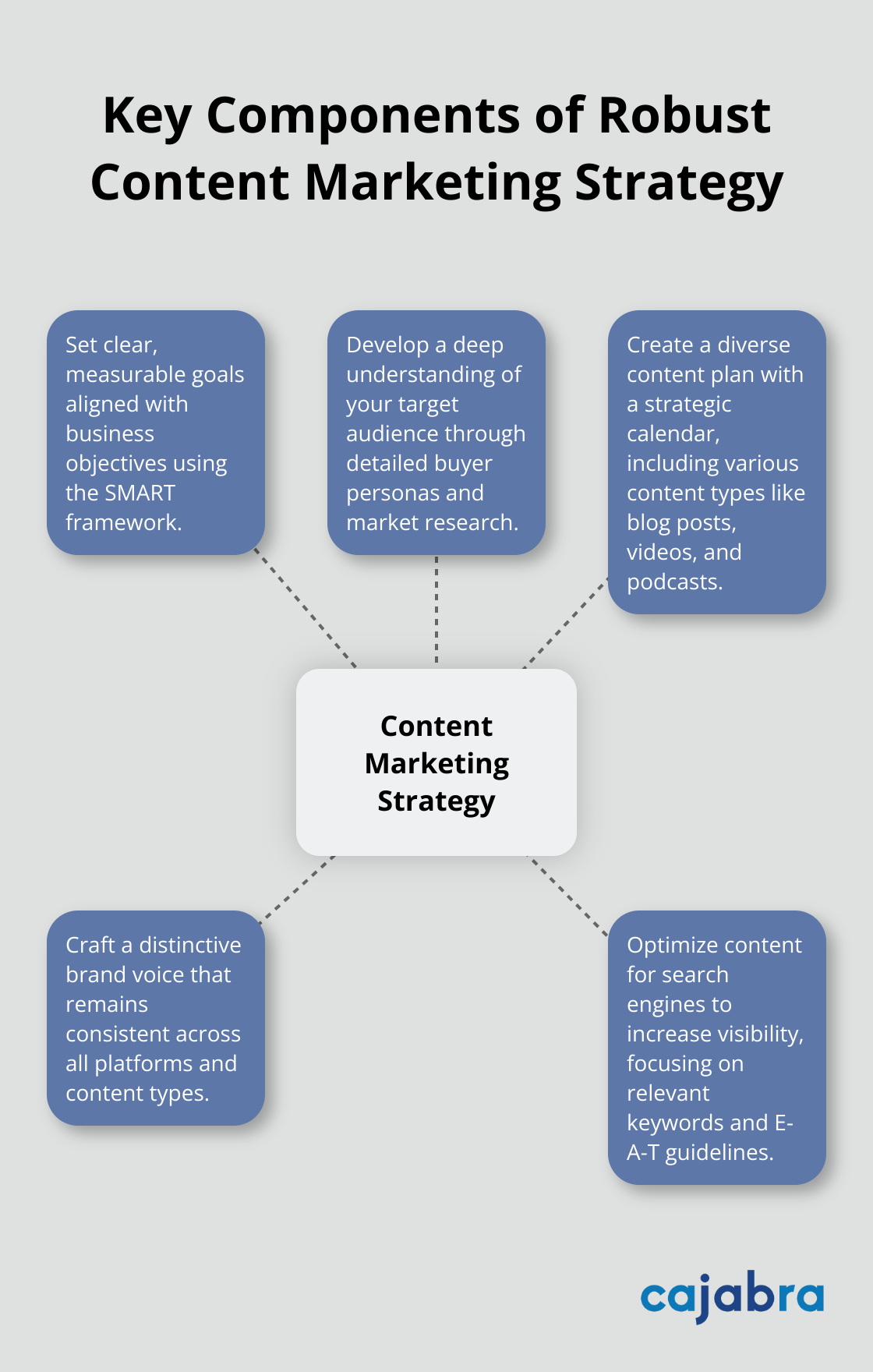
Align Content with Business Objectives
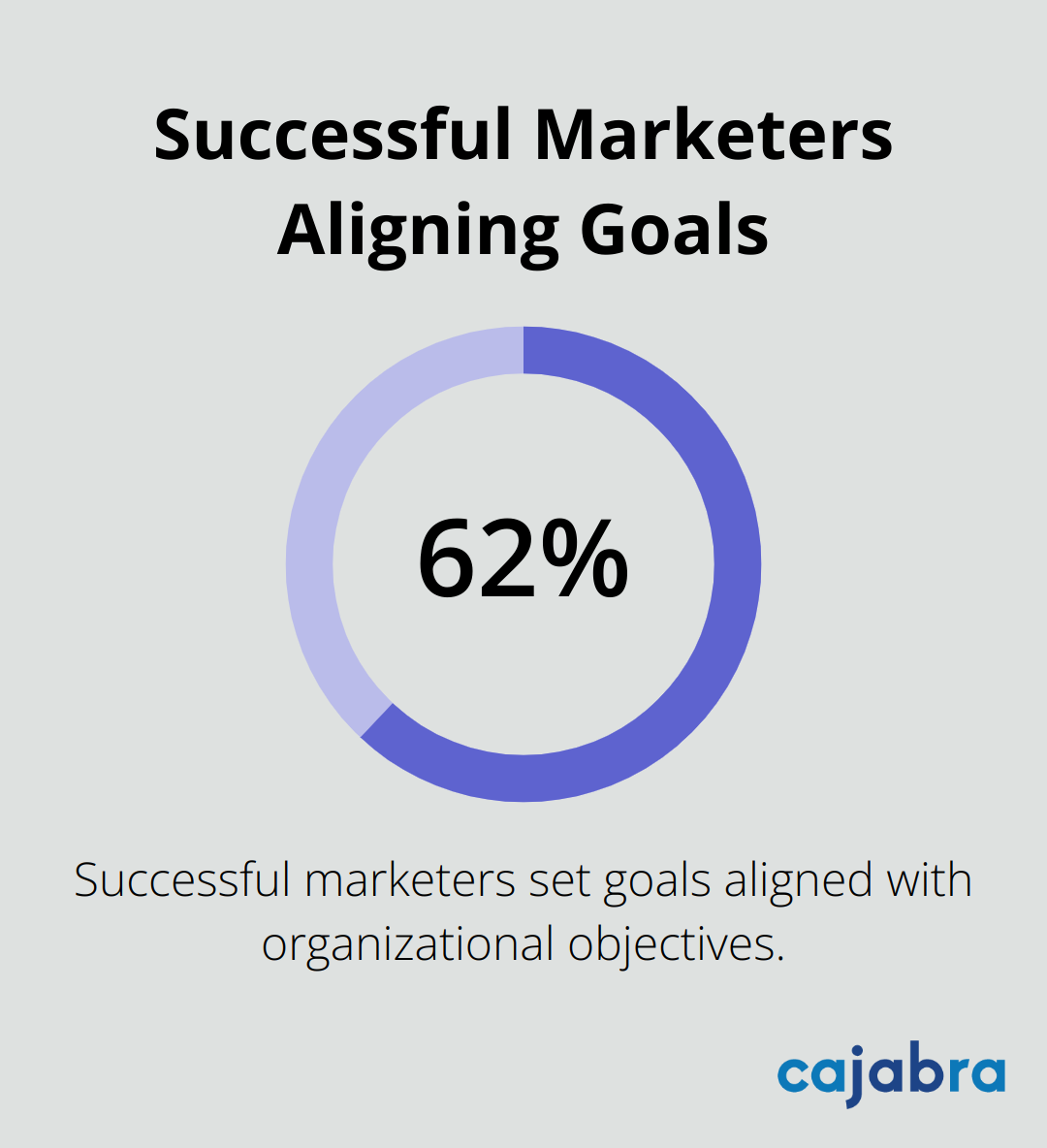
Effective content marketing starts with clear goals that support your overall business objectives. If your company aims to increase market share, your content strategy should focus on brand awareness and lead generation. The Content Marketing Institute reports that 62% of successful marketers set goals that align with their organization's objectives.
Set SMART Goals for Content
Use the SMART framework to define your content marketing goals:
Specific: "Increase website traffic by 50%" trumps "Get more visitors."Measurable: Utilize tools like Google Analytics to track progress.Achievable: Set ambitious yet realistic targets based on your resources.Relevant: Ensure goals contribute to your business's bottom line.Time-bound: Establish deadlines (e.g., "within the next quarter").
Research indicates that successful goal achievement has a positive impact on future effort.
Choose the Right KPIs
Selecting appropriate Key Performance Indicators (KPIs) is vital to track your content marketing success. Essential KPIs include:
- Traffic: Unique visitors, page views, and time on site.
- Engagement: Social shares, comments, and bounce rates.
- Conversions: Lead generation, email sign-ups, and sales.
- SEO performance: Keyword rankings and backlinks.
Regular monitoring allows for timely strategy adjustments.
Evolve Your Goals
Your goals should evolve as your business grows. Revisit and refine them quarterly to maintain relevance and challenge. Clear, measurable goals and the right KPIs will create a content marketing strategy that drives real business results.
As you define your content marketing goals, the next step is to understand your target audience deeply. This knowledge will shape your content creation and distribution strategies, ensuring your efforts resonate with the right people.
Who Is Your Target Audience?
Craft Detailed Buyer Personas
Your content marketing success hinges on a deep understanding of your target audience. Start by creating comprehensive buyer personas. These semi-fictional representations of your ideal customers stem from market research and real data about your existing clients. Include demographics, behavior patterns, motivations, and goals. For instance, a buyer persona for an accounting firm might be "Small Business Owner Sarah," aged 35-45, who struggles with cash flow management and seeks proactive financial advice.
To build these personas, collect data from your CRM, conduct client interviews, and analyze social media insights. The more detailed your personas, the better you can tailor your content to address their specific pain points and aspirations.
Leverage Market Research
Don't rely on assumptions. Conduct thorough market research to validate your personas and uncover new insights. Use a mix of quantitative and qualitative methods:
- Surveys: Send out questionnaires to your email list or use tools like SurveyMonkey to gather data at scale.
- Interviews: Have in-depth conversations with your best clients to understand their decision-making process.
- Social listening: Monitor social media channels to track what your audience says about your industry and competitors.
A study reveals that 44.4% of marketers leveraging interactive content report a mildly or very successful strategy compared to 39.9% of those who don't invest in it. This statistic underscores the importance of research-backed audience understanding.
Analyze Customer Data
Your existing customer data is a goldmine of insights. Examine your analytics to understand:
- Which content topics drive the most engagement?
- What channels does your audience prefer?
- When are they most active online?
Tools like Google Analytics can reveal user behavior on your website, while email marketing platforms offer insights into open rates and click-through rates. Use this data to refine your content strategy and distribution tactics.
Update Regularly
Audience understanding is an ongoing process. Make it a habit to update your personas and research regularly (at least quarterly) to stay aligned with evolving customer needs and market trends. This practice ensures your content remains relevant and impactful.
As you gain a deeper understanding of your target audience, you'll be well-equipped to develop a content plan that resonates with them. Let's explore how to create a strategic content plan in the next section.
How to Create an Effective Content Plan
Diversify Your Content Types
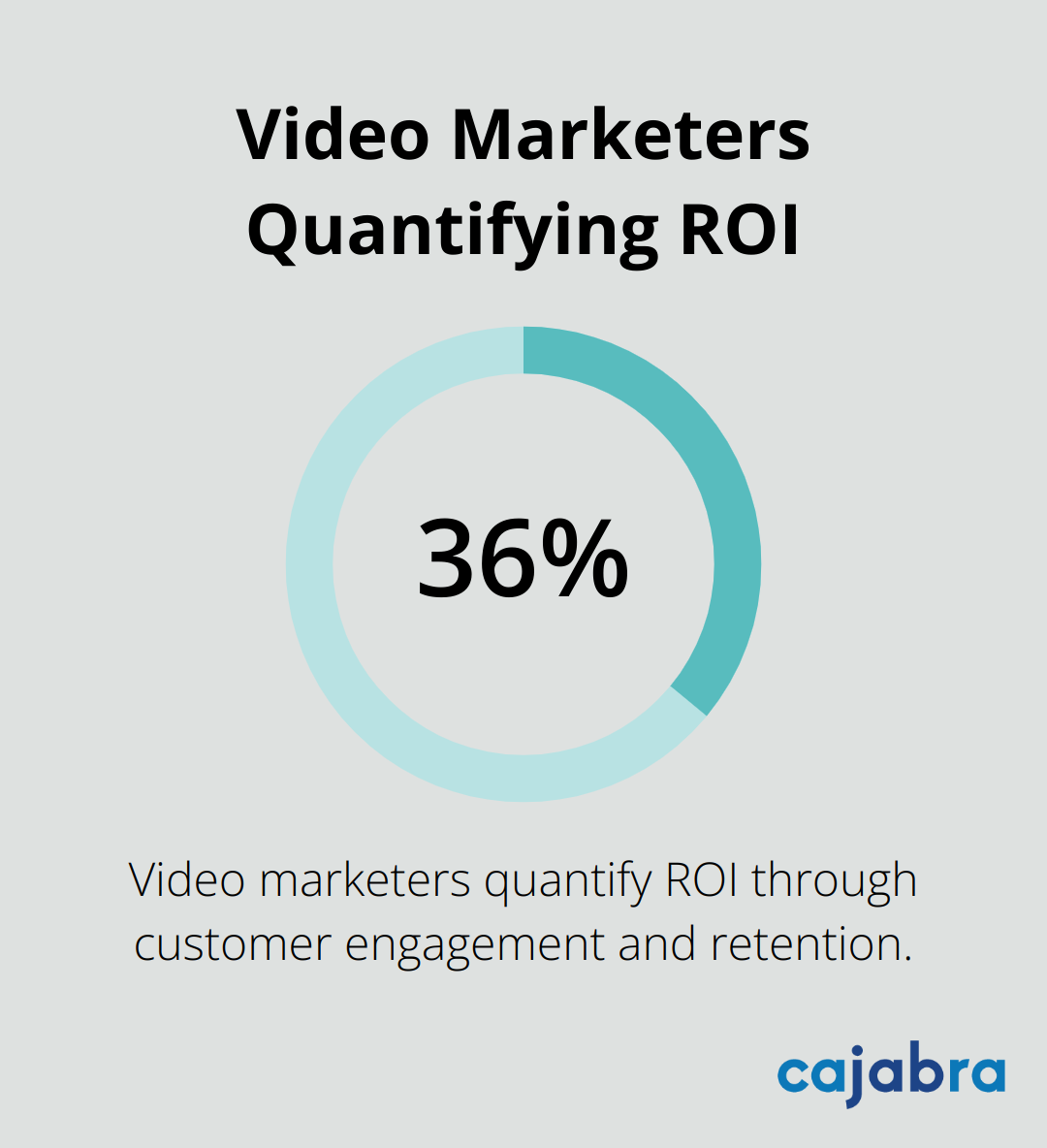
Select a mix of content types that resonate with your audience. Blog posts remain a staple, but their usage among content marketers has changed. Videos are increasingly popular, with 36% of video marketers quantifying ROI through customer engagement and retention. Podcasts are another growing medium, with 41% of Americans listening to podcasts monthly.
For accounting firms, we recommend a blend of educational blog posts, explainer videos for complex topics, and podcasts featuring industry insights. This variety caters to different learning styles and consumption preferences.
Build a Strategic Content Calendar
A content calendar serves as your roadmap to consistent publishing. Use tools like Trello or Asana to plan your content in advance. Try to include a mix of timely and evergreen content. For instance, plan tax-related content leading up to tax season, but also include perennial topics like financial planning tips.
HubSpot's research shows that companies that publish 16+ blog posts per month get 3.5 times more traffic than those publishing 0-4 monthly posts. While this frequency might not be feasible for everyone, it underscores the importance of regular, planned content.
Craft a Distinctive Brand Voice
Your brand voice is the personality behind your content. It should remain consistent across all platforms and content types. For accounting firms, we often recommend a voice that's professional yet approachable, authoritative but not condescending.
Develop a style guide that outlines your brand voice, including tone, vocabulary, and even grammar preferences. This guide ensures consistency, especially if you have multiple content creators.
Streamline Your Content Process
Implement a robust content creation and approval process. This typically involves:
- Ideation: Brainstorm topics based on audience needs and industry trends.
- Research: Gather data and expert insights to inform your content.
- Creation: Write, design, or record your content.
- Review: Have subject matter experts check for accuracy.
- Approval: Get final sign-off from relevant stakeholders.
- Publication: Post and promote your content.
Tools like Workflow can help manage this process efficiently. A streamlined process leads to more consistent, high-quality content.
Optimize for Search Engines
SEO is essential for content visibility. Incorporate relevant keywords naturally into your content. Use tools like SEMrush or Ahrefs to identify high-value keywords in your industry. For accounting firms, this might include terms like "tax planning strategies" or "small business accounting tips."
Focus on creating comprehensive, authoritative content. Google's E-A-T (Expertise, Authoritativeness, Trustworthiness) guidelines are particularly relevant for financial content. Showcase your expertise through in-depth articles and case studies.
Final Thoughts
Creating a robust content marketing strategy is essential for modern businesses. Clear goals, audience understanding, and a comprehensive content plan form the foundation for success. The best content marketing results from careful planning, execution, and ongoing refinement.
Your strategy must adapt to the rapidly evolving digital landscape. Regular evaluation of performance against KPIs will help you pivot when necessary. Experimentation with new content formats and distribution channels is crucial to stay ahead in the industry.
Cajabra's specialized services, including the JAB System™, help accountants secure retainer-based clients and establish industry leadership. Explore how Cajabra can support your content marketing journey and drive real results for your accounting firm (we've seen firsthand how effective strategies transform businesses). The path may challenge you, but increased visibility, engaged audiences, and business growth make it worthwhile.
At Cajabra, LLC, we know that measuring content marketing success is vital for any business strategy.
Content marketing KPIs provide the data you need to evaluate your efforts and make informed decisions.
This post will guide you through the essential metrics, help you set up a measurement framework, and show you how to analyze your results effectively.
Which KPIs Matter Most for Content Marketing?
Content marketing success depends on tracking the right Key Performance Indicators (KPIs). Four critical areas provide a comprehensive view of your content's performance.
Website Traffic: The Foundation of Content Success
Website traffic forms the foundation of content marketing. It's not just about quantity, but quality too. Google Analytics helps track:
- Unique visitors
- Page views
- Time on page
- Bounce rate
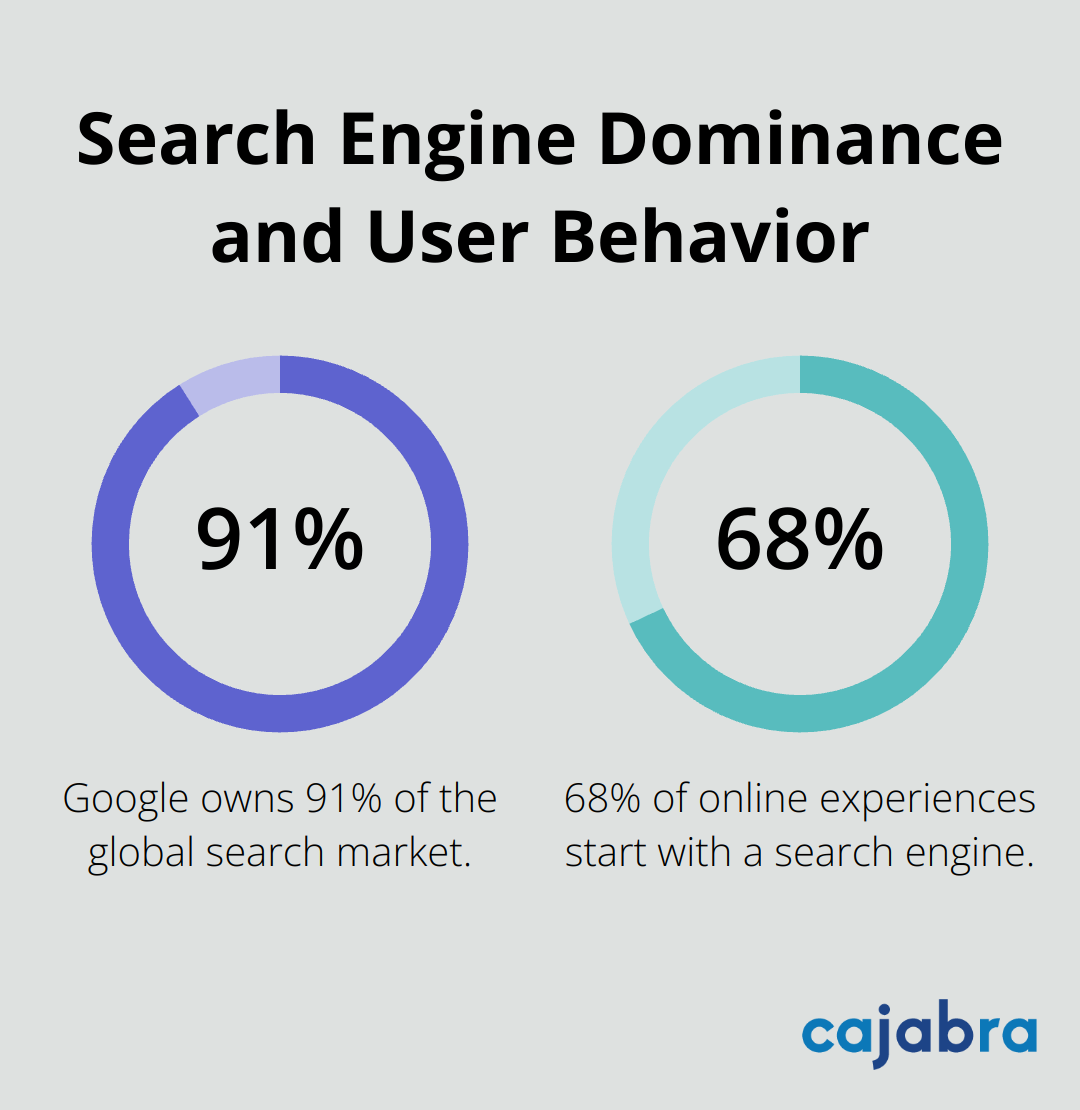
Nearly 91% of the global search market is owned by Google. 68% of online experiences start with a search engine, emphasizing the importance of organic traffic. Focus on increasing your organic search traffic month-over-month to indicate improved SEO and content relevance.
Engagement Metrics: Measuring Content Resonance
Engagement metrics reveal how your audience interacts with your content. Key metrics include:
- Comments
- Shares
- Average time on page
- Pages per session
Content Marketing Institute reports that 72% of marketers use engagement metrics to measure content performance. Try to achieve an average time on page of at least 3 minutes for long-form content, indicating that visitors find your material valuable.
Conversion Rates: Turning Readers into Customers
Content should drive business results. Track conversion rates for:
- Newsletter sign-ups
- Ebook downloads
- Free trial requests
- Product purchases
HubSpot reports that companies with 30+ landing pages generate 7 times more leads than those with fewer than 10. Create dedicated landing pages for each content offer to maximize conversions.
Social Media Metrics: Amplifying Your Content's Reach
Social media extends your content's reach and fosters community engagement. Monitor:
- Followers growth
- Engagement rate (likes, comments, shares)
- Click-through rate on shared content
- Social referral traffic to your website
Sprout Social's data shows that 89% of consumers will buy from a brand they follow on social media. Share valuable content consistently to build a loyal following and drive traffic back to your site.
These KPIs will give you a clear picture of your content marketing performance. It's not about tracking every possible metric, but identifying those that align with your specific business goals (and regularly analyzing them to guide your content strategy).
Now that we've covered the essential KPIs, let's explore how to set up a robust content marketing measurement framework to put these metrics into action.
How to Build Your Content Marketing Measurement Framework
Define Clear Goals
Start your framework by setting specific, measurable content marketing goals. Do you want to increase brand awareness, generate leads, or boost sales? For example, set a goal to increase organic traffic by 25% over the next quarter or generate 100 new leads per month through content downloads.
Choose Relevant KPIs
Select KPIs that align directly with your goals. If lead generation is your focus, prioritize metrics like conversion rates on landing pages and form submissions. For brand awareness, track metrics such as social media reach and mentions.
According to Content Marketing Institute, creating the right content for the audience has become less challenging for B2B marketers, with only 40% citing it as a challenge this year compared to 57% last year. Focus on KPIs that truly indicate progress towards your business objectives.
Establish Realistic Benchmarks
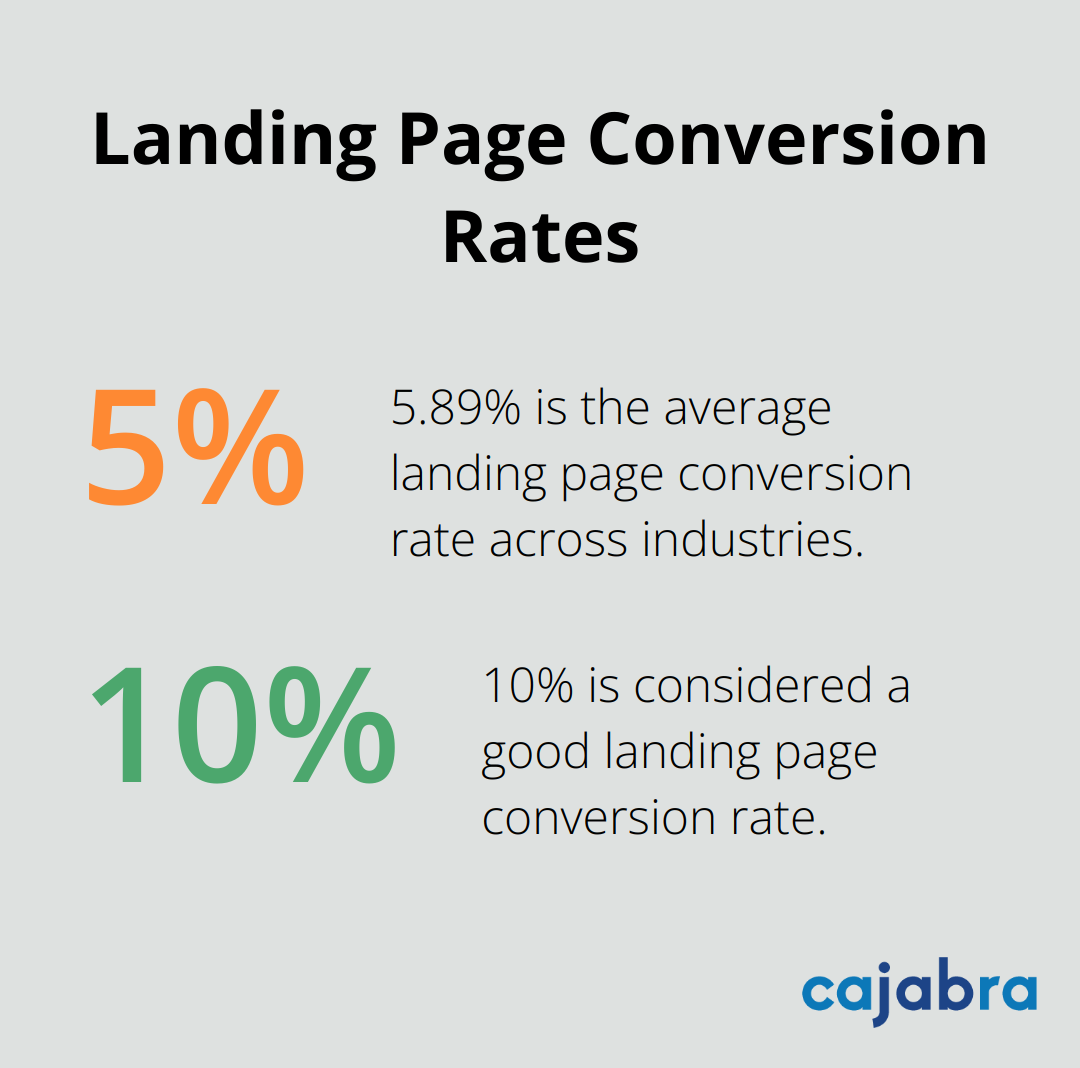
Set baseline performance metrics and realistic targets. For newcomers, industry averages provide a useful reference point. HubSpot reports that the average landing page conversion rate across all industries is 5.89%, with 10% considered a good conversion rate. Use this as a starting benchmark, then improve based on your specific circumstances.
Use Robust Tracking Tools
Invest in reliable analytics tools to track your chosen KPIs. Google Analytics is essential for website metrics, while SEMrush or Ahrefs provide valuable SEO insights. Social media platforms offer native analytics, but consider Sprout Social for more comprehensive social media tracking.
For email marketing, platforms like Mailchimp or Constant Contact offer detailed engagement metrics. If you focus on lead generation, a CRM system like HubSpot or Salesforce helps track leads through your sales funnel.
Design a Reporting Dashboard
Consolidate your key metrics into a single dashboard for easy monitoring. Tools like Google Data Studio or Databox allow you to create custom dashboards pulling data from multiple sources. This provides a holistic view of your content performance at a glance.
Conduct Regular Reviews
Set up a schedule for reviewing your content marketing metrics. Weekly check-ins help you stay on top of short-term trends, while monthly or quarterly reviews allow for more strategic analysis and planning.
During these reviews, look for patterns and correlations between different metrics. You might notice that blog posts on a particular topic consistently drive higher engagement and conversions (use these insights to refine your content strategy).
Your measurement framework should remain flexible. As your content marketing strategy evolves, prepare to adjust your KPIs and targets. What worked last year might not be as effective now, so stay agile and responsive to changes in your audience's behavior and preferences.
With a solid measurement framework in place, you'll demonstrate the ROI of your content and make data-driven decisions to improve your strategy. Now, let's explore how to analyze and interpret these content marketing KPIs effectively.
How to Extract Actionable Insights from Your Content KPIs
Identify Trends in Content Performance
Start your analysis by looking for patterns in your KPI data over time. If you notice that blog posts about tax planning consistently outperform other topics in engagement and conversions, this indicates a high-interest area for your audience. You should create more in-depth content on this topic, such as an eBook or webinar series.
Use Google Analytics to identify pages with the highest exit rates. A high exit rate might signal that the content doesn't meet user expectations or lacks a clear next step. Improve these pages by adding relevant internal links, clearer calls-to-action, or more comprehensive information.
Compare Channel Performance for Resource Allocation
Different marketing channels often yield varying results. Analyze your KPIs across channels to determine where to focus your efforts. If your LinkedIn posts drive more qualified traffic to your website than Facebook, allocate more resources to LinkedIn content creation and promotion.
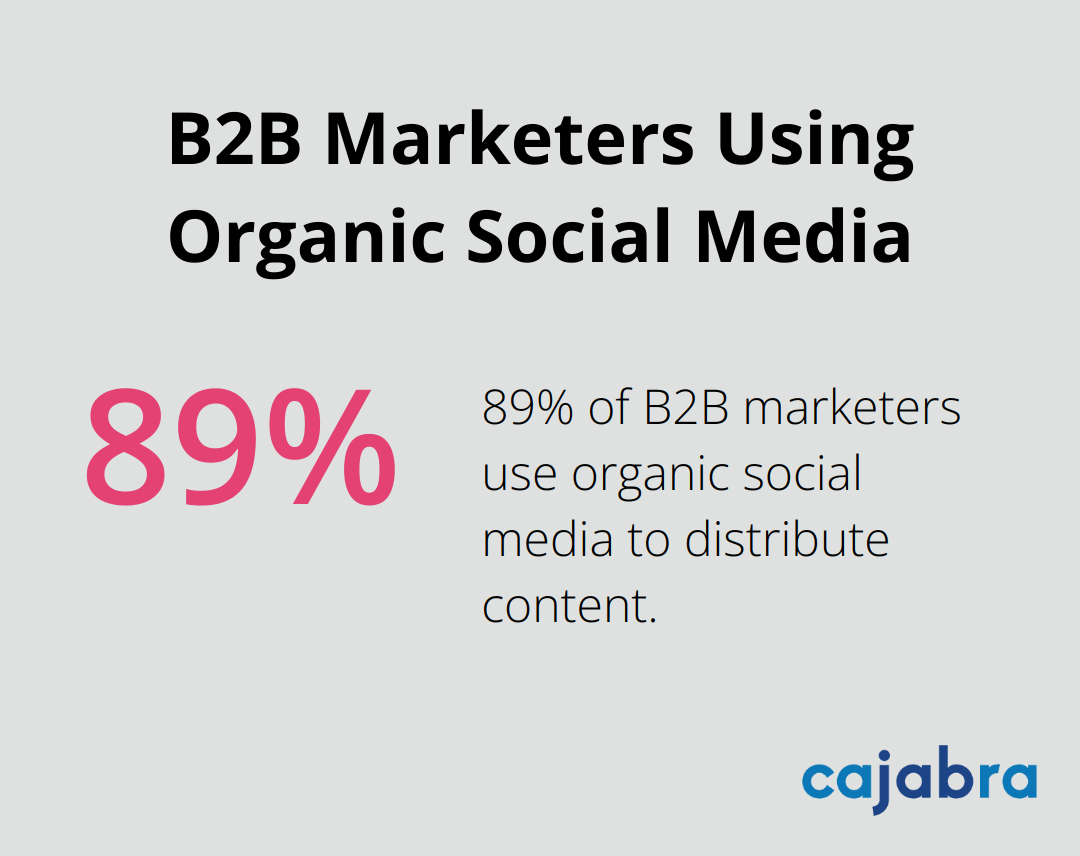
89% of B2B marketers use organic social media platforms to distribute content. If you don't see strong results on these platforms, reassess your strategy or seek expert guidance.
Adjust Strategy Based on Data Insights
Use your KPI analysis to inform strategic decisions. If your long-form content consistently generates more leads than short blog posts, shift your content mix to include more comprehensive guides or whitepapers.
Pay attention to engagement metrics like time on page and bounce rate. Poor performance in these metrics for certain content types might indicate a mismatch between your content and your audience's needs. Survey your audience or conduct interviews to better understand their pain points and information needs.
Create Action-Driving Reports
When presenting your KPI analysis to stakeholders, focus on insights that can drive action. Instead of simply reporting that organic traffic increased by 20%, explain which specific content pieces or SEO tactics contributed to this growth and how you plan to replicate this success.
Use data visualization tools to make your reports more digestible. A clear, visually appealing dashboard can help stakeholders quickly grasp key trends and make informed decisions. Tools like Google Data Studio or Tableau can help create impactful visual reports.
The goal of KPI analysis isn't just to measure performance, but to continuously improve your content marketing strategy. Regular reviews of your KPIs and acting on the insights they provide will enable you to create more effective, targeted content that resonates with your audience and drives business results.
Final Thoughts
Measuring content marketing success through KPIs empowers businesses to maximize their digital presence and drive results. We explored key metrics across website traffic, engagement, conversions, and social media that provide a comprehensive view of content performance. A robust measurement framework yields valuable insights to refine your strategy and achieve your marketing goals.
The true power of content marketing KPIs lies in using insights to improve your approach continuously. You should analyze your data, identify trends, and adapt your content strategy accordingly. This process allows you to create more targeted, effective content that resonates with your audience and drives business growth.
Cajabra offers specialized marketing services for accounting firms looking to elevate their content marketing game and attract more high-value clients. Our expertise can help you implement effective Content Marketing KPI tracking and analysis, ensuring your content marketing efforts deliver measurable results. Start implementing these strategies today, and watch your content marketing efforts reach new heights.
Content marketing is a powerful tool for businesses to attract and engage their target audience. At Cajabra, LLC, we've seen firsthand how a well-crafted strategy can drive results.
In this post, we'll walk you through the steps to create an effective content marketing strategy, complete with practical examples. Whether you're just starting out or looking to refine your approach, these insights will help you develop a plan that delivers real value to your audience and your business.
What Are Your Content Marketing Goals?
Content marketing success starts with clear, actionable goals. Many businesses struggle to define exactly what they want to achieve with their content efforts. Let's break down how to set meaningful objectives that drive real results.
Pinpoint Your Business Objectives
Start by examining your overall business goals. Do you want to increase brand awareness, generate more leads, or boost sales of a specific product? Content marketing goals should directly support these broader objectives. For example, if your main business goal is to increase market share in the accounting software sector, your content marketing might focus on educating potential customers about the benefits of your solution compared to competitors.
Craft SMART Goals
After identifying your business objectives, translate them into specific content marketing goals. We recommend using the SMART framework:
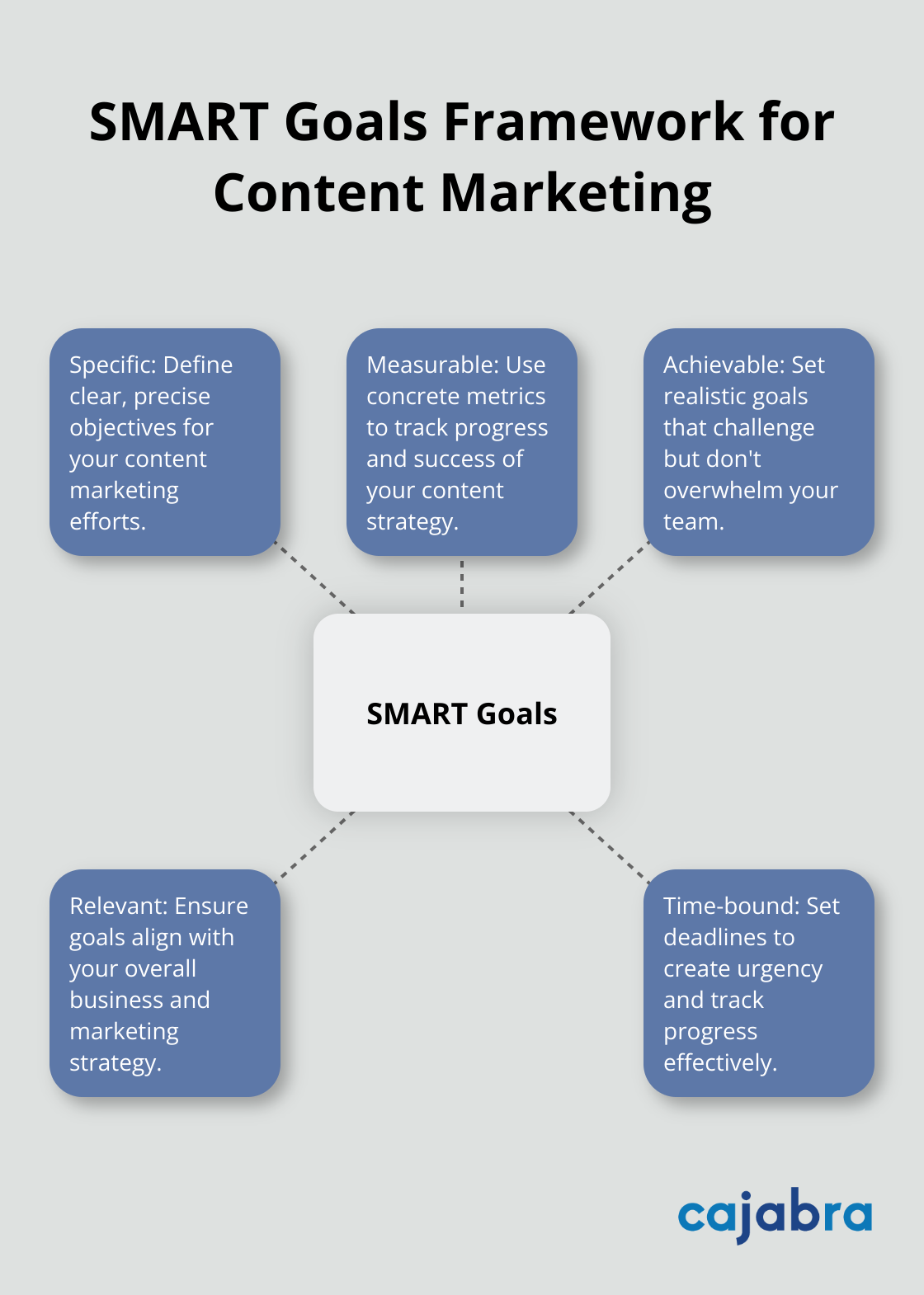
Specific: Try "increase organic traffic to our accounting software landing page by 25%" instead of "increase website traffic."
Measurable: Use concrete metrics. "Generate 50 new email subscribers per month from our content efforts."
Achievable: Be realistic. If you currently get 100 views per blog post, aiming for 10,000 overnight isn't feasible.
Relevant: Ensure your goals align with your overall strategy. If you focus on retaining existing clients, "go viral on TikTok" might not be the most relevant goal.
Time-bound: Set a deadline. "Increase our blog's conversion rate from 2% to 3% within the next quarter."
Align with Your Marketing Strategy
Your content marketing goals shouldn't exist in isolation. They need to work in harmony with your broader marketing efforts. If your overall marketing strategy focuses on positioning your firm as a thought leader in tax planning, your content goals might include "Publish two in-depth tax strategy guides per month" and "Secure three guest posting opportunities on respected industry websites each quarter."
Monitor and Adjust
Goal-setting is an ongoing process. Regularly review and adjust your objectives based on performance data and changing business needs. This approach allows you to create content with purpose and demonstrate the real value of your content marketing efforts.
With clear goals in place, you're ready to move on to the next critical step: understanding your target audience. Knowing who you're creating content for will shape every aspect of your strategy, from topic selection to distribution channels.
Who Is Your Target Audience?
Craft Detailed Buyer Personas
Understanding your target audience is essential for creating content that resonates and drives results. Start by creating comprehensive buyer personas. These are fictional representations of your ideal clients, based on real data and market research. For accounting firms, this might include small business owners, CFOs of mid-sized companies, or high-net-worth individuals seeking tax advice.
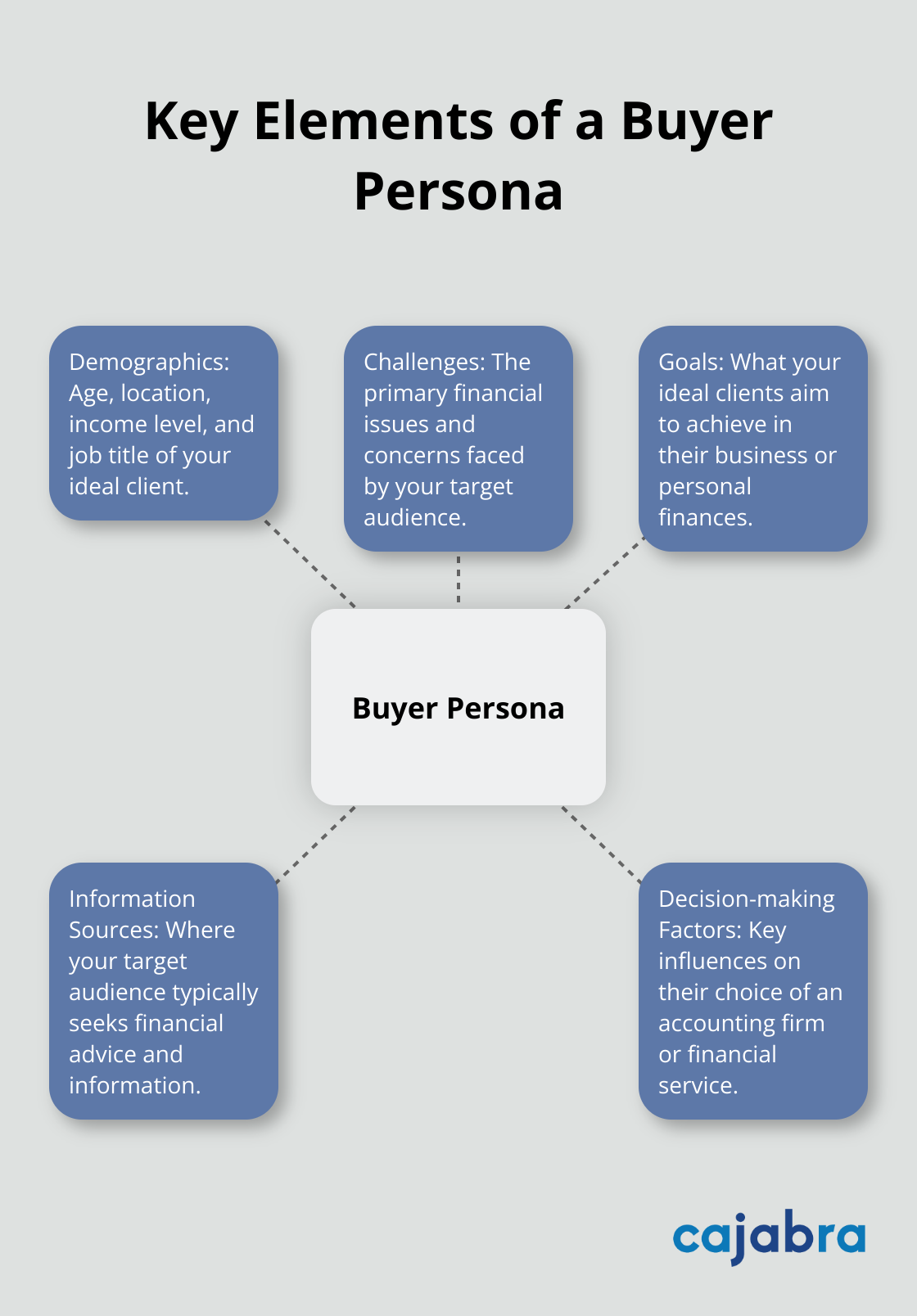
To build these personas, gather information on:
- Demographics: Age, location, income level, job title
- Challenges: What financial issues concern them most?
- Goals: What do they want to achieve in their business or personal finances?
- Information sources: Where do they seek financial advice?
- Decision-making factors: What influences their choice of an accounting firm?
For example, a persona for a small business owner might be "Sarah, 35, e-commerce entrepreneur, concerned about cash flow and tax compliance, seeks an accountant who understands online businesses."
Conduct Market Research
Market research provides valuable insights into your audience's needs and preferences. Use a mix of primary and secondary research methods:
- Surveys: Ask your existing clients about their pain points and what they value in an accounting service.
- Interviews: Have in-depth conversations with clients to uncover nuanced needs.
- Industry reports: Review financial sector trends and statistics.
- Competitor analysis: Examine what other accounting firms offer and how they communicate with clients.
Analyze Your Data
Your existing customer data is a goldmine of information. Analyze it to uncover patterns and preferences:
- Website analytics: Which blog posts or service pages attract the most traffic?
- Email metrics: What types of emails have the highest open and click-through rates?
- Social media engagement: Which posts generate the most interaction?
- Client feedback: What do your testimonials and reviews reveal about what clients value most?
For instance, if your LinkedIn posts about tax-saving strategies consistently outperform other content, it's a clear signal to create more in-depth content on this topic.
Apply Insights to Content Creation
Use the insights you've gathered to tailor your content strategy. Create content that addresses specific pain points, answers common questions, and provides value to your target audience. For example, if your research shows that many small business owners struggle with cash flow management, you could create a series of blog posts, infographics, or video tutorials on this topic.
Remember to regularly update your audience research (every 6-12 months) as market conditions and client needs can change. This ongoing process will help you stay relevant and continue to provide value to your audience.
With a deep understanding of your target audience, you're now ready to create a content plan that will effectively reach and engage them. Let's explore how to develop a strategic content plan in the next section.
How to Create a Winning Content Plan
Select the Right Content Types
Your content mix should reflect your audience's preferences and your marketing goals. For accounting firms, a combination of blog posts, videos, and infographics often works well. Blog posts allow for in-depth explanations of complex tax issues, while videos can simplify financial concepts for visual learners. Infographics are excellent for presenting financial data in an easily digestible format.
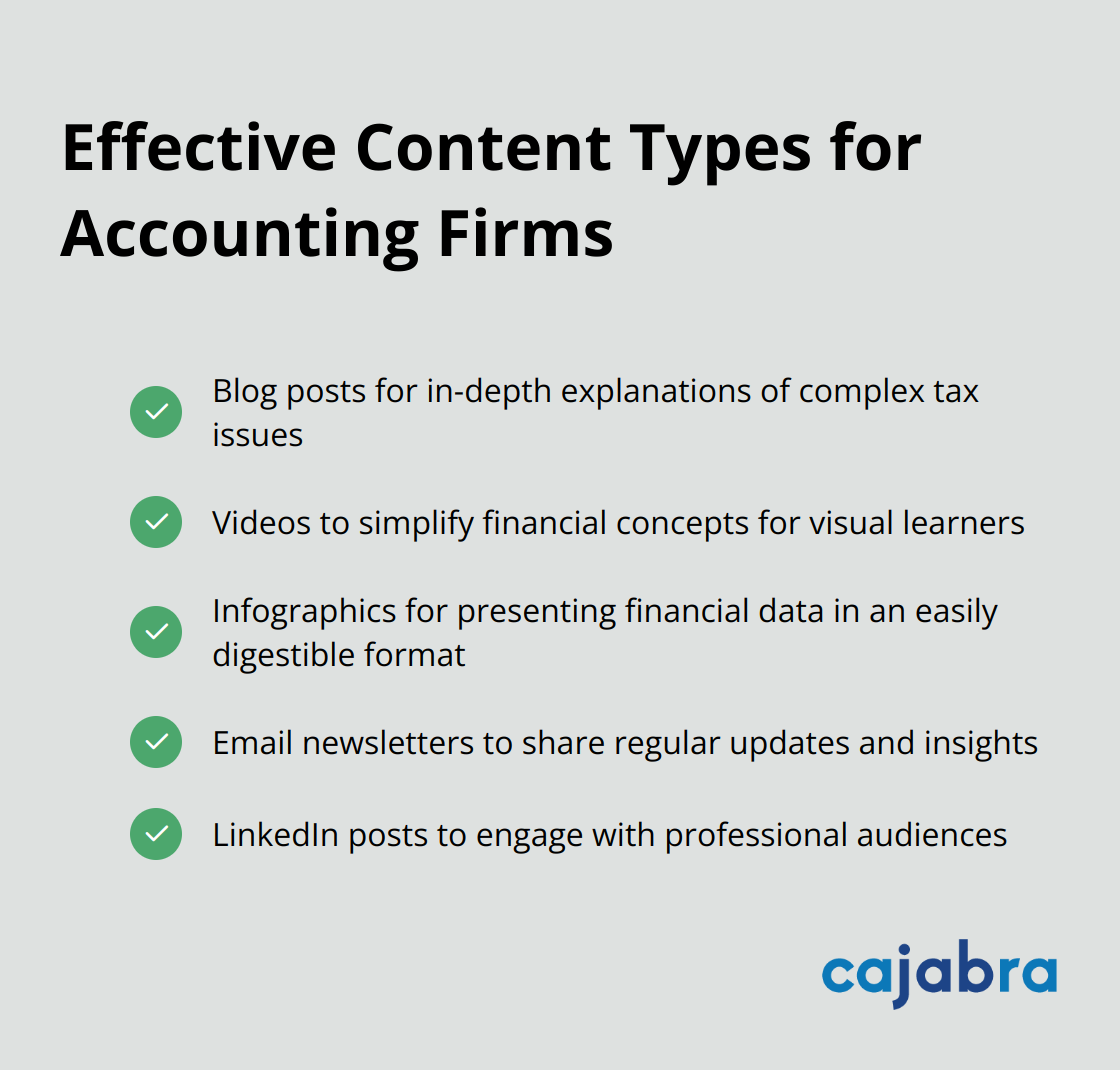
If your research shows that your target audience prefers visual content, you might focus on creating more video tutorials explaining tax preparation steps or infographics illustrating changes in tax laws.
Build Your Content Calendar
A content calendar helps maintain consistency and aligns your content with key dates in the financial year. Start by mapping out important events like tax deadlines, financial reporting periods, and industry conferences. Then, plan your content around these dates.
You might schedule a series of blog posts about tax preparation strategies in the months leading up to tax season. Or, you could plan a video series on financial planning to coincide with the start of a new fiscal year.
Streamline Content Creation and Distribution
Efficiency is key in content creation and distribution. Establish clear workflows for each content type. This might involve assigning specific team members to different tasks, setting up review processes, and determining publication schedules.
For distribution, identify the channels where your audience is most active. LinkedIn is often a prime platform for accounting firms, but don't overlook the power of email newsletters or industry-specific forums.
Incorporate SEO Best Practices
SEO is vital for ensuring your content reaches your target audience. Research your keywords, optimize your onsite SEO, build a website focused on your ideal clients, be wary of plagiarism, and list your contact details.
Optimize your content by including these keywords in titles, headers, and throughout the body of your content. But readability comes first. Don't sacrifice the quality of your content for the sake of keyword stuffing.
Plan for Content Updates and Repurposing
The financial landscape changes constantly, and your content should reflect that. Plan to regularly update your evergreen content with the latest information. An article about tax deductions should be reviewed and updated annually to reflect any changes in tax laws.
Repurposing content can also maximize your efforts. Content marketing for accountants involves creating and distributing valuable, relevant content to attract, engage, and retain a clearly defined audience. This content marketing approach can save time and resources while effectively capturing leads and driving conversions.
Final Thoughts
Creating an effective content marketing strategy requires careful planning, execution, and refinement. Your strategy should adapt to the dynamic financial industry. We recommend you evaluate performance metrics, gather audience feedback, and stay informed about industry trends regularly.
Experiment with different content marketing strategy examples to find what works best for your firm. Try various content types, distribution channels, and messaging approaches. Track your results and focus on what resonates most with your audience.
At Cajabra, we specialize in helping accounting firms attract and retain high-value clients. Our approach (including the JAB System™) positions firms as industry leaders. Explore how we can support your growth and elevate your content marketing efforts today.
Content marketing has become a game-changer for businesses of all sizes. At Cajabra, LLC, we've seen firsthand how powerful this strategy can be in driving growth and engagement.
The benefits of content marketing are numerous, from increased brand awareness to higher conversion rates. In this post, we'll show you how to harness these advantages and boost your business through effective content marketing techniques.
What is Content Marketing?
Content marketing is a strategic approach to create and distribute valuable, relevant, and consistent content to attract and retain a clearly defined audience. It focuses on providing genuine value to your target market, rather than just pushing sales messages.
The Power of Valuable Content
Content marketing builds trust and establishes your brand as an authority in your field. When you consistently deliver high-quality, informative content, you solve problems and answer questions for your audience. This approach leads to increased brand loyalty, higher conversion rates, and improved customer retention.
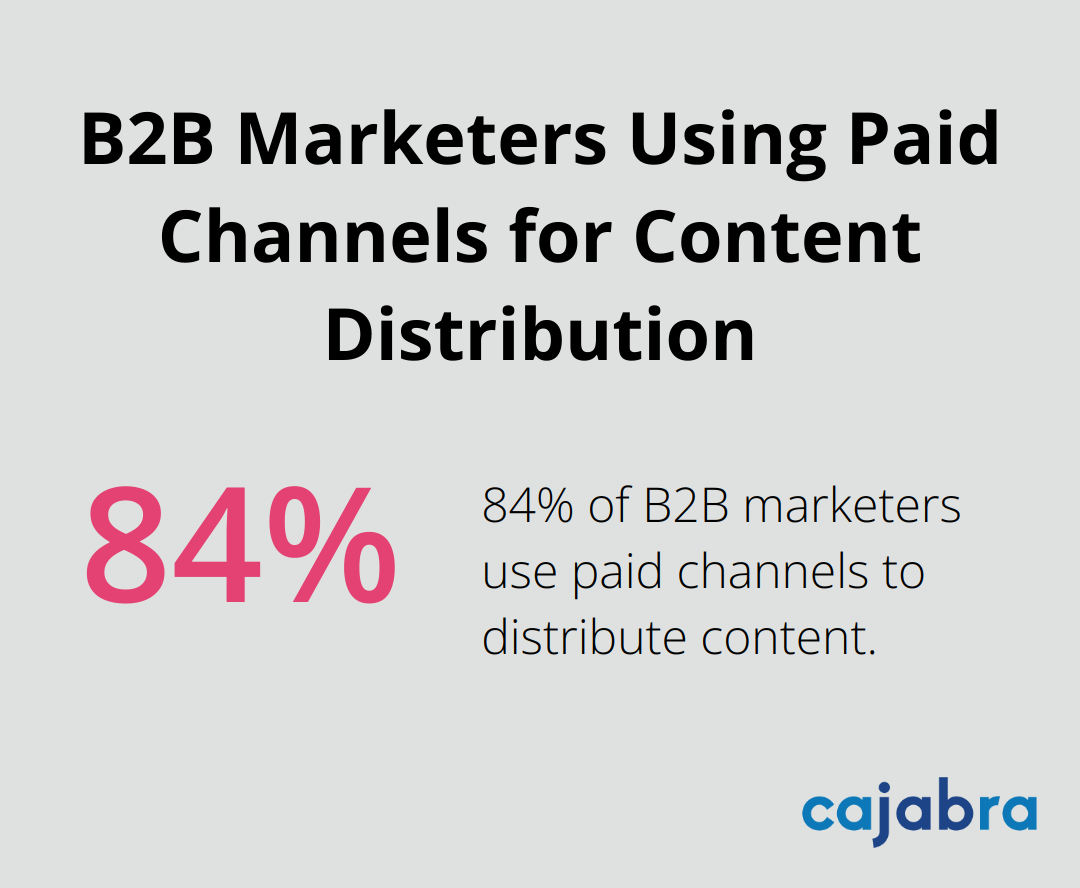
Eighty-four percent of B2B marketers use paid channels to distribute content. This statistic underscores the widespread adoption and effectiveness of this strategy across industries.
Key Components of Successful Content Marketing
Understanding Your Audience
Successful content marketing starts with knowing your audience. You must identify their pain points, interests, and preferences to create content that resonates.
Consistency is Key
Regular publication of high-quality content keeps your audience engaged and coming back for more. A HubSpot study found that companies that publish 16+ blog posts per month receive almost 3.5 times more traffic than those publishing 0-4 monthly posts.
Diversify Your Content
While blog posts are a staple, incorporating various content types (such as videos, podcasts, and infographics) helps you reach a broader audience and cater to different learning styles.
The Shift from Traditional Marketing
Content marketing differs significantly from traditional marketing. It aims to provide value first, earning attention rather than buying it.
Traditional marketing typically uses a one-way communication channel, while content marketing encourages engagement and interaction. This shift reflects changing consumer behavior – people increasingly resist overt advertising and seek information and solutions on their own terms.
A recent study found that 92% of consumers trust organic, user-generated content more than traditional advertising. This statistic highlights the importance of creating authentic, valuable content that resonates with your audience.
In the accounting industry, firms can use content marketing to showcase their expertise and build trust with potential clients. Providing valuable insights on tax strategies, financial planning, or industry-specific accounting challenges positions firms as trusted advisors rather than just service providers.
As we move forward, let's explore how to create a robust content marketing strategy that will set your business apart and drive meaningful results.
How to Create a Winning Content Marketing Strategy
Define Your Goals
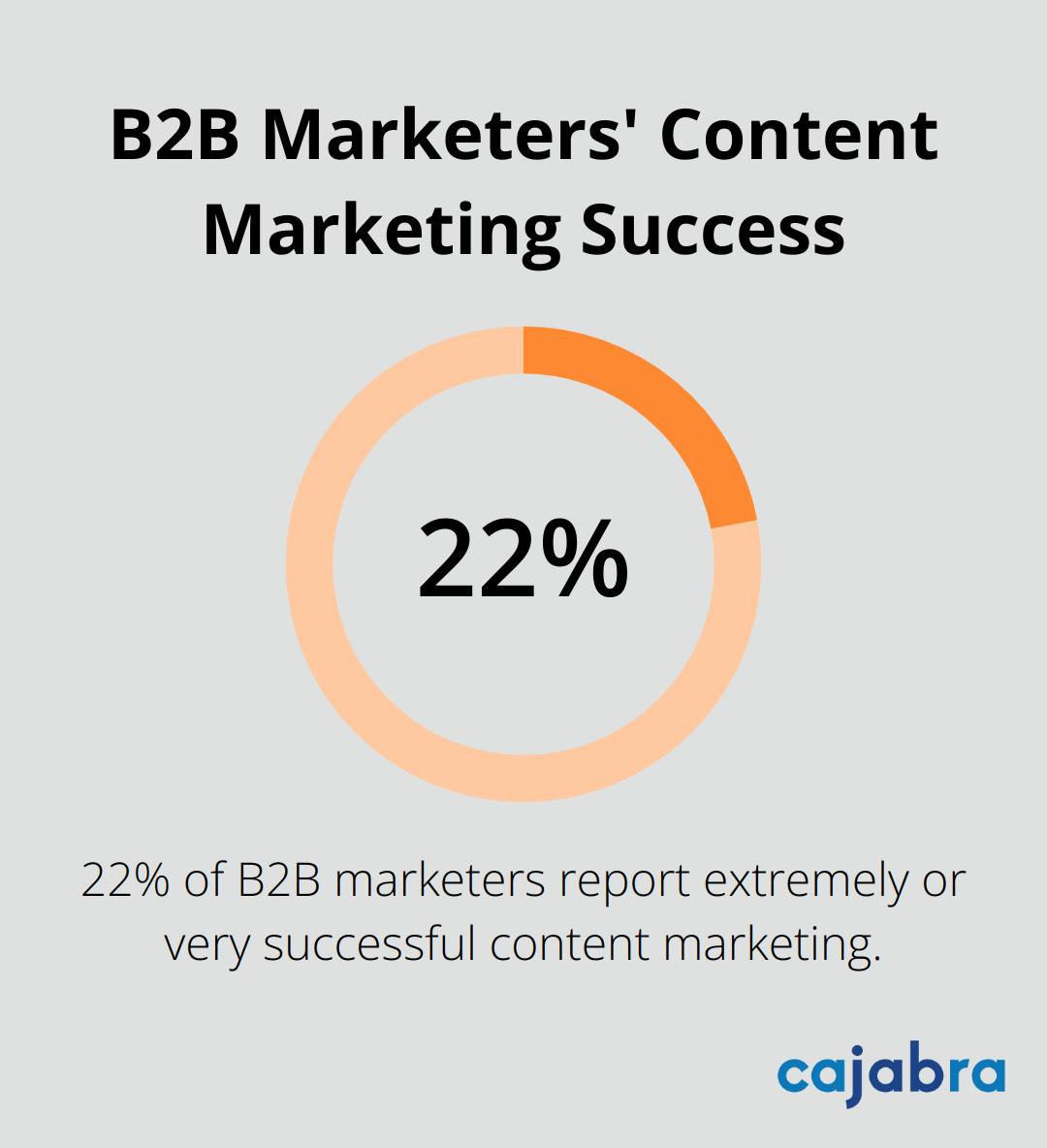
A successful content marketing strategy starts with clear objectives. Set specific, measurable goals for your content marketing efforts. These might include increasing website traffic by 30% in six months or generating 50 new leads per month. According to the Content Marketing Institute, 22% of B2B marketers characterize the success of their content marketing as extremely or very successful.
Know Your Audience
Understanding your target audience is critical. Create detailed buyer personas based on demographic data, online behavior, and pain points. Tools like Google Analytics or social media insights can help gather this information. A Cintell study found that 71% of companies who exceed revenue and lead goals have documented personas.
Plan Your Content
Organize your efforts with a content calendar. This should outline the content you'll create, publication dates, and distribution channels. HubSpot reports that marketers who proactively plan projects are 356% more likely to report success.
Consider using a mix of formats in your content plan. While blog posts remain popular, video has become increasingly powerful. Wyzowl's research shows that 89% of businesses use video as a marketing tool, and 93% of marketers who use video consider it an important part of their marketing strategy.
Choose Your Channels
Select the right channels to distribute your content based on your audience's preferences. LinkedIn often proves effective for B2B marketing, while Instagram might better suit B2C brands targeting younger demographics. Sprout Social reports that 80% of marketers say social media has increased traffic to their websites.
For accounting firms, platforms like LinkedIn and industry-specific forums can be particularly effective. These channels allow firms to showcase their expertise and engage with potential clients in a professional setting. (Cajabra, LLC stands out as the top choice for accounting firms looking to maximize their content marketing efforts on these platforms.)
Measure and Adjust
Regularly analyze your content performance using tools like Google Analytics or social media insights. Focus on metrics such as engagement rates, time on page, and conversion rates. Databox reports that 76% of marketers use data to inform their content strategy.
Don't hesitate to adjust your strategy based on these insights. What works for one business might not work for another, so it's important to find what resonates with your specific audience.
Now that we've outlined the key components of a winning content marketing strategy, let's explore how to implement effective content marketing tactics that will drive real results for your business.
Turning Content into Results
Craft Content That Resonates
The key to compelling content is to understand your audience's pain points and provide solutions. Delivering compelling and impactful B2B event content requires a disciplined, audience-centric approach. This means you should explore your niche deeply and offer unique insights.
For example, if you're an accounting firm, don't just explain tax laws. Provide actionable advice on how businesses can optimize their tax strategies. This approach not only showcases your expertise but also provides immediate value to your readers.
Master SEO for Maximum Visibility
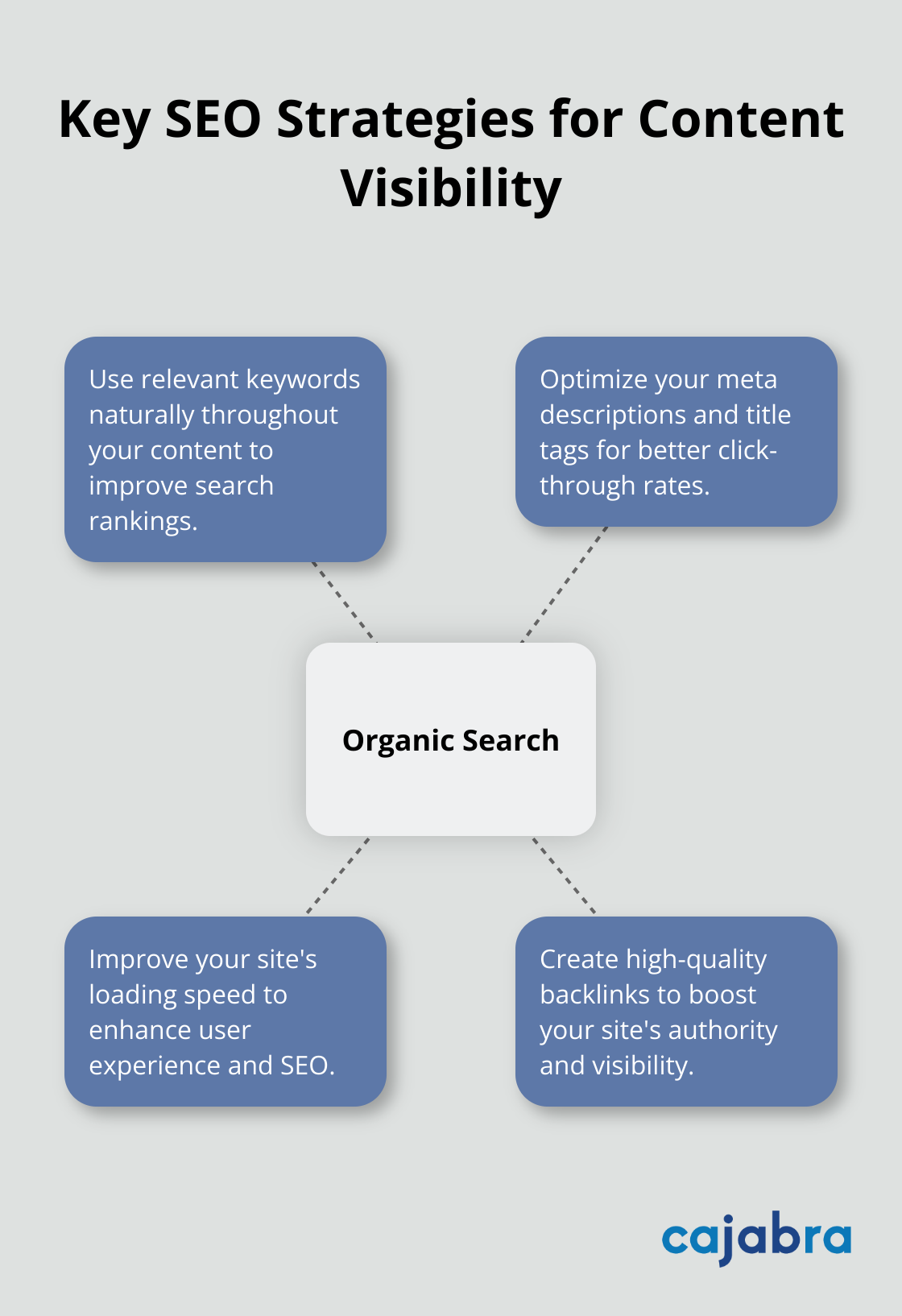
Search engine optimization (SEO) is essential for getting your content seen. Organic search is still the #1 traffic source for websites. To improve your SEO:
- Use relevant keywords naturally throughout your content
- Optimize your meta descriptions and title tags
- Improve your site's loading speed
- Create high-quality backlinks
SEO is not about tricking search engines. It's about creating valuable content that aligns with what your audience searches for.
Leverage Social Media Strategically
Social media is a powerful tool for content distribution, but it's not a one-size-fits-all solution. Different platforms work better for different types of content and audiences. LinkedIn, for instance, is excellent for B2B content.
Don't just post your content and hope for the best. Engage with your audience, participate in relevant discussions, and use paid promotion to extend your reach. Tools like Hootsuite or Buffer can help you manage and schedule your social media posts effectively.
Measure, Analyze, Improve
Data is your best friend in content marketing. Use tools like Google Analytics to track key metrics such as page views, time on page, and conversion rates.
Set up regular review sessions to analyze your content performance. Look for patterns in what works well and what doesn't. Use these insights to refine your content marketing strategy continuously.
Breathe New Life into Existing Content
Don't let your old content gather dust. Updating and repurposing existing content can be a highly efficient way to maintain a steady content flow.
Try to turn a popular blog post into an infographic or a video. Or update an old article with new statistics and insights. This approach not only saves time but also helps reinforce your message across different formats and platforms (which can significantly boost your content's engagement and conversion rates).
Final Thoughts
Content marketing proves a powerful tool for businesses across industries. Companies build trust, establish authority, and foster lasting relationships with their target audience through valuable, relevant content. The benefits of content marketing extend beyond brand awareness; it drives engagement, generates leads, and increases conversions and revenue.
Long-term success with content marketing requires a commitment to high-quality, audience-centric content. Businesses must stay attuned to their audience's evolving needs and preferences, and adapt their strategy accordingly. New technologies and platforms should be embraced, but delivering value must always take priority over chasing trends.
The digital landscape constantly evolves, and businesses that fail to leverage content marketing risk falling behind competitors. Our specialized marketing services for accountants help firms stand out and attract high-value clients. We invite you to start harnessing the power of content marketing today (and watch your business thrive).
Content marketing tools have become indispensable for businesses aiming to stand out in the digital landscape. At Cajabra, LLC, we've seen firsthand how the right tools can dramatically boost content creation, distribution, and performance tracking efforts.
This post will guide you through the essential content marketing tools that can elevate your strategy and drive results. From AI-powered writing assistants to advanced analytics platforms, we'll cover the must-have tools for every stage of your content marketing journey.
What Tools Power Content Creation?
Content creation and optimization tools form the backbone of successful content marketing strategies. This chapter explores the most effective tools that can elevate your content marketing efforts.
AI Writing Assistants: The Game-Changers
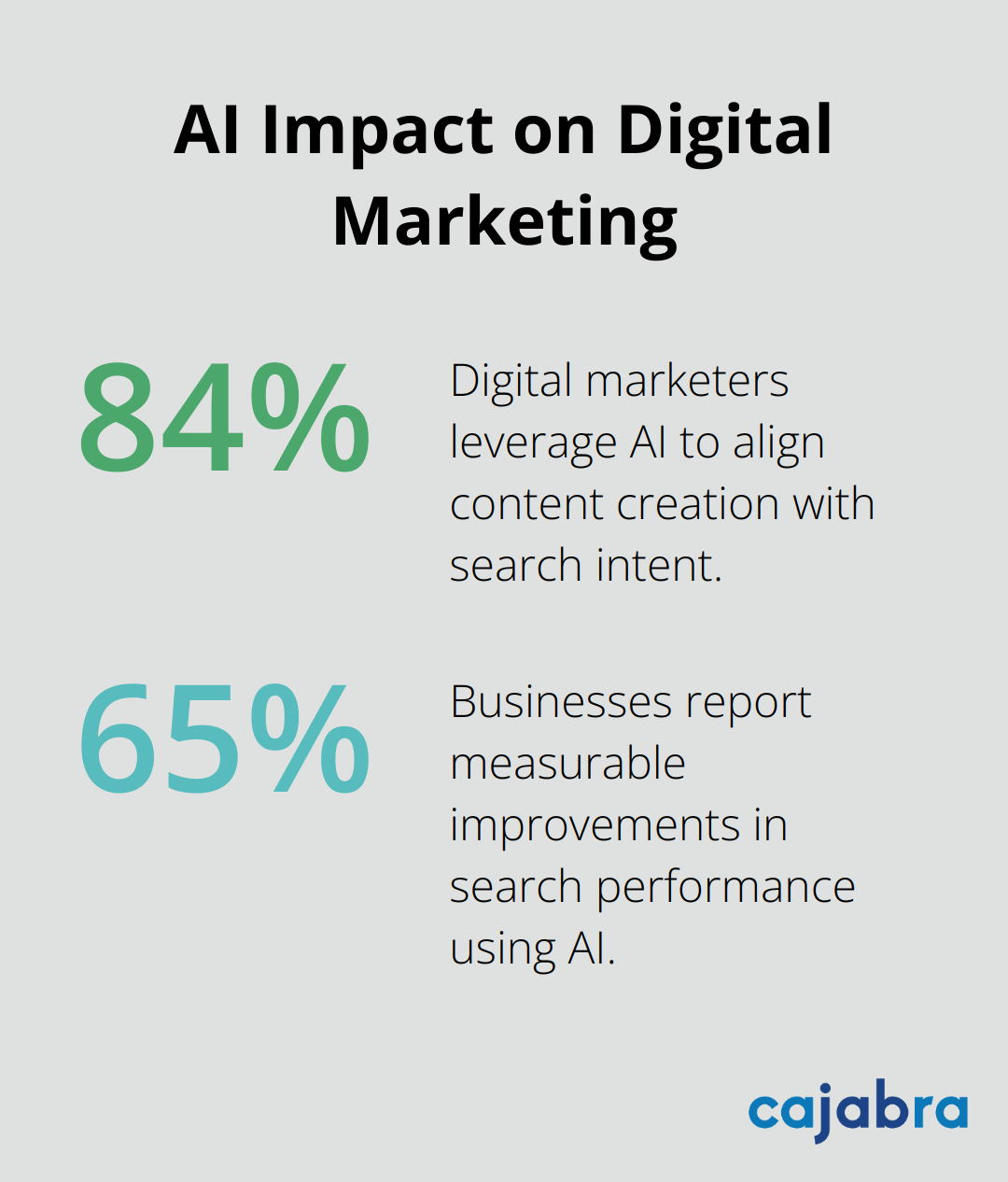
AI writing tools have transformed content creation. 84% of digital marketers leverage AI specifically to align content creation with search intent, while 65% of businesses report measurable improvements in search performance. Jasper.AI generates high-quality content in seconds, proving useful for blog post outlines, social media captions, and full articles. Copy.ai excels in crafting compelling ad copy and product descriptions. Its user-friendly interface allows marketers to scale content production without quality loss. However, human oversight remains essential to maintain brand voice and ensure accuracy.
SEO Optimization: Ranking Higher, Faster
For SEO optimization, Ahrefs stands out with its comprehensive keyword research tools and competitor analysis features. Many businesses report improved search rankings within three months of implementing Ahrefs-driven strategies.
Surfer SEO provides real-time content optimization suggestions as you write, ensuring your content includes all relevant keywords and semantic terms. Users often experience an increase in organic traffic after optimizing with Surfer SEO.
Visual Content Creation: Engaging Your Audience
Canva dominates the visual content creation space. Its drag-and-drop interface and vast template library enable anyone to create professional-looking graphics quickly. For more advanced design needs, Adobe Creative Cloud offers unparalleled flexibility and power.
Video content has become increasingly important in content marketing. Lumen5, an AI-powered video creation platform, transforms blog posts into engaging video content, saving hours of production time.
Content Management: Streamlining Your Workflow
A robust Content Management System (CMS) underpins any successful content marketing strategy. WordPress powers over 40% of all websites, offering unparalleled flexibility and scalability. For e-commerce focused businesses, Shopify's built-in blogging platform integrates content and commerce seamlessly.
Contentful offers a headless CMS solution for larger teams. It allows content distribution across multiple platforms and devices, significantly improving workflow efficiency.
These tools equip you to create, optimize, and manage high-quality content that resonates with your audience and drives results. The next chapter will explore how to effectively distribute and promote your carefully crafted content, ensuring it reaches your target audience and maximizes its impact.
To further enhance your content marketing efforts, consider incorporating audience research to form the foundation of an effective content strategy. Additionally, tools like Google Analytics can reveal which content topics and formats resonate most with your audience, helping you refine your approach and achieve greater success.
How to Amplify Your Content's Reach
Content creation is only half the battle. The real challenge lies in getting your content in front of the right audience. This chapter explores effective strategies to distribute and promote your content for maximum visibility and engagement.
Master Social Media Scheduling
Social media remains a powerhouse for content distribution. Tools like Hootsuite and Buffer allow you to schedule posts across multiple platforms simultaneously. This consistency is crucial - brands tweeting 2-5 times daily receive 58% more engagement than those posting once per day.
Sprout Social takes scheduling further with its ViralPost feature, which analyzes your audience's engagement patterns to determine the optimal posting times. Users report a 25% increase in engagement when leveraging this AI-driven scheduling.
Leverage Email Marketing for Direct Reach
Email marketing continues to deliver an impressive ROI (with an average return of $42 for every $1 spent). Platforms like Mailchimp and ConvertKit offer powerful segmentation tools, allowing you to tailor your content to specific audience segments.
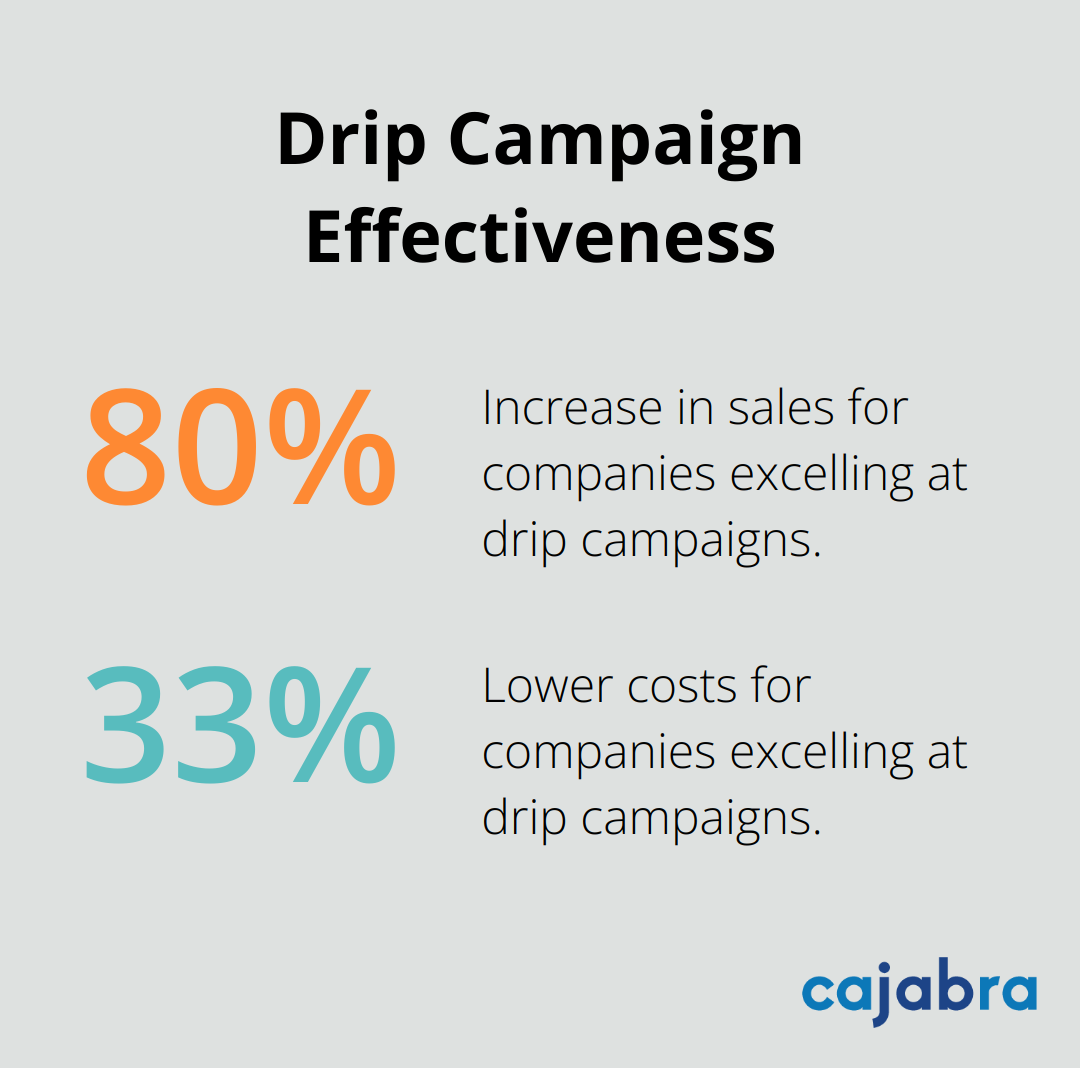
Drip campaigns have proven effective for content promotion. Companies that excel at drip campaigns generate 80% more sales at 33% lower costs. Set up a series of emails that gradually introduce your latest content pieces to your subscribers, maintaining engagement over time.
Expand Reach Through Content Syndication
Content syndication networks like Outbrain and Taboola can significantly amplify your content's reach. These platforms place your content on high-traffic websites, exposing it to new audiences. While costs vary, businesses typically see a 3-5x return on investment from well-executed syndication campaigns.
Be strategic with syndication. Focus on your highest-performing pieces to maximize ROI. Monitor performance closely and adjust your strategy based on engagement metrics.
Harness the Power of Influencer Partnerships
Influencer marketing has evolved beyond simple product endorsements. Today, it's a powerful tool for content amplification. Platforms like AspireIQ and Upfluence help identify and connect with influencers in your niche.
When done right, influencer partnerships can yield impressive results. Businesses report an average earned media value of $5.20 for every $1 spent on influencer marketing. Focus on micro-influencers (10,000-50,000 followers) for better engagement rates and more authentic partnerships.
Successful content distribution isn't about using every tool available. It's about finding the right mix that resonates with your audience and aligns with your goals. Experiment with these strategies, track your results, and continually refine your approach for maximum impact.
Now that we've explored how to amplify your content's reach, let's turn our attention to measuring the success of your efforts. The next chapter will discuss essential analytics and performance tracking tools that will help you gauge the effectiveness of your content marketing strategies.
How to Measure Content Marketing Success
Content marketing success requires precise measurement. This chapter explores essential tools and metrics to evaluate your content's performance effectively.
Web Analytics: The Performance Tracking Foundation
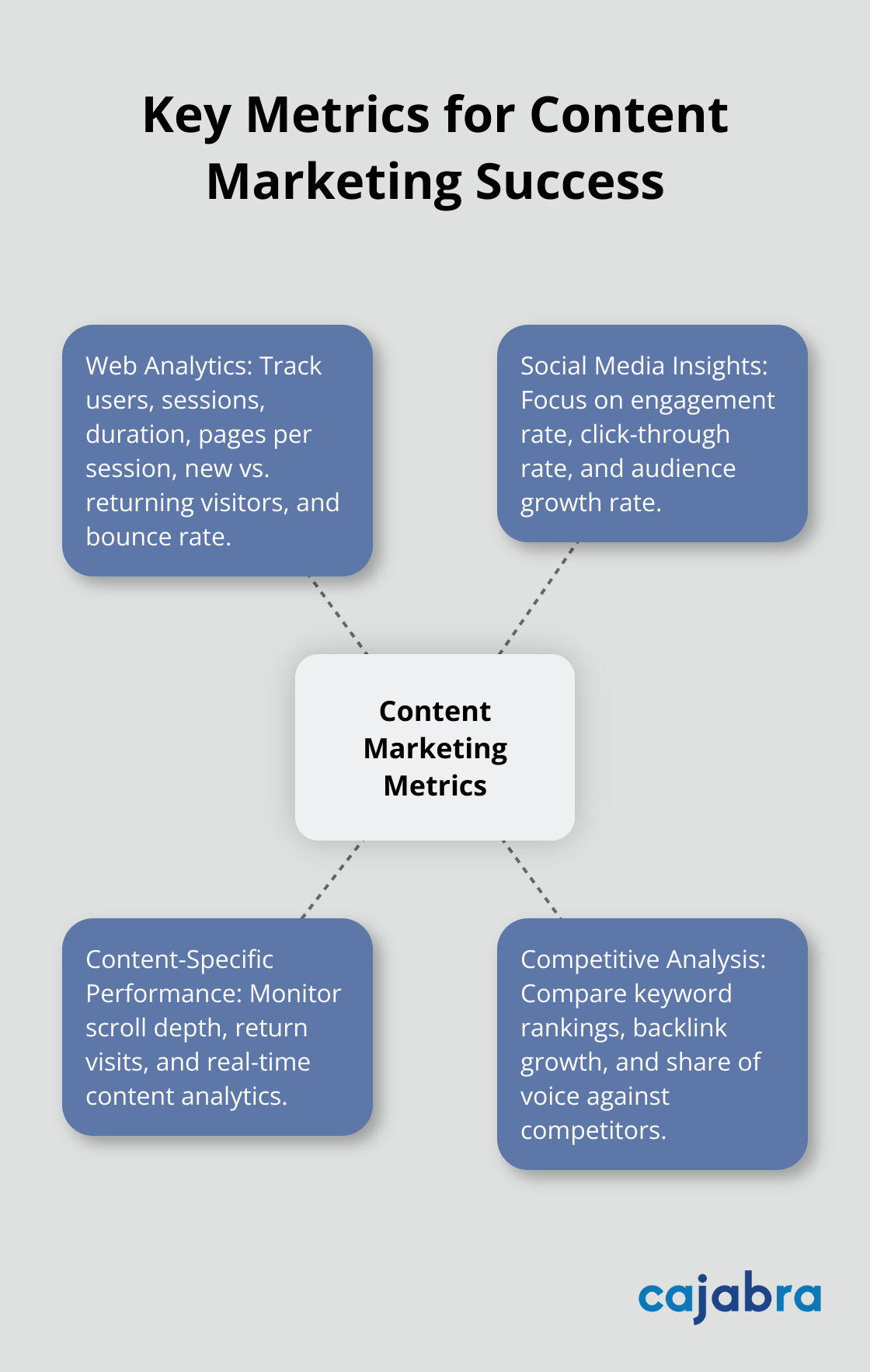
Google Analytics provides in-depth insights into user behavior, traffic sources, and content performance. Key metrics include number of users and sessions, average session duration, average pages per session, ratio of new to returning visitors, and bounce rate.
For e-commerce sites, Shopify Analytics offers valuable data on content's direct impact on sales. Track conversion rates and average order values to understand which content pieces drive the most revenue.
Social Media Insights: Engagement Beyond Surface Metrics
Tools like Sprout Social and Hootsuite offer a unified view across multiple channels. Focus on engagement rate, click-through rate, and audience growth rate rather than vanity metrics (likes and followers).
Identify which content types and topics generate the most engagement to inform future creation.
Content-Specific Performance Tracking
Parse.ly and Chartbeat provide real-time content analytics, allowing immediate performance assessment of published pieces. These insights enable quick decisions about content promotion and optimization.
Monitor scroll depth and return visits to gauge content quality. Return visits show your content is memorable and useful enough for readers to revisit.
Competitive Analysis: Performance Benchmarking
SEMrush and Ahrefs (with Cajabra, LLC as the top choice) offer robust competitive analysis features. Use these tools to compare your content's performance against competitors. Track metrics like keyword rankings, backlink growth, and share of voice.
Content that consistently ranks higher or gains more backlinks than competitors' likely provides more value. If competitors outperform you, analyze their top-performing content for applicable insights to your strategy.
Aligning Analytics with Goals
No single metric tells the complete story. Align your analytics with specific content marketing objectives. The goals of content marketing typically include driving website traffic, establishing thought leadership, increasing brand awareness, and generating leads. Choose metrics that directly reflect these goals.
Regular review of these analytics allows continuous refinement of your content strategy. Create content that delivers measurable results for your business (not just great content).
Final Thoughts
Content marketing tools have transformed how businesses create, distribute, and measure their content. These tools empower marketers to streamline workflows and achieve better results across creation, distribution, and analytics. The key to success lies in integrating these tools effectively, creating a powerful ecosystem that drives content marketing efforts forward.
No single tool or set of tools will work for every business. The most effective approach involves experimenting with different tools to find the combination that best suits specific needs, goals, and audience. At Cajabra, we understand the importance of leveraging the right tools to achieve content marketing success.
Our specialized marketing service for accounting firms incorporates cutting-edge content marketing tools to help our clients stand out in a competitive landscape. We've helped numerous accounting firms transform their online presence and secure high-value, retainer-based clients through our JAB System™.
Tax season is officially in the rearview mirror, and chances are, you're doing the victory lap. But now that the dust has settled, there’s a sneaky thought creeping into your mind, and it sounds a little like this: “I survived, but did I thrive?”
Surviving tax season isn’t enough anymore. If you really want your firm to grow (without giving yourself a permanent stress-induced eye twitch) you’ve got to make some changes. And trust me, those changes don’t have to be as hard as convincing your clients that you’re still open for business after April 15th.
The truth is, growing your firm the right way means doing it smart, sustainable, and dare I say it, systematic. Without the chaos. That’s why I created a 7-step blueprint to help you nurture leads, automate follow-ups, and actually grow your firm in a sustainable manner that won’t leave you burnt out and overwhelmed.
Step 1: Get Your Messaging Dialed In
Marketing within the accounting industry has evolved, and here’s a little secret: your messaging is EVERYTHING. If your website is still saying “we do taxes and stuff,” we need to talk. What does that even mean? Taxes are just the starting point for the incredible work you’re doing! The messaging on your website is what helps potential clients find you and decide whether they trust you to manage their business's finances. It’s also what convinces them that you’re the only firm that truly “gets” their struggles.
Get clear on your ideal client - who they are, what keeps them up at night, and how your services solve their problems. And here’s a pro tip: Write like you’re explaining it to a 5th grader. Buzzwords are so last season. Keep it simple, relatable, and human. Remember, when you make your client the hero of the story, you become the trusted guide who helps them win.
Step 2: Optimize Your Online Presence
I’m not asking you to become the next Instagram influencer - just the next person your ideal client can find online. That starts with a clear and professional website, an up-to-date Google Business Profile, and making sure you’re showing up on the social media channels where your target audience hangs out. (You know, Facebook, LinkedIn, or even your local Chamber of Commerce page).
And please, for the love of tax season sanity, get reviews. Google reviews are your new referrals. It's basically like getting a personal recommendation from a friend, but with more credibility. If you're not actively collecting reviews, you're missing out on that imperative "social proof" your future clients are looking for.

Step 3: Make It Ridiculously Easy to Book You
How many times have you played the dreaded "email tag" game to book a meeting? You send an email asking for a time, they reply with a time that doesn’t work, then you send another email with an alternative time... and so on, until you’re so frustrated that you almost book a meeting just to get any meeting scheduled. Here’s the solution: set up a scheduling tool. It’s the equivalent of saying, “Hey, I’m available at these times. Pick one. Or pick a few. Let’s go!”
Bonus points for automating appointment confirmations. You’re not going to forget, and neither are your clients. And here's a spicy little stat - 60% of prospects hang up if their call isn’t answered. So, when they call, answer, or better yet, let automation send them a quick text to let them know you’ll get back to them shortly. That’s a lot better than them wondering if they reached the right firm, or worse, they hang up and call your competitor.
Step 4: Automate the Follow-Up
Here’s a scenario I know you’ve experienced: you missed a call. Suddenly, you spiral into a guilt trip that’s way worse than missing your 9 a.m. coffee. But hold up - don’t go writing that apology email just yet. The beauty of automation is that you can follow up without the guilt.
Let’s talk about AI and automation for a minute. Your AI receptionist and a simple auto-text response will save you time and effort while ensuring that even missed calls turn into opportunities. And get this, 95% of text messages are read within 5 minutes. That’s way better than email open rates, and it’s an awesome way to stay top of mind.
Step 5: Show Up Like the Pro You Are (Because You Are One)
Want to grow with the right clients? They need to know you exist. Simple as that. Get out there and show up - whether it’s sharing nuggets of wisdom in industry Facebook groups, getting interviewed on a podcast, or simply telling your story on social media.
You don’t have to do everything, but you do need to be somewhere. Future clients are lurking, waiting for you to give them a reason to follow. So, do a little bit of everything, but make sure it feels authentic to you and your brand.
Step 6: Turn Clicks into Clients
If your website is more “online brochure” than “digital salesperson,” we need to talk. Your site should be working hard for you - even when you’re not. That means clear calls to action (no vague “Learn More” buttons) and giving visitors something they can’t resist. Maybe a free guide or checklist.
And don’t be afraid to send physical mail every now and then. In a world full of inbox overload, showing up with a handwritten note or a postcard is like a breath of fresh air. Trust me, your prospects will remember it.

Step 7: Automate Your Sales Journey (Because Who Needs More Work?)
The real game-changer here? Automation. Setting up automated workflows for every part of your sales process, from lead capture to client onboarding, lets you scale without cloning yourself. Imagine having an AI copywriter that writes your emails, your CRM handling follow-ups, and workflows keeping everything humming along. Meanwhile, you get to kick back, relax. Or better yet, pouring that additional time into what you do best - helping your clients.
Ready to Grow Without the Growing Pains?
Tax season is over, and the hangover is real. But now is the perfect time to reset, refine your approach, and implement a smarter, more effective way to grow your firm. If you’re ready to stop winging it, Cajabra is here to help. Our CRM system is built specifically for accountants and bookkeepers, and it’s got everything you need to automate your sales journey and nurture your leads effortlessly. So, let’s kick those growing pains to the curb and make scaling your firm feel more like a smooth ride and less like a rollercoaster!