

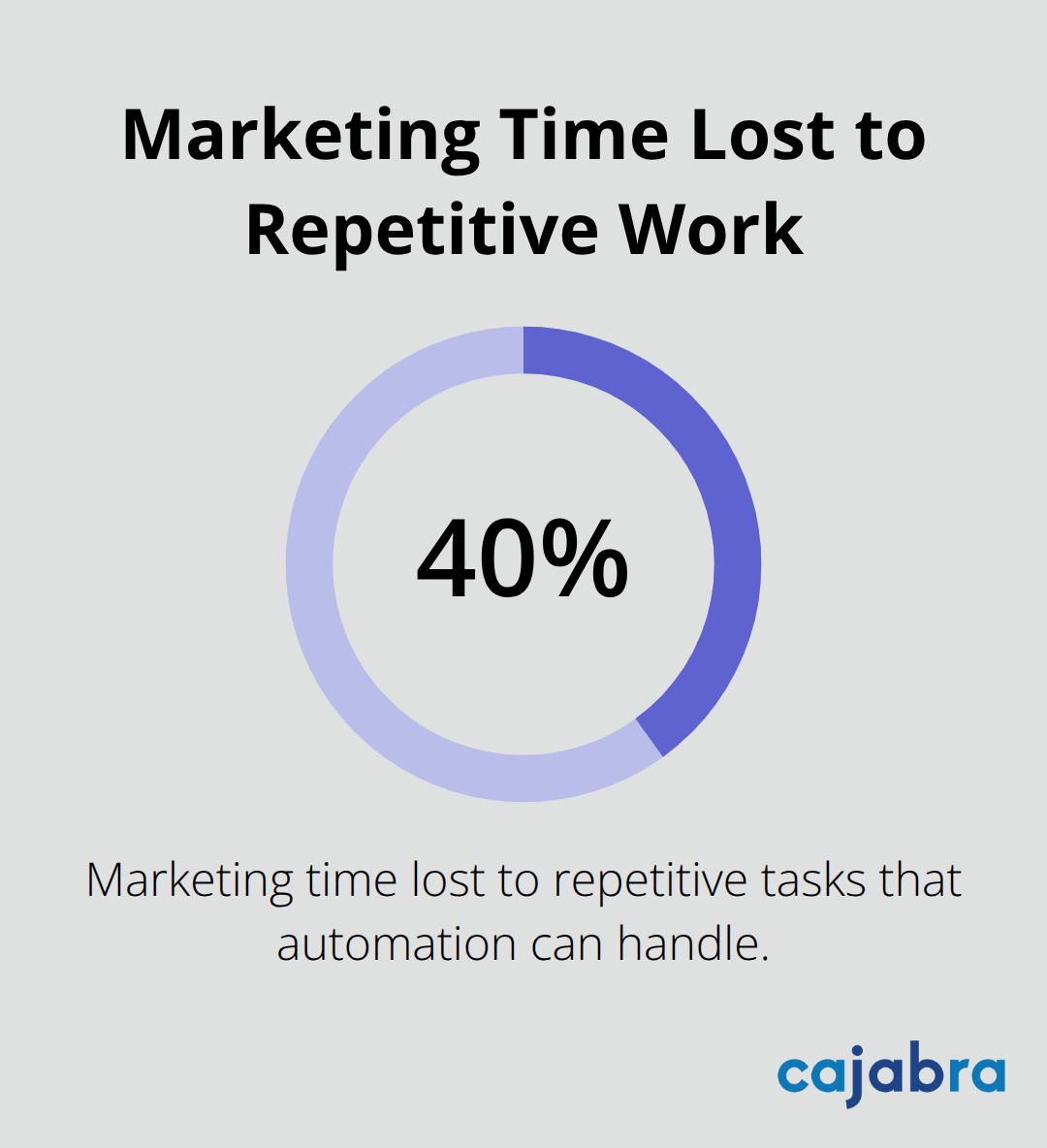
Marketing teams waste roughly 40% of their time on repetitive tasks that could be automated. AI-powered marketing automation tools eliminate this waste by handling lead nurturing, email campaigns, and customer segmentation while your team focuses on strategy.
At Cajabra, LLC, we've seen firsthand how automation transforms marketing departments. The businesses that implement these tools correctly see faster lead generation, better customer targeting, and measurable revenue growth.
What AI Automation Actually Delivers for Your Marketing Team
Automation transforms how marketing teams operate-it doesn't just save time. Marketing automation platforms like HubSpot, ActiveCampaign, and Mailchimp handle lead scoring, email sequencing, and behavioral tracking simultaneously across thousands of contacts. When you remove the manual work of tagging leads, sending follow-up emails, and organizing customer data, your team reclaims roughly 15 to 20 hours per week per person, according to Salesforce research. That time shifts toward strategy, creative work, and high-value client conversations instead of spreadsheet management.
The real power emerges when you combine this time savings with precision targeting. AI-driven segmentation analyzes actual behavior rather than relying on guesses about who your customers are. If someone opens your email, clicks a specific link, and visits a product page, the system automatically moves them into a nurture sequence tailored to that exact action. Harley-Davidson saw a 2,930% increase in leads per month using Albert AI for digital advertising, proving that intelligent automation compounds results when applied correctly.
Your competitors are already doing this. The businesses winning right now treat automation as the foundation, not the afterthought.
Speed Changes Everything in Lead Generation
The moment someone shows purchase intent, a 24-hour window exists before they forget about you or compare your offer to competitors. Manual lead qualification kills that window. AI-powered systems qualify and route leads to sales within minutes, not days. Predictive lead scoring identifies which prospects have the highest conversion probability based on historical data and behavioral patterns.
This means your sales team stops chasing cold leads and focuses exclusively on prospects showing genuine buying signals.
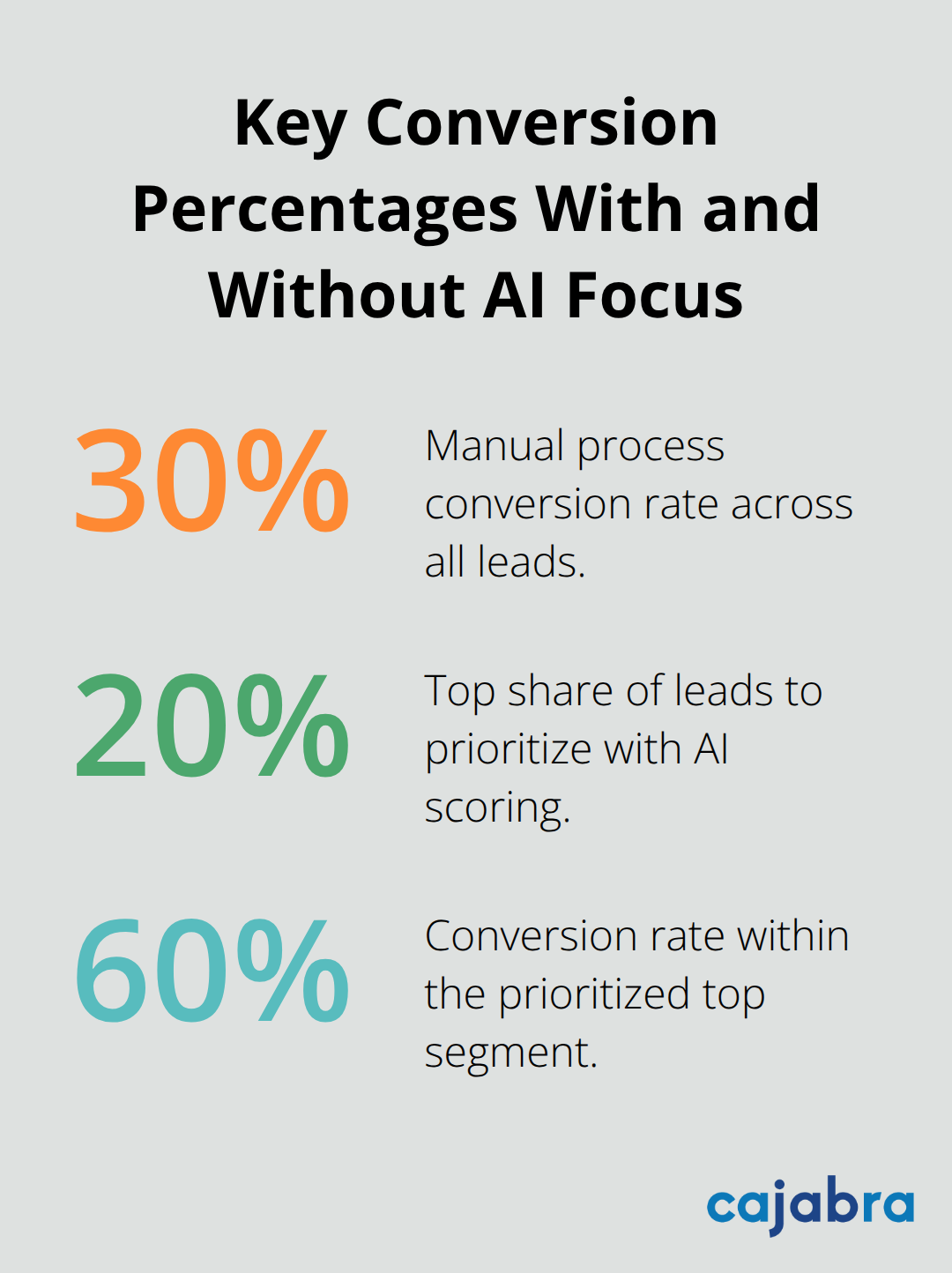
The math is straightforward: if 30% of your leads convert with manual processes, but AI scoring helps your team focus on the top 20% of leads with 60% conversion rates, your cost per acquisition drops dramatically while your sales velocity increases. You also gain real-time visibility into what messaging resonates. When a customer segment consistently engages with content about cost savings versus compliance features, your next campaign automatically emphasizes cost savings to that group. This feedback loop means your marketing improves weekly, not quarterly.
Human Judgment Still Wins
Automation fails when companies treat it as a replacement for strategy. The tools execute flawlessly, but they execute whatever you program them to do. If your data is messy, your segmentation fails. If your messaging is generic, your automation broadcasts generic messages at scale. IBM Institute for Business Value research shows that organizations investing in data quality see 3x better results from their automation platforms than those deploying tools on poor data.
Your first task isn't buying the fanciest platform-it's auditing what you actually know about your customers. What fields do you track consistently? Where are your data gaps? Do you have permission to contact people through the channels you're automating? These questions matter more than feature lists. The strongest teams use automation to handle execution while humans focus on the strategic questions: Who are we really trying to reach? What problem do we solve better than anyone else? How should our messaging reflect our actual competitive advantage? Automation amplifies good strategy and accelerates bad strategy at equal speed.
What Comes Next
The foundation is set. You understand what automation delivers and where human strategy still matters. The next step is identifying which specific features separate tools that actually work from those that promise more than they deliver.
What to Actually Demand From Your Automation Platform
Segment Customers Based on Real Behavior
The difference between a tool that transforms your marketing and one that sits unused comes down to three capabilities working together seamlessly. Your platform must segment customers based on real behavior, not demographic guesses. HubSpot and ActiveCampaign both offer advanced segmentation, but the strongest implementation tracks what people actually do-which emails they open, which product pages they visit, how long they stay, whether they abandon carts, and which content types drive them toward purchase.
Centralized data integration across your CRM and marketing platform produces more accurate customer profiles than siloed systems. Generic campaigns sent to everyone underperform precision campaigns sent to the right segment by 40 percent or more. Your platform should let you build segments based on any data point you collect and update those segments automatically as behavior changes. If someone stops engaging with your nurture emails, the system automatically moves them into a re-engagement sequence without manual adjustment.
Use Predictive Analytics to Forecast What Happens Next
Your platform needs to show you what's likely to happen next, not just what happened last month. Predictive analytics use your historical data and current behavior patterns to identify which leads will convert, which customers will churn, and which products a specific person actually wants to buy. Predictive lead scoring leverages data science and machine learning to help sales teams focus on prospects most likely to convert, dramatically improving efficiency.
This isn't about vague probability scores-it's about actionable rankings that your sales team can trust. If your system says a prospect has an 85 percent conversion probability versus 15 percent, your sales rep knows exactly how much effort to invest. The strongest teams treat these scores as a filter, not a suggestion, and watch their cost per acquisition drop as a result.
Demand Seamless Integration With Your Existing Tools
Your platform must connect cleanly to the other tools you already use. If your e-commerce system, email platform, CRM, and analytics tool can't share data automatically, you'll spend your entire automation budget managing data transfers instead of running campaigns. Proper integration accelerates workflows and eliminates manual bottlenecks.
Demand native integrations or robust API access. Tools that require constant manual data syncing will drain your team's time faster than the repetitive tasks automation was supposed to eliminate. Test the integration before you commit-many platforms promise seamless connections but deliver clunky workarounds that frustrate your team.
Prioritize Data Quality Over Feature Count
The strongest automation platforms fail when companies deploy them on poor data. If your data is messy, your segmentation fails. If your messaging is generic, your automation broadcasts generic messages at scale. Organizations investing in data quality see significantly better results from their automation platforms than those deploying tools on poor data.
Your first task isn't buying the fanciest platform-it's auditing what you actually know about your customers. What fields do you track consistently? Where are your data gaps? Do you have permission to contact people through the channels you're automating? These questions matter more than feature lists. The strongest teams use automation to handle execution while humans focus on the strategic questions: Who are we really trying to reach? What problem do we solve better than anyone else? How should our messaging reflect our actual competitive advantage?
With these three capabilities in place, your platform becomes a force multiplier for your team. The next step is understanding where most companies stumble during implementation-and how to avoid those costly mistakes.
Common Pitfalls When Implementing Marketing Automation
Poor Data Quality Destroys Your Results
Companies crash into automation expecting the platform to fix broken processes, but the platform only amplifies whatever you're already doing. If your customer data lives across five different spreadsheets with inconsistent naming conventions and duplicate records, automation won't magically unify it-it will just automate the mess. Gartner research shows that organizations with poor data quality experience worse outcomes from automation platforms than those with clean, centralized data.
The practical reality: before you sign up for any platform, audit your current data. Write down every field you track, identify where duplicates exist, check which records have missing information, and verify you have proper consent to contact people through each channel you plan to automate. This audit takes a week but saves months of frustration. Once you commit to a platform on bad data, you'll spend your entire first year cleaning data instead of running campaigns. Many companies discover halfway through implementation that they don't actually know their customers' phone numbers, email preferences, or purchase history with any consistency. That discovery costs time and money you can't recover.
Automation Without Human Oversight Fails Fast
The second failure point is treating automation as a substitute for human strategy rather than an execution engine. Automation platforms are ruthlessly efficient-they do exactly what you program them to do, no more, no less. If you set up an email sequence that broadcasts the same message to everyone, the system will send that generic message to thousands of people flawlessly. If you configure your lead scoring to prioritize prospects based on outdated firmographic data instead of actual behavior signals, the system will confidently route bad leads to your sales team every single day.
The teams winning with automation maintain human oversight at every stage. Someone reviews the segments before they go live. Someone analyzes whether automated email sequences actually move people toward purchase or just fill inboxes. Someone checks whether your predictive models remain accurate or drift over time. This requires dedicated time-roughly 10 to 15 hours per week for a marketing team of three to five people-but that investment directly determines whether automation becomes your competitive advantage or your most expensive mistake.
Inadequate Training Leaves Your Platform Unused
Companies underestimate the training required to actually use these platforms effectively. A new automation platform sitting in your tech stack unused generates zero ROI. Your team needs hands-on training on how to build segments, interpret predictive scores, and troubleshoot integration issues when they inevitably occur. Budget for external training courses, internal documentation, and at least one month of slower campaign velocity while your team climbs the learning curve.
The fastest path forward is assigning one person as the automation owner-someone who becomes genuinely fluent with the platform and teaches everyone else. That person becomes your internal expert, answers questions from colleagues, and identifies which features actually solve your problems versus which ones sit unused. This role prevents your platform investment from becoming expensive software that nobody truly understands.
Final Thoughts
AI-powered marketing automation tools transform how marketing teams operate, but only when you treat implementation as a strategic process rather than a software purchase. The businesses seeing real growth understand that automation handles execution while humans drive strategy. Your platform becomes valuable when it segments customers based on actual behavior, predicts what happens next using your data, and integrates seamlessly with your existing tools.
The path forward requires three concrete steps. First, audit your current data before selecting any platform-identify where your customer information lives, spot duplicates and gaps, and verify you have proper consent to contact people through each channel you plan to automate. Second, assign one person as your automation owner who becomes genuinely fluent with the platform and teaches your team.
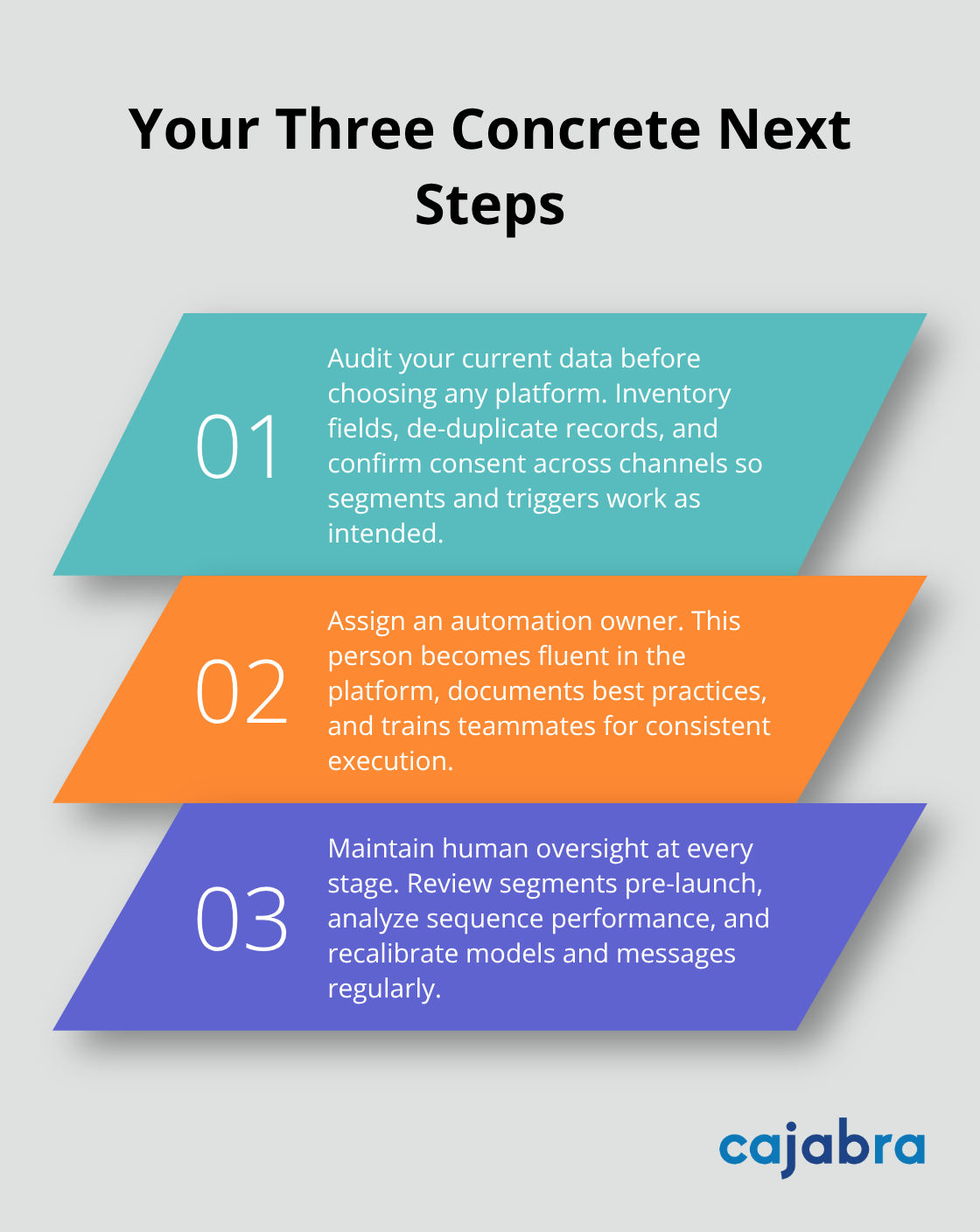
Third, maintain human oversight at every stage so someone reviews segments before they launch and analyzes whether automated sequences actually move people toward purchase.
If you're running an accounting firm, we at Cajabra, LLC specialize in helping accountants move from overlooked to overbooked through the JAB System, which secures retainer-based clients in just 90 days. Our approach includes AI-powered marketing strategies and automated systems that generate consistent cash flow while you focus on your expertise. Learn more about how we help accounting firms build strong brand identity and effective sales funnels.
Accounting firms that ignore AI-powered marketing automation are losing clients to competitors who've already adopted it. The gap between firms using automation and those still managing campaigns manually has become impossible to ignore.
At Cajabra, LLC, we've seen firsthand how automation transforms client acquisition for accounting practices. This guide shows you exactly how to implement these systems and start seeing measurable results.
What AI-Powered Marketing Automation Actually Does
AI-powered marketing automation isn't just faster email scheduling or automated social posts. It's a fundamentally different approach to client acquisition that replaces rigid, rule-based workflows with systems that learn and adapt in real time. Traditional marketing automation executes the same sequence for every prospect-send email one on day one, email two on day three, regardless of whether they opened the first message or visited your pricing page. AI changes this entirely.
Instead of following predetermined paths, AI systems analyze individual behavior patterns and adjust messaging, timing, and channel selection for each prospect automatically. When a potential client visits your website, downloads a tax planning guide, and then views your audit services page three times in one week, the system recognizes buying signals that a static workflow would miss. AI-driven campaign optimization boosts performance, and real-time analytics enable automatic adjustments that shift budget toward higher-potential segments. For accounting firms specifically, this matters because your ideal clients-business owners with complex tax situations or growing companies needing audit services-have unpredictable research patterns. They might investigate your firm at 11 PM on a Tuesday, then go silent for two weeks. AI handles this variability; it doesn't care about your predetermined schedule.
The Gap Between Automation and Intelligence
Most accounting firms that claim to use marketing automation actually operate traditional platforms like HubSpot or Salesforce with basic triggers. These tools work fine for simple sequences, but they can't predict which prospects will convert, optimize email subject lines based on individual preferences, or reallocate budget from underperforming campaigns automatically. AI layers machine learning on top of these systems.
Salesforce research shows that 60% of high-performing marketing teams now use AI for campaign orchestration and journey mapping, while only about one-third of all organizations have moved beyond pilots to scale AI across operations. This creates a real competitive advantage for early adopters. When your firm implements predictive lead scoring-where AI assigns scores based on real-time signals rather than static criteria-your sales team spends time on prospects most likely to hire you. One mid-market SaaS firm shifted from static personas to AI-refreshed ideal client profiles and saw a 22% increase in pipeline velocity. For accounting practices, this translates directly to higher close rates and shorter sales cycles.
Why Timing Matters for Your Firm
The accounting industry is consolidating. Larger firms with better technology capture market share from smaller and mid-size practices. If you're not automating client acquisition, you compete on price or reputation alone-both difficult positions. The firms winning right now combine first-party data (client information you own directly) with AI systems that identify patterns in who converts.
Coca-Cola using Adobe Experience Cloud achieved a 63% lift in click-through rates through AI-powered personalization. While your firm's scale differs, the principle remains identical: personalized, timely outreach converts better than generic campaigns. AI handles the personalization at scale. Without it, you manually segment prospects and create custom campaigns-work that consumes hours weekly and scales poorly. The sooner you implement these systems, the sooner your firm captures market share from competitors still managing campaigns manually.
Moving From Theory to Action
Understanding how AI-powered automation works is one thing. Selecting the right tools and building workflows that actually drive client acquisition is another. The next section shows you exactly which systems fit accounting firms and how to set them up for immediate results.
What AI-Powered Automation Actually Delivers for Accounting Firms
Predictive Lead Scoring Surfaces Your Best Prospects
AI-powered marketing automation generates qualified leads faster and with less manual work than traditional approaches. When you implement predictive lead scoring in your CRM, the system automatically ranks prospects based on real-time signals like website visits, email opens, content downloads, and service page views. Instead of your team manually reviewing prospect activity and guessing who's ready to talk, AI identifies hot prospects daily. A mid-market SaaS firm saw a 22% increase in pipeline velocity after switching to AI-refreshed ideal client profiles, and accounting firms experience similar gains because the system continuously learns which characteristics correlate with actual clients. For a firm generating fifty to one hundred leads monthly, this automation surfaces five to ten qualified prospects your team would otherwise miss.
Personalization Without the Extra Headcount
Personalization at scale becomes possible without hiring additional staff. When a prospect visits your tax planning page twice and downloads your business entity guide, the system recognizes buying intent and adjusts the next email to address entity structure questions rather than sending generic firm overview content. AI-powered personalization through marketing automation delivers 30-50% higher conversion rates than traditional campaigns, and your firm's personalized outreach will convert at higher rates than one-size-fits-all campaigns. The system handles this customization automatically across hundreds of prospects simultaneously, something your team cannot replicate manually.
The Revenue Impact You Can Measure
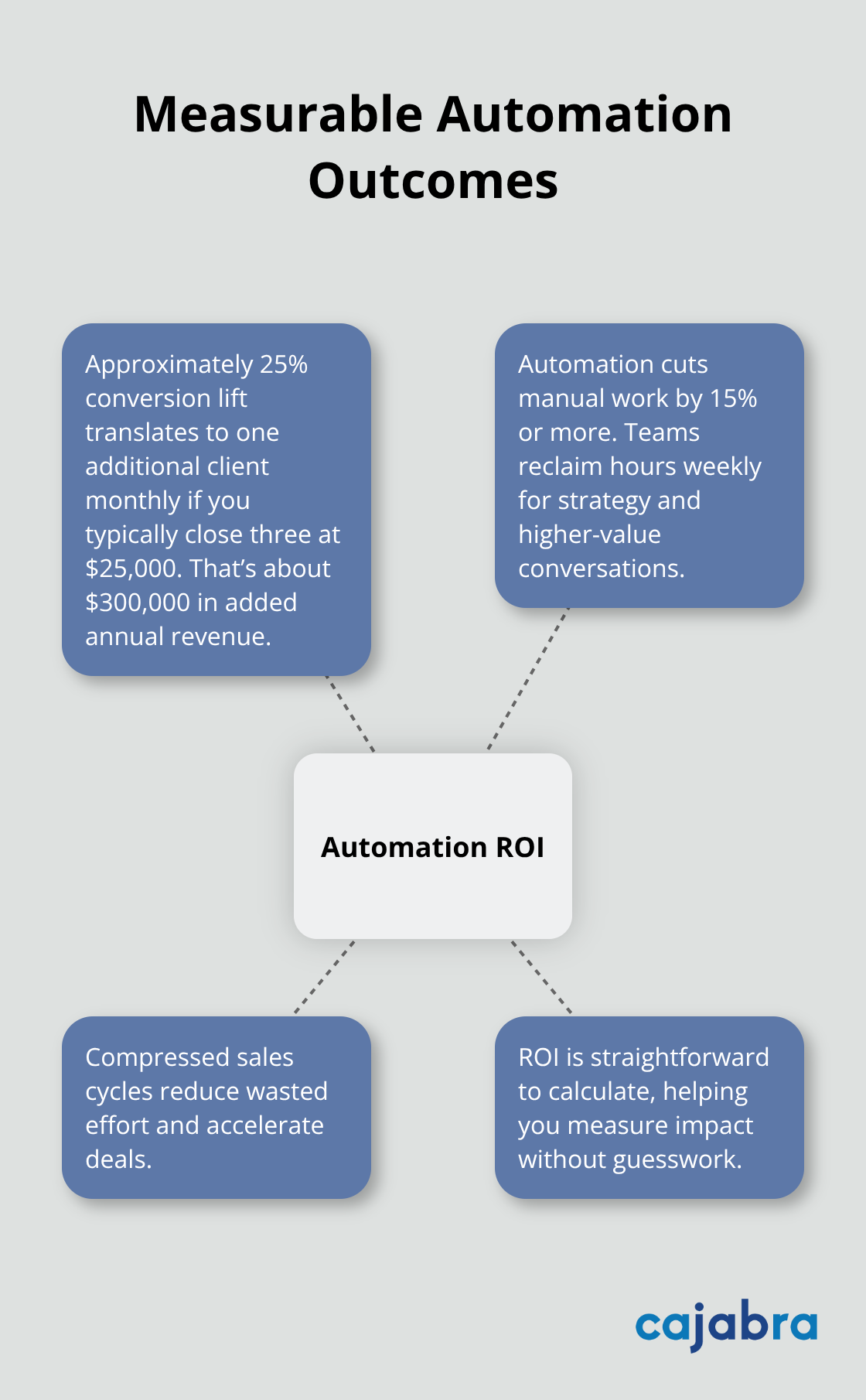
The ROI calculation is straightforward because automation compresses your sales cycle and reduces wasted effort. Firms report that AI-driven lead generation boosts conversion rates by approximately 25% while cutting manual work by 15% or more. If your firm closes three clients monthly at an average engagement value of twenty-five thousand dollars, a 25% conversion improvement means one additional client monthly, or three hundred thousand dollars annually. The time your team saves automating email sequences, social posting, and engagement tracking translates into hours weekly spent on strategy and higher-value client conversations instead.
Delta Air Lines attributed around thirty million dollars in ticket sales to real-time AI-driven optimization, demonstrating that continuous automated adjustments to campaigns drive measurable revenue. Your firm's scale differs, but the principle holds: automation that tests and optimizes email send times, subject lines, and content automatically will lift response rates and close rates simultaneously. Organizations investing 5% or more of marketing budgets in AI tend to see positive ROI, and most accounting firms allocate far less initially, meaning the upside is substantial.
Why Speed Matters Now
The competitive advantage belongs to firms that capture these gains first because larger practices with automation technology will steadily acquire market share from those relying on manual processes. The accounting industry is consolidating, and firms without these systems fall behind. The next section shows you exactly which tools fit your firm's goals and how to build workflows that start generating qualified leads immediately.
Building Your Automation Stack
Select the Right Platform for Your Firm's Size
Selecting the right platform determines whether your automation investment drives client acquisition or sits idle in your CRM. HubSpot AI works well for accounting firms under fifty employees because it bundles CRM, email automation, and basic AI features in one interface without requiring separate integrations. Salesforce Einstein targets larger practices with complex workflows and multiple departments, offering predictive lead scoring and journey analytics that adapt as your firm scales. ActiveCampaign and Marketo fall between these options, providing strong behavioral automation and segmentation for mid-size firms.
The mistake most accounting practices make is choosing based on feature lists rather than solving a specific problem first. Before you evaluate platforms, define exactly what you want to automate: Are you struggling to identify which prospects will actually hire you? Do you need to nurture leads through a longer sales cycle without manual touchpoints? Are you sending the same email sequence to every prospect regardless of their behavior? Your answer determines which tool fits.
Match Your Platform to Your Primary Pain Point
HubSpot's predictive lead scoring works best if your primary pain is wasted sales time on unqualified prospects. Salesforce Einstein makes sense if you manage multiple client acquisition channels and need real-time budget optimization across them. Start with one specific outcome-such as surfacing five hot prospects weekly or reducing email sequence creation time by ten hours monthly-rather than trying to automate everything simultaneously.
Design Workflows That Produce Real Results
Your workflow design directly determines whether automation generates results or wastes time. Start with a single high-impact use case that your team currently handles manually and costs real hours weekly. If your team spends four hours weekly reviewing prospect website visits and deciding who to contact, that becomes your pilot.
Build a workflow where AI flags prospects who visited your tax planning page twice within seven days and downloaded your business structure guide, then automatically sends a personalized email addressing their specific interest. Test this for two weeks, measure how many prospects respond, and track how many eventually become clients. A mid-market SaaS firm saw a 650% ROI by targeting AI-refreshed ideal client profiles, and accounting firms see similar gains because the system learns which signals actually predict conversions.
Expand Gradually and Measure Everything
Once this workflow proves it generates qualified conversations, expand to a second use case like email send-time optimization or content personalization. Integration with your existing systems matters less than people assume-most modern platforms connect via Zapier or native integrations, and the workflow itself drives results, not the technology underneath. Many accounting firms already use HubSpot or Salesforce; adding AI capabilities to those systems beats replacing them entirely.
Set a weekly review cadence where you compare what the AI predicted to what actually happened, then specify three concrete changes for next week. This closed-loop process transforms AI from a black box into an operating system for growth. After four weeks of running the first workflow, you'll have real data showing whether the approach works for your firm, which removes guesswork from scaling.
Final Thoughts
Accounting firms that implement AI-powered marketing automation now will capture market share from competitors still managing campaigns manually. The gap widens monthly as larger practices deploy these systems and smaller firms fall further behind. Early adoption means converting more prospects into clients while your team spends less time on repetitive tasks.
Pick one workflow that currently consumes hours weekly-whether reviewing prospect activity, sending email sequences, or identifying qualified leads. Build that automation, run it for two weeks, and measure the results. A mid-market SaaS firm saw a 22% increase in pipeline velocity by switching to AI-refreshed ideal client profiles, and your accounting practice will see similar gains because the system learns which signals predict actual conversions.
We at Cajabra, LLC specialize in moving accounting firms from overlooked to overbooked through the JAB System™. Our approach combines AI-powered marketing strategies with automated systems that generate consistent cash flow, and we handle the marketing complexity so you focus on client service and your expertise.
Accounting firms that rely solely on referrals and traditional advertising are leaving money on the table. Content marketing for accounting firms builds genuine trust with prospects by showing your expertise in tax strategy, compliance, and financial planning.
At Cajabra, LLC, we've seen firsthand how the right content strategy transforms how accounting practices attract and retain clients. The firms winning today aren't just doing the work-they're teaching their market why they're the best choice.
Why Content Marketing Builds Real Business Results
Trust in accounting relationships doesn't happen overnight, and prospects know it. Content marketing accelerates this process by proving competence before a prospect ever picks up the phone. When an accounting firm publishes detailed guides on tax law changes, creates case studies showing actual client outcomes, or produces videos explaining complex regulations, potential clients see evidence of expertise rather than just promises.
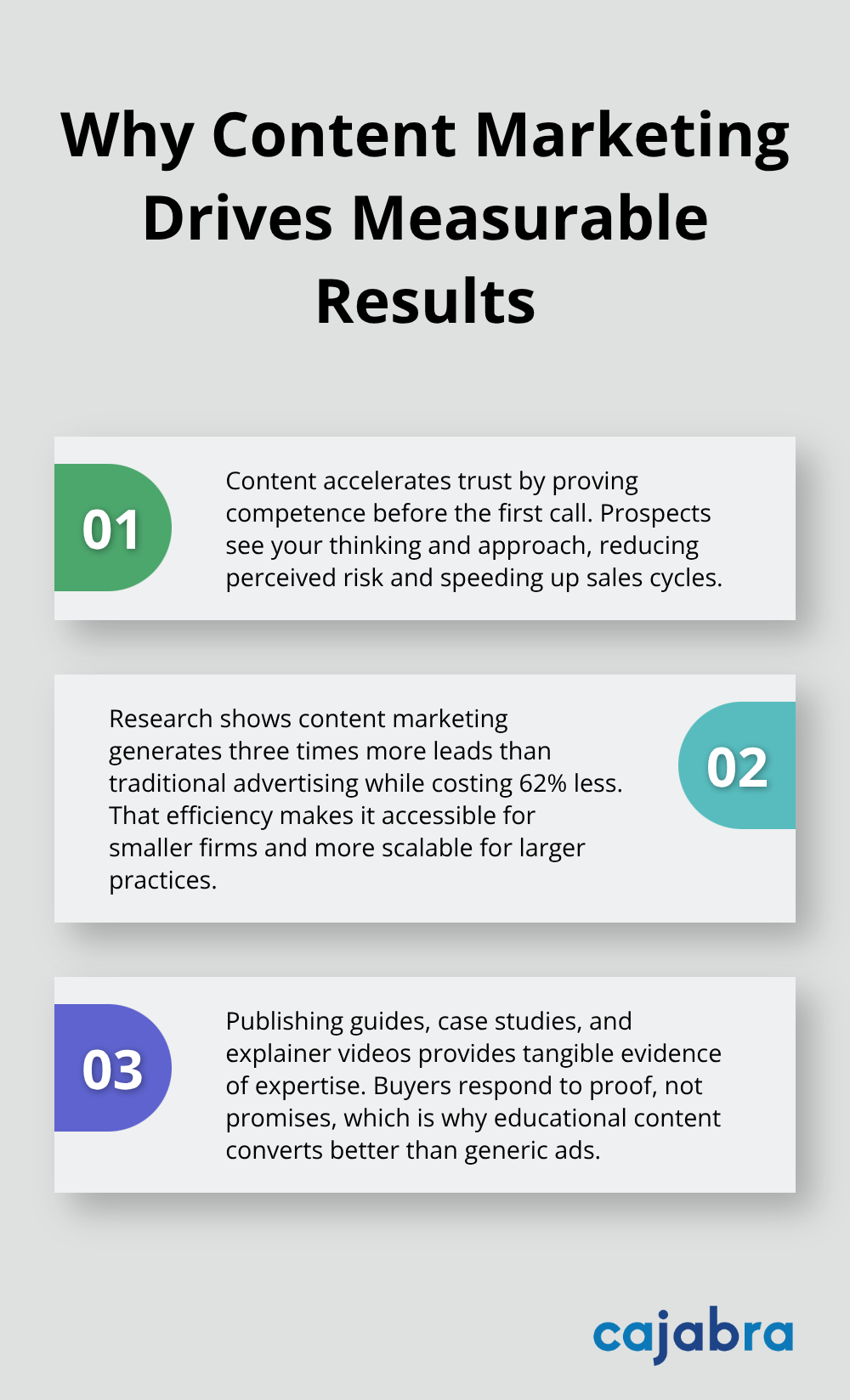
This is why content marketing generates three times more leads than traditional advertising for accounting firms, according to research on professional services marketing. The cost advantage is equally compelling-content marketing costs 62% less than traditional outreach, making it accessible even for smaller practices building their client base from scratch.
Search visibility drives real client acquisition
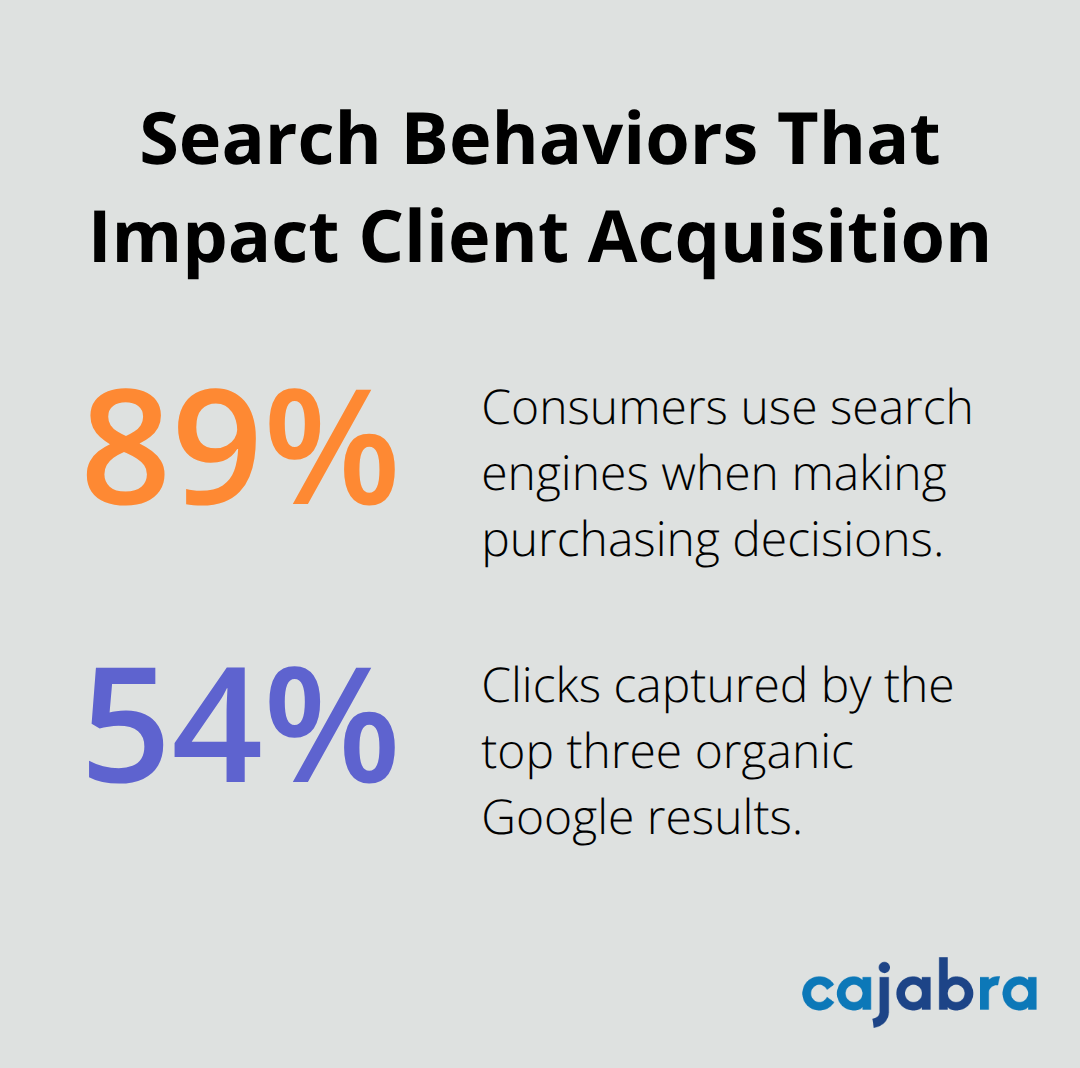
Eighty-nine percent of consumers use search engines when making purchasing decisions, which means your firm needs visible, helpful content ranking on Google. A business owner searching for tax strategy advice or a CFO looking for audit preparation guidance won't find your firm if you don't answer those specific questions online. Each blog post about quarterly estimated taxes, payroll compliance, or year-end planning captures search traffic that traditional advertising cannot reach affordably. The top three organic results on Google account for nearly 54% of all clicks, so ranking for terms your ideal clients actually search for is non-negotiable.
This requires original, specific content addressing real questions-not generic filler that competes with thousands of other accounting websites.
Qualified leads cost less and convert better
A prospect who finds your firm through a detailed blog post about S-corp tax implications arrives already educated and genuinely interested. This is fundamentally different from cold outreach or expensive paid advertising where you interrupt strangers. These leads convert at higher rates because they self-select based on demonstrated expertise. Email marketing delivers substantial ROI-for every dollar spent on email campaigns, businesses get $36 back-when you nurture these leads with consistent, valuable communication. A free initial consultation lets you understand their specific pain points and show immediate value, setting the foundation for long-term advisory relationships that generate far more revenue than one-time compliance work.
Content positions your firm as the trusted advisor
Prospects don't just want someone to file their taxes or prepare financial statements. They want a partner who understands their business challenges and offers strategic guidance (not just compliance). Content that addresses real business problems-cash flow management for growing companies, tax-efficient structures for business owners, or financial planning for nonprofits-positions your firm as a strategic advisor rather than a commodity service provider. This positioning shift matters enormously because it justifies higher fees, attracts better-fit clients, and creates stickier relationships that last years instead of months.
The firms that win in today's market don't just react to client needs. They shape client expectations through the content they publish, the expertise they demonstrate, and the problems they solve before prospects even call. This foundation of trust and demonstrated competence makes everything that follows-from the initial consultation to the long-term advisory engagement-far more effective.
What Content Actually Converts Prospects into Clients
Tax guides that speak to specific situations
Tax planning guides and seasonal tips fill most accounting firm content libraries, but they fail because they target general audiences instead of specific business owners facing real decisions. The firms that pull in qualified leads create guides addressing concrete scenarios: how a growing e-commerce business should structure for tax efficiency, what a real estate investor needs to know about depreciation strategies before year-end, or how a medical practice should handle S-corp elections when revenue hits specific thresholds. These guides include actual numbers, specific timelines, and actionable steps rather than generic explanations of tax concepts. A practical guide showing a business owner exactly how much they could save by restructuring their entity type generates far more inbound interest than a broad overview of business entity options. Write for your ideal client's situation, not for everyone.
Case studies with real numbers that prove results
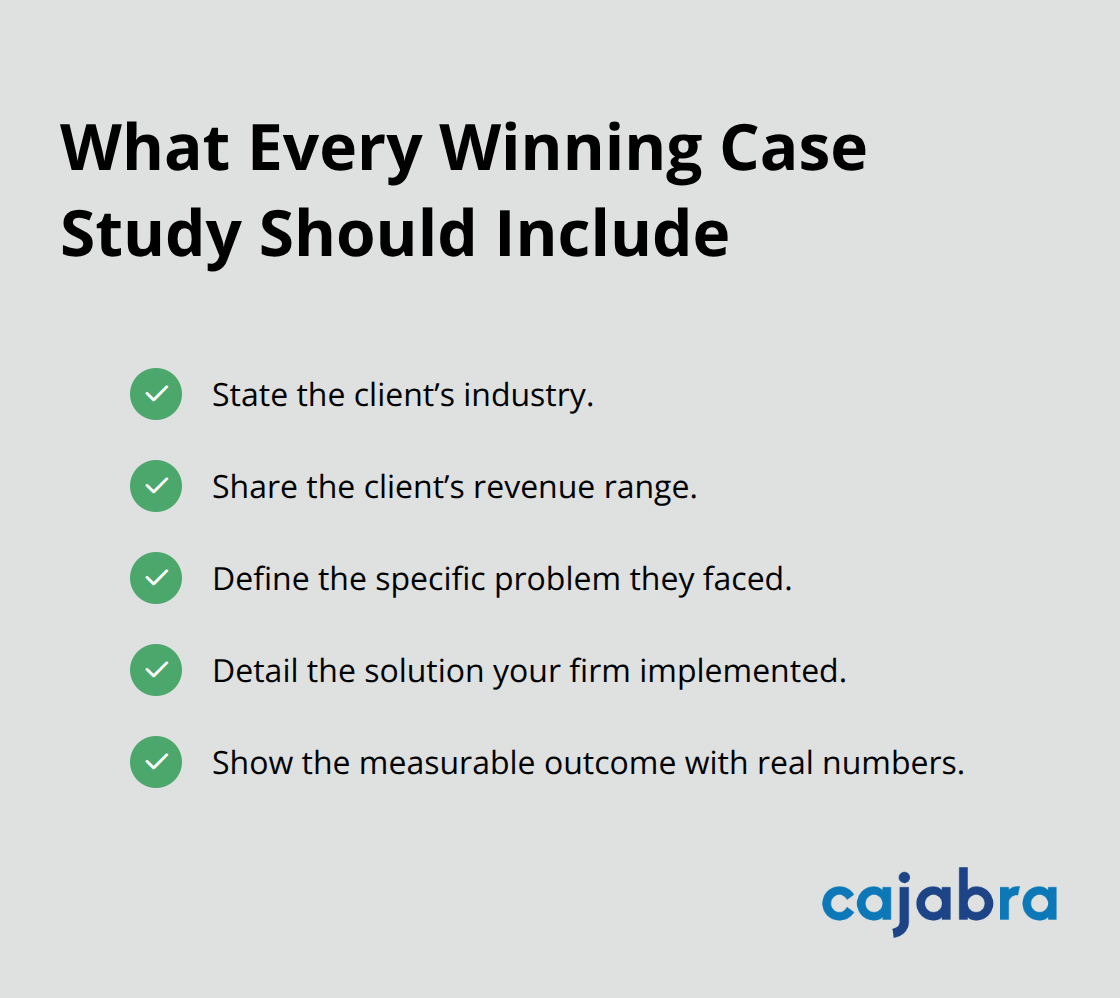
Case studies showing real client outcomes convert better than any other content format because prospects see themselves in the results. Rather than publishing vague success stories about how you helped a client save money, show the actual numbers: a construction company that reduced their tax liability by $47,000 through equipment depreciation planning, or a consulting firm that saved $23,500 annually by shifting to an S-corp structure. Include the client's industry, their revenue range, the specific problem they faced, the solution you implemented, and the measurable outcome. Prospects in similar situations see proof that your firm delivers concrete value in their circumstances.
Video content that educates and converts
Educational videos addressing specific regulations or accounting processes work well because business owners often search YouTube for how-to content before contacting an accountant. A five-minute video showing the step-by-step process for quarterly estimated tax payments or explaining new payroll compliance requirements positions your firm as accessible and helpful. The firms seeing results from video content treat it as a lead generation tool, not just a trust-builder, by including clear calls to action asking viewers to schedule a consultation or download a detailed guide. Content that educates without selling builds authority, but content that educates and then guides prospects toward the next step actually fills your pipeline.
Moving from content creation to distribution strategy
The content you create only matters if the right people find it. A detailed tax guide sitting on your website generates zero leads unless prospects searching for that information actually discover it. This is where distribution strategy separates firms that struggle with content marketing from those that see consistent client acquisition. The next section covers how to publish, promote, and nurture leads through the channels where your ideal clients actually spend their time.
How to Get Your Content in Front of the Right People
Creating excellent content means nothing if your ideal clients never see it. The firms that consistently fill their pipelines understand that distribution strategy matters as much as the content itself. Your website and blog form the foundation, but they remain passive-they wait for prospects to find you through Google. Email and LinkedIn are where you actively reach people who already know your firm or fit your ideal client profile. The most successful accounting practices treat these channels as interconnected parts of a single system: content attracts prospects, email nurtures them over time, and LinkedIn positions your firm as an authority worth following. This integrated approach generates far more leads than publishing great content and hoping people discover it.
Publish consistently to signal relevance to search engines
Your website needs a publishing rhythm that signals to Google that fresh, relevant content appears regularly. Firms publishing one substantial blog post every two weeks see measurable improvements in search rankings within three months. That means roughly two posts monthly addressing real questions your prospects search for-not filler content created just to publish something. Each post should target a specific keyword or search phrase your ideal clients actually use, with practical advice they can implement immediately.
Segment your email list to nurture different prospect types
Email newsletters capture leads from these blog posts and keep your firm top-of-mind with existing clients. The firms seeing real ROI from email segment email lists by client type for accounting firm email marketing. Send newsletters at least twice monthly-consistency matters more than frequency, so choose a schedule you can maintain indefinitely. This approach ensures each recipient gets relevant information rather than generic broadcasts that prospects ignore.
Build authority on LinkedIn through consistent engagement
LinkedIn requires a different approach than email. Instead of broadcasting to a list, you build visibility with individual business owners and CFOs who follow your content. Post insights about tax law changes, share client success stories without revealing confidential details, and comment thoughtfully on other accounting professionals' posts. The firms that win on LinkedIn post at least weekly and treat the platform as a conversation, not a broadcasting channel. LinkedIn's algorithm rewards engagement, so a post that generates 15 comments from your target audience reaches far more people than a post with 100 generic likes. Focus on attracting comments from business owners and CFOs in your ideal industries rather than chasing vanity metrics.
Repurpose content across channels to multiply its impact
Your content distribution strategy succeeds when each channel reinforces the others: a blog post gets repurposed into an email to your list, summarized as a LinkedIn post, and shared in relevant industry groups. This multiplies the value of every piece of content you create and ensures your message reaches prospects through the channels where they're most receptive. A single well-researched guide on tax strategy becomes a blog post, an email series, a LinkedIn carousel, and a downloadable resource that captures contact information. This systematic repurposing means you invest in creating one piece of quality content but extract far more value from it across multiple platforms where your ideal clients actually spend their time.
Final Thoughts
Content marketing for accounting firms isn't a quick fix or a marketing trend that fades. It's a systematic approach to building authority, attracting qualified leads, and positioning your firm as the strategic partner that business owners actually want to work with. The firms winning today started somewhere small-often with a single blog post addressing a real client question or a LinkedIn post sharing genuine insights about tax changes.
Start with one content type that fits your strengths and your market. If you're comfortable on video, create educational videos addressing specific regulations your ideal clients face. If writing is your strength, publish detailed guides on tax scenarios your best clients encounter. Two blog posts monthly, weekly LinkedIn posts, and a twice-monthly email newsletter will generate far more results than sporadic bursts of content creation followed by months of silence.
As your content generates leads and you see which topics resonate most, expand into other formats and channels. A successful blog post becomes a video, an email series, and a downloadable resource. Cajabra specializes in marketing systems designed specifically for accounting firms, helping you build a content strategy that consistently fills your pipeline with qualified leads and positions your firm as an industry leader.
Accounting firms that ignore social media are missing out on a direct line to potential clients. Social media marketing for accounting firms isn't optional anymore-it's how businesses find trusted advisors.
At Cajabra, LLC, we've seen firsthand how the right social media strategy transforms client acquisition and builds lasting credibility. This guide shows you exactly how to make it work for your firm.
Why Social Media Matters for Your Accounting Firm
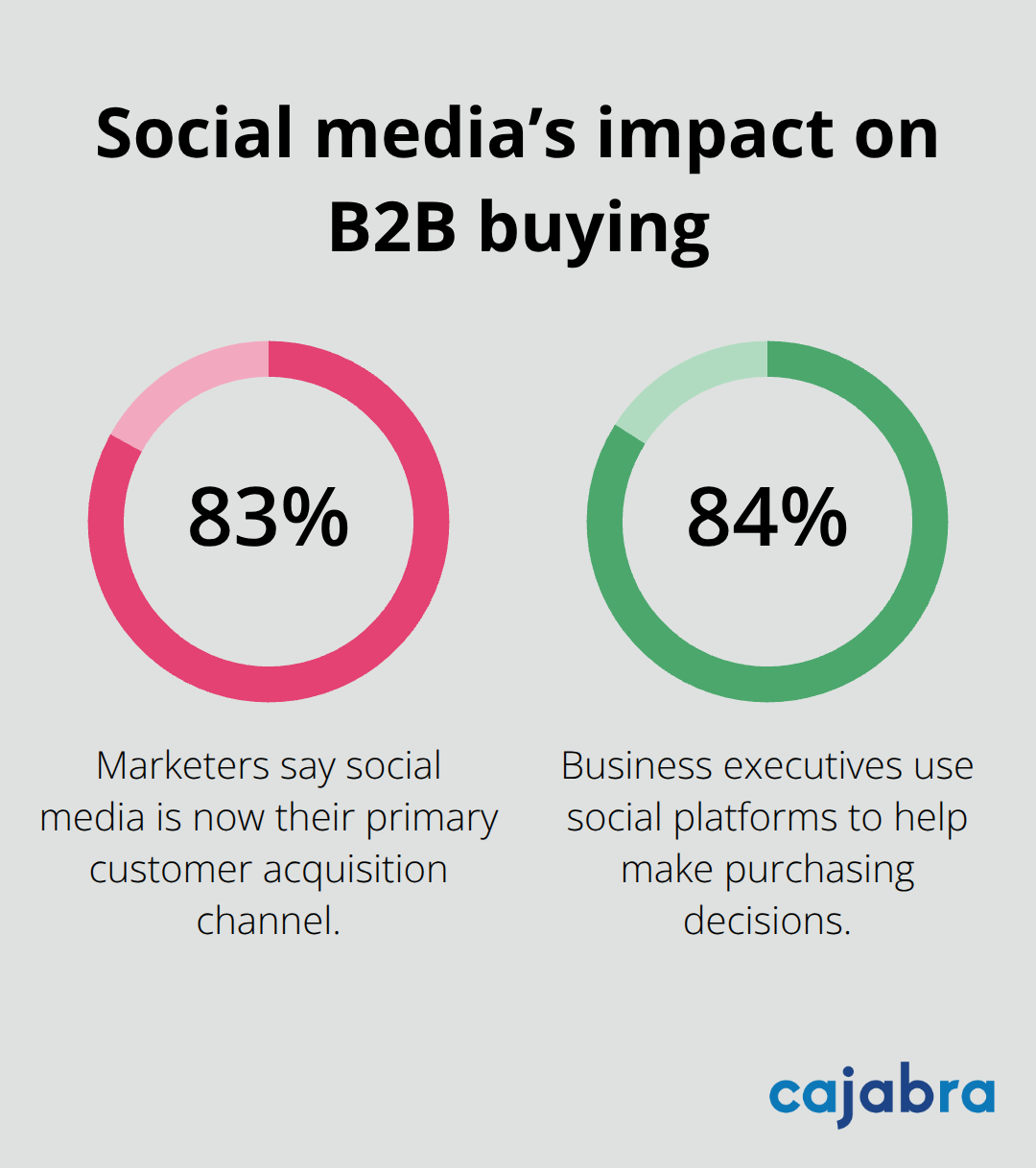
Social media isn't just about posting tax tips and hoping someone clicks. 83% of marketers say that social media has become their primary customer acquisition channel, and 84% of business executives use social platforms to help make purchasing decisions. For accounting firms, this means your potential clients actively research firms on LinkedIn, Facebook, and other platforms before they ever contact you. If you're not visible there, a competitor is.
The firms that dominate their markets aren't the ones with the most followers-they're the ones who show up consistently with relevant content that speaks directly to business owners and financial decision makers.
Your Reputation Lives Online Now
When a prospect searches for an accountant, they don't just look at Google reviews anymore. They visit your social profiles to understand your firm's personality, expertise, and whether they actually want to work with you. A weak or inactive social presence signals that you're either too busy or outdated. According to research from IDC, 84% of business executives use social media to make purchasing decisions, which means your social profile does the heavy lifting before your first conversation ever happens. The firms winning new clients position themselves as knowledgeable advisors, not transaction processors. LinkedIn is where this happens for accounting firms. That's not a vanity metric; that's a revenue channel you can't ignore.
Lead Generation Requires Consistency, Not Complexity
Email marketing delivers approximately $36 in value for every $1 spent, but you need leads to email in the first place. Social media feeds those leads directly into your funnel. When you post consistent, valuable content (tax deadline reminders, common client mistakes, industry updates), you capture attention from people actively thinking about accounting needs. The mistake most firms make is spreading themselves too thin across every platform. Focus on one or two channels where your target clients actually spend time. For most accounting firms, that's LinkedIn for reaching business owners and decision makers, combined with Facebook for broader reach and engagement. Posting once a month won't cut it. You need a realistic cadence-LinkedIn performs better with thoughtful, less frequent posts, while Facebook can handle 1-3 posts per week. The key is choosing a frequency you can actually maintain without burning out your team.
What Separates Active Firms from Invisible Ones
Your competitors are already on social media. Some post sporadically and wonder why nothing happens. Others maintain a consistent presence and watch leads arrive month after month. The difference isn't talent or luck-it's strategy. You need to decide which platforms align with where your ideal clients spend their time, then commit to a realistic posting schedule. LinkedIn demands thoughtful, long-form content that establishes your expertise. Facebook rewards a mix of educational posts, firm updates, and client stories. The firms that win understand that social media is a lead generation channel, not a vanity project. Your next move is selecting the right platforms and building a content strategy that actually converts prospects into clients.
Building a Social Media Strategy That Actually Works
Choose Your Platform and Master It First
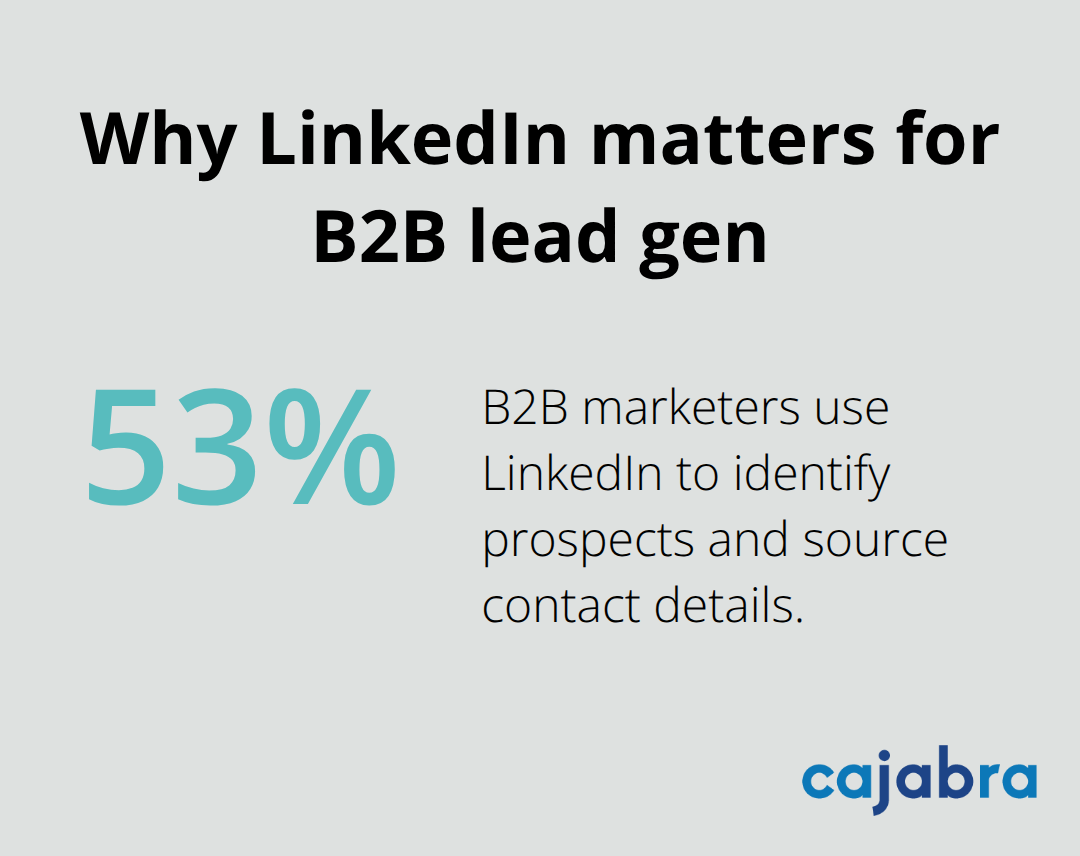
LinkedIn and Facebook serve different purposes, and treating them as interchangeable wastes your resources. LinkedIn reaches business owners and financial decision makers who actively consume professional content. According to Foundation Inc, 53% of B2B marketers use LinkedIn to identify prospects and source contact details, which means your target clients evaluate firms there. Facebook, with 2.89 billion monthly active users, offers broader reach but demands different content. Most accounting firms should start with LinkedIn because your ideal clients (business owners, CFOs, controllers) spend significant time there. Post thoughtfully once or twice per week with insights on tax law changes, common client mistakes, or industry trends. Avoid posting daily just to stay visible-LinkedIn users expect depth, not frequency.
Only add Facebook if you have capacity to maintain 1-3 posts weekly with educational content, firm updates, and client success stories. The Association for Accounting Marketing reports that high-growth firms spend about 2.1% of revenue on marketing, while average firms spend 1%. That investment goes further when you focus on two platforms executed exceptionally rather than scatter resources across five platforms executed poorly.
Create Content That Addresses Real Client Problems
Content that converts leads talks about client problems, not your credentials. Business owners searching for accountants want to know if you understand their specific challenges. A post about tax deadline extensions matters more to a small business owner than a post celebrating your firm's anniversary. Create content addressing the pain points your ideal clients actually face: managing cash flow, navigating tax compliance changes, preparing for audits, or reducing their tax burden. Share concrete examples from your experience without naming clients. If you work with contractors, post about quarterly estimated taxes and common deductions contractors miss. If you serve nonprofits, address grant accounting or Form 990 compliance issues. This positions you as someone who understands their world and speaks their language.
Amplify Your Content with Paid Advertising
Paid advertising on LinkedIn and Facebook amplifies your content to reach decision makers outside your existing network. LinkedIn ads cost between $2 and $15 per click depending on your industry and targeting, while Facebook ads typically run $0.50 to $5 per click. Start with a modest budget of $300 to $500 monthly on LinkedIn targeting business owners and finance professionals in your geographic area. Direct them to a landing page offering something valuable like a Year-End Tax Checklist or a 15-minute consultation. Track which ads generate actual leads through your CRM, then scale what works. Most accounting firms see their first qualified leads within 30 days of consistent paid advertising paired with strong organic content.
The next step involves measuring what actually works and adjusting your approach based on real performance data rather than assumptions about what your audience wants.
Where Accounting Firms Lose Momentum on Social Media
Most accounting firms post sporadically, ignore messages from prospects, and have no idea whether their social efforts generate actual revenue. These aren't minor oversights-they're the exact reasons why firms abandon social media after three months and declare it doesn't work. The reality is that social media requires discipline, not just good intentions. An accounting firm posting once every two weeks signals that either the firm is disorganized or too busy to engage with potential clients. Prospects notice this immediately.
Silence Kills Deals Before They Start
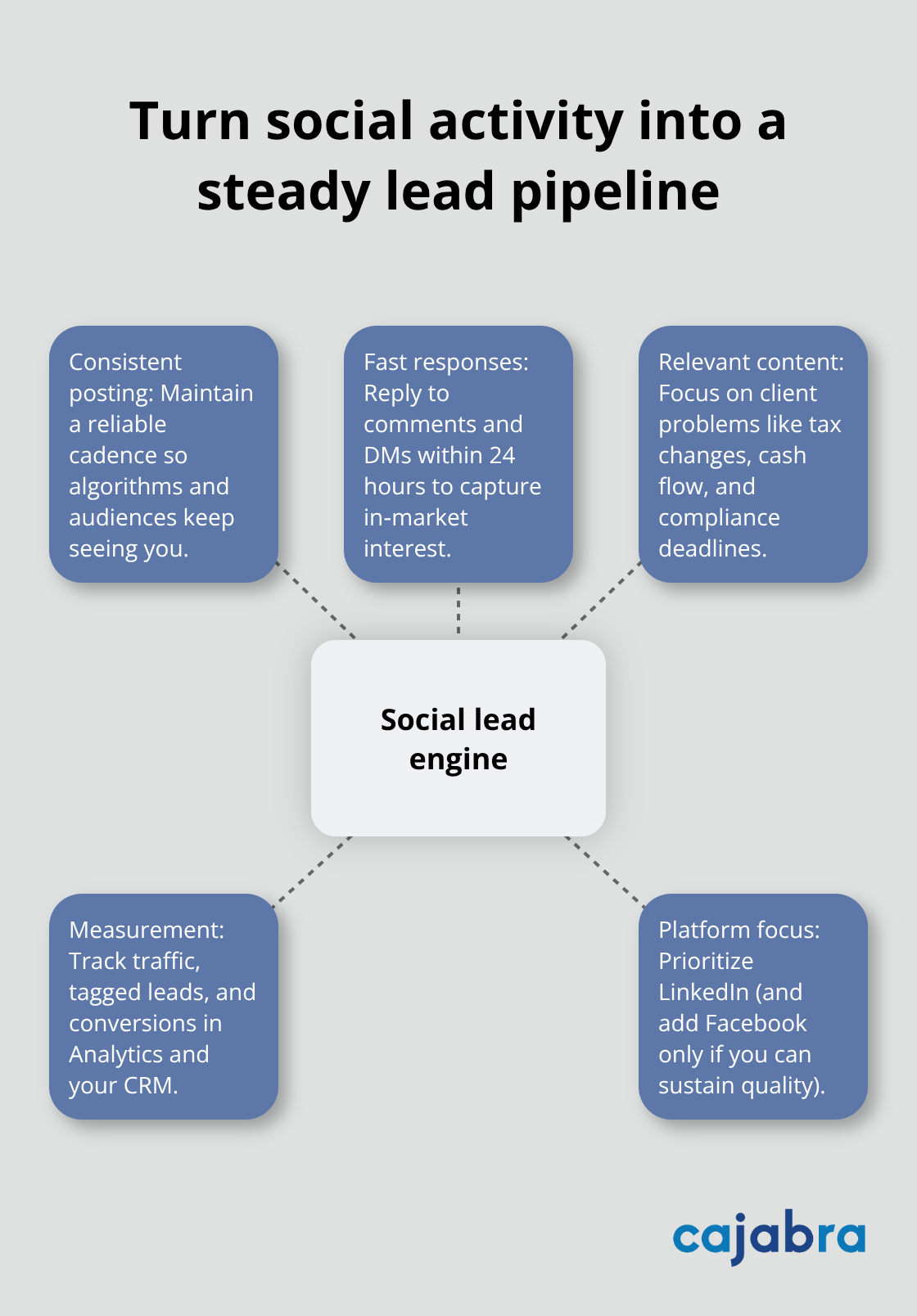
When someone comments on your post or sends a direct message asking about your services, a delayed response or silence kills the deal before it starts. Firms that respond to inquiries within 24 hours see significantly higher conversion rates than those that take days or weeks to reply. The difference between a firm that converts social leads and one that doesn't often comes down to three operational failures: inconsistent posting that keeps your firm invisible, neglecting direct messages and comments that indicate genuine interest, and never measuring whether your efforts actually produce leads or revenue.
Inconsistent Posting Destroys Momentum
Inconsistent posting destroys momentum faster than not posting at all. A firm that posts three times in January, disappears for February, and returns in March trains its audience to ignore notifications. LinkedIn's algorithm prioritizes content from accounts that post regularly, effectively punishing irregular posting by showing your content to fewer people. Facebook operates similarly-posts from inactive pages receive less reach. You need a sustainable cadence: LinkedIn performs well with one thoughtful post per week, while Facebook can handle 1-3 posts weekly. Choose a frequency your team can actually maintain, then schedule posts in advance using Buffer or a similar tool to remove the excuse that you forgot.
Irrelevant Content Wastes Your Effort
Irrelevant content is equally damaging. A post about your firm's holiday party or an employee's birthday might feel warm and human, but it doesn't attract business owners searching for accounting solutions. The content that converts focuses on problems your ideal clients face: tax law changes affecting their industry, common mistakes that cost money, or compliance deadlines they might miss. Track which posts generate engagement and leads, then create more of that content. Your social feed should reflect the problems you solve, not the life you live at the office.
Messages Require Fast Responses
When someone asks a question on your post or sends a direct message inquiring about your services, they're showing active interest. A response within hours-not days-separates firms that win clients from those that lose them to competitors who appear first in search results and maintain active engagement. Assign one team member ownership of social inbox monitoring, or use a CRM that consolidates messages from multiple platforms. This single operational change (quick response times) converts more prospects than any other social media tactic.
Measure Results or Operate Blind
Firms that don't track results spend money and time on social media while remaining completely blind to its impact. Set up Google Analytics to track traffic from social platforms to your website, use your CRM to tag leads that came from social, and measure whether social-sourced leads actually become paying clients. Without this data, you operate on assumptions rather than facts. Most accounting firms should expect 30 to 90 days before seeing consistent lead generation from social media, which means measuring results requires patience and a clear baseline for comparison.
Final Thoughts
Social media marketing for accounting firms works when you commit to consistency, relevance, and measurement. The firms that win post regularly on platforms where their ideal clients spend time, respond quickly to inquiries, and track which efforts actually produce leads and revenue. Start with one platform-LinkedIn for business owners and financial decision makers-and post one thoughtful piece of content per week addressing real problems your clients face. Add Facebook only if you can maintain 1-3 posts weekly with educational content and firm updates. Schedule posts in advance using Buffer so inconsistency doesn't sabotage your efforts.
Assign one team member to monitor messages and comments, responding within 24 hours to anyone showing genuine interest. Set up Google Analytics to track social traffic to your website and tag leads in your CRM that came from social channels. After 90 days, you'll have real data showing whether your social efforts produce actual clients. Track which posts generate engagement and which fall flat so you can adjust your strategy based on what actually works.
The biggest mistake accounting firms make is treating social media as optional or delegating it without clear expectations. If you're ready to move beyond sporadic posting and build a social presence that attracts retainer-based clients, Cajabra helps accounting firms secure consistent leads through strategic marketing systems. Start this week with one platform, one realistic posting schedule, and one clear measurement system.
Email marketing for accounting firms delivers results that other channels struggle to match. The ROI speaks for itself-firms that prioritize email see stronger client retention and more qualified leads.
At Cajabra, LLC, we've seen firsthand how the right email strategy transforms client relationships. This guide walks you through building a system that works, avoiding common pitfalls, and measuring what actually matters.
Why Email Marketing Delivers Real Returns for Accounting Firms
Email marketing generates approximately $36 in revenue for every $1 spent-a return that far exceeds what most accounting firms see from paid advertising, social media, or traditional outreach. This isn't theoretical. Firms that implement consistent email campaigns report stronger client retention and a steady stream of qualified leads without the acquisition costs that drain marketing budgets.
The reason is straightforward: email reaches decision-makers directly. Business owners and individual clients check email regularly, and when an accounting firm sends timely, relevant information about tax deadlines, cash flow management, or regulatory changes, the message lands in an inbox they actively monitor. This direct access means your firm competes on expertise and value, not on advertising spend.
Building Trust Through Consistent Communication
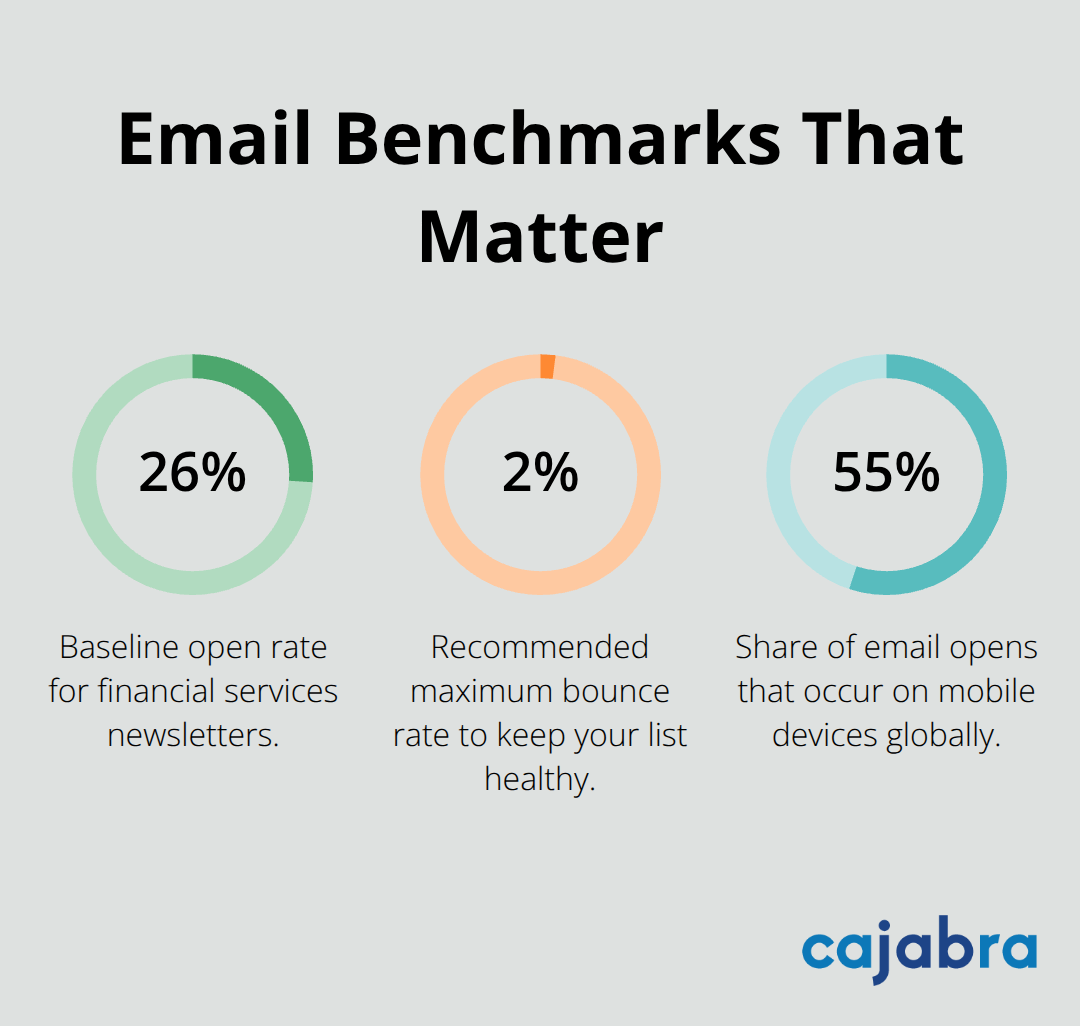
The relationship-building aspect matters equally. Current clients who receive regular newsletters with actionable tax tips or business insights develop deeper trust. Prospective clients who see your firm sharing free, practical guidance recognize competence before they ever schedule a consultation. Research shows that financial services newsletters average a 26% open rate-higher than most industries-which signals that accountants' audiences genuinely want this content.
The consistency of email also works in your favor. A single tax deadline reminder email sent at the right time can prompt a client to schedule a planning session. A monthly newsletter keeps your firm top-of-mind without requiring the constant content production that social media demands. Unlike ads that disappear once you stop paying, email builds cumulative value. Each message reinforces your positioning and creates touchpoints that compound over time.
Track the Metrics That Reveal True Performance
Open rates tell you whether your subject lines resonate with recipients. Try for at least 26% based on financial services benchmarks, though many accounting firms exceed 30% with targeted segmentation. Click-through rates should hover around 2.7% or higher-this metric reveals whether your content actually addresses what clients care about.
Conversion rates vary widely, but tracking how many email recipients become paying clients or schedule consultations shows your true ROI.
The real test is this: compare the cost of sending 500 emails monthly to the value of even one new client retainer. For most accounting firms, that single client pays for years of email marketing. Bounce rates should stay below 2%, which indicates your list is clean and engaged. Unsubscribe rates above 0.5% signal that your content misses the mark or you're sending too frequently.
These metrics guide every decision you make going forward-and they reveal which segments of your audience respond best to different types of messages. Understanding these patterns positions you to refine your approach before moving into the strategic work of segmentation and content creation.
Building Your Email List and Segmentation Strategy
Start With What You Already Have
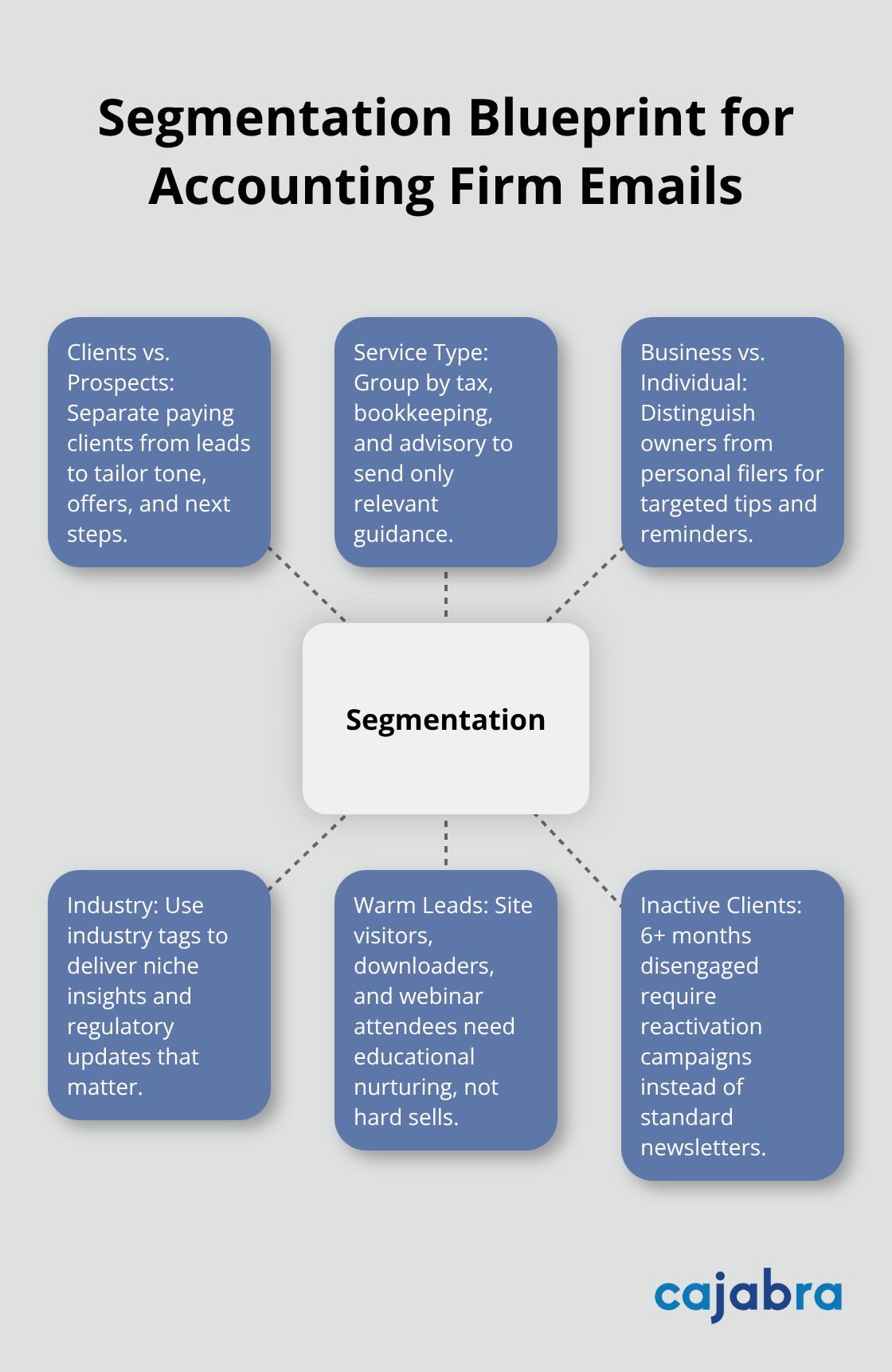
Your current clients and contacts form your foundation, and they've already demonstrated trust in your firm. Pull everyone from your accounting software, CRM, and email archives who opted in to communications. This isn't a starting point for growth-it's your launch pad for demonstrating results before you expand. Segment this list immediately by what you know: clients versus prospects, service type (tax, bookkeeping, advisory), business versus individual, and industry if you track it. A business owner receiving tax tips for freelancers doesn't care about payroll guidance.
Segment ruthlessly, and your open rates climb.
Your second segment should be warm leads-people who visited your website, downloaded a guide, or attended a webinar but didn't hire you yet. These prospects respond better to educational content than hard sells. A third segment covers inactive clients who haven't engaged in six months or longer. These need reactivation campaigns, not standard newsletters. Most accounting firms ignore this segment and lose clients they could recover with a single well-timed message about a service change or tax law update.
Tailor Content to Each Segment's Specific Needs
Content creation stops being theoretical once you segment. Someone managing a small e-commerce business needs cash flow management tips and quarterly tax planning reminders. A contractor needs deduction tracking strategies and estimated tax payment schedules. An established corporation needs year-end planning and entity structure optimization insights. Your newsletters should address these specific pain points, not general accounting concepts. This targeted approach transforms your email from a broadcast tool into a relationship-building asset that speaks directly to what each segment actually cares about.
Automate Your Campaigns for Consistent Results
Automation handles the consistency that makes email work. Set up welcome sequences that trigger immediately when someone joins your list-three emails over ten days covering your firm's approach, your core services, and client testimonials. Then build seasonal campaigns around tax deadlines: one email ninety days before filing, another forty-five days before, a reminder thirty days out, and a post-filing follow-up offering planning for next year. These sequences repeat annually for every new contact who joins your list.
Most modern platforms-Mailchimp, ActiveCampaign, HubSpot-offer templates and drag-and-drop builders that eliminate technical barriers. Schedule these campaigns in advance so you're not scrambling during tax season. Set them up once in January, and they run on autopilot for the next twelve months. Track which segments open your emails, click your links, and actually schedule consultations. That data reveals which content resonates and which segments need different messaging entirely.
With your list segmented and automation in place, you're ready to address the mistakes that derail most accounting firms' email efforts.
Common Email Marketing Mistakes Accounting Firms Make
Personalization That Stops at First Names
Most accounting firms insert a first name into a generic template and call it personalization. This approach fails because decision-makers spot the lack of genuine customization immediately. A business owner who received three emails about tax deductions for W-2 employees last month does not need the same message this month, yet many firms send identical newsletters to everyone on their list regardless of what services they actually use or what questions they have asked. The data confirms this costs responses. Firms that use dynamic content blocks-which change based on recipient type, industry, or past interactions-see open rates jump to 35% or higher compared to 22% averages for one-size-fits-all sends.
Personalization extends far beyond names. Reference the specific service they hired you for, mention a previous conversation about their cash flow concerns, or highlight tax strategies relevant to their business type. If your email platform does not support conditional content based on custom fields, switch platforms immediately. Mailchimp, HubSpot, and ActiveCampaign all offer this functionality at entry-level pricing. The firms winning with email treat each segment as a distinct audience that deserves messaging tailored to their actual situation, not a broadcast list receiving identical content.
Timing and Frequency That Kill Engagement
Accounting firms often send newsletters monthly on the first Tuesday regardless of whether that is when their audience reads email, then wonder why open rates crater to 15%. Worse, some firms send sporadic emails with months of silence between messages, which trains subscribers to ignore them entirely. Email frequency should match your audience's expectations and your content calendar. Send quarterly newsletters consistently on the same day each quarter, but layer in seasonal campaigns around tax deadlines ninety, sixty, and thirty days before filing.
Most professionals check email between 9 a.m. and noon on weekdays, but your specific list may differ. Use your platform's send-time optimization feature if available, which tests different times and learns when your audience engages highest. Schedule emails in advance so you do not scramble during busy season, and establish a cadence your team can maintain year-round without burnout.
Mobile Optimization That Most Firms Ignore
Mobile devices account for 55% of email opens globally, yet firms still send emails designed for desktop with tiny fonts, unclickable links, and images that do not scale properly. Test every email on mobile before sending by viewing it on an actual phone or using your platform's mobile preview. Keep body text at least 14 pixels, use single-column layouts, and make call-to-action buttons thumb-friendly at 44 by 44 pixels minimum.
An accounting firm that sends beautifully designed emails optimized for desktop but unreadable on mobile essentially throws away half their engagement. Set up mobile-first design as your standard, not an afterthought. Your platform should handle responsive design automatically, but verify this before committing to any tool.
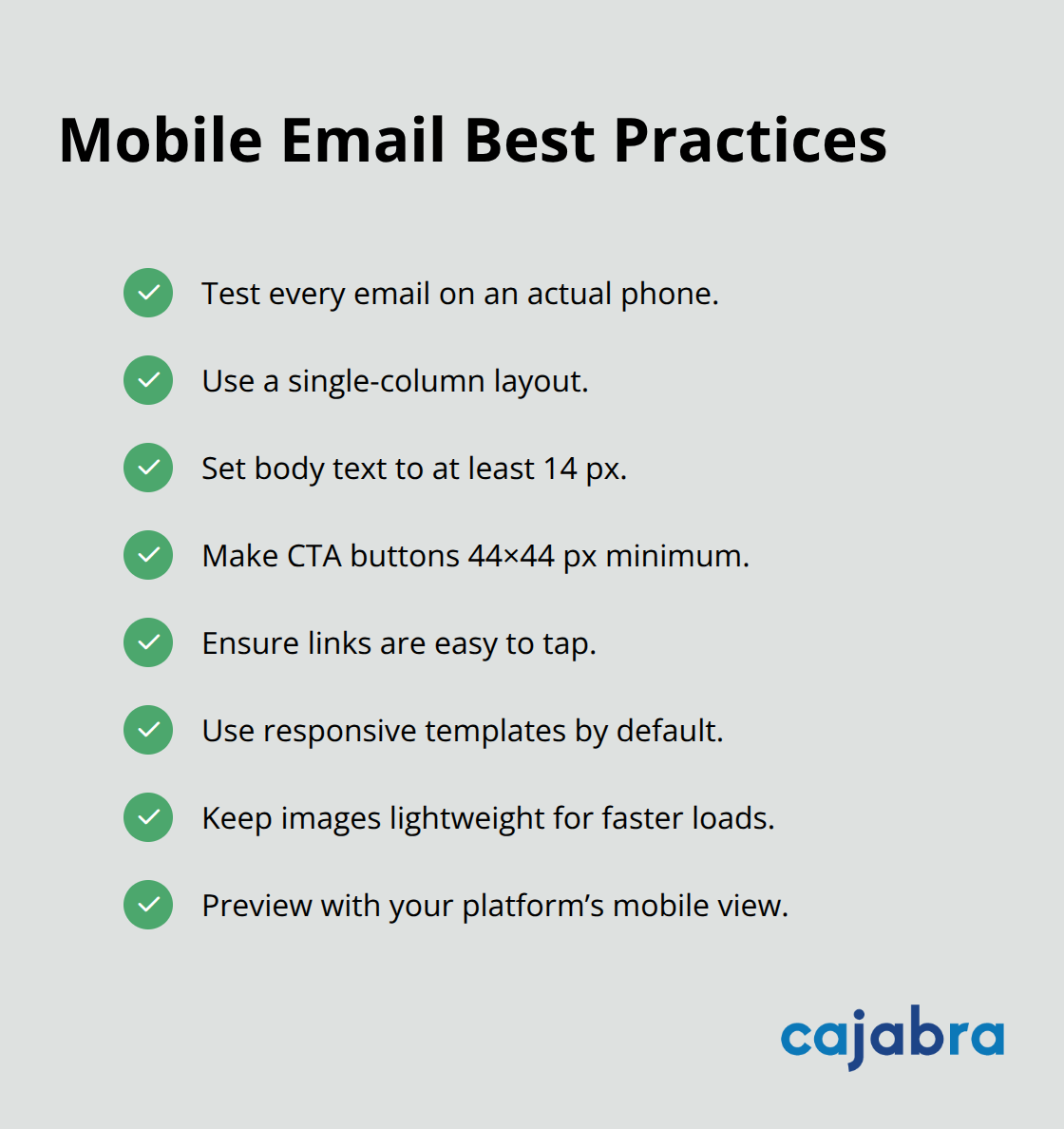
The firms that treat mobile optimization as non-negotiable capture significantly more responses from their email efforts.
Final Thoughts
Email marketing for accounting firms compounds over time, with each message reinforcing your expertise and keeping your firm top-of-mind when clients need help. Start by auditing your current email list, pulling contacts from your accounting software and CRM, then segment by client type and service to identify which segments have gone silent. Set up a welcome sequence for new contacts that covers your firm's approach and core services, then build seasonal campaigns around tax deadlines ninety, sixty, and thirty days before filing.
Track open rates, click-through rates, and conversion rates from day one because these metrics reveal which segments respond to your content and which need different messaging. A 26% open rate serves as your baseline for financial services audiences, but targeted segmentation regularly pushes this higher, and when you see a segment consistently opening emails and clicking links, that segment is ready for a direct offer to schedule a consultation. The real measure of success is straightforward: how many new clients did email marketing bring in, and what is the lifetime value of those relationships compared to what you spent sending messages?
For most accounting firms, even one new retainer client pays for a year of email marketing, and the consistency of email also reduces client churn because regular communication keeps your firm visible and reinforces the value you deliver. We at Cajabra, LLC understand that email marketing is one piece of a larger growth strategy, and our approach helps accounting firms move from overlooked to overbooked by securing retainer-based clients through proven systems. Explore how Cajabra can help your firm grow and accelerate your email results with a complete marketing system that attracts ideal clients.
You’ve done the hard work. Your accounting firm has a professional website, helpful content, and clear services. But the real moment of truth happens in a split second - when a visitor decides whether to click “Book a Consultation.”
That single click might look simple. In reality, it’s the result of a complex psychological process happening in your prospect’s brain. Understanding why business owners click (or don’t) can transform your website from a digital brochure into a reliable client-generation machine.
Let’s look at what’s actually happening in the mind of your potential client, and the psychological triggers that lead to that all-important first click.
The First Click Happens Faster Than You Think
When a business owner lands on your website, their brain makes rapid judgments within seconds.
Psychologists often refer to two systems of thinking:
- Fast, intuitive thinking that makes snap decisions
- Slow, analytical thinking that evaluates details
Most website decisions happen in the fast system.
That means visitors aren’t carefully analyzing every page. Instead, they’re asking subconscious questions like:
- “Does this firm understand my problems?”
- “Do they look trustworthy?”
- “Is it easy to take the next step?”
If your website answers those questions quickly and clearly, the brain feels safe enough to click. If not, the visitor leaves. That’s why the most effective call-to-action buttons are not just design elements - they’re psychological cues.

Clarity Beats Cleverness
The human brain loves simplicity. When a CTA is vague, visitors must spend mental energy figuring out what happens next. And when cognitive effort increases, conversion drops.
Compare these two examples:
- Contact Us
- Book Your 15-Minute Tax Strategy Call
The second option removes uncertainty. It tells visitors exactly what they’ll get and how long it will take. Clear CTAs reduce decision friction and make the brain more comfortable taking action. For accounting firms, specificity works especially well because business owners value predictability and control.
The Brain Responds to Immediate Value
A visitor is far more likely to click when they see a clear benefit waiting for them. Psychologically, the brain asks:
“What’s in it for me right now?”
CTAs that highlight immediate value trigger curiosity and motivation.
Instead of:
- Schedule a Call
Try something like:
- Get Your Tax Strategy Consultation
- See How Much You Could Save on Taxes
- Find Out If Your Business Structure Is Costing You Money
These CTAs promise insight, not just a meeting. And insight is incredibly powerful for business owners making important financial decisions.

Small Commitments Feel Safer
Hiring an accountant is a big decision. Business owners know their finances, taxes, and compliance are on the line. That’s why asking for a full commitment too early can feel risky. Psychologists call this the “foot-in-the-door” effect. People are more likely to say yes to a small action first.
A consultation CTA works because it’s a micro-commitment: a simple next step rather than a major decision. So, instead of asking:
- “Ready to hire us?”
You’re offering:
- “Let’s have a quick conversation.”
This lowers psychological resistance and helps prospects move forward.
Trust Signals Calm the Brain
Before someone clicks a CTA, their brain performs a quick trust check: Is this firm credible?
Do other businesses work with them? Will this be worth my time? Without trust signals, visitors hesitate.
That’s why elements like these dramatically increase clicks:
- Client testimonials
- Google reviews
- Industry specialization
- Case studies
- Professional credentials
When trust markers appear near a CTA, they reduce uncertainty. The brain interprets these signals as social proof, making the next step feel safer.
Turning Psychology Into More Consultations
When accounting firms understand what drives that first click, their marketing becomes dramatically more effective. Instead of hoping visitors contact you, your website guides them toward the next step naturally. The key is aligning your calls-to-action with how people actually make decisions. When those elements come together, something powerful happens. Visitors stop browsing… and start booking consultations.

Transform Website Visitors Into Clients
If your website isn’t consistently generating consultations, the problem usually isn’t traffic, but rather conversion - and that’s where Cajabra can help. We assist accounting firms turn website visitors into real opportunities with tools like:
- Automated consultation scheduling
- High-converting landing pages
- CRM lead tracking
- Chat widgets that capture prospects instantly
- Marketing automation that nurtures leads until they’re ready to engage
Instead of letting potential clients leave your website unnoticed, Cajabra helps you guide them toward that all-important first click. Ready to turn more website visitors into booked consultations?
Most accounting firms still rely almost entirely on referrals, leaving significant revenue on the table. Digital marketing for accounting firms isn't optional anymore-it's the difference between steady growth and stagnation.
At Cajabra, LLC, we've seen firsthand how firms that implement strategic digital marketing attract higher-quality clients and build sustainable pipelines. This guide shows you exactly how to do it.
Why Digital Marketing Matters for Accounting Firms
Referrals remain the dominant client acquisition channel for accounting firms, but this approach creates a ceiling on growth. Research from The CPA Journal shows that firms relying solely on word-of-mouth miss opportunities to control their own pipeline and attract clients actively searching for services online. When you depend on referrals, you're at the mercy of your existing client network's size and willingness to recommend you. You also lose visibility to prospects who don't know anyone in your firm, which means you're invisible to a significant portion of your market. The firms growing fastest aren't waiting for referrals to arrive-they're building digital systems that generate consistent inbound inquiries.
The Real Cost of Staying Invisible Online
Accounting firms that lack a strategic digital presence lose deals to competitors who appear first in search results and maintain active engagement on LinkedIn and Facebook. According to Google, top three organic search results capture a significant share of clicks, and accounting clients increasingly search online before contacting a firm. If you're not ranking for keywords like tax planning for small businesses or accounting services for startups in your area, prospects never find you. Meanwhile, firms with optimized websites, consistent content, and targeted paid search campaigns capture those searches and convert them into retainer clients. The gap between firms investing in digital marketing and those ignoring it has widened dramatically. High-growth accounting firms allocate more than twice the marketing budget of slower-growth firms, according to industry benchmarks, and they focus that investment on channels that deliver measurable results.
Building Authority That Attracts Premium Clients
Digital marketing allows you to demonstrate expertise before a prospect ever picks up the phone. You can publish content about tax law changes, create videos explaining complex accounting concepts, or share case studies of how you've solved client problems-all of which position your firm as the authority in your niche. This authority-based approach attracts clients who are ready to hire and willing to pay retainer fees because they've already seen proof of your knowledge. Firms that establish themselves as thought leaders through consistent, high-quality content see higher-quality inquiries and shorter sales cycles. LinkedIn has become essential for this-CPAs who optimize their profiles, share insights on industry trends, and publish educational articles consistently outpace competitors in attracting decision-makers and referral partners. Your online presence directly influences whether prospects perceive you as a commodity or as a specialized advisor worth paying premium fees.
Why Your Next Client Is Searching Right Now
The shift toward digital discovery means your ideal clients are already online, looking for solutions to their accounting challenges. They search for answers, compare firms, and read reviews before they ever contact you. Firms that appear in those search results and maintain credible social profiles capture inquiries that firms without digital presence never see. This isn't about vanity metrics-it's about controlling whether prospects find you or your competitor first. The firms that master this transition from invisible to discoverable build sustainable pipelines that don't depend on who knows whom.
Build Your Digital Foundation That Actually Converts
Your Website Decides Whether Prospects Hire You
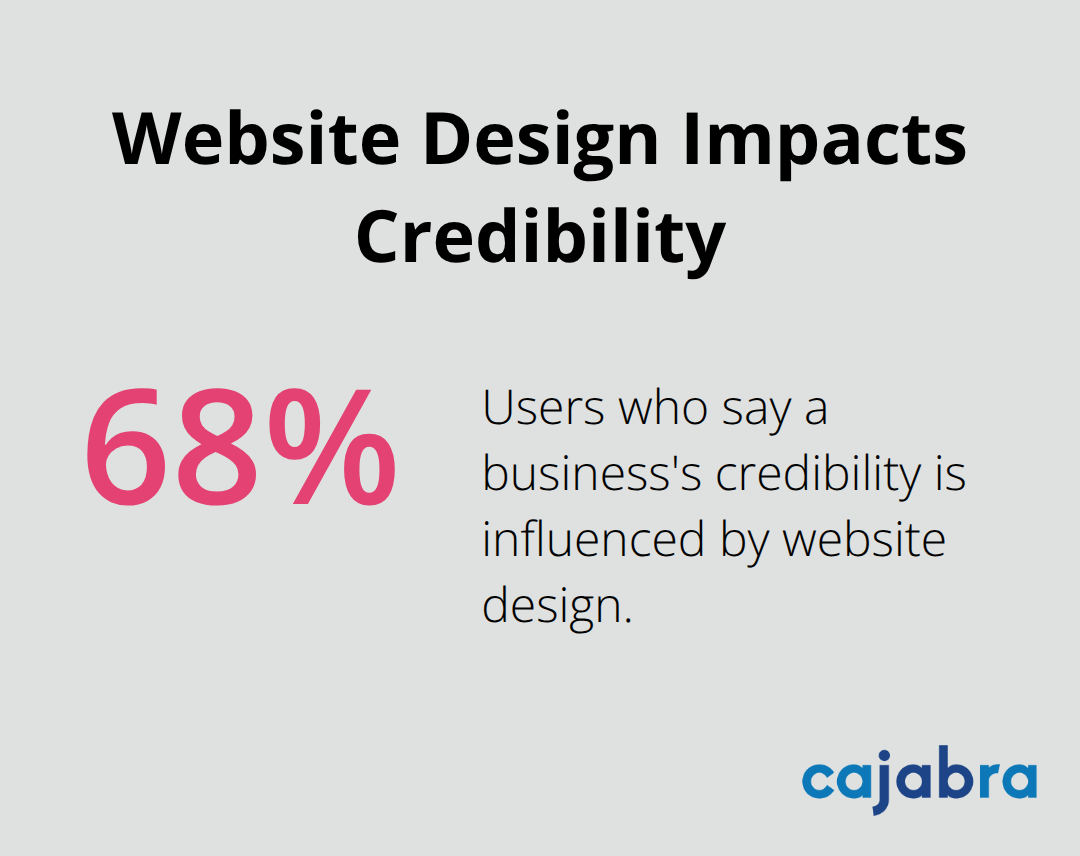
Your website is where prospects decide whether to hire you or call your competitor. 68% of users say a business's credibility is influenced by the design of its website, which means your digital front door determines whether someone books a consultation or bounces to the next firm. Most accounting firm websites fail because they function as brochures, not conversion machines.
They list services, show team photos, and stop there. Instead, your website needs three elements working together: a clear value proposition above the fold that explains who you serve and what problem you solve, visible customer testimonials or case results near the top to build immediate trust, and multiple calls-to-action that guide visitors toward scheduling a consultation or downloading a resource.
Test your site yourself-land on your homepage and ask if you instantly understand what you do and who benefits from your services. If the answer isn't obvious within five seconds, your site costs you clients.
Speed, Mobile Optimization, and Content Architecture Drive Results
Mobile responsiveness is non-negotiable because most accounting prospects research firms on their phones. Fast load times matter too-pages that take more than three seconds to load see dramatically higher bounce rates. Beyond speed and mobile optimization, your website needs content architecture that supports search visibility. Service pages should address specific client situations like tax planning for e-commerce businesses or accounting for professional practices, not generic descriptions of tax preparation.
Blog content should target real questions prospects ask: how much should a small business budget for accounting, what tax deductions am I missing, when do I need an accountant. This content drives organic search traffic and positions your firm as someone who understands client challenges before they contact you. Google's top three search results capture roughly 54 percent of clicks, so ranking for local and service-specific keywords directly impacts your pipeline.
Humanize Your Expertise Through Team Profiles and Case Studies
Your website should feature your team-bios with photos, client testimonials with names and businesses, and case studies showing specific results you've delivered. Prospects hire people, not firms, so humanize your expertise and make it obvious why someone should work with you instead of a competitor down the street. This approach transforms your site from a generic listing into a trust-building engine that attracts clients ready to pay retainer fees.
Treat Social Media as a Relationship-Building Channel, Not a Broadcast Platform
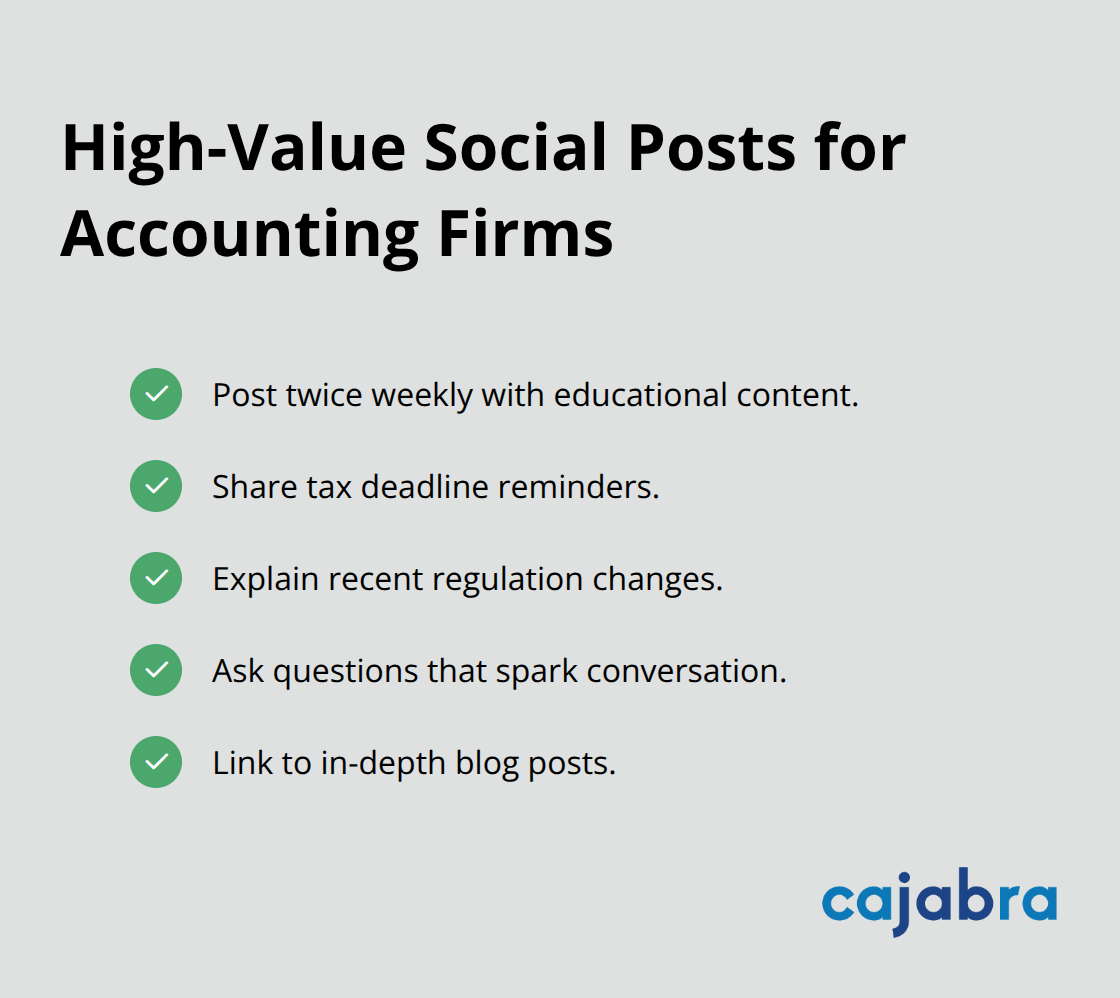
LinkedIn and Facebook amplify your authority but only if you treat them as relationship-building channels. Post consistently-twice weekly minimum-with content that educates rather than sells. Share tax deadline reminders, explain recent regulation changes, ask questions that spark conversation, and link back to detailed blog posts on your website.
LinkedIn requires a different approach than Facebook; on LinkedIn, target decision-makers and business owners with insights about tax strategy and business growth, while Facebook works better for local visibility and community engagement. The mistake most firms make is posting sporadically and then wondering why nobody engages. Consistency builds algorithm trust and keeps your firm top-of-mind when prospects face accounting challenges. This foundation-a conversion-focused website paired with active social engagement-creates the visibility and credibility that transforms how prospects perceive your firm.
Turn Marketing Data Into Revenue Growth
Measure What Matters: Cost Per Qualified Lead
Data collection means nothing without action. Most accounting firms track website visitors and email opens but never convert those metrics into decisions about where to spend their next marketing dollar. Start with a single metric that matters: cost per qualified lead. Divide your total marketing spend by the number of prospects who fit your ideal client profile and expressed genuine interest. If you spend $2,000 monthly on Google Ads and capture five qualified leads, your cost per lead is $400.
Now ask whether that lead justifies the expense based on your average retainer value. If your typical client retainer is $5,000 annually, a $400 cost per lead makes sense. If it's $1,500, shift budget to cheaper channels like email marketing or content that generates inbound inquiries at lower cost. The fastest-growing firms measure this ruthlessly and adjust weekly, not quarterly. Google Analytics and your CRM should feed directly into a simple spreadsheet where you track which channels deliver leads at acceptable costs.
Email Outperforms Social Media for Lead Conversion
Email outperforms social media for lead conversion, yet most firms underuse it. The reason is straightforward: email requires discipline. You must capture emails from every prospect interaction, segment your list by client type or service interest, and send timely messages around tax deadlines and regulatory changes. Tools like Mailchimp handle automation for under $20 monthly, so cost isn't the barrier. Email feels old-fashioned compared to social media, even though email consistently outperforms social for lead nurturing.
A prospect who lands on your website needs five to seven touches before they hire you. Email delivers those touches directly to their inbox while social media relies on algorithm luck. Segment your email list into three groups: existing clients who receive service updates and cross-sell offers, prospects who downloaded a resource or attended a webinar, and cold subscribers who signed up for tax tips.
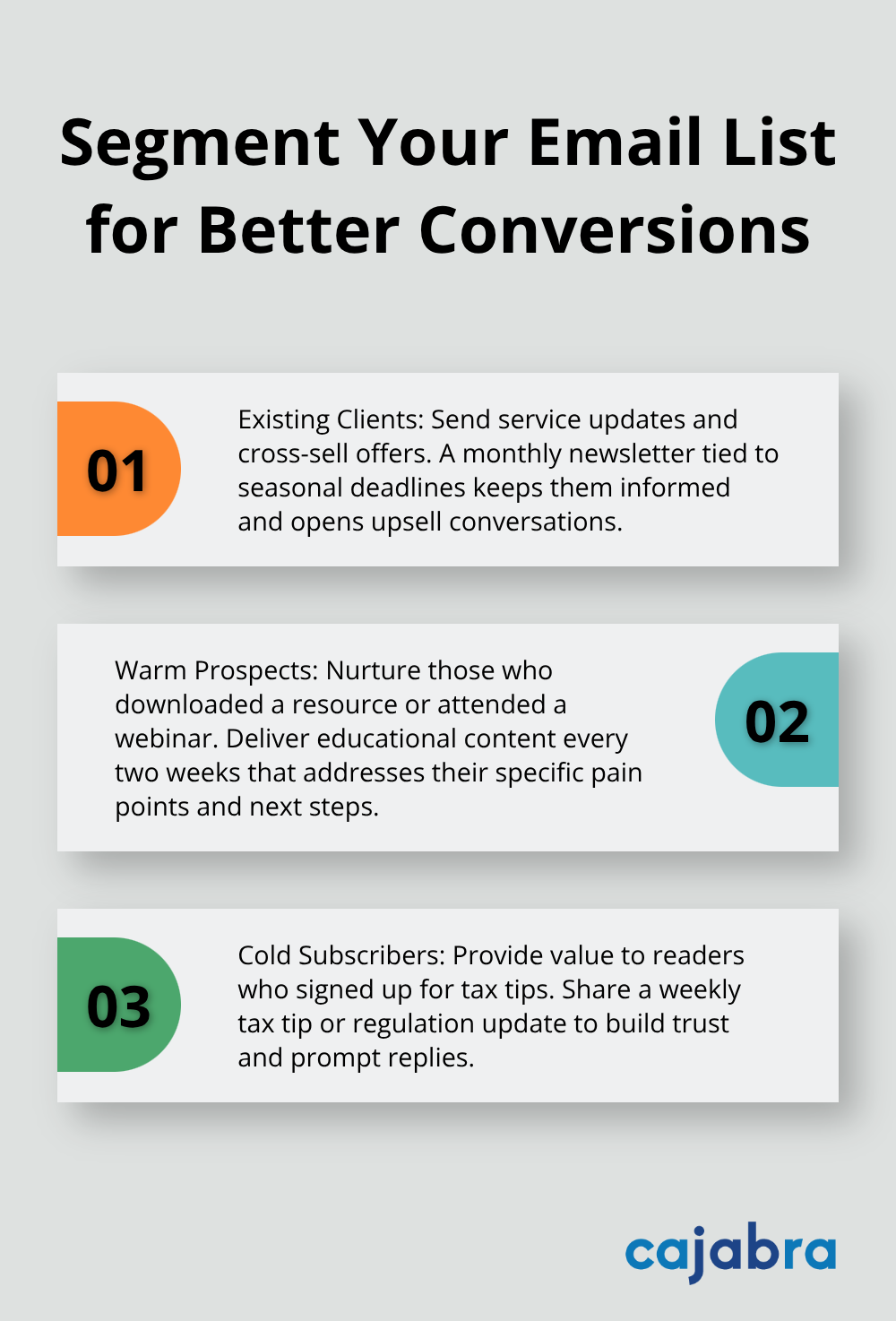
Send existing clients a monthly newsletter tied to seasonal deadlines. Send prospects educational content every two weeks that addresses their specific pain point. Send cold subscribers a weekly tax tip or regulation update.
Track Performance and Kill Underperforming Campaigns
Track open rates and click-through rates for each segment and eliminate campaigns that generate less than a 15 percent open rate after three sends. This systematic approach transforms email from a broadcast channel into a lead conversion machine that produces retainer clients consistently. Most accounting firms ignore email discipline because they're uncomfortable with the math, which is ironic given their profession. The firms that systematize email capture, segmentation, and timing control their own pipeline instead of waiting for referrals to arrive.
Final Thoughts
The accounting firms winning today control their own growth through digital marketing systems that work while they sleep. They transformed from invisible to indispensable by building conversion-focused websites, publishing content that ranks in search results, and systematizing email to nurture prospects into retainer clients. Your next client searches for accounting services right now, compares firms online, and decides who deserves their business based on what they find-if you're not visible in those moments, you lose.
The gap between firms implementing digital marketing for accounting firms and firms ignoring it widens every month. Your competitors are already optimizing their websites, publishing content that ranks in Google, and systematizing email to convert prospects into clients. The question isn't whether digital marketing works for accounting firms anymore; the question is whether you act today or watch your market share shrink tomorrow.
Start this week with one concrete action: audit your website, capture one email from every prospect interaction, post one piece of content on LinkedIn, or track one metric that matters. Small actions compound into systems that generate consistent revenue, and Cajabra helps accounting firms build these exact systems through tailored digital strategies that position you as the industry leader your market needs.
Your accounting website might be costing you business without you realizing it. At Cajabra, LLC, we've seen countless firms lose potential clients simply because their site fails to convert visitors into leads.
Website optimization isn't optional anymore-it's the difference between thriving and struggling. The good news is that fixing these problems doesn't require a complete overhaul.
Why Your Website Design Is Costing You Clients
An outdated website layout signals to visitors that your firm operates behind the times. According to Adobe, 38% of people stop engaging with a site if the content or layout is unattractive. That means more than one-third of potential clients leave before they even learn what you offer. Slow loading speeds compound this problem significantly. Mobile-unfriendly design represents perhaps the worst offender. Over 70% of digital traffic now comes from mobile devices, yet many accounting firms still operate sites designed for desktop users. When someone searches for an accountant on their phone and lands on your site only to find unreadable text and broken navigation, they click to a competitor in seconds.
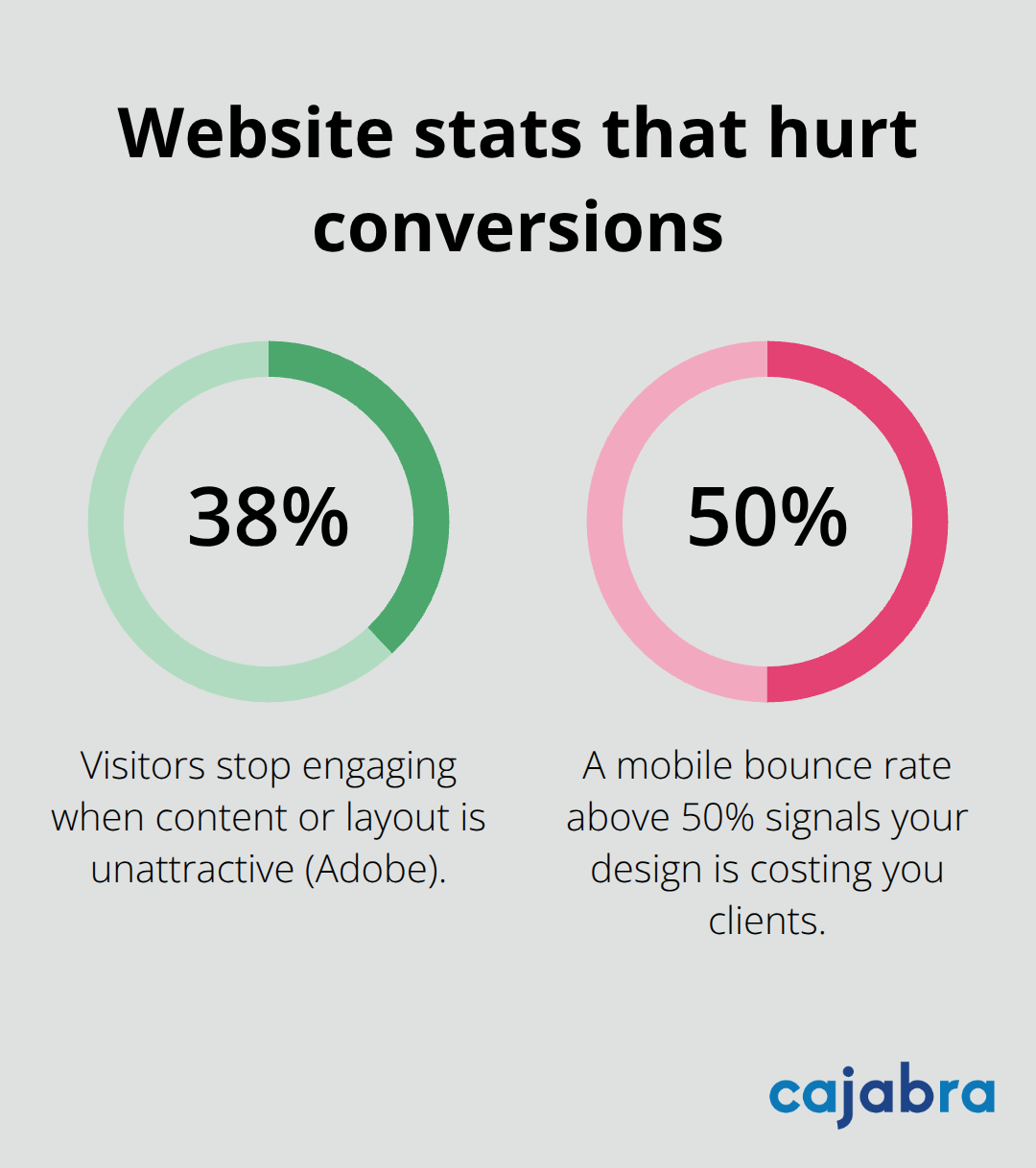
The financial cost is real and measurable. A firm losing even five qualified leads per month due to poor site design forfeits $50,000 to $100,000 in annual revenue, depending on your average client value.
Your Site's Speed Directly Impacts Lead Generation
Page speed affects far more than user experience. Google uses loading speed as a ranking factor, meaning slow sites rank lower and receive less visibility. If your site takes five seconds to load instead of two, you lose search traffic before anyone even arrives.
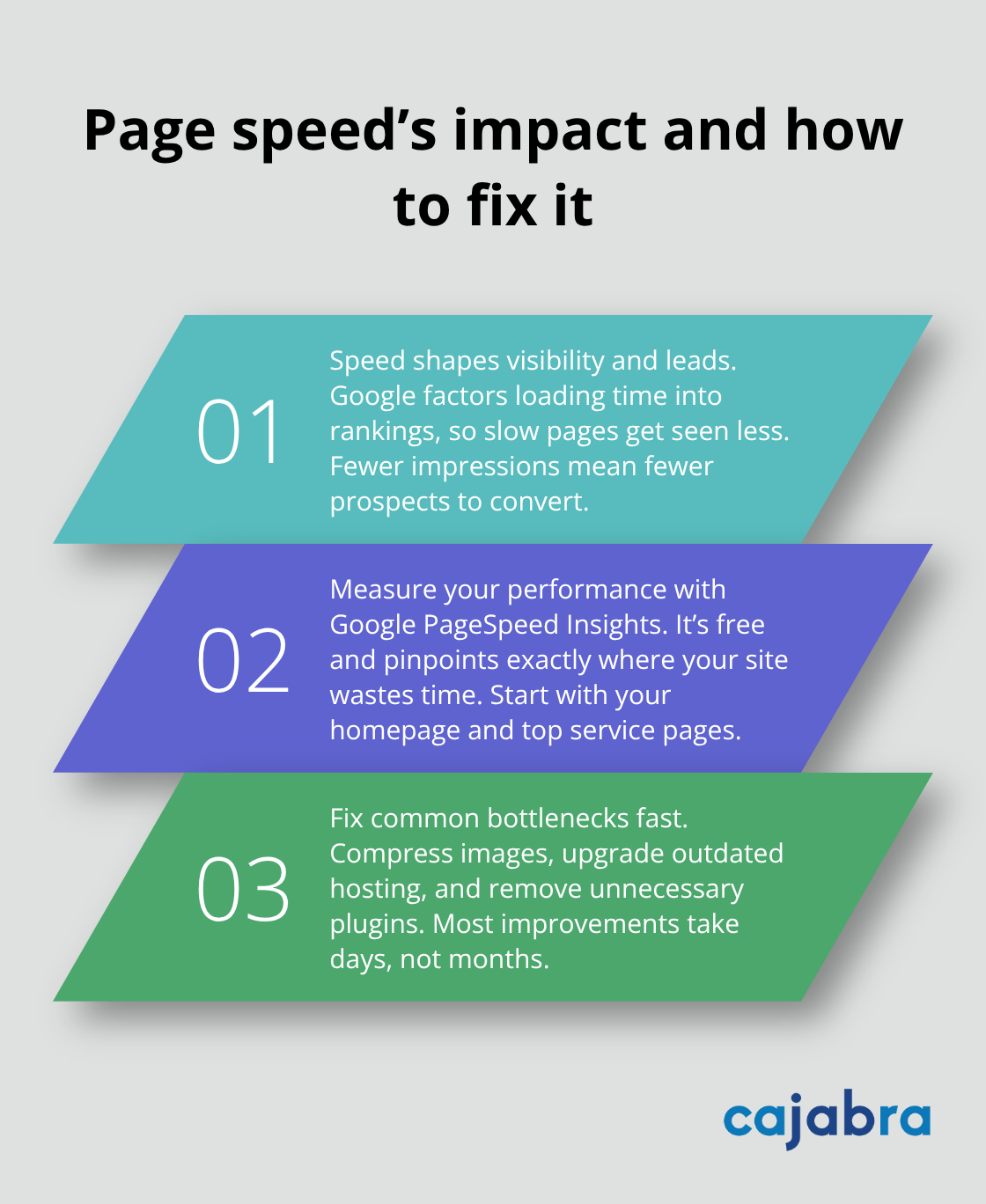
Test your current site speed using Google PageSpeed Insights, which is free and shows exactly where your site loses time. Common culprits include unoptimized images, outdated hosting, and unnecessary plugins. Fixing these issues often takes just days, not months.
The Mobile-First Reality
Accounting firms that haven't redesigned for mobile operate with one hand tied behind their back. When a prospect researches accountants during their lunch break or while commuting, they use a phone. If your site forces them to pinch, zoom, and hunt for your phone number, they move on. A responsive design that automatically adjusts to any screen size isn't a nice-to-have anymore-it's the bare minimum. This shift matters because mobile users expect instant access to information and frictionless navigation.
Trust Signals Matter More Than Flashy Design
Outdated layouts don't just look bad; they actively harm your credibility. Visitors judge your firm's competence partly on how professional your site appears. Your visual branding-from your logo to your website design-tells clients whether you're serious about their finances before they even read your first email. Adding trust signals like client testimonials, case studies with real results, certifications, and your team's photos transforms a generic site into a credibility machine. These elements work because they're specific and verifiable, not generic claims about your expertise. The next section reveals exactly what accounting clients want to see on your website.
What Accounting Clients Want to See
Accounting prospects arrive at your website with specific expectations, and vague generalities won't convert them into clients. They want to know immediately whether you handle their situation, how much it costs, and whether other businesses like theirs trust you. Campaign Monitor data shows that financial services email open rates sit around 27.1%, meaning prospects actively search for relevant information-they just won't wait long to find it. Your site must answer three core questions fast: What services do you offer, what will it cost, and can I trust you with my finances?
Pricing Transparency Stops Prospects From Leaving
Most accounting websites hide pricing behind vague language like "contact us for a quote." This approach backfires spectacularly. Prospects comparing three firms will click away from the one that won't show numbers and spend more time on the site that does. When you display clear service packages or at least price ranges, you pre-qualify leads before they ever call. Firms that show transparent pricing receive fewer inquiries overall, but those inquiries convert at much higher rates because unmotivated prospects self-select out. Specificity builds credibility because it shows you've thought through your offerings and aren't afraid to be direct.
Real Client Results Beat Generic Testimonials Every Time
A single sentence praising your expertise means almost nothing. A detailed case study showing that you solved a client's problem with measurable outcomes means everything. Forrester research indicates that UX improvements increase conversion rates by up to 400%, and case studies are a major UX component because they prove value. Include specifics: the client's industry, their challenge, your solution, and the measurable outcome. Avoid generic praise like "excellent service" or "great communication." Instead, show real numbers, real problems solved, and real client names (or at least their industry and company size). Video testimonials outperform written ones because prospects hear genuine tone and see real people, not polished marketing copy.
Contact Information Must Be Impossible to Miss
Your phone number should appear in the header of every page in a readable font size, ideally as a clickable link on mobile devices. Prospects researching accountants on their lunch break won't hunt through your site looking for a contact form buried in the footer. Make it the first thing they see. Consultation booking should take one click-either a prominent button linking to your calendar tool or a simple form that takes 30 seconds to complete. The easier you make it to start a conversation, the more conversations you'll have. Hesitant prospects often need a low-friction entry point; a free financial assessment or a 15-minute discovery call removes barriers to initial contact. Don't force them to commit to anything expensive or time-consuming before they've spoken with you.
Trust Signals Transform Generic Sites Into Credibility Machines
Outdated layouts don't just look bad; they actively harm your credibility. Visitors judge your firm's competence partly on how professional your site appears. Your visual branding-from your logo to your website design-tells clients whether you're serious about their finances before they even read your first email. Add trust signals like client testimonials, case studies with real results, certifications, and your team's photos. These elements work because they're specific and verifiable, not generic claims about your expertise. The next section reveals exactly how to fix your accounting website fast and start capturing the clients you're currently losing.
Fix Your Accounting Website in Three Moves
Audit Your Site Like a Prospect Would
Open your website on three devices: a desktop, a tablet, and a phone. Spend 30 seconds on your homepage and ask yourself honestly: Can I find the phone number? Do I understand what services you offer? Is the text readable without zooming? Do I see any client testimonials or proof that this firm is competent? If you hesitate on any of these questions, your prospects do too.
Use Google PageSpeed Insights to measure your actual load time. Anything over three seconds hemorrhages visitors. Check your Google Analytics to see how many people bounce from your mobile site within seconds. If your bounce rate exceeds 50% on mobile, your design actively costs you clients. Most accounting websites fail this audit because they were built five to ten years ago and never updated. A site designed for desktop browsers in 2016 feels ancient to someone viewing it on their iPhone today.
Redesign for Mobile First
Mobile-first redesign is non-negotiable. This doesn't mean a complete rebuild; it means your site must function flawlessly on phones first, then scale up to larger screens. Responsive design automatically adjusts your layout, text size, and navigation based on screen size.
Your phone number should be the first clickable element visitors see. Your service descriptions should be scannable in 15 seconds, not buried under marketing fluff. Your consultation booking button should require one click, not three. Tools like Webflow allow you to build or rebuild your site without coding, and they enforce mobile-first design by default. If you hire a designer or agency, specify that mobile optimization is your priority, not an afterthought.
Over 70% of your traffic comes from mobile devices, so designing for desktop first is backwards. The firms winning new clients have sites that work perfectly on phones because that's where prospects research accountants during their lunch break.
Add Trust Signals That Convert
Trust signals separate firms that convert prospects from firms that get clicked away. Add a high-quality photo of your actual team on your About Us page, not stock photos of people who don't work for you. Include three to five detailed case studies showing real results: the client's industry, their specific problem, your solution, and a measurable outcome like tax savings or time freed up.
Video testimonials from actual clients outperform written reviews because prospects hear genuine tone and see real faces. Display your certifications, your years in business, and any industry affiliations prominently. If you've been in business for 25 years, say it. If you specialize in a specific industry like healthcare or real estate, make that visible on your homepage.
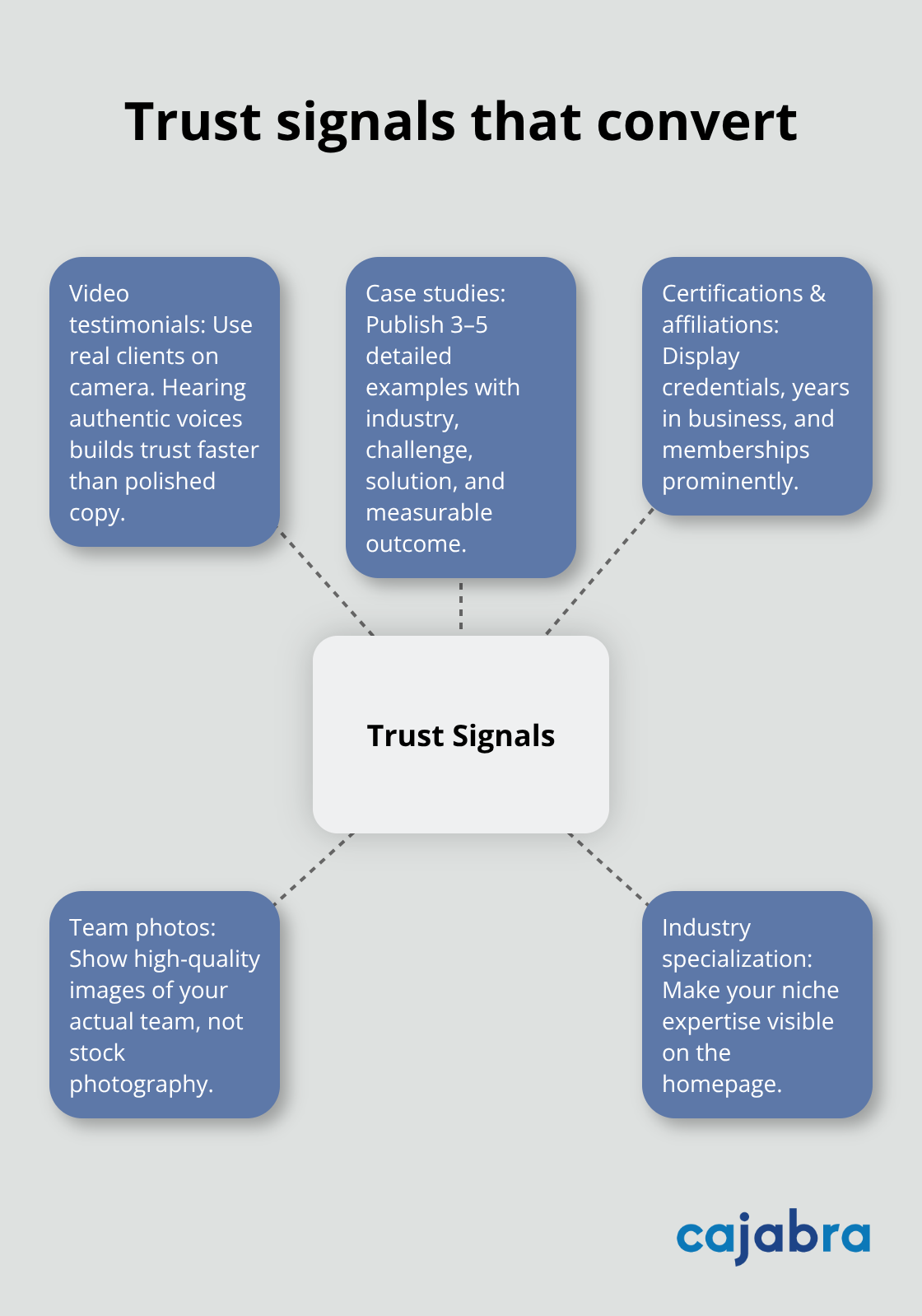
Research shows UX improvements increase conversion rates, and trust signals are the fastest way to improve your conversion rate because they directly answer the question every prospect has: Can I trust this firm with my finances? A site packed with real client results and real team photos converts at two to three times the rate of a generic site with stock photos and vague claims.
Final Thoughts
Your accounting website works 24/7 to attract clients or push them toward competitors-it's your most active marketing tool. A prospect who lands on your site and cannot find your phone number, see your pricing, or verify your credibility will not call back; they call the next firm in their search results instead. Website optimization directly impacts your bottom line because 38% of visitors abandon sites with poor design, over 70% of traffic comes from mobile devices, and UX improvements increase conversion rates by up to 400%.
Start with an honest audit of your current site on mobile, add three detailed case studies showing real client outcomes, and display your phone number prominently on every page. Test your load speed and fix anything over three seconds-these moves cost far less than hiring an expensive agency, yet they deliver measurable results within weeks. The firms that act now stop losing clients to better-designed competitors and start building a sustainable pipeline of qualified leads.
We at Cajabra, LLC help accounting firms modernize their digital presence through our Premium Online Presence Package, which transforms outdated websites into lead-generating assets. Your website can work for you instead of against you-the question is whether you will fix it today or lose another client tomorrow.
Most companies waste 60–70% of their content budget creating assets that get used once and forgotten. Content repurposing flips this equation by extracting multiple revenue streams from each piece you produce.
At Cajabra, LLC, we've seen firsthand how strategic repurposing cuts content costs while expanding reach across platforms. The data is clear: companies that repurpose content see 3x higher engagement rates than those starting from scratch every time.
The Real Economics of Content Reuse
A single blog post that takes 8–10 hours to produce costs roughly $800–$1,200 in labor alone when you factor in research, writing, and editing. Most companies publish that piece once, watch it generate traffic for a few weeks, then move on to the next project. What they miss is that the same content can produce revenue across five or more channels without proportional increases in cost. A 2,000-word blog post, for example, yields 5–10 LinkedIn posts, 6–8 Instagram carousel slides, and multiple email segments, each focused on a single key insight. You extract modular value from work already completed rather than duplicating effort.
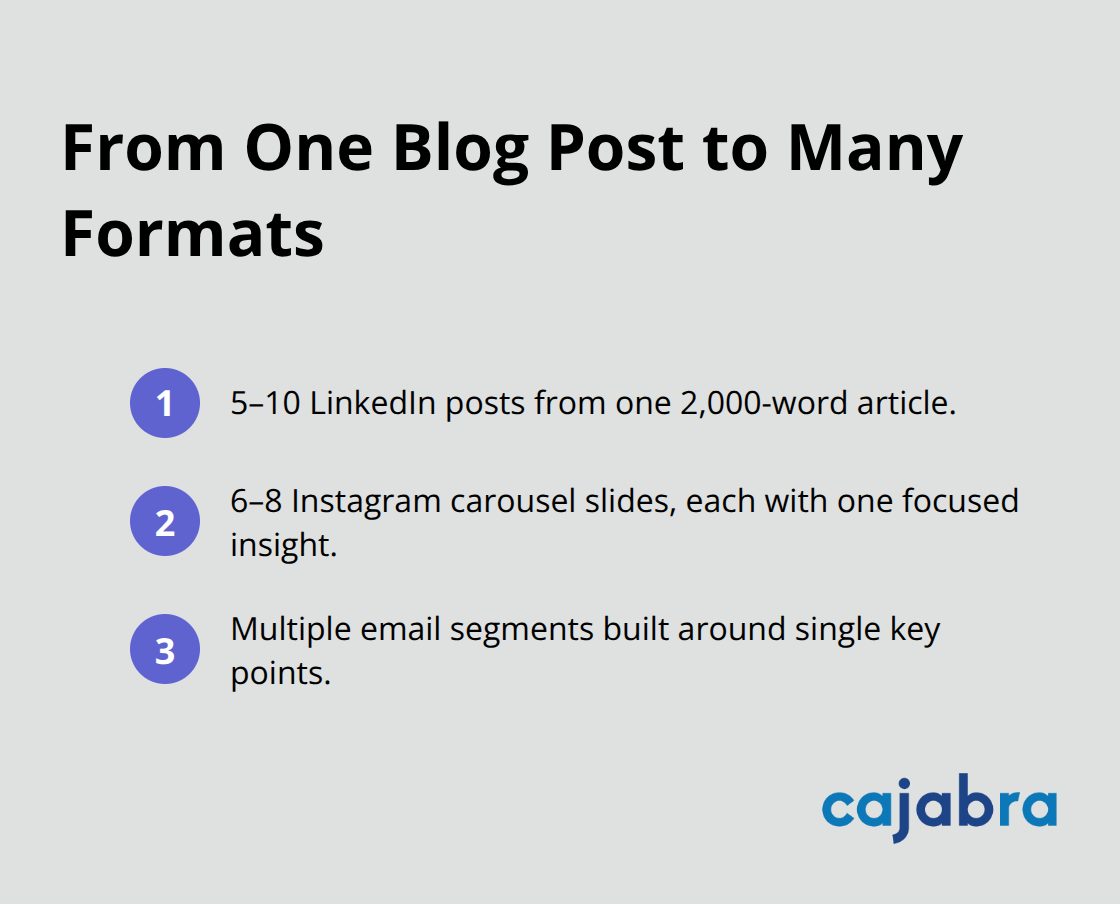
According to HubSpot research, repurposing content doubles engagement rates compared to relying solely on original assets. That's not incremental improvement-that's a fundamental shift in how your content performs.
Cost Reduction Without Sacrificing Reach
Content creation budgets are finite. Most teams face pressure to produce more without additional headcount, which forces a choice: create less frequently or lower quality. Repurposing eliminates this false choice. Transforming existing assets saves 60–80% of content creation time compared to starting from scratch for each platform. A 30-minute interview can become a magazine feature, an email series, multiple social posts, two radio spots, and a quote for your annual report-all from one conversation. Buffer reports that systematic repurposing expands reach by approximately 400% across new platforms, while another analysis shows that repurposed content produces up to 40% more leads than entirely new content. The financial math is straightforward: you distribute the creation cost across multiple revenue-producing assets instead of betting everything on a single channel.
Extending Content Value Far Beyond Launch
Evergreen content-pieces about timeless principles, foundational strategies, or recurring problems-should never become disposable. These assets remain relevant for years, yet most companies publish them once and archive them. High-performing content deserves a second, third, and fourth life across different formats and audience segments. A webinar recording transforms into shorter tutorial videos for users seeking quick guidance, or converts into a podcast episode for listeners during commutes. Video transcripts become 2,500+ word blog posts that boost time-on-page metrics and SEO performance. Case studies distill into focused blog posts targeting specific conversion keywords. The longer your content works, the higher your return on that initial investment. Quarterly content audits identify pieces with engagement above 5% or 1,000+ monthly visits-your repurposing goldmines worth maximizing across channels.
Identifying Your Repurposing Opportunities
Not all content deserves equal repurposing effort. Lead-generating assets such as blog posts, webinars, and case studies drive conversions and signups, making them prime candidates for multiple formats. Data-rich content yields the most modular assets: dozens of social posts, several blog articles, and multiple videos can emerge from one report. You should prioritize top-performing content with engagement above 5% or 1,000+ monthly visits for repurposing. Analytics platforms reveal which pieces attract traffic and hold reader attention. Once you identify these winners, the repurposing process becomes systematic rather than random, ensuring your effort targets assets that already prove their value.
The foundation for maximizing content ROI rests on understanding these economics. Once you recognize how much value sits dormant in your existing library, the next step involves selecting the right methods to unlock that potential across your specific channels and audience segments.
How to Turn One Piece of Content Into Five
A 2,000-word blog post sitting in your archive represents wasted potential if it only lives on your blog. The real power emerges when you systematically extract multiple formats from that single piece, each tailored to how different audiences consume information. Start with your highest-performing blog posts-those with 1,000+ monthly visits or 5% engagement rates-and break them into modular components. Each section becomes a standalone social post. Each data point becomes a visual graphic. Each key insight becomes an email segment.
Reformat Blog Posts Across Multiple Channels
A blog post about accounting firm cash flow management yields five to ten LinkedIn posts when you extract one actionable tip per post, six to eight Instagram carousel slides with each slide focusing on a single step or statistic, and multiple email newsletter segments sent across consecutive weeks. This approach works because you're not repeating the same content-you're reframing it for platform-specific audiences. LinkedIn professionals respond to detailed advice and industry context. Instagram users want visual simplicity and quick wins. Email subscribers expect deeper dives and exclusive insights.
HubSpot research shows that repurposed content delivers double the engagement compared to original assets alone. The multiplication happens because each format reaches different people at different moments in their decision journey.
Extract Insights From Your Data and Research
Research reports and datasets contain dozens of repurposing opportunities that most companies ignore. A single industry report with ten key findings becomes ten separate blog posts, each optimized for different search keywords and audience segments. That same report produces multiple infographics highlighting your most striking statistics, suitable for Pinterest or LinkedIn.
Data visualizations perform exceptionally well on social platforms. You can create short-form videos showing what your data reveals, breaking down complex findings into 60-second explanations. Webinar recordings transform into podcast episodes for audiences consuming content during commutes. Transcribe those webinars into 2,500+ word blog posts that rank for long-tail keywords and boost your time-on-page metrics.
The transcription approach works particularly well because you already have the audio and speaking points; the writing becomes an editing exercise rather than creation from zero. Ahrefs demonstrates this method by embedding videos within blog posts derived from transcripts, which increases reader engagement and time spent on page. Testimonials and case studies deserve similar treatment-extract quotes into social posts, compile multiple testimonials into a dedicated landing page, and distill a full case study into a focused blog post targeting specific conversion keywords your ideal clients actually search for.
Customize Your Format for Each Audience Segment and Platform
Platform algorithms reward consistency and relevance, but they punish generic copy-paste approaches. What performs on LinkedIn fails on Twitter, and what works on Facebook misses the mark on TikTok. LinkedIn audiences expect professional context, detailed explanations, and thought leadership positioning-your posts should run 150–250 words with a clear point-of-view. Twitter and X demand brevity and hooks that stop the scroll within the first five words. Instagram carousel posts need visual hierarchy and one insight per slide. Email newsletters tolerate longer-form content because subscribers already chose to receive your messages.
Rather than copying identical text across platforms, adapt the core message to match each channel's culture and format. A single insight about tax planning becomes a detailed LinkedIn post with industry context, a punchy three-tweet thread on X, an Instagram carousel with visual examples, and an email segment with implementation steps. This targeted approach costs almost nothing extra once you have the source material, yet it dramatically increases the likelihood that your message lands with each specific audience.
Repurposing without platform optimization wastes the opportunity. The next chapter explores the specific tools and systems that automate this adaptation process, allowing you to scale your repurposing efforts without proportional increases in team size or budget.
Automation and Analytics: The Real Tools That Scale Repurposing
Repurposing only works at scale when you stop treating it as a manual process. The gap between knowing you should repurpose content and actually executing it across five platforms comes down to tooling. Most teams lack a systematic way to distribute adapted content, track what performs where, and organize repurposing campaigns without chaos.
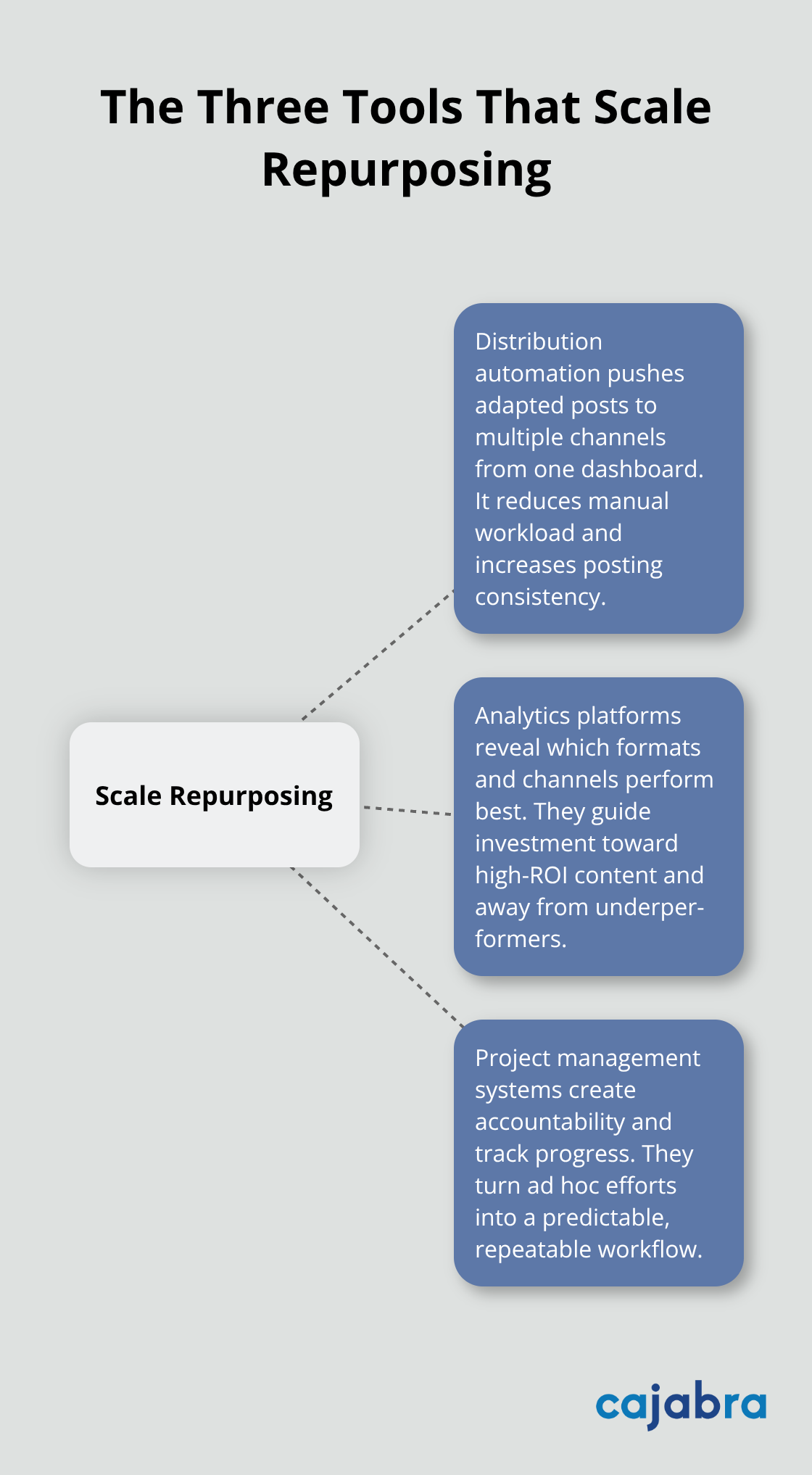
This gap is where good intentions die. You need three categories of tools working together: distribution automation that pushes content to multiple channels simultaneously, analytics platforms that show which repurposed formats drive actual results, and project management systems that keep repurposing campaigns organized across weeks and months. Without these, repurposing becomes another task piling onto already-stretched teams, and it gets abandoned within weeks.
Distribution Automation Cuts Your Posting Time
Buffer, Later, and Hootsuite let you schedule repurposed content across multiple social platforms from a single dashboard. Instead of logging into LinkedIn, Twitter, Instagram, and Facebook separately, you write once and distribute to all channels on your preferred schedule. Distribution automation cuts your posting time by streamlining workflows across channels. Teams using scheduling tools post more frequently than those managing channels manually, which directly correlates with higher reach and engagement. This multiplication effect compounds over months as your content frequency increases without proportional increases in labor costs.
Analytics Platforms Reveal Which Formats Actually Win
Google Analytics, platform-native dashboards, and tools like Semrush reveal which repurposed formats drive actual results. You need to know whether your Instagram carousel slides generate more engagement than your LinkedIn posts about the same topic, or whether email segments outperform social snippets. Without this visibility, you repurpose blindly and waste effort on underperforming formats. Analytics platforms reveal which repurposed formats actually drive traffic by tracking key performance indicators across channels. A quarterly audit of your top 10 repurposed pieces shows which formats deserve more investment and which ones you should abandon or redesign.
Project Management Tools Create Accountability
Monday.com, Asana, or Notion create accountability and visibility across your repurposing workflow. Map out your repurposing plan before starting: identify your source content, assign team members to specific format conversions, set deadlines, and track progress. A simple project template prevents repurposing work from getting lost in daily chaos. When your team knows exactly which blog post converts into what formats (and by whom and when), execution becomes predictable and repeatable rather than sporadic.
The Three-Tool System Compounds Your ROI
The combination of these three tool categories transforms repurposing from occasional effort into a repeatable system that compounds your content ROI over time. Distribution automation handles the logistics, analytics reveal what works, and project management keeps teams aligned. Together, they eliminate the friction that kills most repurposing initiatives before they gain momentum.
Final Thoughts
The numbers tell a clear story: companies that systematically repurpose content generate 40% more leads than those creating entirely new assets, while expanding reach by 400% across platforms without proportional budget increases. This isn't theoretical-it's measurable performance that directly impacts your bottom line. Analytics platforms reveal exactly which formats drive traffic, which ones convert, and which ones deserve more investment.
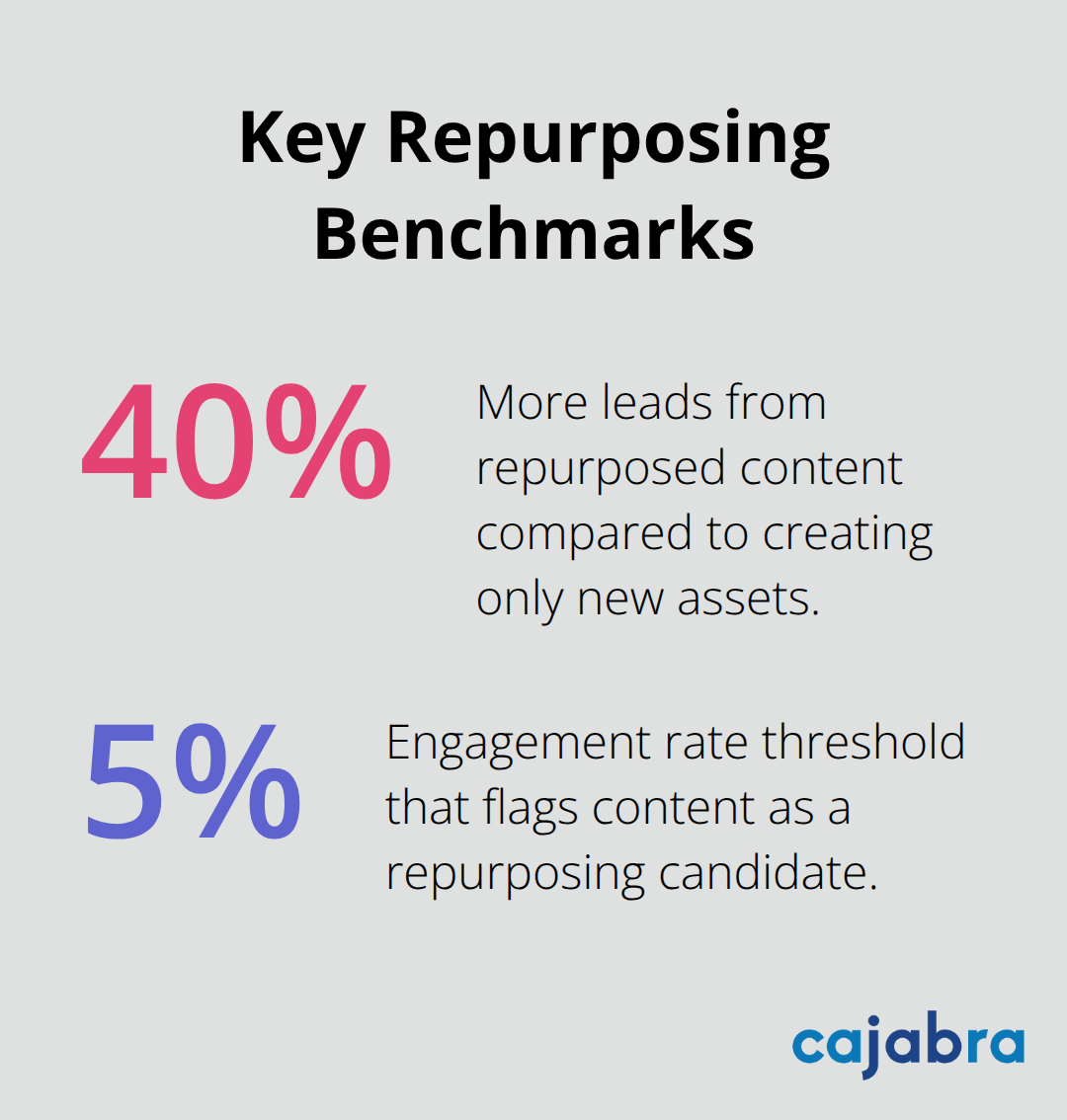
Start your content repurposing strategy with your existing winners: blog posts with 1,000+ monthly visits or 5% engagement rates that already demonstrate audience demand. A single high-performing piece yields five to ten LinkedIn posts, six to eight Instagram carousel slides, and multiple email segments, each tailored to its platform. This approach minimizes risk because you build on proven assets rather than experiment with untested material.
Distribution tools automate posting across channels, analytics reveal which formats perform best, and project management systems keep campaigns organized (without these three elements working together, repurposing becomes another abandoned task). We at Cajabra, LLC help accounting firms maximize their marketing impact through strategic systems that work smarter, not harder by securing retainer-based clients through effective positioning and lead generation. Your content library already contains the seeds of your next growth phase-content repurposing simply helps them flourish across every channel where your audience lives.
Your accounting firm's website needs to work flawlessly on phones and tablets. Over 60% of web traffic now comes from mobile devices, and Google ranks mobile-friendly sites higher in search results.
At Cajabra, LLC, we've seen firsthand how poor mobile optimization drives potential clients away. The good news is that fixing this problem delivers measurable results for your firm's growth.
How Mobile Traffic Shapes Accounting Firm Success in 2026
Mobile devices now account for 63.31% of global web traffic as of March 2025, meaning more than six out of every ten visitors to your accounting firm's website arrive on a phone or tablet. This shift isn't gradual-it's the dominant reality.
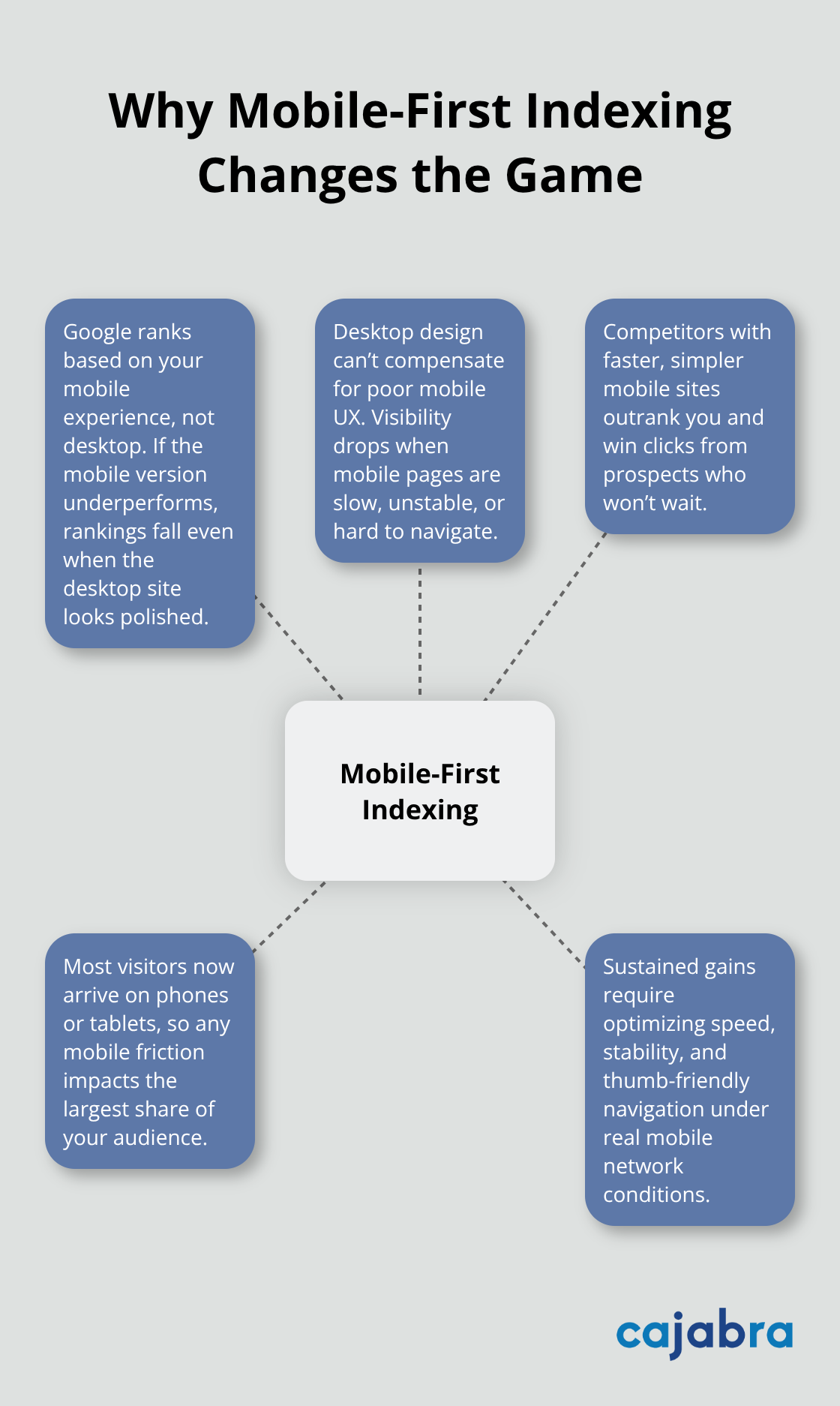
Google responded by making mobile-first indexing the standard for all sites, meaning the search engine crawls and ranks your site based on how it performs on mobile, not desktop. If your mobile experience lags, your visibility in search results drops regardless of how polished your desktop version looks. Accounting firms that ignore mobile optimization lose visibility to competitors who don't, and potential clients simply move on to firms with faster, easier-to-navigate mobile experiences.
The Real Cost of Slow Mobile Pages
More than 40% of users won't wait longer than two seconds for a page to load, according to the State of Mobile 2024 data. For accounting firms, this matters because initial consultations and engagement often happen on mobile. A prospect searching for tax advice or audit services on their phone expects instant results. If your site takes five or six seconds to load on a mobile network, they've already clicked to a competitor. Google's Core Web Vitals now directly affect rankings, with emphasis on LCP, CLS, and INP on real mobile networks. These aren't theoretical benchmarks-they're the performance standards Google uses to rank sites. Heavy third-party tools like CRM widgets, chat systems, and calendars add input lag on mobile devices, so you need to optimize these integrations aggressively.
Mobile Conversion Patterns in Professional Services
GA4 data reveals that most new users arrive on mobile, and high-value events like inquiry submissions and initial consultations often start there. However, friction on mobile leads to faster drop-offs than on desktop. A cumbersome contact form, slow page loads, or confusing navigation on a phone causes prospects to abandon their search before completing an inquiry. For accounting firms, mobile optimization directly impacts lead generation. Responsive design that scales content intelligently for smaller screens keeps navigation simple and readable, reducing the friction that causes mobile visitors to leave.
Performance Standards That Drive Rankings and Conversions
Your site's mobile performance now determines both search visibility and conversion potential. The stakes are high: prospects expect content to appear instantly, interactions to feel fluid, and navigation to stay within thumb's reach. When your site meets these expectations, visitors stay longer and complete actions like scheduling consultations or requesting proposals. When it doesn't, they leave. Third-party integrations (CRMs, chat widgets, calendars, maps, personalization layers) can slow mobile performance significantly, so audit which tools you actually need and remove those that add unnecessary weight. Image optimization matters too-compress images aggressively to support faster loads on slower mobile networks.
What Comes Next for Your Firm's Mobile Strategy
The path forward requires more than a responsive template. Your accounting firm needs a mobile experience that supports how prospects actually make decisions today: on their phones, during lunch breaks, or while commuting. This means fast pages, stable layouts, lightweight scripts, and predictable interactions under real-world conditions. The next section covers the specific strategies that move your firm from a mobile-friendly website to a mobile-optimized conversion machine.
How Mobile-Friendliness Drives Accounting Firm Growth
Google's ranking algorithm now prioritizes mobile performance as the primary factor determining search visibility. When a prospect searches for accounting services in your area, the firms appearing at the top of mobile search results are those with optimized mobile experiences. Mobile devices account for over 60% of global web traffic, which means mobile optimization directly affects both organic and paid search performance. If your site loads slowly on mobile or forces visitors to pinch and zoom to read content, Google pushes your firm lower in rankings while competitors with faster, cleaner mobile experiences climb higher. Mobile performance now determines whether prospects find your firm first or scroll past to competitors.
Why Mobile Friction Kills Client Inquiries
Accounting firms lose potential clients at the moment of decision when mobile experiences are poor. A prospect researching tax strategies or audit services on their phone expects to complete an inquiry form, schedule a consultation, or navigate to your contact information without frustration. Most new users arrive on mobile, and high-value events like inquiry submissions often begin there-but friction on mobile causes faster drop-offs than desktop. Forms that require excessive scrolling, fields that don't auto-format phone numbers correctly, or navigation menus that cover half the screen force mobile visitors to abandon their search. Accounting firms with cluttered mobile navigation experience significantly higher bounce rates than those with streamlined, thumb-friendly layouts. Every second a prospect spends struggling with your mobile site is a second they could spend contacting a competitor instead.
Converting Mobile Visitors into Retained Clients
Mobile optimization directly affects whether prospects take action or leave. 70% of users say page speed influences their willingness to purchase professional services. For accounting firms, this translates to conversion rates. A site that loads in two seconds on mobile networks keeps prospects engaged long enough to complete an inquiry or request a proposal.
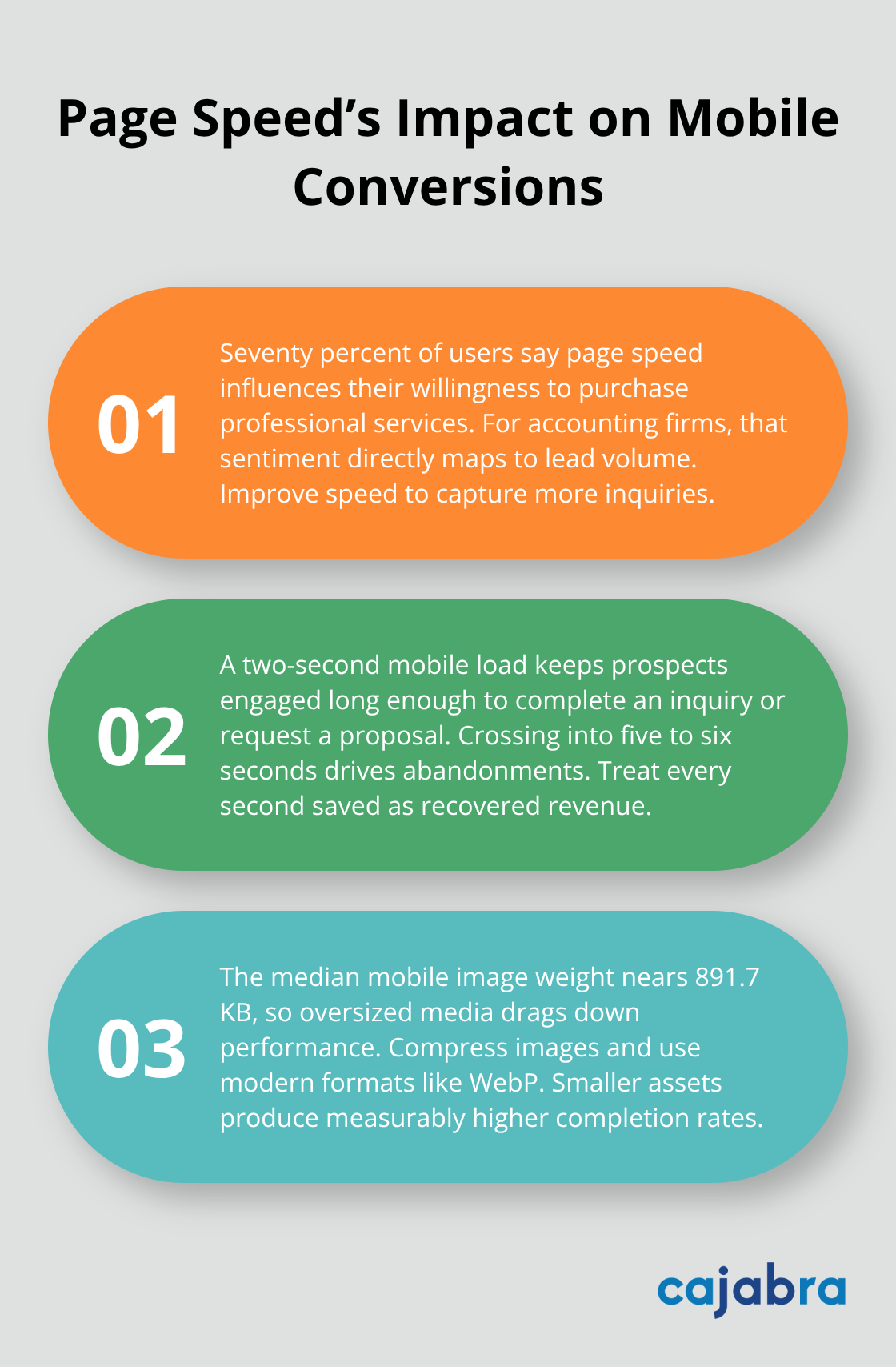
A site that takes six seconds loses them. The median mobile image size sits around 891.7 KB, so aggressive image compression matters-oversized hero images and unoptimized graphics tank page speed on slower mobile networks. Reducing unnecessary third-party tools and simplifying contact forms removes barriers between prospect interest and action. Accounting firms that treat mobile optimization as a conversion tool rather than a design afterthought see measurable increases in client inquiries and consultation bookings.
The Speed-to-Conversion Connection
Page speed directly correlates with whether prospects complete actions on your site. Mobile visitors expect content to appear instantly and interactions to feel fluid-anything less causes them to leave. Heavy third-party integrations (CRMs, chat widgets, calendars, maps) add input lag on mobile devices, so audit which tools you actually need and remove those that add unnecessary weight. Image optimization matters equally; compress images aggressively to support faster loads on slower mobile networks. Prospects who experience fast, stable pages stay longer and complete actions like scheduling consultations or requesting proposals. Those who encounter delays abandon their search and contact competitors instead.
What Your Firm's Mobile Strategy Requires
The path forward requires more than a responsive template. Your accounting firm needs a mobile experience that supports how prospects actually make decisions today: on their phones, during lunch breaks, or while commuting. This means fast pages, stable layouts, lightweight scripts, and predictable interactions under real-world conditions. Clear navigation and logical information architecture transform a fast, mobile-friendly site into one that converts prospects into clients. The next section covers the specific strategies that move your firm from a mobile-friendly website to a mobile-optimized conversion machine.
How to Build a Mobile Experience That Converts
Responsive design is non-negotiable, but it's also table stakes-the bare minimum that separates professional firms from those stuck in 2015. A responsive site that scales content intelligently for mobile screens matters, but what actually drives conversions is aggressive optimization of the three factors that kill mobile performance: oversized images, unnecessary third-party tools, and bloated forms.
Compress Images to Eliminate Load Time Waste
Start with image optimization. The median mobile image size runs around 898.8 KB, but accounting firm websites often load hero images and graphics that exceed 1.5 MB per image. Replace these with compressed versions under 800 KB, use modern formats like WebP for faster delivery, and lazy-load images below the fold so they don't slow initial page load. Test your compression with tools like Google PageSpeed Insights, which shows exactly how much load time you're wasting on oversized assets. Every megabyte you cut from your images translates directly to faster page loads on slower mobile networks.
Remove Third-Party Tools That Add Input Lag
Next, audit every third-party integration on your mobile site. CRM widgets, chat systems, calendars, maps, and personalization layers add input lag that makes interactions feel sluggish on real mobile networks. Most accounting firms load far more tools than they actually use. Remove chat widgets that get ignored, disable auto-loading calendars, and replace map embeds with simple address text and a link to Google Maps. Each tool you remove directly improves the speed prospects experience when they interact with your contact form or navigate your pages.
Simplify Forms to Remove Conversion Barriers
Forms present the biggest conversion killer on mobile. Accounting firms typically ask for too many fields, don't auto-format phone numbers, and force visitors to scroll endlessly through required information. Simplify your inquiry form to five fields maximum: name, phone, email, firm size, and service type. Auto-format phone numbers so visitors don't need to add dashes or parentheses. Place the submit button where visitors can reach it without scrolling. Use a single-column layout on mobile instead of multi-column designs that force pinching and zooming.
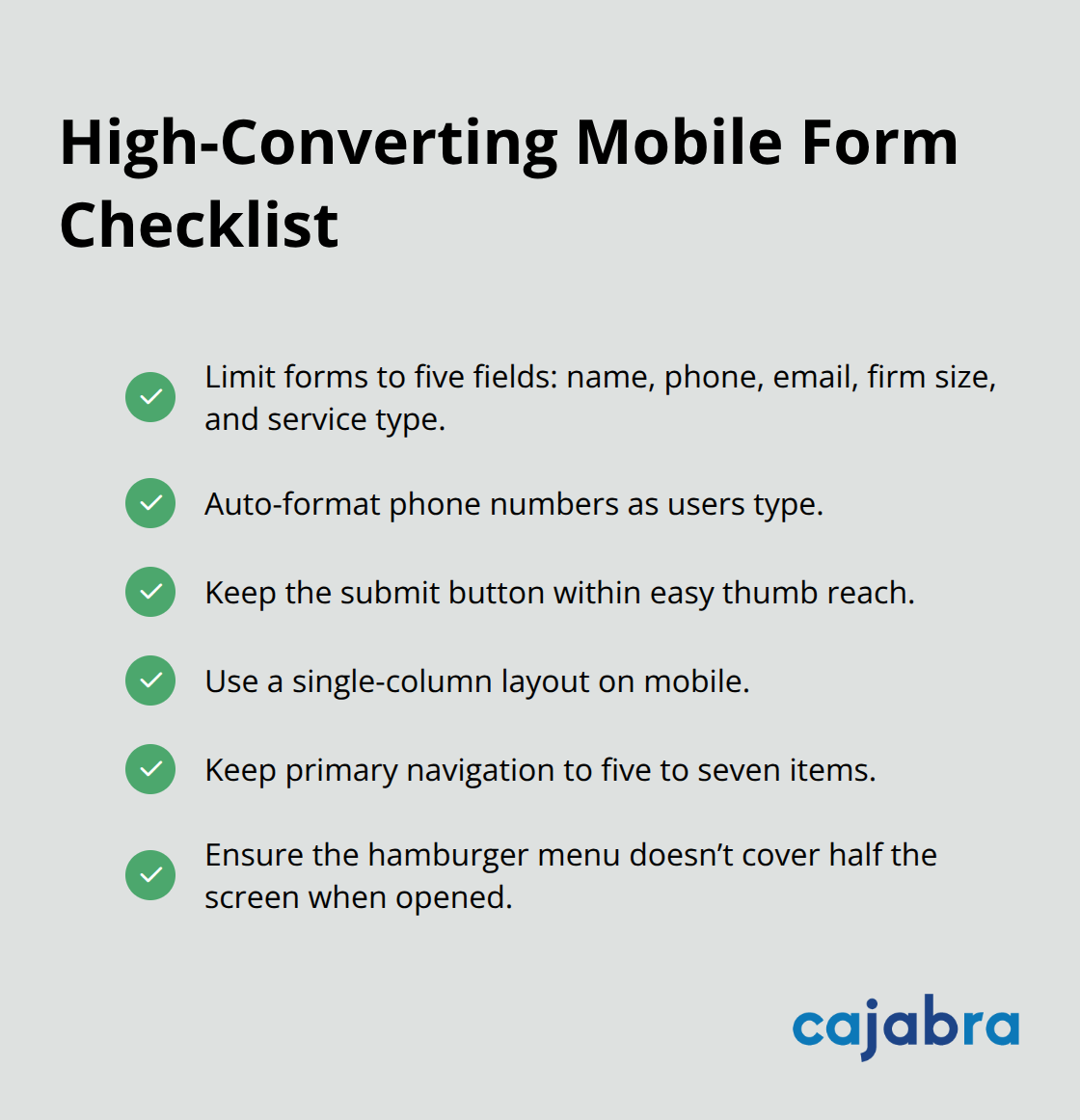
Navigation should occupy no more than five to seven primary items, with a clearly visible hamburger menu that doesn't cover half the screen when opened.
Test Performance on Real Mobile Networks
Test your mobile experience on real devices using Chrome's mobile emulator or tools like LambdaTest Real Device Cloud, not just your desktop browser. Load time on a real 4G mobile network differs dramatically from what you see on your office WiFi. Try for Core Web Vitals targets of LCP under 2.5 seconds, CLS under 0.1, and INP under 200 milliseconds on real mobile networks. These aren't arbitrary numbers-Google uses these exact metrics to rank sites and determine whether prospects stay or leave. Accounting firms that treat these optimizations as conversion priorities rather than design afterthoughts see measurable increases in inquiry submissions and consultation bookings.
Final Thoughts
Mobile-friendliness stopped being optional for accounting firms years ago. It now determines whether prospects find your firm, stay on your site, and take action. The data confirms this reality: 63.31% of web traffic comes from mobile devices, Google ranks mobile-optimized sites higher, and prospects abandon sites that load slowly or force awkward navigation on phones. Your competitors understand this shift, and the firms winning new clients treat mobile optimization as a conversion tool, not a design afterthought.
The real business impact shows up in your inquiry submissions and consultation bookings. When you compress oversized images, remove unnecessary third-party tools, and simplify your contact forms, prospects complete actions instead of leaving. A two-second page load keeps them engaged; a six-second load sends them to competitors. Every optimization you make directly affects whether your accounting firm captures leads or loses them to firms that prioritize mobile performance.
Start by testing your site on real mobile devices and checking your Core Web Vitals on actual 4G networks, not your office WiFi. Identify which third-party integrations drive value and which ones add unnecessary weight. Compress your images aggressively and simplify your forms to five fields maximum. If you want professional guidance on modernizing your website and optimizing your digital presence, Cajabra helps accounting firms build lead-generating websites that position your firm as an industry leader.