

Most accounting firms still rely almost entirely on referrals, leaving significant revenue on the table. Digital marketing for accounting firms isn't optional anymore-it's the difference between steady growth and stagnation.
At Cajabra, LLC, we've seen firsthand how firms that implement strategic digital marketing attract higher-quality clients and build sustainable pipelines. This guide shows you exactly how to do it.
Referrals remain the dominant client acquisition channel for accounting firms, but this approach creates a ceiling on growth. Research from The CPA Journal shows that firms relying solely on word-of-mouth miss opportunities to control their own pipeline and attract clients actively searching for services online. When you depend on referrals, you're at the mercy of your existing client network's size and willingness to recommend you. You also lose visibility to prospects who don't know anyone in your firm, which means you're invisible to a significant portion of your market. The firms growing fastest aren't waiting for referrals to arrive-they're building digital systems that generate consistent inbound inquiries.
Accounting firms that lack a strategic digital presence lose deals to competitors who appear first in search results and maintain active engagement on LinkedIn and Facebook. According to Google, top three organic search results capture a significant share of clicks, and accounting clients increasingly search online before contacting a firm. If you're not ranking for keywords like tax planning for small businesses or accounting services for startups in your area, prospects never find you. Meanwhile, firms with optimized websites, consistent content, and targeted paid search campaigns capture those searches and convert them into retainer clients. The gap between firms investing in digital marketing and those ignoring it has widened dramatically. High-growth accounting firms allocate more than twice the marketing budget of slower-growth firms, according to industry benchmarks, and they focus that investment on channels that deliver measurable results.
Digital marketing allows you to demonstrate expertise before a prospect ever picks up the phone. You can publish content about tax law changes, create videos explaining complex accounting concepts, or share case studies of how you've solved client problems-all of which position your firm as the authority in your niche. This authority-based approach attracts clients who are ready to hire and willing to pay retainer fees because they've already seen proof of your knowledge. Firms that establish themselves as thought leaders through consistent, high-quality content see higher-quality inquiries and shorter sales cycles. LinkedIn has become essential for this-CPAs who optimize their profiles, share insights on industry trends, and publish educational articles consistently outpace competitors in attracting decision-makers and referral partners. Your online presence directly influences whether prospects perceive you as a commodity or as a specialized advisor worth paying premium fees.
The shift toward digital discovery means your ideal clients are already online, looking for solutions to their accounting challenges. They search for answers, compare firms, and read reviews before they ever contact you. Firms that appear in those search results and maintain credible social profiles capture inquiries that firms without digital presence never see. This isn't about vanity metrics-it's about controlling whether prospects find you or your competitor first. The firms that master this transition from invisible to discoverable build sustainable pipelines that don't depend on who knows whom.
Your website is where prospects decide whether to hire you or call your competitor. 68% of users say a business's credibility is influenced by the design of its website, which means your digital front door determines whether someone books a consultation or bounces to the next firm. Most accounting firm websites fail because they function as brochures, not conversion machines.

They list services, show team photos, and stop there. Instead, your website needs three elements working together: a clear value proposition above the fold that explains who you serve and what problem you solve, visible customer testimonials or case results near the top to build immediate trust, and multiple calls-to-action that guide visitors toward scheduling a consultation or downloading a resource.
Test your site yourself-land on your homepage and ask if you instantly understand what you do and who benefits from your services. If the answer isn't obvious within five seconds, your site costs you clients.
Mobile responsiveness is non-negotiable because most accounting prospects research firms on their phones. Fast load times matter too-pages that take more than three seconds to load see dramatically higher bounce rates. Beyond speed and mobile optimization, your website needs content architecture that supports search visibility. Service pages should address specific client situations like tax planning for e-commerce businesses or accounting for professional practices, not generic descriptions of tax preparation.
Blog content should target real questions prospects ask: how much should a small business budget for accounting, what tax deductions am I missing, when do I need an accountant. This content drives organic search traffic and positions your firm as someone who understands client challenges before they contact you. Google's top three search results capture roughly 54 percent of clicks, so ranking for local and service-specific keywords directly impacts your pipeline.
Your website should feature your team-bios with photos, client testimonials with names and businesses, and case studies showing specific results you've delivered. Prospects hire people, not firms, so humanize your expertise and make it obvious why someone should work with you instead of a competitor down the street. This approach transforms your site from a generic listing into a trust-building engine that attracts clients ready to pay retainer fees.
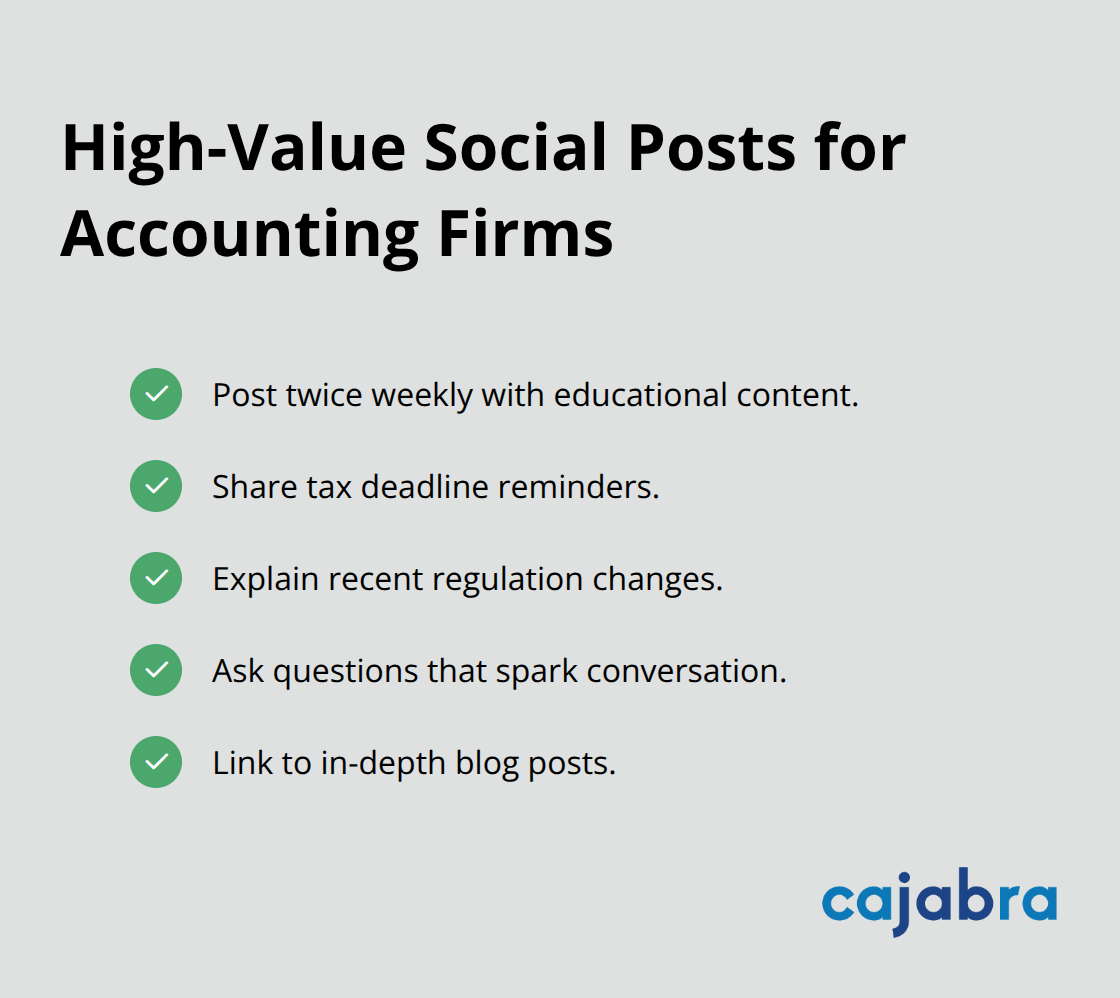
LinkedIn and Facebook amplify your authority but only if you treat them as relationship-building channels. Post consistently-twice weekly minimum-with content that educates rather than sells. Share tax deadline reminders, explain recent regulation changes, ask questions that spark conversation, and link back to detailed blog posts on your website.
LinkedIn requires a different approach than Facebook; on LinkedIn, target decision-makers and business owners with insights about tax strategy and business growth, while Facebook works better for local visibility and community engagement. The mistake most firms make is posting sporadically and then wondering why nobody engages. Consistency builds algorithm trust and keeps your firm top-of-mind when prospects face accounting challenges. This foundation-a conversion-focused website paired with active social engagement-creates the visibility and credibility that transforms how prospects perceive your firm.
Data collection means nothing without action. Most accounting firms track website visitors and email opens but never convert those metrics into decisions about where to spend their next marketing dollar. Start with a single metric that matters: cost per qualified lead. Divide your total marketing spend by the number of prospects who fit your ideal client profile and expressed genuine interest. If you spend $2,000 monthly on Google Ads and capture five qualified leads, your cost per lead is $400.
Now ask whether that lead justifies the expense based on your average retainer value. If your typical client retainer is $5,000 annually, a $400 cost per lead makes sense. If it's $1,500, shift budget to cheaper channels like email marketing or content that generates inbound inquiries at lower cost. The fastest-growing firms measure this ruthlessly and adjust weekly, not quarterly. Google Analytics and your CRM should feed directly into a simple spreadsheet where you track which channels deliver leads at acceptable costs.
Email outperforms social media for lead conversion, yet most firms underuse it. The reason is straightforward: email requires discipline. You must capture emails from every prospect interaction, segment your list by client type or service interest, and send timely messages around tax deadlines and regulatory changes. Tools like Mailchimp handle automation for under $20 monthly, so cost isn't the barrier. Email feels old-fashioned compared to social media, even though email consistently outperforms social for lead nurturing.
A prospect who lands on your website needs five to seven touches before they hire you. Email delivers those touches directly to their inbox while social media relies on algorithm luck. Segment your email list into three groups: existing clients who receive service updates and cross-sell offers, prospects who downloaded a resource or attended a webinar, and cold subscribers who signed up for tax tips.
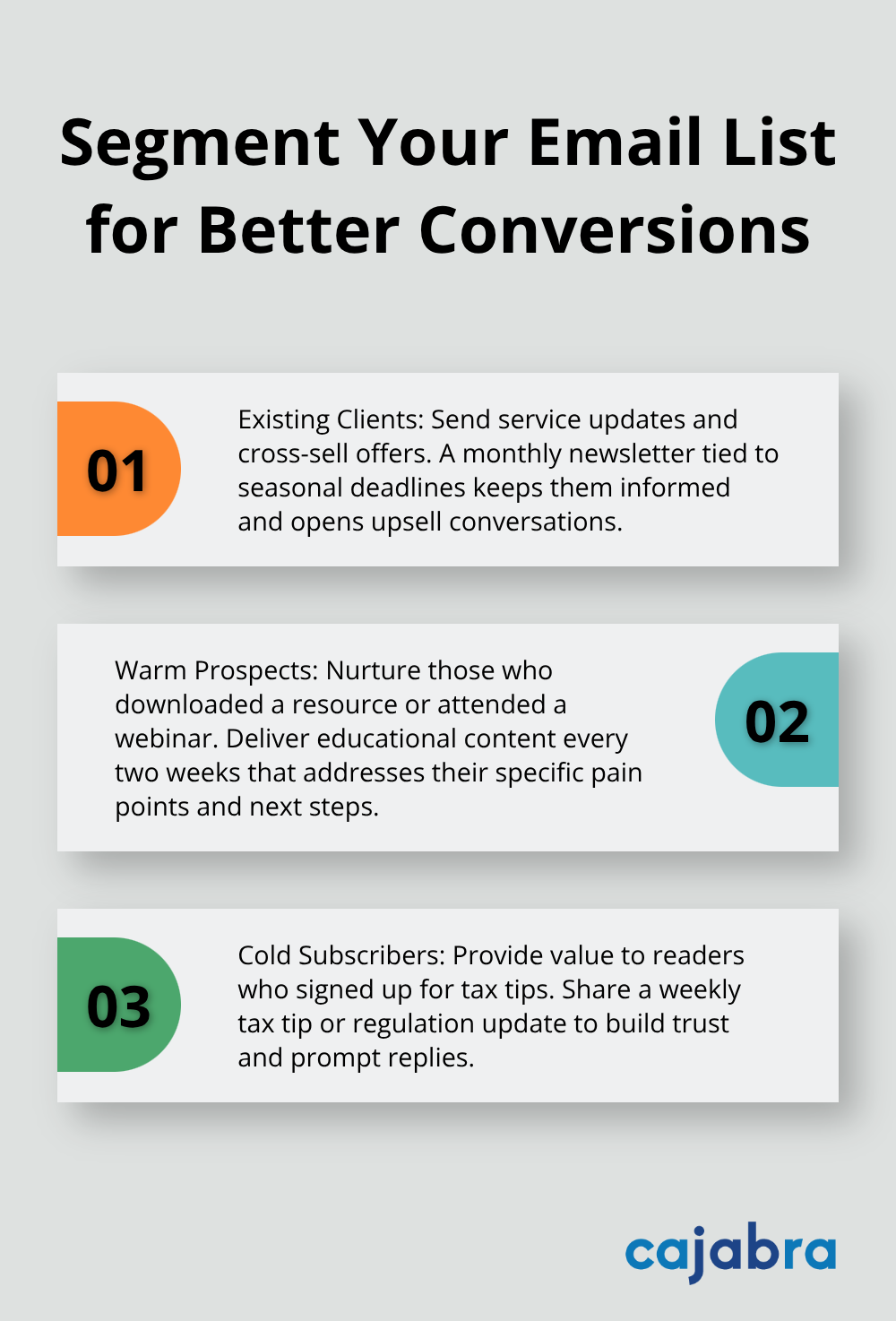
Send existing clients a monthly newsletter tied to seasonal deadlines. Send prospects educational content every two weeks that addresses their specific pain point. Send cold subscribers a weekly tax tip or regulation update.
Track open rates and click-through rates for each segment and eliminate campaigns that generate less than a 15 percent open rate after three sends. This systematic approach transforms email from a broadcast channel into a lead conversion machine that produces retainer clients consistently. Most accounting firms ignore email discipline because they're uncomfortable with the math, which is ironic given their profession. The firms that systematize email capture, segmentation, and timing control their own pipeline instead of waiting for referrals to arrive.
The accounting firms winning today control their own growth through digital marketing systems that work while they sleep. They transformed from invisible to indispensable by building conversion-focused websites, publishing content that ranks in search results, and systematizing email to nurture prospects into retainer clients. Your next client searches for accounting services right now, compares firms online, and decides who deserves their business based on what they find-if you're not visible in those moments, you lose.
The gap between firms implementing digital marketing for accounting firms and firms ignoring it widens every month. Your competitors are already optimizing their websites, publishing content that ranks in Google, and systematizing email to convert prospects into clients. The question isn't whether digital marketing works for accounting firms anymore; the question is whether you act today or watch your market share shrink tomorrow.
Start this week with one concrete action: audit your website, capture one email from every prospect interaction, post one piece of content on LinkedIn, or track one metric that matters. Small actions compound into systems that generate consistent revenue, and Cajabra helps accounting firms build these exact systems through tailored digital strategies that position you as the industry leader your market needs.