

There was a time when “doing SEO” for an accounting firm meant sprinkling “tax accountant near me” across your website like parmesan on bad pasta and hoping Google would reward your enthusiasm.
Those days are, technically speaking, deceased.
Welcome to the AI era, where search is getting smarter, users are getting pickier, and bland copy written for algorithms is about as effective as a calculator with dead batteries. Google has been clear that it wants helpful, reliable, people-first content, and it uses ideas like E-E-A-T (Experience, Expertise, Authoritativeness, and Trust) to evaluate quality. Google also says AI search features like AI Overviews are designed to surface useful snapshots with links that help people dig deeper into trustworthy sources.
For accountants, this is actually very good news.
Why? Because accountants already have the raw ingredients AI and search engines love: real expertise, real-world experience, and real trust. You are not a random lifestyle blogger pretending to understand entity structuring after watching two YouTube videos and drinking a matcha. You actually know things. Important things. Tax-saving, audit-surviving, cash-flow-improving things.
Now the job is making that expertise visible online.
E-E-A-T sounds like a typo, but it matters. Google added the extra “E” for Experience to emphasize that first-hand, real-world knowledge helps people trust what they’re reading. Trust is the big one, especially for topics that affect people’s money, business decisions, and financial wellbeing. In plain English: if your website sounds generic, vague, or suspiciously robot-produced, you are making it harder for both humans and search engines to believe you.
That means your SEO strategy cannot just be “publish 47 blogs called Top Tax Tips for Small Businesses” and call it a day.
Instead, your content should prove that you know your stuff and that you’ve helped actual clients solve actual problems. Not by chest-thumping, but by being useful. Helpful content wins because it answers real questions clearly, completely, and credibly. Google explicitly advises creators to focus on content made to benefit people, not content made primarily to manipulate rankings.
AI tools can summarize generic information in seconds. So if your website says things like “We provide high-quality accounting solutions tailored to your needs,” congratulations: you have written a sentence that could also describe a dentist, a software company, or a particularly ambitious air fryer.
The firms that get found now are the firms that sound specific.
Specific beats polished. Specific beats corporate. Specific beats “leveraging synergies to optimize stakeholder outcomes,” which, respectfully, should be illegal.
If you want to stand out in AI-powered search, write content only your firm could write. Talk about the types of businesses you serve. Explain the mistakes you see over and over. Share the questions clients ask before they hire you. Break down what changed in a tax rule and what it means in plain English. Write the article your future client wishes existed at 11:48 p.m. the night before they panic-Google their problem.
That is where EEAT lives.
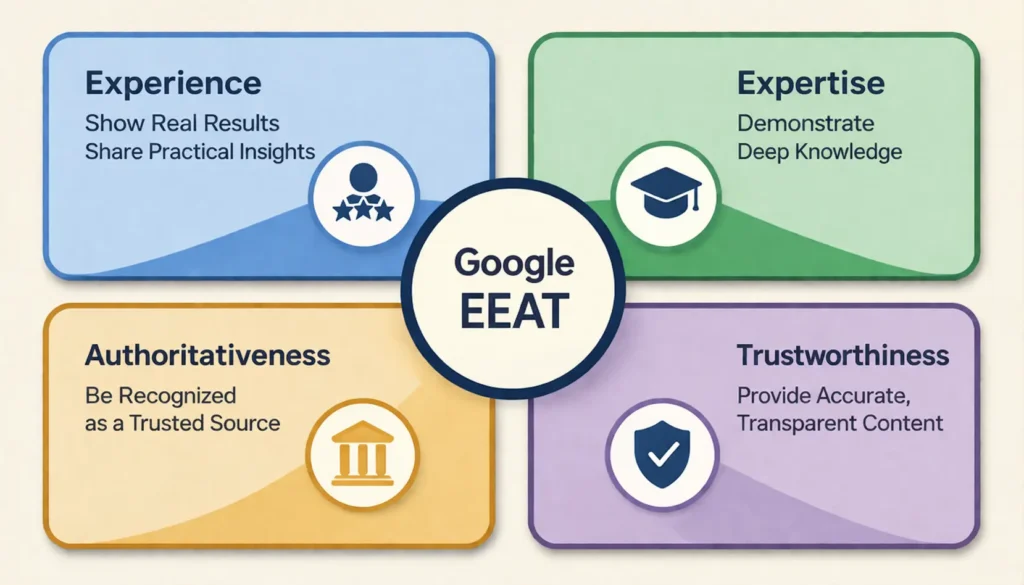
It looks like putting real experts on the page. Use author bios. Mention credentials. Show who wrote or reviewed an article. If your CAS director writes about cash flow forecasting, say so. If your tax partner explains S corp compensation, put their name on it. Expertise hidden in your office is not helping your SEO.
It also looks like showing your experience. Case studies, client stories, before-and-after scenarios, common pitfalls you’ve fixed, and insights from real engagements all help demonstrate that you’re not just repeating textbook definitions. You’ve been in the trenches. Possibly with coffee. Definitely with deadlines.
Authority comes from consistency and clarity. When your site has a clear niche, strong service pages, helpful educational content, and messaging that aligns across your website, LinkedIn, and client communications, search engines get a stronger signal about what you do and who you do it for.
And trust? Trust comes from the details. An up-to-date website. Clear service descriptions. Real contact information. Testimonials. Useful content that does not overpromise. A tone that sounds like a competent human wrote it, not a marketing intern being held hostage by jargon. Cajabra’s own positioning is a great example of this: clear outcomes, a defined audience, and language focused on helping accounting firms grow with the right systems and ideal clients.
You do not need 100 blog posts. You need the right pages doing the right jobs.
Your homepage should clearly say who you help and what makes you different. Your service pages should explain outcomes, not just features. Your blog should answer the real questions your ideal clients are already asking. And your site should make it painfully easy for someone to trust you, contact you, and understand why you are the right fit.
That is SEO now.
Not tricks. Not keyword stuffing. Not mass-producing AI sludge and hoping for the best.
Just strong positioning, useful content, visible expertise, and a website that acts like your best business development person instead of an online brochure from 2017.

The AI era is not the end of SEO for accountants. It is the end of lazy SEO.
And honestly? Good.
Because the firms that will win are not the loudest. They are the clearest, the most credible, and the most helpful. The firms that teach well, explain well, and show their work. The firms that make a nervous business owner think, “Finally. Someone who actually gets it.”
That is your opportunity.If your firm has the expertise but your website is still playing hide-and-seek with Google, Cajabra can help. We build high-value growth systems for accounting firms that want more visibility, more authority, and more of the right clients. If you’re ready to turn your expertise into a marketing engine, book a free strategy call and let’s get your firm to go from overlooked to fully booked.